SmarterEd

Aussie Maths & Science Teachers: Save your time with SmarterEd

  • Login
  • Get Help
  • About

Vectors, SPEC2 2024 VCAA 16 MC

Particle 1 has position vector  \({\underset{\sim}{r}}_1(t)=\cos (t) \underset{\sim}{ i }+\sin (t) \underset{\sim}{ j }+\sqrt{\sin (2 t)} \underset{\sim}{ k }\)  and Particle 2 has position vector  \({\underset{\sim}{r}}_2(t)=\sin (t) \underset{\sim}{ i }+\cos (t) \underset{\sim}{ j }+\sqrt{\sin (2 t)} \underset{\sim}{ k }\), where \(t\) is measured in seconds and  \(t \in\left(0, \dfrac{\pi}{2}\right)\).

The number of times the velocity of Particle 1 is perpendicular to the position vector  \({\underset{\sim}{r}}_2(t)\) during the first \(\dfrac{\pi}{2}\) seconds is

  1. \(1\)
  2. \(2\)
  3. \(3\)
  4. \(4\)
Show Answers Only

\(A\)

Show Worked Solution

\(\text{By CAS:}\)

\({\underset{\sim}{v}}_1(t)=\dfrac{d}{dt} \left({\underset{\sim}{r}}_1(t)\right)=-\sin (t)\underset{\sim}{i}+\cos (t) \underset{\sim}{j}+\dfrac{\cos (2 t)}{\sqrt{\sin (2 t)}}\, \underset{\sim}{k}\)

\(\text{Find when} \ {\underset{\sim}{v}}_1(t) \perp {\underset{\sim}{r}}_2(t)\)

\(\text{Solve}\ \ {\underset{\sim}{v}}_{1} (t) \cdot {\underset{\sim}{r}}_{2} (t)=0\ \ \text{for}\ \ t \in\left(0, \dfrac{\pi}{2}\right):\)

\({\underset{\sim}{v}}_1(t) \cdot {\underset{\sim}{r}}_2(t)=-\sin ^2(t)+\cos ^2(t)+\cos (2 t)=2 \cos (2 t)\)

\(2 t=\dfrac{\pi}{2} \ \Rightarrow \ t=\dfrac{\pi}{4}\)

\(\Rightarrow A\)

♦ Mean mark 43%.

Filed Under: Position Vectors as a Function of Time Tagged With: Band 5, smc-1178-20-Find r(t) v(t) a(t), smc-1178-50-Other

Vectors, SPEC2 2020 VCAA 1

A particle moves in the  `x\ – y`  plane such that its position in terms of `x` and `y` metres at `t` seconds is given by the parametric equations

`x = 2sin(2t)`

`y = 3cos(t)`

where `t >= 0`

  1. Find the distance, in metres, of the particle from the origin when  `t = pi/6`.   (2 marks)

    --- 4 WORK AREA LINES (style=lined) ---

  2.   i. Express  `(dy)/(dx)`  in terms of `t` and, hence, find the equation of the tangent to the path of the particle at  `t = pi`  seconds.   (3 marks)

    --- 5 WORK AREA LINES (style=lined) ---

  3.  ii. Find the velocity, `underset ~ v`, in `text(ms)^(−1)`, of the particle when  `t = pi`.   (2 marks)

    --- 4 WORK AREA LINES (style=lined) ---

  4. iii. Find the magnitude of the acceleration, in `text(ms)^(−2)`, when  `t = pi`.   (2 marks)

    --- 4 WORK AREA LINES (style=lined) ---

  5. Find the time, in seconds, when the particle first passes through the origin.   (1 mark)

    --- 1 WORK AREA LINES (style=lined) ---

  6. Express the distance, `d` metres, travelled by the particle from  `t = 0`  to  `t = pi/6`  as a definite integral and find this distance correct to three decimal places.   (2 marks)

    --- 3 WORK AREA LINES (style=lined) ---

Show Answers Only
  1. `sqrt39/2\ text(metres)`
  2.   i. `y = −3`
  3.  ii. `4underset~i`
  4. iii. `3\ text(ms)^(−2)`
  5. `pi/2\ \ (text(1st time))`
  6. `1.804\ \ (text(to 3 d.p.))`
Show Worked Solution

a.   `text(At)\ \ t = pi/6,`

`x = 2sin\ pi/3 = sqrt3`

`y = 3cos\ pi/6 = (3sqrt3)/2`

`:.\ text(Distance)` `= sqrt((sqrt3)^2 + ((3sqrt3)/2)^2)`
  `= sqrt39/2\ text(metres)`


b.i.   `(dx)/(dt) = 4cos(2t),\ \ (dy)/(dt) = −3sin(t)`

`(dy)/(dx)` `= (dy)/(dt) · (dt)/(dx)`
  `= (−3sin(t))/(4cos(2t))`

 
`text(When)\ t = pi :`

`(dy)/(dx)` `= (−3sin(pi))/(4cos(2pi))=0`

 
`text(Equation of tangent where)\ \ m = 0,\ text(through)\ (0, −3):`

`y = −3`
  

b.ii.   `underset~r(t)` `= 2sin(2t)underset~i + 3cos(t)underset~j`
  `underset~v(t)` `= 4cos(2t)underset~i-3sin(t)underset~j`
  `underset~v(pi)` `= 4cos(2pi)underset~i-3sin(pi)underset~i`
    `= 4underset~i`


b.iii.  `underset~a(t) = −8sin(2t)underset~i-3cos(t)underset~j`

♦ Mean mark (b)(iii) 48%.
`underset~a(pi)` `= −8sin(2pi)underset~i-3cos(pi)underset~j`
  `= 3underset~j`
`|underset~a(pi)|` `= sqrt(0^2 + 3^2)`
  `= 3\ text(ms)^(−2)`


c.   `text(Find)\ t\ text(when)\ \ x = 2sin(2t) = 0\ \ text(and)\ \ y = 3cos(t) = 0:`

`t = pi/2\ \ (text(1st time))`


d.    `text(Distance)` `= int_0^(pi/6) sqrt(((dx)/(dt))^2 + ((dy)/(dt))^2)\ dt`
    `= int_0^(pi/6) sqrt((4cos(2t))^2 + (−3sin(t))^2)\ dt`
    `~~ 1.804\ \ (text(to 3 d.p.))`

Filed Under: Motion (SM), Position Vectors as a Function of Time Tagged With: Band 4, Band 5, smc-1178-20-Find r(t) v(t) a(t), smc-1178-50-Other

Vectors, SPEC1 2012 VCAA 9

The position of a particle at time  `t`  is given by

`underset ~r (t) = (2 sqrt (t^2 + 2) - t^2) underset ~i + (2 sqrt (t^2 + 2) + 2t) underset ~j,\ \ t >= 0.`

  1. Find the velocity of the particle at time  `t.`   (1 mark)

    --- 4 WORK AREA LINES (style=lined) ---

  2. Find the speed of the particle at time  `t = 1`  in the form  `(a sqrt b)/c`, where `a, b` and `c` are positive integers.   (2 marks)

    --- 6 WORK AREA LINES (style=lined) ---

  3. Show that at time  `t = 1,\ \ (dy)/(dx) = (1 + sqrt 3)/(1 - sqrt 3).`   (2 marks)

    --- 5 WORK AREA LINES (style=lined) ---

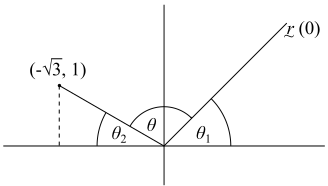
  4. Find the angle in terms of `pi`, between the vector  `-sqrt 3 underset ~i + underset ~j`  and the vector  `underset ~r (t)`  at time  `t = 0.`   (2 marks)

    --- 6 WORK AREA LINES (style=lined) ---

Show Answers Only
  1. `((2t)/sqrt(t^2 + 2) – 2t) underset ~i + ((2t)/sqrt(t^2 + 2) + 2) underset ~j`
  2. `(4 sqrt 6)/3`
  3. `text(Proof)\ \ text{(See Worked Solutions)}`
  4. `(7 pi)/12`
Show Worked Solution

a.  `underset ~r (t) = (2 sqrt (t^2 + 2) – t^2) underset ~i + (2 sqrt (t^2 + 2) +2t) underset ~j`

  `underset ~v(t)` `=dot underset ~r(t)`
    `= (2(2t)(1/2)(t^2 + 2)^(-1/2) – 2t) underset ~i + (2(2t)(1/2)(t^2 + 2)^(-1/2) + 2)underset ~j`
    `= ((2t)/sqrt(t^2 + 2) – 2t) underset ~i + ((2t)/sqrt(t^2 + 2) + 2) underset ~j`


b.    `underset ~v(1)` `= (2/sqrt(1 + 2) – 2)underset ~i + (2/sqrt(1 + 2) + 2) underset ~j`
    `= (2/sqrt 3 – 2) underset ~i + (2/sqrt 3 + 2)underset ~j`
  `|\ underset ~v(1)\ |` `= sqrt((2/sqrt 3 – 2)^2 + (2/sqrt 3 + 2)^2)`
    `= sqrt(4/3 – 8/sqrt 3 + 4 + 4/3 + 8/sqrt 3 + 4)`
    `= sqrt(8/3 + 8)`
    `= sqrt(32/3)`
    `= (4sqrt2)/sqrt3`
    `= (4 sqrt 6)/3`

♦ Mean mark part (c) 41%.

c.    `(dy)/(dt)` `= (dy)/(dx) xx (dx)/(dt)`
  `(dy)/(dx)` `=((dy)/(dt))/((dx)/(dt))`
  `:. (dy)/(dx)|_(t=1)` `= (2/sqrt 3 + 2)/(2/sqrt 3 – 2)`
    `= ((2 + 2 sqrt 3)/sqrt 3) xx (sqrt 3/(2 – 2 sqrt 3))`
    `= (2 + 2 sqrt 3)/(2 – 2 sqrt 3)`
    `= (1 + sqrt 3)/(1 – sqrt 3)`


d.   `text(At)\ \ t=0:` 

♦♦ Mean mark part (d) 32%.

`underset ~r(0) = 2 sqrt 2 underset ~i + 2 sqrt 2 underset ~j`

`theta_1` `= tan^(-1)((2 sqrt 2)/(2 sqrt 2)) = pi/4`
`theta_2` `= tan^(-1)(1/sqrt 3)=pi/6`

 
`text(Let)\ \ theta=\ text(angle between the vectors:)`

`theta` `= pi – theta_1 – theta_2`
  `= pi – pi/4 – pi/6`
  `= (12 pi – 3 pi – 2 pi)/12`
  `= (7 pi)/12`

Filed Under: Position Vectors as a Function of Time Tagged With: Band 3, Band 4, Band 5, smc-1178-20-Find r(t) v(t) a(t), smc-1178-50-Other

Vectors, SPEC2 2018 VCAA 4

Two yachts, `A` and `B`, are competing in a race and their position vectors on a certain section of the race after time  `t`  hours are given by

`underset ~ r_A (t) = (t + 1) underset ~i + (t^2 + 2t) underset ~j \ and \ underset ~r_B (t) = t^2 underset ~i + (t^2 + 3) underset ~j, \ t >= 0`

where displacement components are measured in kilometres from a given reference buoy at origin `O`.

  1. Find the cartesian equation of the path for each yacht.   (2 marks)

    --- 4 WORK AREA LINES (style=lined) ---

  2. Show that the two yachts will not collide if they follow these paths.   (2 marks)

    --- 4 WORK AREA LINES (style=lined) ---

  3. Find the coordinates of the point where the paths of the two yachts cross. Give your coordinates correct to three decimal places.   (2 marks)

    --- 5 WORK AREA LINES (style=lined) ---

One of the rules for the race is that the yachts are not allowed to be within 0.2 km of each other. If this occurs there is a time penalty for the yacht that is travelling faster.

  1. For what values of `t` is yacht `A` travelling faster than yacht `B`?   (2 marks)

    --- 6 WORK AREA LINES (style=lined) ---

  2. If yacht `A` does not alter its course, for what period of time will yacht `A` be within 0.2 km of yacht `B`? Give your answer in minutes, correct to one decimal place.   (2 marks)

    --- 6 WORK AREA LINES (style=lined) ---

Show Answers Only
  1. `y_A = x_A^2-1, x_A > 1; qquad y_B = x_B + 3, x_B > 0`
  2. `text(Proof)\ \ text{(See Worked Solutions)}`
  3. `(x, y) ~~ (2.562, 5.562)`
  4. `0 < t < 5/2`
  5. `4.1\ text(minutes)`
Show Worked Solution

a.  `x_A = t + 1,\ \ y_A = = t^2 + 2t`

`y_A` `= t^2 + 2 t + 1-1`
  `= (t + 1)^2-1`
`:. y_A` `= x_A^2-1`

 
`x_B = t^2,`

`y_B` `= t^2+3`
`:.y_B` `= x_B+3`


b.  `text(Same)\ \ xtext(-coordinate occurs when:)`

`t+1` `= t^2`
`t` `= (1+sqrt5)/2,\ \ \ (t>0)`

 
`text(When)\ \ t = (1+sqrt5)/2,`

`y_A=(3sqrt5+5)/2`

`y_B= (sqrt5+9)/2  !=y_A`
 

`:.\ text(No collision)`


c.   `x + 3` `= x^2-1`
  `x^2-x-4` `= 0`
  `x` `= (1 + sqrt 17)/2,\ \ \ (t>0 \ =>\ x>1)`
  `y` `= (7 + sqrt 17)/2`
  `:. (x, y)` `= ((1 + sqrt 17)/2, (7 + sqrt 17)/2)`
    `=(2.562, 5.562)`


d.    `underset ~dot r_A (t)` `= underset ~i + (2t + 2)underset ~j`
  `|underset ~dot r_A (t)|` `= sqrt(1 + (2t + 2)^2)`
    `= sqrt(4t^2 + 8t + 5)`
     
  `underset ~dot r_B (t)` `= 2t underset ~i + 2t underset ~j`
  `|underset ~dot r_B (t)|` `= sqrt (4t^2 + 4t^2)`
    `= sqrt(8t^2)`

  
 `text(Yacht A is travelling faster when:)`

♦ Mean mark part (d) 41%.

`sqrt(4t^2 + 8t + 5)` `> sqrt (8t^2)`
`4t^2 + 8t + 5` `> 8t^2`
`4t^2-8t-5` `< 0`

 
`:. 0 < t < 5/2`


e.    `underset ~ r_B-underset ~r_A` `= (t^2-(t + 1)) underset ~ i + (t^2 + 3-(t^2 + 2t)) underset ~j`
    `= (t^2-t-1) underset ~i + (-2t + 3) underset ~j`


`d = |underset ~r_B-underset~r_A|= sqrt ((t^2-t-1)^2 + (3-2t)^2)`
 

`text(Find)\ \ t\ \ text(such that:)`

♦ Mean mark part (e) 37%.

`sqrt ((t^2-t-1)^2 + (3-2t)^2) < 0.2`

`=> 1.52883 < t < 1.59734`

 
`:.\ text(Period of time yachts are within 0.2 km)`

`~~ 1.59734-1.52883`

`~~0.068506\ text(hours)`

`~~ 4.1\ text(minutes)`

Filed Under: Position Vectors as a Function of Time Tagged With: Band 4, Band 5, smc-1178-10-Find Cartesian equation, smc-1178-20-Find r(t) v(t) a(t), smc-1178-30-Collision, smc-1178-50-Other

Vectors, SPEC2-NHT 2018 VCAA 13 MC

Let  `underset~i`  and  `underset~j`  be unit vectors in the east and north directions respectively

At time `t, t >= 0`, the position of particle `A` is given by  `underset~r_A = (t^2 - 5t + 6) underset~i + (5t - 8) underset~j`  and the position of particle `B` is given by  `underset~r_B = (3 - t) underset~i + (t^2 - t) underset~j`.

Particle `A` will be directly east of particle `B` when `t` equals

  1. 1
  2. 2
  3. 1 and 2
  4. 2 and 4
  5. 4
Show Answers Only

`E`

Show Worked Solution

`text(Find)\ t\ text(when particles align:)`

`5t – 8` `= t^2 – t`
`0` `= t^2 – 6t – 8`
`0` `= (t – 4)(t – 2)`

 
`t = 2, quad t = 4`
 

`x_A(2)` `= 4 – 10 + 6 = 0`
`x_B(2)` `= 1 > x_A (2) \ ->\  B\ text(is East of)\ A`
`x_A(4)` `= 16 – 20 + 6 = 2`
`x_B(4)` `= -1 < x_A (2) \ ->\  A\ text(is East of)\ B`


`=>  E`

Filed Under: Position Vectors as a Function of Time Tagged With: Band 5, smc-1178-50-Other

Copyright © 2014–2025 SmarterEd.com.au · Log in