SmarterEd

Aussie Maths & Science Teachers: Save your time with SmarterEd

  • Login
  • Get Help
  • About

Vectors, SPEC2 2023 VCAA 16 MC

A student throws a ball for his dog to retrieve. The position vector of the ball, relative to an origin \(O\) at ground level \(t\) seconds after release, is given by  \(  \underset{\sim}{\text{r}}{}_\text{B} (t)=5 t \underset{\sim}{\text{i}}+7 t \underset{\sim}{\text{j}}+(15 t-4.9 t^2+1.5) \underset{\sim}{\text{k}} \). Displacement components are measured in metres, where \(\underset{\sim}{\text{i}}\) is a unit vector to the east, \(\underset{\sim}{\text{j}}\) is a unit vector to the north and \( \underset{\sim} {\text{k}}\) is a unit vector vertically up.

The total \( \textbf{vertical} \) distance, in metres, travelled by the ball before it hits the ground is closest to

  1. 1.5
  2. 11.5
  3. 13.0
  4. 24.5
  5. 26.0
Show Answers Only

\(D\)

Show Worked Solution

\(\text{Upwards distance}\ (z) = 15t-4.9t^2+1.5\)

\(\dfrac{dz}{dt}=15-9.8t\)

\(\text{Find}\ t\ \text{when}\ \dfrac{dz}{dt}=0\ \text{(vertical max):} \)

\(15-9.8t=0\ \ \Rightarrow \ \ t=\dfrac{15}{9.8} \)

\(z\Big{(}t=\dfrac{15}{9.8}\Big{)} = 15 \times \Big{(}\dfrac{15}{9.8}\Big{)}-4.9 \times \Big{(}\dfrac{15}{9.8}\Big{)}^2 + 1.5 \approx 12.98\ \text{m} \)
 

\(\text{At}\ \ t=0, \ z=1.5 \)

\(\therefore \text{Total vertical distance}\ = (12.98-1.5)+12.98 \approx 24.5\ \text{m} \)

\(\Rightarrow D\)

Filed Under: Position Vectors as a Function of Time Tagged With: Band 5, smc-1179-70-Projectile motion

Vectors, SPEC2 2021 VCAA 4

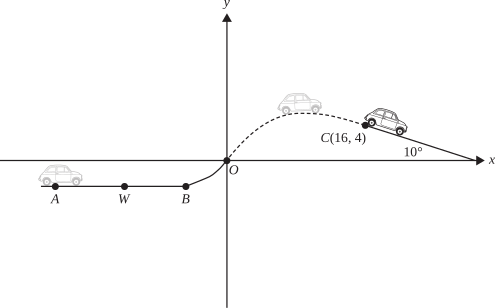
A car that performs stunts moves along a track, as shown in the diagram below. The car accelerates from rest at point `A`, is launched into the air by the ramp `BO` and lands on a second section of track at or beyond point `C`.  This second section of track is inclined at `10^@` to the horizontal.

Due to tailwind, the effect of air resistance is negligible. Point `O` is taken as the origin of a cartesian coordinate system and all displacements are measured in metres. Point `C` has the coordinates `(16, 4)`.

At point `O`, the speed of the car is `u` ms`\ ^(-1)` and it takes off at an angle of `theta` to the horizontal direction. After the car passes point `O`, it follows a trajectory where the position of the car's rear wheels relative to point `O`, is given by

`underset~r(t) = ut cos(theta) underset~i + (ut sin(theta)-1/2 g t^2)underset~j`  until the car lands on the second section of track that starts at point `C`.
 

  1. Show that the path of the rear wheels of the car, while in the air, is given in cartesian form by
  2.    `y = x tan(theta)-(4.9x^2)/(u^2cos^2(theta))`.   (1 mark)

    --- 3 WORK AREA LINES (style=lined) ---

  3. If  `theta = 30^@`, find the minimum speed, in ms`\ ^(-1)`, that the car must reach at point `O` for the rear wheels to land on the second section of track at or beyond point `C`. Give your answer correct to two decimal places.   (2 marks)

    --- 4 WORK AREA LINES (style=lined) ---

  4. The ramp  `BO`  is constructed so that the angle `theta` can be varied.
  5. For what values of `theta` and `u` will the path of the rear wheels of the car join up smoothly with the beginning of the second section of track at point `C`? Give your answer for `theta` in degrees, correct to the nearest degree, and give your answer for `u` in ms`\ ^(-1)`, correct to one decimal place.   (3 marks)

    --- 5 WORK AREA LINES (style=lined) ---

The car accelerates from rest along the horizontal section of track `AB`, where its acceleration, `a`  ms`\ ^(-2)`, after it has travelled `s` metres from point `A`, is given by  `a = 60/v`, where `v` is its speed at `s` metres.

  1. Show that `v` in terms of `s` given by  `v = (180x)^(1/3)`.   (2 marks)

    --- 5 WORK AREA LINES (style=lined) ---

  2. After the car leaves point `A`, it accelerates to reach a speed of 20 ms`\ ^(-1)` at point `B`. However, if the stunt is called off, the car immediately brakes and reduces its speed at a rate of 9 ms`\ ^(-2)`.  It is only safe to call off the stunt if the car can come to rest at or before point `B`.  Point `W` is the furthest point along the section `AB` at which the stunt can be called off.
  3. How far is point `W` from point `B`?  Give your answer in metres, correct to one decimal place.   (3 marks)

    --- 6 WORK AREA LINES (style=lined) ---

Show Answers Only
  1. `text(Show Worked Solutions)`
  2. `17.87\ text(ms)^-1`
  3. `u = 16.4\ text(ms)^-1, \ theta = 34.1^@`
  4. `text(Show Worked Solutions)`
  5. `16.4\ text{m}`
Show Worked Solution

a.   `x = ut costheta\ …\ (1)`

`y=ut sin theta-1/2 g t^2\ …\ (2)`

`text{Using (1):}`

`t = x/(u costheta)\ …\ (3)`

`text{Substitute (3) into (2):}`

`y` `= u · x/(u costheta) sintheta-4.9 · (x^2)/(u^2cos^2theta)`
  `= x tan theta-(4.9 x^2)/(u^2 cos^2 theta)`


b.   `text(When)\ \ theta = 30^@`

♦ Mean mark part (b) 45%.

`y = x\ tan 30^@-(4.9 x^2)/(u^2 cos^2 30^@)`

`y = x/sqrt3-(4.9x^2)/(u^2) · 4/3`

`text{Substitute (16, 4) into equation and solve for}\ u:`

`4 = 16/sqrt3-(4.9 xx 16^2)/(u^2) · 4/3`

`u = 17.87\ text(ms)^-1\ \ text{(to 2 d.p.)}`


c.   `text(Smooth join will occur when)`

♦♦♦ Mean mark part (c) 12%.

`y(16) = 4\ …\ (1), \ \ text{and}`

`text(Gradient of motion equals the gradient of landing ramp)`

`(dy)/(dx)|_(x = 16) = -tan10^@\ …\ (2)`

`text{Solve (1) and (2) by CAS for}\ \ u, theta:`

`u = 16.4\ text(ms)^-1`

`theta = 34.1^@`


d.   `a = 60/v`

♦ Mean mark part (d) 40%.

`v · (dv)/(ds) = 60/v`

`int v^2 dv = int 60\ ds`

`1/3 v^3 = 60s + c`

`text(When)\ \ s = 0, v = 0 \ => \ c = 0`

`1/3 v^3` `= 60s`
`v^3` `= 180s`
`v` `= (180s)^(1/3)`


e.   `text(Find)\ s\ text{at point}\ B\ text{(by CAS):}`

♦♦♦ Mean mark part (e) 8%.
`(180s)^(1/3)` `= 20`
`s` `= (400)/9\ text(m)`

 
`text(Car decelerates at 9 ms)^(-1)`

`d/(ds)(1/2v^2)` `= -9`
`1/2 v^2` `= -9s + c`

 
`text(When)\ \ s = 400/9, v = 0 \ => \ c = 400`

`1/2 v^2` `= 400-9s`
`v` `= sqrt(800-18s)`

 
`text{Solve for}\ s\ text{(by CAS):}`

`(180s)^(1/3)` `= sqrt(800-18s)`
`s` `= 28.08`

 
`text(Distance of)\ W\ text(from)\ B`

`= 400/9-28.08`

`= 16.4\ text{m (to 1 d.p.)}`

Filed Under: Forces and Motion Along a Curve Tagged With: Band 4, Band 5, Band 6, smc-1179-70-Projectile motion

Vectors, SPEC2-NHT 2019 VCAA 4

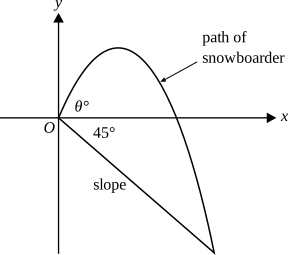
A snowboarder at the Winter Olympics leaves a ski jump at an angle of `theta` degrees to the horizontal, rises up in the air, performs various tricks and then lands at a distance down a straight slope that makes an angle of 45° to the horizontal, as shown below.

Let the origin `O` of a cartesian coordinate system be at the point where the snowboarder leaves the jump, with a unit vector in the positive `x` direction being represented by  `underset~i`  and a unit vector in the positive `y` direction being represented by  `underset~j`. Distances are measured in metres and time is measured in seconds.

The position vector of the snowboarder  `t`  seconds after leaving the jump is given by

`underset~r (t) = (6t-0.01t^3) underset~i + (6 sqrt3 t-4.9t^2 + 0.01t^3) underset~j , \ t ≥ 0`


  1. Find the angle  `theta °`.    (2 marks)

    --- 4 WORK AREA LINES (style=lined) ---

  2. Find the speed, in metres per second, of the snowboarder when she leaves the jump at `O`.   (1 mark)

    --- 4 WORK AREA LINES (style=lined) ---

  3. Show that the time spent in the air by the snowboarder is  `(60(sqrt3 + 1))/(49)`  seconds.   (3 marks)

    --- 5 WORK AREA LINES (style=lined) ---

  4. Find the total distance the snowboarder travels while airborne. Give your answer in metres, correct to two decimal places.   (2 marks)

    --- 4 WORK AREA LINES (style=lined) ---

Show Answers Only
  1. `60°`
  2. `12 \ text(ms)^-1`
  3. `5.5 \ text(m)`
  4. `text(See Worked Solutions)`
  5. `38.51 \ text{m  (to 2 decimal places)}`
Show Worked Solution

a.   `v(t) = (6-0.03t^2)underset~i + (6 sqrt3-9.8t + 0.03t^2) underset~j`

`text(When) \ t =0,`

`v(t) = 6underset~i + 6 sqrt3 underset~j`

`tan theta = (6 sqrt3)/(6) = sqrt3`

`:. \ theta` `= tan^-1 sqrt3`
  `= 60°`


b.    `text(Speed)` `= |v(0)|`
    `= sqrt(6^2 + (6 sqrt3)^2)`
    `= 12 \ text(ms)^-1`

 
c.   `text(Max height when) \ underset~j \ text(component of) \ v(t) = 0`

`text(Solve): \ \ 6 sqrt3-9.8t + 0.03t^2 = 0`

`=> t =  1.064 \ text(seconds)`

`text(Max height)` `= 6 sqrt3 (1.064)-4.9(1.064)^2 + 0.01(1.064)^3`  
  `~~5.5\ text(m)`  

 
d.   `text(Time of Flight  ⇒  Solve for)\ \ t\ \ text(when)\ \ y=-x:`

`6 sqrt 3 t-4.9t^2 + 0.01 t^3` `= -(6t-0.001t^3)`
`(6 + 6 sqrt3)t-4.9 t^2` `= 0`
`t(6 + 6 sqrt3-4.9 t)` `= 0`
`4.9 t` `= 6 + 6 sqrt3`
`t` `= (6 + 6 sqrt3)/(4.9)`
  `= (60(sqrt3 + 1))/(49)\ text(seconds)`


e.
   `text(Total distance) \ = text(Area under) \ v(t) \ text(graph from)\ \ t = 0 \ \ text(to)\ \ t_1 = (60(sqrt3 + 1))/(49)`

`|v(t)| = sqrt{(6-0.03 t^2)^2 + (6 sqrt3- 9.8t + 0.03 t^2)^2}`

`text(Distance)` `= int_0^(t_1) |v(t)| \ dt`
  `= 38.51 \ text{m (to 2 d.p.)}`

Filed Under: Forces and Motion Along a Curve Tagged With: Band 4, Band 5, Band 6, smc-1179-70-Projectile motion

Vectors, SPEC2-NHT 2017 VCAA 4

A cricketer hits a ball at time  `t = 0`  seconds from an origin `O` at ground level across a level playing field.

The position vector  `underset ~r(t)`, from `O`, of the ball after `t` seconds is given by
 
  `qquad underset ~r(t) = 15t underset ~i + (15 sqrt 3 t-4.9t^2)underset ~j`,
 
where,  `underset ~i`  is a unit vector in the forward direction, `underset ~j`  is a unit vector vertically up and displacement components are measured in metres.

  1. Find the initial velocity of the ball and the initial angle, in degrees, of its trajectory to the horizontal.   (2 marks)

    --- 4 WORK AREA LINES (style=lined) ---

  2. Find the maximum height reached by the ball, giving your answer in metres, correct to two decimal places.   (2 marks)

    --- 5 WORK AREA LINES (style=lined) ---

  3. Find the time of flight of the ball. Give your answer in seconds, correct to three decimal places.   (1 mark)

    --- 2 WORK AREA LINES (style=lined) ---

  4. Find the range of the ball in metres, correct to one decimal place.   (1 mark)

    --- 2 WORK AREA LINES (style=lined) ---

  5. A fielder, more than 40 m from `O`, catches the ball at a height of 2 m above the ground.


    How far horizontally from `O` is the fielder when the ball is caught? Give your answer in metres, correct to one decimal place.   (2 marks)

    --- 5 WORK AREA LINES (style=lined) ---

Show Answers Only
  1. `underset ~v (0) = 15 underset ~i + 15 sqrt 3 underset ~j`


    `theta = pi/3 = 60^@`

  2. `34.44\ text(m)`
  3. `5.302\ text(s)`
  4. `79.5\ text(m)`
  5. `78.4\ text(m)`
Show Worked Solution

a.   `underset ~v (t) = underset ~ dot r (t) = 15 underset ~i + (15 sqrt 3-9.8t)underset ~j`

`text(Initial velocity occurs when)\ \ t=0:`

`:. underset ~v (0) = 15 underset ~i + 15 sqrt 3 underset ~j`
 

`text(Let)\ \ theta = text(Initial trajectory,)`

`tan theta` `=(15sqrt3)/15=sqrt3`  
`:. theta` `=pi/3\ \ text(or)\ \ 60^@`  


b.  `text(Max height)\ =>underset~j\ \ text(component of)\ \ underset ~v=0.`

`15 sqrt 3-9.8t` `=0`
`t` `=(15 sqrt 3)/9.8`
  `=2.651…`

 
`text(Find max height when)\ \ t = 2.651…`

`:.\ text(Max height)` `= 15 sqrt 3 xx 2.651-4.9 xx (2.651)^2`
  `~~ 34.44\ text(m)`


c.   `text(Ball travels in parabolic path.)`

`:.\ text(Total time of flight)`

`= 2 xx (15 sqrt 3)/9.8`

`~~ 5.302\ text(s)`


d.   `text(Range)` `= x ((15 sqrt 3)/4.9)-x(0)`
  `= (225 sqrt 3)/4.9`
  `~~ 79.5\ text(m)`


e.
   `text(Find)\ \ t\ \ text(when height of ball = 2 m:)`

`15 sqrt 3 t-4.9t^2` `=2`  
`4.9t^2-15 sqrt 3 t + 2` `=0`  

  
`t_1 ~~ 0.078131,\ \ t_2 ~~ 5.22406`

 
`text(When)\ \ t=0.0781,`

`x= 15 xx 0.0781 = 1.17\ \ text{(no solution →}\ x<40 text{)}`

 `text(When)\ \ t=5.2241,`

`x=15 xx 5.2241 = 78.4\ text(m)`
 

`:.\ text(Ball is caught 78.4 m horizontally from)\ O.`

Filed Under: Forces and Motion Along a Curve Tagged With: Band 4, Band 5, smc-1179-70-Projectile motion

Vectors, SPEC2-NHT 2018 VCAA 4

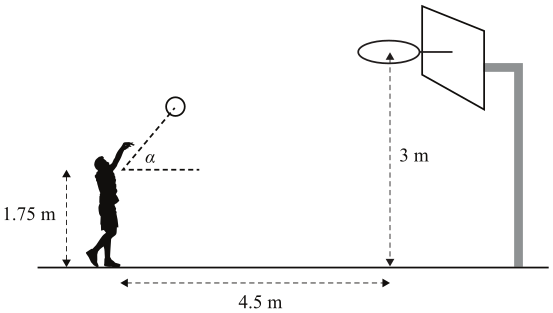
A basketball player aims to throw a basketball through a ring, the centre of which is at a horizontal distance of 4.5 m from the point of release of the ball and 3 m above floor level. The ball is released at a height of 1.75 m above floor level, at an angle of projection `alpha` to the horizontal and at a speed of  `V\ text(ms)^(-1)`. Air resistance is assumed to be negligible.


The position vector of the centre of the ball at any time, `t` seconds, for  `t >= 0`, relative to the point of release is given by 
 
`qquad underset ~r(t) = Vt cos (alpha) underset ~i + (Vt sin(alpha)-4.9t^2) underset ~j`,
 
where  `underset ~i`  is a unit vector in the horizontal direction of motion of the ball and  `underset ~j`  is a unit vector vertically up. Displacement components are measured in metres.

  1. For the player’s first shot at goal, `V = 7\ text(ms)^(-1)` and  `alpha = 45^@`
  2.   i. Find the time, in seconds, taken for the ball to reach its maximum height. Give your answer in the form  `(a sqrt b)/c`, where  `a, b` and `c` are positive integers.   (2 marks) 

    --- 5 WORK AREA LINES (style=lined) ---

  3.  ii. Find the maximum height, in metres, above floor level, reached by the centre of the ball.   (2 marks)

    --- 4 WORK AREA LINES (style=lined) ---

  4. iii. Find the distance of the centre of the ball from the centre of the ring one second after release. Give your answer in metres, correct to two decimal places.   (2 marks)

    --- 4 WORK AREA LINES (style=lined) ---

  5. For the player’s second shot at goal, `V = 10\ text(ms)^(-1)`.
    Find the possible angles of projection, `alpha` , for the centre of the ball to pass through the centre of the ring. Give your answers in degrees, correct to one decimal place.   (3 marks)

    --- 5 WORK AREA LINES (style=lined) ---

  6. For the player’s third shot at goal, the angle of projection is  `alpha = 60^@`
  7. Find the speed `V` required for the centre of the ball to pass through the centre of the ring. Give your answer in metres per second, correct to one decimal place.   (2 marks)

    --- 4 WORK AREA LINES (style=lined) ---

Show Answers Only
    1. `(5 sqrt 2)/14`
    2. `3\ text(m)`
    3. `128\ text(m)`
  1. `alpha ~~ 29.7^@ or 75.8^@`
  2. `7.8\ text(ms)^(-1)`
Show Worked Solution
a.i.    `underset ~r(t)` `=7t\ cos 45^@ underset ~i+(7t\ sin 45^@-4.9t^2) underset ~j`
    `=(7sqrt2t)/2 underset ~i + ((7sqrt2)/2 t-4.9t^2) underset ~j`
     

 `text(Maximum height when)\ \ underset ~V_(underset ~j) (t) = 0:`

`(7sqrt2)/2-9.8t` `= 0`
`t` `= (5 sqrt 2)/14\ \ text(seconds)`


a.ii.   `underset ~r_(underset ~j)((5 sqrt 2)/14)` `= 7 xx (5 sqrt 2)/14 xx 1/sqrt 2-4.9 xx ((5 sqrt 2)/14)^2`
    `= 1.25`

 
`:.\ text(Height above floor) = 1.25 + 1.75 = 3\ text(m)`


a.iii.  `underset ~r_text(ring)= 4.5 underset ~i + 1.25 underset ~j`

  `underset ~r_text(ring)-underset ~r_text(ball)` `= (4.5-7/sqrt 2) underset ~i + (1.25-((7sqrt2)/2-4.9)underset ~j`
  `d` `= |underset ~r_text(ring)-underset ~r(1)|`
    `= sqrt((4.5-7/sqrt 2)^2 + (1.25-7/sqrt 2 + 4.9)^2)`
    `~~ 1.28\ text(m)`


b.   `underset ~r(t) = 10 t cos (alpha) underset ~i + (10t sin (alpha)-4.9t^2) underset ~j`

`=> 10t cos (alpha) = 4.5`

`=>10t sin (alpha)-4.9t^2 = 1.25`
 

`:. alpha ~~ 29.7^@ or 75.8^@\ \ (text{solve by CAS for}\ \ 0<=alpha<=90)`


c.   `underset ~r(t)=Vt cos (60^@)underset ~i + (Vt sin (60^@)-4.9t^2) underset ~j`

`Vt cos (60^@)` `=4.5`  
`(Vt)/2` `= 9/2`  
`=> Vt` `=9`  

 
`=> (Vt sqrt 3)/2-49t^2 = 1.25`
 

`:. V~~ 7.8\ text(ms)^(-1)\ \ \ text{(solve simultaneously by CAS)}`

Filed Under: Forces and Motion Along a Curve Tagged With: Band 4, Band 5, smc-1179-70-Projectile motion

Copyright © 2014–2025 SmarterEd.com.au · Log in