SmarterEd

Aussie Maths & Science Teachers: Save your time with SmarterEd

  • Login
  • Get Help
  • About

Calculus, SPEC1 2022 VCAA 10

Let `f(x)=\sec (4 x)`.

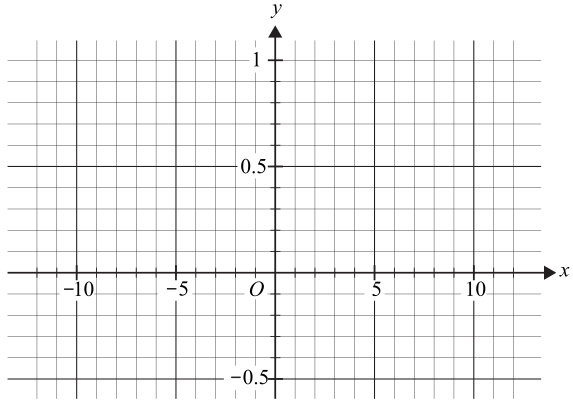
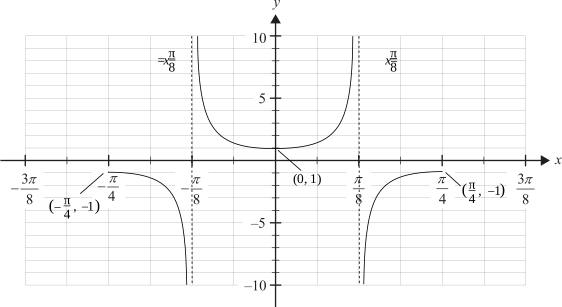
  1. Sketch the graph of `f` for `x \in\left[-\frac{\pi}{4}, \frac{\pi}{4}\right]` on the set of axes below. Label any asymptotes with their equations and label any turning points and the endpoints with their coordinates.   (3 marks)
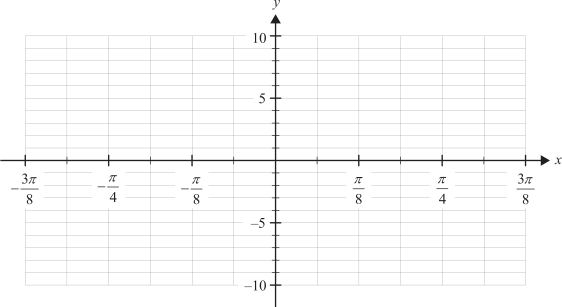


  2. The graph of  `y=f(x)` for `x \in\left[-\frac{\pi}{24}, \frac{\pi}{48}\right]` is rotated about the `x`-axis to form a solid of revolution.
    Find the volume of this solid. Give your answer in the form `\frac{(a-\sqrt{b}) \pi}{c}`, where `a`, `b`, `c in R`.   (3 marks)
Show Answers Only

a.  
       

b.   `\frac{(3-\sqrt{3}) \pi}{6}`

Show Worked Solution

a.      


♦ Mean mark (a) 49%.
b.    `V` `=\pi \int_{-\frac{\pi}{24}}^{\frac{\pi}{48}} \sec ^2(4 x)\ dx`
    `=\frac{\pi}{4}[\tan (4 x)]_{-\frac{\pi}{24}}^{\frac{\pi}{48}}`
    `=\frac{\pi}{4} \tan \left(\frac{\pi}{12}\right)-\frac{\pi}{4} \tan \left(-\frac{\pi}{6}\right)`
    `=\frac{\pi}{4} \tan \left(\frac{\pi}{3}-\frac{\pi}{4}\right)-\frac{\pi}{4} \xx -\frac{1}{\sqrt{3}}`
    `=\frac{\pi}{4} \tan \left(\frac{sqrt3-1}{1+sqrt3} xx \frac{1-sqrt3}{1-sqrt3}\right)+\frac{\pi}{4sqrt3}`
    `=\frac{\pi}{4} \tan \left(\frac{sqrt3-3-1+sqrt3}{-2}\right)+\frac{\pi}{4sqrt3}`
    `=\frac{\pi}{4}(2-\sqrt{3}) +\frac{\pi}{4sqrt3}`
    `=\frac{\pi(2 \sqrt{3}-3+1)}{4 \sqrt{3}}`
    `=\frac{(6-2 \sqrt{3}) \pi}{12}`
    `=\frac{(3-\sqrt{3}) \pi}{6}`

♦ Mean mark (b) 55%.

Filed Under: Solids of Revolution Tagged With: Band 5, smc-1180-20-Trig function, smc-1180-50-x-axis rotations

Calculus, SPEC2 2023 VCAA 11 MC

The area of the curved surface generated by revolving part of the curve with equation  \(y=\cos ^{-1}(x)\)  from  \((0, \dfrac{\pi}{2})\) to \((1,0)\) about the \(y\)-axis can be found by evaluating

  1. \(2 \pi \displaystyle {\int_0^{\dfrac{\pi}{2}}\left(\cos ^{-1}(x) \sqrt{1+\dfrac{1}{x^2-1}}\right)} d x\)
  2. \(2 \pi \displaystyle {\int_0^1\left(\cos ^{-1}(x) \sqrt{1+\dfrac{1}{x^2-1}}\right)} d x\)
  3. \(2 \pi \displaystyle {\int_0^{\dfrac{\pi}{2}} \cos (y) \sqrt{1-\sin ^2(y)}} d y\)
  4. \(2 \pi \displaystyle {\int_0^{\dfrac{\pi}{2}} \sqrt{1+u^2} \ d u}\), where \(u=\sin (y)\)
  5. \(2 \pi \displaystyle {\int_0^1 \sqrt{1+u^2} \ d u } \), where \(u=\sin (y)\)
Show Answers Only

\(E\)

Show Worked Solution

\(I = 2 \pi \displaystyle {\int_0^{\dfrac{\pi}{2}} \cos (y) \sqrt{1+\sin ^2(y)}}\ d y\)

\(\text{Let}\ \ u=\sin(y) \)

\(\dfrac{du}{dy}=\cos(y)\ \ \Rightarrow \ \ du=\cos(y)\ dy \)

\(\text{When}\ \ y=\dfrac{\pi}{2}\ \Rightarrow \ u=1,\ \ y=0\ \Rightarrow u=0 \)

\(\therefore I = 2 \pi \displaystyle {\int_0^{1} \sqrt{1+u^2}}\ d u\)

\(\Rightarrow E\)

Filed Under: Solids of Revolution Tagged With: Band 4, smc-1180-20-Trig function, smc-1180-60-y-axis rotation

Calculus, SPEC1 2021 VCAA 4

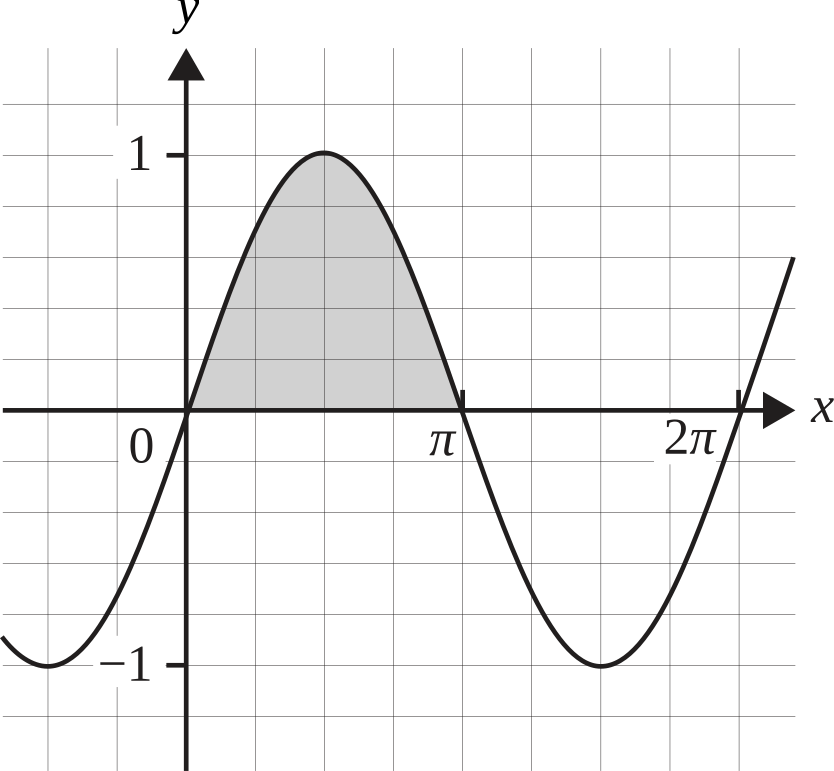
  1. The shaded region in the diagram below is bounded by the graph of  `y = sin(x)`  and the `x`-axis between the first two non-negative `x`-intercepts of the curve, that is interval  `[0, pi]`.  The shaded region is rotated about the `x`-axis to form a solid of revolution.


    Find the volume, `V_s` of the solid formed.   (3 marks)

    --- 3 WORK AREA LINES (style=lined) ---

  2. Now consider the function  `y = sin(kx)`, where `k` is a positive real constant. The region bounded by the graph of the function and the `x`-axis between the first two non-negative `x`-intercepts of the graph is rotated about the `x`-axis to form a solid of revolution.
  3. Find the volume of this solid in term of `V_s`.   (1 mark)

Show Answers Only

  1. `(pi^2)/2\ text(u)³`
  2. `1/k V_s`

Show Worked Solution

a.    `V_s` `= pi int_0^pi sin^2(x)\ dx`
    `= pi int_0^pi 1/2(1-cos(2x))\ dx`
    `= pi/2 int_0^pi 1-cos(2x)\ dx`
    `= pi/2 [x-1/2 sin(2x)]_0^pi`
    `= pi/2[pi-1/2 sin(2pi)-(0-1/2 sin 0)]`
    `= (pi^2)/2\ text(u)³`

♦♦ Mean mark part (b) 30%.


b.   `y = sin(kx)\ \ text(is the dilation of)\ \ y = sin(x)\ \ text(by a factor of)`

`k\ \ text(from the)\ \ xtext(-axis)`

`:. V = 1/k V_s`

Filed Under: Solids of Revolution Tagged With: Band 4, Band 5, smc-1180-20-Trig function, smc-1180-50-x-axis rotations

Calculus, SPEC1 2011 VCAA 11

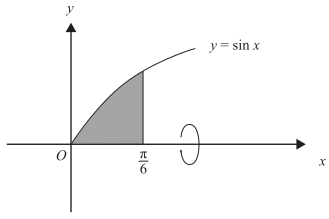
The region in the first quadrant enclosed by the curve  `y = sin(x)`, the line  `y = 0`  and the line  `x = pi/6`  is rotated about the `x`-axis.

Find the volume of the resulting solid of revolution.   (3 marks)

--- 8 WORK AREA LINES (style=lined) ---

Show Answers Only

`pi^2/12-(sqrt3 pi)/8\ \ text(u³)`

Show Worked Solution

`V` `= pi int_(0)^(pi/6) y^2\ dx`
  `= pi int_0^(pi/6) sin^2(x)\ dx`
  `= pi/2 int_0^(pi/6) (1-cos 2x)\ dx`
  `= pi/2 [x-1/2 sin (2x)]_0^(pi/6)`
  `=pi/2 [(pi/6-1/2 sin (pi/3))-0]`
  `=pi/2 (pi/6-(sqrt 3)/4)`
  `=pi^2/12-(sqrt3 pi)/8\ \ text(u³)`

Filed Under: Solids of Revolution Tagged With: Band 4, smc-1180-20-Trig function, smc-1180-50-x-axis rotations

Calculus, SPEC1 2013 VCAA 9

The shaded region below is enclosed by the graph of  `y = sin(x)`  and the lines  `y = 3x`  and  `x = pi/3.`

This region is rotated about the `x`-axis.

VCAA 2013 spec 9

Find the volume of the resulting solid of revolution.  (4 marks)

Show Answers Only

`pi^4/9 – pi^2/6 + (sqrt 3 pi)/8\ \ text(u³)`

Show Worked Solution

`text{Volume of large (outer) cone}`

`= 1/3 pi r^2 xx h`

`=1/3 pi xx pi^2 xx pi/3`

`=pi^4/9`
 

`text{Volume of smaller (inner) cone}`

`= pi int_0^(pi/3) sin^2 x\ dx`

`= pi/2 int_0^(pi/3) (1 – cos 2x)\ dx`

`= pi/2[x – 1/2 (sin 2x)]_0^(pi/3)`

`=pi/2 [pi/3 – 1/2 sin ((2pi)/3)]`

`=pi/2(pi/3 + 1/2 xx sqrt3/2)`

`= pi^2/6 – (sqrt3 pi)/8`
 

`:.\ text(Volume of solid)`

`=pi^4/9 – pi^2/6 + (sqrt3 pi)/8\ \ text(u³)`

Filed Under: Solids of Revolution Tagged With: Band 4, smc-1180-20-Trig function, smc-1180-50-x-axis rotations

Calculus, SPEC2-NHT 2017 VCAA 1

  1. i.  Use an appropriate double angle formula with  `t = tan((5 pi)/12)`  to deduce a quadratic equation of the form  `t^2 + bt + c = 0`, where `b` and `c` are real values.   (2 marks)

    --- 5 WORK AREA LINES (style=lined) ---

  2. ii. Hence show that  `tan((5 pi)/12) = 2 + sqrt 3`.   (1 mark)

    --- 2 WORK AREA LINES (style=lined) ---

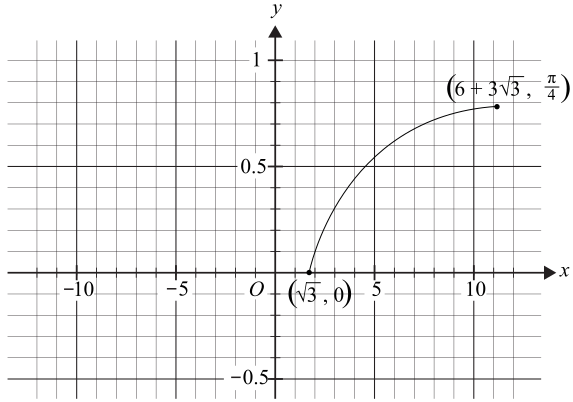
Consider  `f: [sqrt 3, 6 + 3 sqrt 3] -> R,\ \ f(x) = arctan (x/3)-pi/6`.

  1. Sketch the graph of `f` on the axes below, labelling the end points with their coordinates.   (3 marks)

    --- 3 WORK AREA LINES (style=lined) ---


  1. The region between the graph of  `f`  and the `y`-axis is rotated about the `y`-axis to form a solid of revolution.
  2. i.  Write down a definite integral in terms of  `y`  that gives the volume of the solid formed.   (2 marks)

    --- 5 WORK AREA LINES (style=lined) ---

  3. ii. Find the volume of the solid, correct to the nearest integer.   (1 mark)

    --- 2 WORK AREA LINES (style=lined) ---

  1. A fish pond that has a shape approximately like that of the solid of revolution in part c. is being filled with water. When the depth is `h` metres, the volume, `V\ text(m)^3`, of water in the pond is given by


    `qquad V = tan(h + pi/6)-h-sqrt 3/3`


    If water is flowing into the pond at a rate of 0.03 m³ per minute, find the rate at which the depth is increasing when the depth is 0.6 m. Give your answer in metres per minute, correct to three decimal places.   (3 marks)

    --- 6 WORK AREA LINES (style=lined) ---

Show Answers Only
  1. i.  `t^2-2t sqrt 3-1 = 0`
  2. ii. `text(Proof)\ text{(See Worked Solutions)}`
  3. `text(See Worked Solutions)`
  4. i.  `V = pi int_0^(pi/4) 9 tan^2 (y + pi/6)\ dy`
  5. ii. `67`
  6. `0.007\ text(m/min)`
Show Worked Solution

a.i.   `tan (theta/2) = tan ((5pi)/12) = t`

`tan (theta)` `=(2 tan (theta/2))/(1-tan^2(theta/2)`
`tan((5 pi)/6)` `= (2tan ((5pi)/12))/(1-tan^2((5pi)/2)`
`-1/sqrt 3` `= (2t)/(1-t^2), quad (t != +- 1)`
`-(1-t^2)` `= 2t sqrt 3`
`-1 + t^2` `= 2t sqrt 3`

 
`:. t^2-2 sqrt 3 t-1 = 0`


a.ii.    `t^2-2 sqrt 3 t + (-sqrt 3)^2 +3 -4 = 0`
  `(t-sqrt 3)^2` `= 4`
  `t-sqrt 3` `= +- 2`
  `t` `= sqrt 3 +-2`

 
`=> tan ((5 pi)/12)\ \ text(is in 1st quadrant,)`

`:. t` `= tan ((5 pi)/12) = 2 + sqrt 3`


b.    `f(sqrt 3)` `= 0`
`f(6 + 3 sqrt 3)` `=pi/4`

`text(Graphing)\ \ f(x) = arctan (x/3)-pi/6\ \ text(on CAS will)`

`text(show the shape of the graph.)`


c.i.    `y` `= tan^(-1)(x/3)-pi/6`
  `y + pi/6` `= tan^(-1)(x/3)`
  `x/3` `= tan(y + pi/6)`
  `x` `= 3 tan (y + pi/6)`
  `x^2` `= 9 tan^2 (y + pi/6)`


`:. V` `= pi int_0^(pi/4) x^2\ dy`  
  `=pi int_0^(pi/4) 9 tan^2 (y + pi/6)\ dy`  


c.ii.  `pi int_0^(pi/4) 9 tan^2 (y + pi/6)\ dy`

`=66.99…`

`=67\ text(u³)`


d.    `(dV)/(dt)` `= 0.03`
  `V` `= tan(h + pi/6)-h-sqrt 3/3`
  `(dV)/(dh)` `= tan^2 (h+pi/6)\ \ \ text{(by CAS)}`
  `(dh)/(dt)` `= (dh)/(dV) * (dV)/(dt)`
    `= 1/(tan^2 (h+pi/6)) xx 3/100`

  
`(dh)/(dt)|_(h = 0.6)~~0.007\ text(m/min)`

Filed Under: Related Rates of Change, Solids of Revolution Tagged With: Band 4, Band 5, smc-1180-20-Trig function, smc-1180-60-y-axis rotation, smc-1185-10-Volume

Calculus, SPEC2-NHT 2018 VCAA 1

Consider the function  `f`  with rule  `f(x) = 10 arccos (2-2x)`.

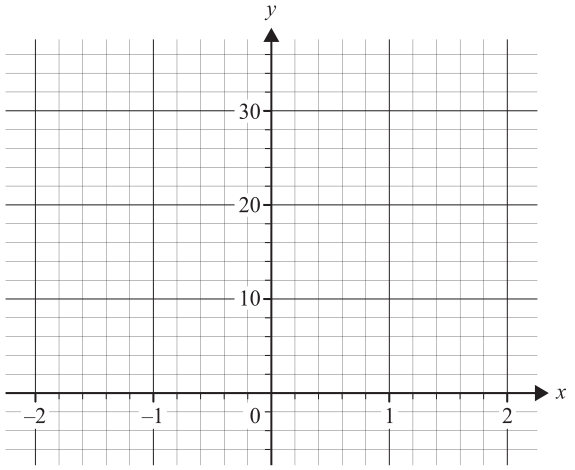
  1.  Sketch the graph of  `f`  over its maximal domain on the set of axes below. Label the endpoints with their coordinates.   (3 marks)

    --- 0 WORK AREA LINES (style=lined) ---


  1. A vase is to be modelled by rotating the graph of  `f`  about the `y`-axis to form a solid of revolution, where units of measurement are in centimetres.
    1.  Write down a definite integral in terms of `y` that gives the volume of the vase.   (2 marks)

      --- 5 WORK AREA LINES (style=lined) ---

    2.  Find the volume of the vase in cubic centimetres.  (1 mark)

      --- 2 WORK AREA LINES (style=lined) ---

  2. Water is poured into the vase at a rate of 20 cm³ s¯¹.
  3. Find the rate, in centimetres per second, at which the depth of the water is changing when the depth is  `5 pi`  cm.  (3 marks)

    --- 6 WORK AREA LINES (style=lined) ---

  4. The vase is placed on a table. A bee climbs from the bottom of the outside of the vase to the top of the vase.
  5. What is the minimum distance the bee will need to travel? Give your answer in centimetres, correct to one decimal place.  (1 mark)

    --- 3 WORK AREA LINES (style=lined) ---

Show Answers Only

  1. `text(See Worked Solutions)`
  2.  i. `V = pi int_0^(10 pi) (1-1/2 cos (y/10))^2 dy`
  3. ii. `V = (45 pi^2)/4 text(cm)^3`
  4. `20/pi text(cm s)^(-1)`
  5. `31.4\ text(cm)`

Show Worked Solution

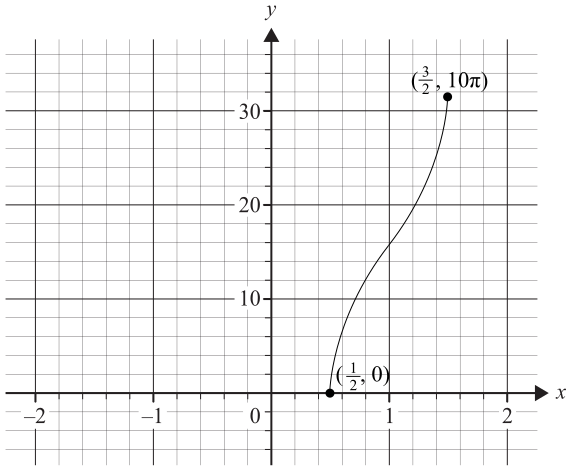
a.  

`2-2x in [-1, 1]`

`-2x in [-3, -1]`

`:. x in [1/2, 3/2]`

`f(1/2)` `= 10 cos^(-1) (1)=0`
`f(3/2)` `= 10 cos^(-1) (1)=10pi`


b.i.   `y` `= 10 cos^(-1) (2-2x)`
  `y/10` `= cos^(-1) (2-2x)`
  `cos (y/10)` `= 2-2x`
  `2x` `= 2-cos (y/10)`
  `x` `= 1-1/2 cos (y/10)`


  `:. V` `= pi int_0^(10 pi) x^2\ dy`
    `= pi int_0^(10 pi) (1-1/2 cos (y/10))^2\ dy`


b.ii.   `V = (45 pi^2)/4 text(cm)^3`


c.  `(dV)/(dt) = 20\ text(cm³/s)\ \ \ text{(given)}`

`(dV)/(dh) = pi (1-1/2 cos (y/10))^2\ \ text(when)\ \ y=5pi` 

`=> (dV)/(dh) = pi`
 

`:. (dh)/(dt)` `= (dh)/(dV)*(dV)/(dt)`
  `= 1/pi * 20`
  `= 20/pi\ text(cm s)^(-1)`


d.   `f(x) = 10cos^(-1)(2-2x)`

`l=int_(1/2)^(3/2) sqrt(1 + (f′(x))^2)\ dx`

  `~~31.4\ text(cm)\ \ \ text{(by CAS)}`

Filed Under: Related Rates of Change, Solids of Revolution Tagged With: Band 3, Band 4, Band 5, smc-1180-20-Trig function, smc-1180-60-y-axis rotation, smc-1185-10-Volume

Calculus, SPEC1-NHT 2018 VCAA 9

  1.    i. Given that  `cot(2 theta) = a`, show that  `tan^2(theta) + 2a tan(theta)-1 = 0`.   (2 marks)

    --- 5 WORK AREA LINES (style=lined) ---

  2.  ii. Show that  `tan(theta) = -a +- sqrt(a^2 + 1)`.  (1 mark)

    --- 4 WORK AREA LINES (style=lined) ---

  3. iii. Hence, show that  `tan(pi/12) = 2-sqrt 3`, given that  `cot(2 theta) = sqrt 3`, where  `theta in (0, pi)`.   (1 mark)

    --- 5 WORK AREA LINES (style=lined) ---

  4.  Find the gradient of the tangent to the curve  `y = tan (theta)`  at  `theta = pi/12`.   (2 marks)

    --- 5 WORK AREA LINES (style=lined) ---

  5.  A solid of revolution is formed by rotating the region between the graph of  `y = tan(theta)`, the horizontal axis, and the lines  `theta = pi/12`  and  `theta = pi/3`  about the horizontal axis.
  6. Find the volume of the solid of revolution.   (3 marks)

    --- 6 WORK AREA LINES (style=lined) ---

Show Answers Only

    1. `text(Proof)\ \ text{(See Worked Solutions)}`
    2. `text(Proof)\ \ text{(See Worked Solutions)}`
    3. `text(Proof)\ \ text{(See Worked Solutions)}`
  1. `8-4 sqrt 3`
  2. `pi (2 sqrt 3-2-pi/4)`

Show Worked Solution

a.i.   `1/(tan 2 theta)` `= a`
  `1` `= a tan (2 theta)`
  `1` `= a ((2 tan (theta))/(1-tan^2(theta)))`
  `1/a (1-tan^2 (theta))` `= 2 tan (theta)`
  `1-tan^2 (theta)` `= 2a tan (theta)`
  `:. tan^2 (theta) + 2 a tan (theta)-1` `=0\ \ text(… as required)`


a.ii.   `[tan^2 (theta) + 2a tan (theta) + a^2]-a^2-1` `= 0`
  `(tan (theta) + a)^2` `= a^2 + 1`
  `tan (theta) + a` `= +- sqrt(a^2 + 1)`
  `:. tan (theta)` `= -a +- sqrt(a^2 + 1)`


a.iii.   `theta in (0, pi) \ => \ 2 theta in (0, 2 pi)`

`text(S)text(ince)\ \ cot(2theta)=sqrt3\ \ \ =>\ \ \ tan(2theta)=1/sqrt3`

  `:. 2 theta` `= pi/6, pi + pi/6`
  `theta` `= pi/12, (7 pi)/12`
  `tan (theta)` `=-sqrt 3 +- sqrt((sqrt 3)^2 + 1)`
    `=-sqrt 3 +- sqrt(3 + 1)`
    `=-sqrt 3 +- 2`

 
`:. tan (pi/12) = 2-sqrt 3,\ \ \ \ (tan (pi/12) > 0)`


b.   `y` `=tan(theta)`
  `y prime` `= sec^2 (theta)`
    `= 1 + tan^2 (theta)`


`y prime (pi/12)` `= 1 + tan^2 (pi/12)`
  `= 1 + (2-sqrt 3)^2`
  `= 1 + 4-4 sqrt 3 + 3`
  `= 8-4 sqrt 3`


c.   `V` `= pi int_(pi/12)^(pi/3) y^2\ d theta`
    `= pi int_(pi/12)^(pi/3) tan^2 (theta)\ d theta`
    `= pi int_(pi/12)^(pi/3) (1 + tan^2 (theta)-1)\ d theta`
    `= pi int_(pi/12)^(pi/3) (sec^2 (theta)-1)\ d theta`
    `= pi [tan (theta)-theta]_(pi/12)^(pi/3)`
    `= pi (tan (pi/3)-pi/3-(tan (pi/12)-pi/12))`
    `= pi (sqrt 3-(4 pi)/12-(2-sqrt 3) + pi/12)`
    `= pi (2 sqrt 3-2-pi/4)\ \ text(u³)`

Filed Under: Solids of Revolution, Tangents and Curve Sketching Tagged With: Band 3, Band 4, Band 5, smc-1180-20-Trig function, smc-1180-50-x-axis rotations, smc-1182-10-Find gradient

Copyright © 2014–2025 SmarterEd.com.au · Log in