SmarterEd

Aussie Maths & Science Teachers: Save your time with SmarterEd

  • Login
  • Get Help
  • About

Calculus, SPEC1 2024 VCAA 5

The curve with equation  \(y=\sqrt{k-\dfrac{1}{x^2}}\),  for  \(1 \leq x \leq \dfrac{k}{2}\)  where  \(k>2\), is rotated about the \(x\)-axis to form a solid of revolution that has volume  \(\dfrac{7 \pi}{2}\) units\(^3\).

Show that \(k\) satisfies the equation  \(k^3-2 k^2-9 k+4=0\).   (3 marks)

--- 8 WORK AREA LINES (style=lined) ---

Show Answers Only

  \(V\) \(=\pi \displaystyle{\int}_1^{\frac{k}{2}}\left(k-\dfrac{1}{x^2}\right) dx\)
  \(\dfrac{7 \pi}{2}\) \(=\pi\left[kx+\dfrac{1}{x}\right]_1^{\frac{k}{2}}\)
  \(7\) \(=2\left[\left(\dfrac{k^2}{2}+\dfrac{2}{k}\right)-(k+1)\right]\)
  \(7\) \(=k^2+\dfrac{4}{k}-2 k-2\)
  \(7k\) \(=k^3+4-2 k^2-2 k\)
  \(0\) \(=k^3-2k^2-9k+4\)

Show Worked Solution

\(y=\sqrt{k-\dfrac{1}{x^2}}\)

  \(V\) \(=\pi \displaystyle{\int}_1^{\frac{k}{2}}\left(k-\dfrac{1}{x^2}\right) dx\)
  \(\dfrac{7 \pi}{2}\) \(=\pi\left[kx+\dfrac{1}{x}\right]_1^{\frac{k}{2}}\)
  \(7\) \(=2\left[\left(\dfrac{k^2}{2}+\dfrac{2}{k}\right)-(k+1)\right]\)
  \(7\) \(=k^2+\dfrac{4}{k}-2 k-2\)
  \(7k\) \(=k^3+4-2 k^2-2 k\)
  \(0\) \(=k^3-2k^2-9k+4\)

Filed Under: Solids of Revolution Tagged With: Band 4, smc-1180-40-Other graphs, smc-1180-50-x-axis rotations

Calculus, SPEC2 2022 VCAA 1

Consider the family of functions \(f\) with rule  \(f(x)=\dfrac{x^2}{x-k}\), where \(k \in R \backslash\{0\}\).

  1. Write down the equations of the two asymptotes of the graph of \(f\) when \(k=1\).   (2 marks)

    --- 3 WORK AREA LINES (style=lined) ---

  2. Sketch the graph of  \(y=f(x)\)  for  \(k=1\)  on the set of axes below. Clearly label any turning points with their coordinates and label any asymptotes with their equations.   (3 marks)
     

--- 0 WORK AREA LINES (style=lined) ---

  1.  i. Find, in terms of \(k\), the equations of the asymptotes of the graph of  \(f(x)=\dfrac{x^2}{x-k}\).   (1 mark)

    --- 2 WORK AREA LINES (style=lined) ---

  2. ii. Find the distance between the two turning points of the graph of  \(f(x)=\dfrac{x^2}{x-k}\) in terms of \(k\).   (2 marks)

    --- 4 WORK AREA LINES (style=lined) ---

  3. Now consider the functions \(h\) and \(g\), where  \(h(x)=x+3\)  and  \(g(x)=\abs{\dfrac{x^2}{x-1}}\).
  4. The region bounded by the curves of \(h\) and \(g\) is rotated about the \(x\)-axis.
    1. Write down the definite integral that can be used to find the volume of the resulting solid.   (2 marks)

      --- 5 WORK AREA LINES (style=lined) ---

    2. Hence, find the volume of this solid. Give your answer correct to two decimal places.   (1 mark)

      --- 2 WORK AREA LINES (style=lined) ---

Show Answers Only

a.  \(\text {Asymptotes: } x=1,\  y=x+1\)

b.   
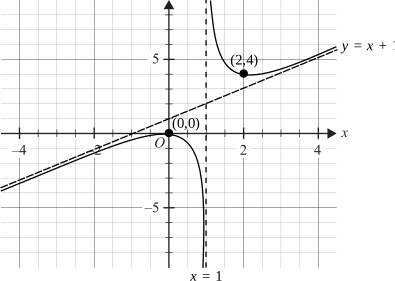
       

c.i.   \(\text {Asymptotes: } x=k,\  y=x+k\)

c.ii.  \(\text {Distance }=2 \sqrt{5}|k|\)

d.i.  \(\displaystyle V=\pi \int_{\frac{-\sqrt{7}-1}{2}}^{\frac{\sqrt{7}-1}{2}}(x+3)^2-\left(\frac{x^2}{x-1}\right)^2 dx\)

d.ii.  \(V=51.42\ \text{u}^3 \)

Show Worked Solution

a.    \(\text {When } k=1 :\)

\(f(x)=\dfrac{x^2}{x-1}=\dfrac{(x+1)(x-1)+1}{(x-1)}=x+1+\dfrac{1}{x-1}\)

\(\text {Asymptotes: } x=1,\  y=x+1\)
 

b.    


c.i. \(f(x)=\dfrac{x^2}{x-k}=\dfrac{(x+k)(x-k)+k^2}{x-k}=x+k+\dfrac{k^2}{x-k}\)

\(\text {Using part a.}\)

\(\text {Asymptotes: } x=k,\  y=x+k\)
 

c.ii.  \(f^{\prime}(x)=1-\left(\dfrac{k}{x-k}\right)^2\)

\(\text {TP’s when } f^{\prime}(x)=0 \text { (by CAS):}\)

\(\Rightarrow(2 k, 4 k),(0,0)\)

\(\text {Distance }\displaystyle=\sqrt{(2 k-0)^2+(4 k-0)^2}=\sqrt{20 k^2}=2 \sqrt{5}|k|\)
 

d.i  \(\text {Solve for intersection of graphs (by CAS):}\)

\(\displaystyle x+3=\left|\frac{x^2}{x-1}\right|\)

\(\displaystyle \Rightarrow x=\frac{3}{2}, x=\frac{-1 \pm \sqrt{7}}{2}\)

\(\displaystyle V=\pi \int_{\frac{-\sqrt{7}-1}{2}}^{\frac{\sqrt{7}-1}{2}}(x+3)^2-\left(\frac{x^2}{x-1}\right)^2 dx\)
 

d.ii. \(V=51.42\ \text{u}^3 \text{ (by CAS) }\)

♦♦ Mean mark (d)(ii) 37%.

Filed Under: Partial Fractions, Quotient and Other Functions (SM), Solids of Revolution Tagged With: Band 3, Band 4, Band 5, smc-1154-10-Quotient functions/Asymptotes, smc-1154-30-Absolute value, smc-1154-50-Sketch graph, smc-1180-40-Other graphs, smc-1180-50-x-axis rotations

Calculus, SPEC1 2022 VCAA 10

Let `f(x)=\sec (4 x)`.

  1. Sketch the graph of `f` for `x \in\left[-\frac{\pi}{4}, \frac{\pi}{4}\right]` on the set of axes below. Label any asymptotes with their equations and label any turning points and the endpoints with their coordinates.   (3 marks)


  2. The graph of  `y=f(x)` for `x \in\left[-\frac{\pi}{24}, \frac{\pi}{48}\right]` is rotated about the `x`-axis to form a solid of revolution.
    Find the volume of this solid. Give your answer in the form `\frac{(a-\sqrt{b}) \pi}{c}`, where `a`, `b`, `c in R`.   (3 marks)
Show Answers Only

a.  
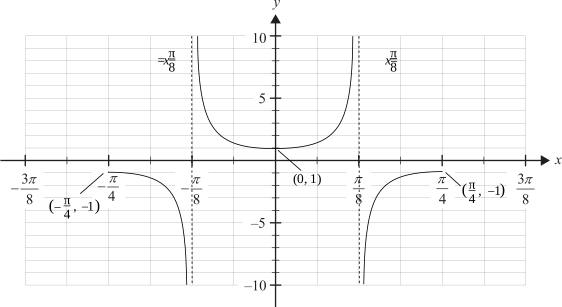
       

b.   `\frac{(3-\sqrt{3}) \pi}{6}`

Show Worked Solution

a.      


♦ Mean mark (a) 49%.
b.    `V` `=\pi \int_{-\frac{\pi}{24}}^{\frac{\pi}{48}} \sec ^2(4 x)\ dx`
    `=\frac{\pi}{4}[\tan (4 x)]_{-\frac{\pi}{24}}^{\frac{\pi}{48}}`
    `=\frac{\pi}{4} \tan \left(\frac{\pi}{12}\right)-\frac{\pi}{4} \tan \left(-\frac{\pi}{6}\right)`
    `=\frac{\pi}{4} \tan \left(\frac{\pi}{3}-\frac{\pi}{4}\right)-\frac{\pi}{4} \xx -\frac{1}{\sqrt{3}}`
    `=\frac{\pi}{4} \tan \left(\frac{sqrt3-1}{1+sqrt3} xx \frac{1-sqrt3}{1-sqrt3}\right)+\frac{\pi}{4sqrt3}`
    `=\frac{\pi}{4} \tan \left(\frac{sqrt3-3-1+sqrt3}{-2}\right)+\frac{\pi}{4sqrt3}`
    `=\frac{\pi}{4}(2-\sqrt{3}) +\frac{\pi}{4sqrt3}`
    `=\frac{\pi(2 \sqrt{3}-3+1)}{4 \sqrt{3}}`
    `=\frac{(6-2 \sqrt{3}) \pi}{12}`
    `=\frac{(3-\sqrt{3}) \pi}{6}`

♦ Mean mark (b) 55%.

Filed Under: Solids of Revolution Tagged With: Band 5, smc-1180-20-Trig function, smc-1180-50-x-axis rotations

Calculus, SPEC2 2023 VCAA 3

The curve given by  \(y^2=x-1\), where  \(2 \leq x \leq 5\), is rotated about the \(x\)-axis to form a solid of revolution.

  1.  i. Write down the definite integral, in terms of \(x\), for the volume of this solid of revolution.  (1 mark)

    --- 2 WORK AREA LINES (style=lined) ---

  2. ii. Find the volume of the solid of revolution.  (1 mark)

    --- 2 WORK AREA LINES (style=lined) ---

  3.  i. Express the curved surface area of the solid in the form  \(\pi \displaystyle \int_a^b \sqrt{A x-B}\, d x\), where \(a, b, A, B\) are all positive integers.  (2 marks)

    --- 4 WORK AREA LINES (style=lined) ---

  4. ii. Hence or otherwise, find the curved surface area of the solid correct to three decimal places.  (1 mark)

    --- 2 WORK AREA LINES (style=lined) ---

The total surface area of the solid consists of the curved surface area plus the areas of the two circular discs at each end.

The 'efficiency ratio' of a body is defined as its total surface area divided by the enclosed volume.

  1. Find the efficiency ratio of the solid of revolution correct to two decimal places.  (2 marks)

    --- 2 WORK AREA LINES (style=lined) ---

  2. Another solid of revolution is formed by rotating the curve given by  \(y^2=x-1\) about the \(x\)-axis for  \(2 \leq x \leq k\), where \(k \in R\). This solid has a volume of \(24 \pi\).
  3. Find the efficiency ratio for this solid, giving your answer correct to two decimal places.  (3 marks)

    --- 4 WORK AREA LINES (style=lined) ---

Show Answers Only

a.i. \(\displaystyle V=\pi \int y^2 d x=\pi \int_2^5(x-1) dx\)
 

a.ii. \(\text{Evaluating integral (by calc):}\)

\(V=\dfrac{15 \pi}{2}\ \text{u}^3\)
 

b.i.  \(\displaystyle y=\sqrt{x-1} \ \Rightarrow \ \frac{d y}{d x}=\frac{1}{2} \cdot \frac{1}{\sqrt{x-1}} \ \Rightarrow \ \frac{d^2 y}{dx^2}=\frac{1}{4(x-1)}\)

\(\ \ \begin{aligned} \displaystyle \int_2^5 2 \pi \sqrt{x-1} \ \sqrt{1+\frac{1}{4(x-1)}} \ d x & =\int_2^5 2 \pi \sqrt{x-1+\frac{1}{4}}\, d x \\ & =\pi \int_2^5 \sqrt{4 x-3}\, d x\end{aligned}\)

 
b.ii.
\(\text{Evaluate integral in b.i.}\)

\(\text {S.A.}=30.847\ \text{u}^2\)
 

c.    \(y=\sqrt{x-1}\)

\(\text{At}\ \ x=2\ \ \Rightarrow y=1\)

\(\text{At}\ \ x=5\ \ \Rightarrow y=2\)

\begin{aligned}
\text{Total S.A. } &=30.847+\pi(1)^2+\pi(2)^2 \\
&=46.5545\ \text{u}^2 \\
\end{aligned}

\(\text {Efficiency ratio}=\dfrac{46.5545}{\frac{15 \pi}{2}}=1.98\ \text{(2 d.p.)}\)
 

d.   \(V=\displaystyle \pi \int_2^k(x-1) d x=24 \pi\)

\(\text{Solve (by calc):}\)

\(\dfrac{\pi k(k-2)}{2}=24 \pi \ \Rightarrow \ k=8 \)

\(\text {S.A.}=\pi \displaystyle{\int_2^8} \sqrt{4 x-3}\, d x=75.9163 \ldots\)

\(\text{Total S.A.}=75.9163+\pi(1+7)=101.049 \)

\(\text{Efficiency ratio}=\dfrac{101.049}{24 \pi}= 1.34\ \text{(2 d.p.)}\)

Show Worked Solution

a.i. \(\displaystyle V=\pi \int y^2 d x=\pi \int_2^5(x-1) dx\)
 

a.ii. \(\text{Evaluating integral (by calc):}\)

\(V=\dfrac{15 \pi}{2}\ \text{u}^3\)
 

b.i.  \(\displaystyle y=\sqrt{x-1} \ \Rightarrow \ \frac{d y}{d x}=\frac{1}{2} \cdot \frac{1}{\sqrt{x-1}} \ \Rightarrow \ \frac{d^2 y}{dx^2}=\frac{1}{4(x-1)}\)

\(\ \ \begin{aligned} \displaystyle \int_2^5 2 \pi \sqrt{x-1} \ \sqrt{1+\frac{1}{4(x-1)}} \ d x & =\int_2^5 2 \pi \sqrt{x-1+\frac{1}{4}}\, d x \\ & =\pi \int_2^5 \sqrt{4 x-3}\, d x\end{aligned}\)

 
b.ii.
\(\text{Evaluate integral in b.i.}\)

\(\text {S.A.}=30.847\ \text{u}^2\)
 

c.    \(y=\sqrt{x-1}\)

\(\text{At}\ \ x=2\ \ \Rightarrow y=1\)

\(\text{At}\ \ x=5\ \ \Rightarrow y=2\)

\begin{aligned}
\text{Total S.A. } &=30.847+\pi(1)^2+\pi(2)^2 \\
&=46.5545\ \text{u}^2 \\
\end{aligned}

\(\text {Efficiency ratio}=\dfrac{46.5545}{\frac{15 \pi}{2}}=1.98\ \text{(2 d.p.)}\)
 

d.   \(V=\displaystyle \pi \int_2^k(x-1) d x=24 \pi\)

\(\text{Solve (by calc):}\)

\(\dfrac{\pi k(k-2)}{2}=24 \pi \ \Rightarrow \ k=8 \)

\(\text {S.A.}=\pi \displaystyle{\int_2^8} \sqrt{4 x-3}\, d x=75.9163 \ldots\)

\(\text{Total S.A.}=75.9163+\pi(1+7)=101.049 \)

\(\text{Efficiency ratio}=\dfrac{101.049}{24 \pi}= 1.34\ \text{(2 d.p.)}\)

Filed Under: Solids of Revolution Tagged With: Band 3, Band 4, Band 5, smc-1180-30-Square root, smc-1180-50-x-axis rotations, smc-1180-65-Surface area, smc-1180-80-Efficiency ratio

Calculus, SPEC1 2023 VCAA 7

The curve defined by the parametric equations

\(x=\dfrac{t^2}{4}-1, \ y=\sqrt{3} t\), where  \(0 \leq t \leq 2 \text {, }\)

is rotated about the \(x\)-axis to form an open hollow surface of revolution.

Find the surface area of the surface of revolution.

Give your answer in the form \(\pi\left(\dfrac{a \sqrt{b}}{c}-d\right)\), where \(a, b, c\) and \(d \in Z^{+}\).   (4 marks)

--- 10 WORK AREA LINES (style=lined) ---

Show Answers Only

\(\pi\Bigg{(} \dfrac{64\sqrt3}{3}-24\Bigg{)} \)

Show Worked Solution

\(x=\dfrac{t^2}{4}-1 \ \Rightarrow \dfrac{dx}{dt}=\dfrac{t}{2} \)

\(y=\sqrt{3} t \ \Rightarrow \dfrac{dy}{dt} = \sqrt3\)

\(\text{S.A.}\) \[=2\pi \int_0^2 \sqrt3 t \times \sqrt{\Big{(}\dfrac{dx}{dt}\Big{)}^2+\Big{(}\frac{dy}{dt}\Big{)}^2}\ dt\]  
  \[=2\sqrt3 \pi \int_0^2 t\sqrt{\dfrac{t^2}{4}+3}\ dt\]  

 
\(\text{Let}\ \ u=\dfrac{t^2}{4}\ \ \Rightarrow \ \dfrac{du}{dt}=\dfrac{t}{2}\ \ \Rightarrow \ 2\,du=t\,dt\)

\(\text{When}\ \ t=2, u=4; \ t=0, u=3\)

\(\text{S.A.}\) \[=4\sqrt3\pi \times \dfrac{2}{3}\Big{[}u^{\frac{3}{2}}\Big{]}_3^4 \]  
  \(=\dfrac{8\sqrt3 \pi}{3}\big{(}4^{\frac{3}{2}}-3^{\frac{3}{2}}\big{)} \)  
  \(=\dfrac{8\sqrt3 \pi}{3}(8-3\sqrt3) \)  
  \(=\pi\Bigg{(} \dfrac{64\sqrt3}{3}-24\Bigg{)} \)  

Filed Under: Solids of Revolution, Tangents and Curve Sketching Tagged With: Band 5, smc-1180-50-x-axis rotations, smc-1182-65-Paramatric functions

Calculus, SPEC1 2021 VCAA 4

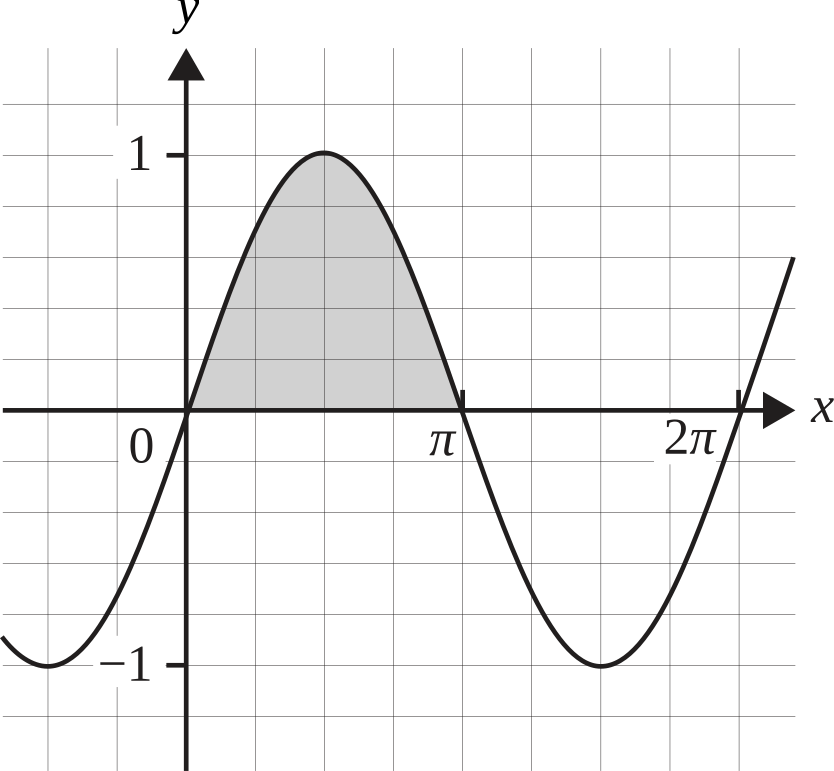
  1. The shaded region in the diagram below is bounded by the graph of  `y = sin(x)`  and the `x`-axis between the first two non-negative `x`-intercepts of the curve, that is interval  `[0, pi]`.  The shaded region is rotated about the `x`-axis to form a solid of revolution.


    Find the volume, `V_s` of the solid formed.   (3 marks)

    --- 3 WORK AREA LINES (style=lined) ---
  2. Now consider the function  `y = sin(kx)`, where `k` is a positive real constant. The region bounded by the graph of the function and the `x`-axis between the first two non-negative `x`-intercepts of the graph is rotated about the `x`-axis to form a solid of revolution.
  3. Find the volume of this solid in term of `V_s`.   (1 mark)

Show Answers Only

  1. `(pi^2)/2\ text(u)³`
  2. `1/k V_s`

Show Worked Solution

a.    `V_s` `= pi int_0^pi sin^2(x)\ dx`
    `= pi int_0^pi 1/2(1-cos(2x))\ dx`
    `= pi/2 int_0^pi 1-cos(2x)\ dx`
    `= pi/2 [x-1/2 sin(2x)]_0^pi`
    `= pi/2[pi-1/2 sin(2pi)-(0-1/2 sin 0)]`
    `= (pi^2)/2\ text(u)³`

♦♦ Mean mark part (b) 30%.


b.   `y = sin(kx)\ \ text(is the dilation of)\ \ y = sin(x)\ \ text(by a factor of)`

`k\ \ text(from the)\ \ xtext(-axis)`

`:. V = 1/k V_s`

Filed Under: Solids of Revolution Tagged With: Band 4, Band 5, smc-1180-20-Trig function, smc-1180-50-x-axis rotations

Calculus, SPEC1 2020 VCAA 8

Find the volume of, `V`, of the solid of revolution formed when the graph of  `y = 2sqrt((x^2 + x + 1)/((x + 1)(x^2 + 1)))`  is rotated about the `x`-axis over the interval  `[0, sqrt 3]`. Give your answer in the form  `V = 2pi(log_e(a) + b)`, where  `a, b in R`.  (5 marks)

Show Answers Only

`V = 2pi (log_e(2 sqrt 3 + 2) + pi/3)\ text(u³)`

Show Worked Solution
`V` `= pi int_0^sqrt 3 y^2\ dx`
  `= 4 pi int_0^sqrt 3 (x^2 + x + 1)/((x + 1)(x^2 + 1))\ dx`


`text(Using partial fractions):`

`(x^2 + x + 1)/((x + 1)(x^2 + 1))` `= A/(x + 1) + (Bx + C)/(x^2 + 1)`
`x^2 + x + 1` `= Ax^2 + A + (Bx + C)(x + 1)`
  `=(A+B)x^2 + (B+C)x + A + C`

 
`text(If)\ \ x = – 1,\ 2A = 1 \ => \ A = 1/2`

♦ Mean mark 50%.

`text(Equating coefficients of)\ x^2: A + B = 1 \ => \ B = 1/2`

`text(Equating constants): A + C = 1 \ => \ C = 1/2`

`:. V` `= 2 pi int_0^sqrt 3 1/(x + 1) + x/(x^2 + 1) + 1/(x^2 + 1)\ dx`
  `= 2 pi [log_e |x + 1| + 1/2 log_e |x^2 + 1| + tan^(-1)(x)]_0^sqrt 3`
  `= 2 pi (log_e (sqrt 3 + 1) + 1/2 log_e4 + pi/3)`
  `= 2 pi (log_e (sqrt 3 + 1) + log_e 2 + pi/3)`
  `= 2 pi (log_e (2 sqrt 3 + 2) + pi/3)\ text(u³)`

Filed Under: Solids of Revolution Tagged With: Band 5, smc-1180-30-Square root, smc-1180-50-x-axis rotations

Calculus, SPEC1-NHT 2019 VCAA 6

Part of the graph of  `y = (2)/(sqrt(x^2-4x+3))`, where  `x > 3`, is shown below.
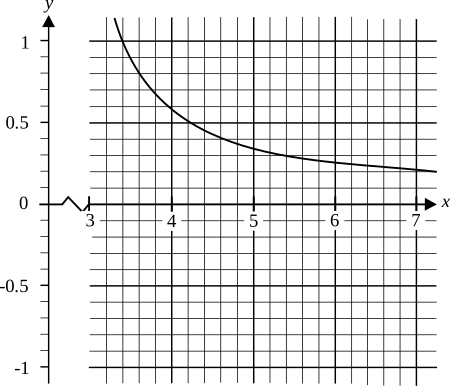


Find the volume of the solid of revolution formed when the graph of  `y = (2)/(sqrt(x^2-4x+3))`  from  `x = 4`  to  `x = 6`  is rotated about the `x`-axis. Give your answer in the form  `a log_e(b)`  where `a` and `b` are real numbers.   (5 marks)

Show Answers Only

`pi log_e ((9)/(5))`

Show Worked Solution

`V = pi int_4 ^6 (4)/(x^2 – 4x + 3)\ dx`
 

`text(Using partial fractions:)`

`(4)/(x^2 – 4x + 3) = (a)/((x-3)) + (b)/((x-1))`

`a(x -1) + b(x – 3)= 4`
 

`text(When)\ \ x = 1, \ -2b = 4  => \ b = -2`

`text(When)\ \ x = 3, \ 2a = 4  => \ a = 2`

`:. \ V` `= pi int_4 ^6 (2)/(x-3) – (2)/(x-1)\ dx`
  `= 2 pi [log_e(x-3) -log_e(x-1)]_4 ^6`
  `= 2 pi [log_e 3 – log_e 5 – (log_e 1 – log_e3)]`
  `= 2 pi (2log_e 3 – log_e 5)`
  `= 2pi log_e((9)/(5))`

Filed Under: Solids of Revolution Tagged With: Band 4, smc-1180-40-Other graphs, smc-1180-50-x-axis rotations, smc-1180-70-Partial Fractions

Calculus, SPEC1 2019 VCAA 8

Find the volume of the solid of revolution formed when the graph of  `y = sqrt((1 + 2x)/(1 + x^2))`  is rotated about the `x`-axis over the interval  `[0,1]`.  (4 marks)

Show Answers Only

`pi(pi/4 + ln2)\ \ text(u³)`

Show Worked Solution
`V` `= pi int_0^1 (1 + 2x)/(1 + x^2)\ dx`
  `= pi int_0^1 1/(1 + x^2)\ dx + pi int_0^1 (2x)/(1 + x^2)\ dx`
  `= pi [tan^(−1)(x)]_0^1 + pi [ln(1 + x^2)]_0^1`
  `= pi(tan^(−1)1 – tan^(−1)0) + pi(ln2 – ln1)`
  `= pi(pi/4) + pi(ln2)`
  `= pi(pi/4 + ln2)\ \ text(u³)`

Filed Under: Solids of Revolution Tagged With: Band 4, smc-1180-30-Square root, smc-1180-50-x-axis rotations

Calculus, SPEC2 2012 VCAA 12 MC

The volume of the solid of revolution formed by rotating the graph of  `y = sqrt (9-(x-1)^2)`  above the `x`-axis is given by

  1. `4 pi(3)^2`
  2. `pi int_(−3)^3(9-(x-1)^2)dx`
  3. `pi int_(−2)^(4)(sqrt(9-(x-1)^2))dx`
  4. `pi int_(−2)^4(9-(x-1)^2)^2dx`
  5. `pi int_(−4)^2(9-(x-1)^2)dx`
Show Answers Only

`A`

Show Worked Solution

`y = sqrt (9-(x-1)^2)\ \ => text(Semi-circle of circle)`

♦ Mean mark 48%.

`text{with centre (1,0), radius = 3}`
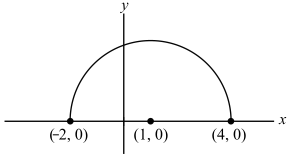
 

`:. V` `= 4/3 pi r^3`
  `= 4/3 pi (3)^3`
  `=4 pi (3)^2`

 
`=> A`

Filed Under: Solids of Revolution Tagged With: Band 5, smc-1180-30-Square root, smc-1180-50-x-axis rotations

Calculus, SPEC1 2011 VCAA 11

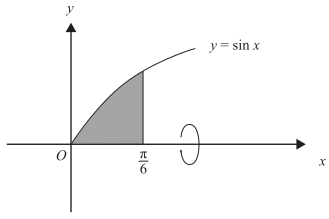
The region in the first quadrant enclosed by the curve  `y = sin(x)`, the line  `y = 0`  and the line  `x = pi/6`  is rotated about the `x`-axis.

Find the volume of the resulting solid of revolution.   (3 marks)

--- 8 WORK AREA LINES (style=lined) ---

Show Answers Only

`pi^2/12-(sqrt3 pi)/8\ \ text(u³)`

Show Worked Solution

`V` `= pi int_(0)^(pi/6) y^2\ dx`
  `= pi int_0^(pi/6) sin^2(x)\ dx`
  `= pi/2 int_0^(pi/6) (1-cos 2x)\ dx`
  `= pi/2 [x-1/2 sin (2x)]_0^(pi/6)`
  `=pi/2 [(pi/6-1/2 sin (pi/3))-0]`
  `=pi/2 (pi/6-(sqrt 3)/4)`
  `=pi^2/12-(sqrt3 pi)/8\ \ text(u³)`

Filed Under: Solids of Revolution Tagged With: Band 4, smc-1180-20-Trig function, smc-1180-50-x-axis rotations

Calculus, SPEC1 2013 VCAA 9

The shaded region below is enclosed by the graph of  `y = sin(x)`  and the lines  `y = 3x`  and  `x = pi/3.`

This region is rotated about the `x`-axis.

VCAA 2013 spec 9

Find the volume of the resulting solid of revolution.  (4 marks)

Show Answers Only

`pi^4/9 – pi^2/6 + (sqrt 3 pi)/8\ \ text(u³)`

Show Worked Solution

`text{Volume of large (outer) cone}`

`= 1/3 pi r^2 xx h`

`=1/3 pi xx pi^2 xx pi/3`

`=pi^4/9`
 

`text{Volume of smaller (inner) cone}`

`= pi int_0^(pi/3) sin^2 x\ dx`

`= pi/2 int_0^(pi/3) (1 – cos 2x)\ dx`

`= pi/2[x – 1/2 (sin 2x)]_0^(pi/3)`

`=pi/2 [pi/3 – 1/2 sin ((2pi)/3)]`

`=pi/2(pi/3 + 1/2 xx sqrt3/2)`

`= pi^2/6 – (sqrt3 pi)/8`
 

`:.\ text(Volume of solid)`

`=pi^4/9 – pi^2/6 + (sqrt3 pi)/8\ \ text(u³)`

Filed Under: Solids of Revolution Tagged With: Band 4, smc-1180-20-Trig function, smc-1180-50-x-axis rotations

Calculus, SPEC2 2017 VCAA 1

Let  `f:D ->R, \ f(x) = x/(1 + x^3)`, where `D` is the maximal domain of  `f`.

  1.   i. Find the equations of any asymptotes of the graph of  `f`.   (1 mark)

    --- 2 WORK AREA LINES (style=lined) ---

  2.  ii. Find  `f′(x)`  and state the coordinates of any stationary points of the graph of  `f`, correct to two decimal places.  (2 marks)

    --- 4 WORK AREA LINES (style=lined) ---

  3. iii. Find the coordinates of any points of inflection of the graph of  `f`, correct to two decimal places.  (2 marks)

    --- 6 WORK AREA LINES (style=lined) ---

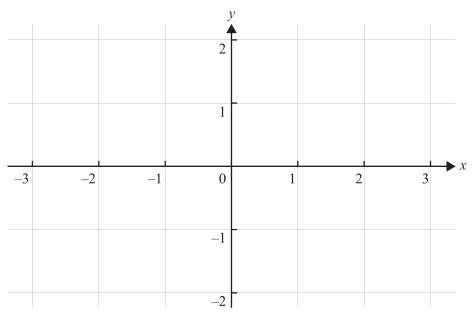
  4. Sketch the graph of  `f(x) = x/(1 + x^3)`  from  `x=–3`  and  `x = 3`  on the axes provided below, marking all stationary points, points of inflection and intercepts with axes, labelling them with their coordinates. Show any asymptotes and label them with their equations.  (3 marks)

    --- 0 WORK AREA LINES (style=lined) ---


  5. The region `S`, bounded by the graph of  `f`, the `x`-axis and the line  `x = 3`, is rotated about the `x`-axis to form a solid of revolution. The line  `x = a`, where  `0 < a < 3`, divides the region `S` into two regions such that, when the two regions are rotated about the `x`-axis, they generate solids of equal volume.
  6. i.  Write down an equation involving definite integrals that can be used to determine `a`.  (2 marks)

    --- 3 WORK AREA LINES (style=lined) ---

  7. ii. Hence, find the value of `a`, correct to two decimal places.  (1 mark)

    --- 1 WORK AREA LINES (style=lined) ---
Show Answers Only
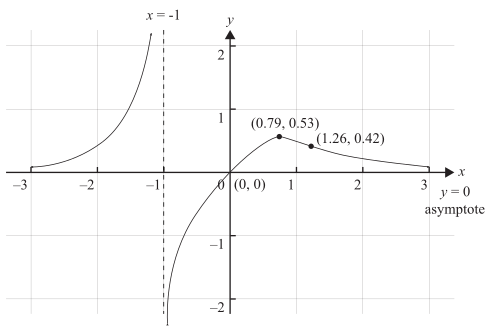
  1. i.  `text(vertical asymptote:)\ \ x = −1“text(horizontal asymptote:)\ \ y = 0`
  2. ii. `text(S.P.)\ \ (0.79, 0.53)`
  3. iii. `text(P.O.I.)\ (1.26, 0.42)`
  4.  
  5. i.  `pi int_a^3 (x^2)/((1 + x^3)^2) dx`
  6. ii. `~~ 0.98`

Show Worked Solution

a.i.   `text(Graphing the function on CAS:`

♦♦ Mean mark 36%.

`text(Vertical asymptote:)\ x = −1`

`text(Horizontal asymptote:)\ \ y = 0`
 

a.ii.   `u = x, \ u′ = 1,\ \ v = 1 + x^3, \ v′ = 3x^2\ \ \ text{(manual or by CAS)}`

`f′(x)` `= (1(1 + x^3)-x(3x^2))/((1 + x^3)^2)`
  `= (1-2x^3)/((1 + x^3)^2)`

 
`text(S.P. when)\ \ f′(x)=0:\ `

`=>  (0.79, 0.53)\ \ \ text{(by CAS)}`


a.iii.  `text(When)\ \ f″(x)=0,\ \ \ text{(by CAS)}`

`=> x = 0, \ x = -1, \ x = 2`

`x != -1`

`text(Check concavity changes:)`

`f″(−1/2) = −1632/343`

`f″(1) = −3/4`

`f″(3) = 675/(10\ 976)`
 

`text(P.O.I. at)\ \ x = sqrt2 ~~ 1.26\ \ text{(concavity changes)}`

`=> f(sqrt2) ~~ 0.42`

`:. text(P.O.I.)\ (1.26, 0.42)`


b.   


c.i.    `V_1` `= pi int_0^a y^2\ dx`
  `V_2` `= pi int_a^3 y^2\ dx`

 
`:.\ text(Equation to solve for)\ a:`

`int_0^a x^2/(1 + x^3)^2\ dx = int_a^3 x^2/(1 + x^3)^2\ dx`


c.ii.  `a=0.98\ \ \ text{(by CAS)}`

Filed Under: Solids of Revolution, Tangents and Curve Sketching Tagged With: Band 3, Band 4, Band 5, smc-1180-40-Other graphs, smc-1180-50-x-axis rotations, smc-1182-35-Sketch curve

Calculus, SPEC1-NHT 2017 VCAA 5

Part of the graph of  `y = (sqrt(x + 1))/(root4(1 - x^2))`  is shown below.
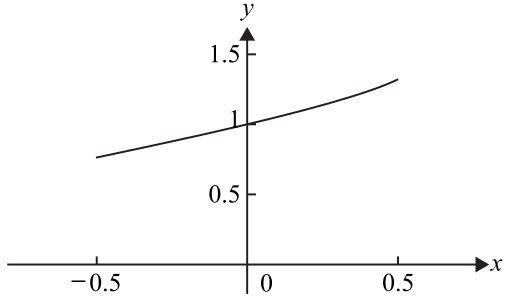


Find the volume generated if the region bounded by the graph of  `y = (sqrt(x + 1))/(root4(1 - x^2))`, the lines  `x = -1/2`  and  `x = 1/2`, and the `x`-axis is rotated about the `x`-axis.  (4 marks)

Show Answers Only

`pi^2/3`

Show Worked Solution
`V` `= pi int_(-1/2)^(1/2) y^2\ dx`
  `= pi int_(-1/2)^(1/2) (x + 1)/sqrt(1 – x^2)\ dx`
  `= pi int_(-1/2)^(1/2) x/sqrt(1 – x^2)\ dx + int_(-1/2)^(1/2) 1/sqrt(1 – x^2)\ dx`

 
`text(Let)\ \ u = 1 – x^2`

`(du)/(dx) = -2x\ \ =>\ \ -1/2\ du = x\ dx`

`text(When)\ \ x=1/2\ \ =>\ \ u=3/4`

`text(When)\ \ x=- 1/2\ \ =>\ \ u=3/4`

`text(Same limit)\ =>\ text(1st integral = 0)`
 

`:. V` `= 0+pi int_(-1/2)^(1/2) 1/sqrt(1 – x^2)\ dx`
  `= pi [sin^(-1) (x)]_(-1/2)^(1/2)`
  `= pi (pi/6 – ((-pi)/6))`
  `= pi (pi/3)`
  `= pi^2/3`

Filed Under: Solids of Revolution Tagged With: Band 4, smc-1180-40-Other graphs, smc-1180-50-x-axis rotations

Calculus, SPEC1 2017 VCAA 10

  1.  Show that  `d/dx(x arccos(x/a)) = arccos(x/a)−x/(sqrt(a^2-x^2))`, where  `a > 0`.   (1 mark)

    --- 3 WORK AREA LINES (style=lined) ---

  2.  State the maximum domain and the range of  `f(x) = sqrt(arccos(x/2))`.   (2 marks)

    --- 2 WORK AREA LINES (style=lined) ---

  3.  Find the volume of the solid of revolution generated when the region bounded by the graph of  `y = f(x)`, and the lines  `x = −2`  and  `y = 0`, is rotated about the `x`-axis.   (4 marks)

    --- 8 WORK AREA LINES (style=lined) ---

Show Answers Only
  1. `text(See Worked Solutions)`
  2. `x ∈ [−2, 2], \ y ∈ [0, sqrtpi]`
  3. `2pi^2`
Show Worked Solution
a.    `u` `= x,` `v` `= cos^(−1)(x/a)`
  `uprime` `= 1,`   `vprime` `= (−1)/sqrt(a^2-x^2)`
`d/(dx)(xcos^(−1)(x/a))` `= uprimev + vprimeu`
  `= cos^(−1)(x/a) + (x(−1))/sqrt(a^2-x^2)`
  `= arccos(x/a)-x/sqrt(a^2-x^2)`


b.   `arccos(x/2)>=0`

`text(Maximal domain:)\  x ∈ [−2, 2]`

`f(x) = (arccos(x/2))^(1/2)`

`text(Range:)\ \ y ∈ [0, sqrtpi]`


c.   `V` `= pi int_(−2)^2 y^2\ dx`
  `= pi int_(−2)^2 cos^(-1)(x/2)\ dx`
  `= pi int_(−2)^2 cos^(-1) (x/2)-x/sqrt(4-x^2) + x/sqrt(4-x^2)\ dx`
  `= pi [x cos^(-1)(x/2)]_(−2)^2 + pi int_(−2)^2 x/sqrt(4-x^2)\ dx`

 
`text(Let)\ \ u = 4-x^2`

♦ Mean mark part (c) 35%.

`(du)/(dx) = -2x\ \ =>\ \ -1/2 (du) = x\ dx`
 

`text(When)\ \ x=2\ \ => \ u=0`

`text(When)\ \ x=-2\ \ =>\ \ u=0`

`:. V` `= pi [2cos^(−1)(1)-(-2)cos^(−1)(−1)]-pi/2 int_0^0 1/sqrtu du`
  `= pi(2 xx 0 + 2 xx pi)`
  `= 2pi^2`

Filed Under: Solids of Revolution Tagged With: Band 3, Band 4, Band 5, smc-1180-40-Other graphs, smc-1180-50-x-axis rotations

Calculus, SPEC1-NHT 2018 VCAA 9

  1.    i. Given that  `cot(2 theta) = a`, show that  `tan^2(theta) + 2a tan(theta)-1 = 0`.   (2 marks)

    --- 5 WORK AREA LINES (style=lined) ---

  2.  ii. Show that  `tan(theta) = -a +- sqrt(a^2 + 1)`.  (1 mark)

    --- 4 WORK AREA LINES (style=lined) ---

  3. iii. Hence, show that  `tan(pi/12) = 2-sqrt 3`, given that  `cot(2 theta) = sqrt 3`, where  `theta in (0, pi)`.   (1 mark)

    --- 5 WORK AREA LINES (style=lined) ---

  4.  Find the gradient of the tangent to the curve  `y = tan (theta)`  at  `theta = pi/12`.   (2 marks)

    --- 5 WORK AREA LINES (style=lined) ---

  5.  A solid of revolution is formed by rotating the region between the graph of  `y = tan(theta)`, the horizontal axis, and the lines  `theta = pi/12`  and  `theta = pi/3`  about the horizontal axis.
  6. Find the volume of the solid of revolution.   (3 marks)

    --- 6 WORK AREA LINES (style=lined) ---

Show Answers Only

    1. `text(Proof)\ \ text{(See Worked Solutions)}`
    2. `text(Proof)\ \ text{(See Worked Solutions)}`
    3. `text(Proof)\ \ text{(See Worked Solutions)}`
  1. `8-4 sqrt 3`
  2. `pi (2 sqrt 3-2-pi/4)`

Show Worked Solution

a.i.   `1/(tan 2 theta)` `= a`
  `1` `= a tan (2 theta)`
  `1` `= a ((2 tan (theta))/(1-tan^2(theta)))`
  `1/a (1-tan^2 (theta))` `= 2 tan (theta)`
  `1-tan^2 (theta)` `= 2a tan (theta)`
  `:. tan^2 (theta) + 2 a tan (theta)-1` `=0\ \ text(… as required)`


a.ii.   `[tan^2 (theta) + 2a tan (theta) + a^2]-a^2-1` `= 0`
  `(tan (theta) + a)^2` `= a^2 + 1`
  `tan (theta) + a` `= +- sqrt(a^2 + 1)`
  `:. tan (theta)` `= -a +- sqrt(a^2 + 1)`


a.iii.   `theta in (0, pi) \ => \ 2 theta in (0, 2 pi)`

`text(S)text(ince)\ \ cot(2theta)=sqrt3\ \ \ =>\ \ \ tan(2theta)=1/sqrt3`

  `:. 2 theta` `= pi/6, pi + pi/6`
  `theta` `= pi/12, (7 pi)/12`
  `tan (theta)` `=-sqrt 3 +- sqrt((sqrt 3)^2 + 1)`
    `=-sqrt 3 +- sqrt(3 + 1)`
    `=-sqrt 3 +- 2`

 
`:. tan (pi/12) = 2-sqrt 3,\ \ \ \ (tan (pi/12) > 0)`


b.   `y` `=tan(theta)`
  `y prime` `= sec^2 (theta)`
    `= 1 + tan^2 (theta)`


`y prime (pi/12)` `= 1 + tan^2 (pi/12)`
  `= 1 + (2-sqrt 3)^2`
  `= 1 + 4-4 sqrt 3 + 3`
  `= 8-4 sqrt 3`


c.   `V` `= pi int_(pi/12)^(pi/3) y^2\ d theta`
    `= pi int_(pi/12)^(pi/3) tan^2 (theta)\ d theta`
    `= pi int_(pi/12)^(pi/3) (1 + tan^2 (theta)-1)\ d theta`
    `= pi int_(pi/12)^(pi/3) (sec^2 (theta)-1)\ d theta`
    `= pi [tan (theta)-theta]_(pi/12)^(pi/3)`
    `= pi (tan (pi/3)-pi/3-(tan (pi/12)-pi/12))`
    `= pi (sqrt 3-(4 pi)/12-(2-sqrt 3) + pi/12)`
    `= pi (2 sqrt 3-2-pi/4)\ \ text(u³)`

Filed Under: Solids of Revolution, Tangents and Curve Sketching Tagged With: Band 3, Band 4, Band 5, smc-1180-20-Trig function, smc-1180-50-x-axis rotations, smc-1182-10-Find gradient

Calculus, SPEC1 2018 VCAA 9

A curve is specified parametrically by  `underset ~r(t) = sec(t) underset ~i + sqrt 2/2 tan(t) underset ~j, \ t in R`.

  1.  Show that the cartesian equation of the curve is  `x^2-2y^2 = 1`.   (2 marks)

    --- 6 WORK AREA LINES (style=lined) ---

  2.  Find the `x`-coordinates of the points of intersection of the curve  `x^2-2y^2 = 1`  and the line  `y = x-1`.   (1 mark)

    --- 5 WORK AREA LINES (style=lined) ---

  3.  Find the volume of the solid of revolution formed when the region bounded by the curve and the line is rotated about the `x`-axis.   (2 marks)

    --- 8 WORK AREA LINES (style=lined) ---

Show Answers Only

  1. `text(Proof)\ \ text{(See Worked Solutions)}`
  2. `x = 1 or x = 3`
  3. `(2 pi)/3`

Show Worked Solution

a.     `x = sec(t), qquad y = sqrt 2/2 tan(t)`

`x^2 = sec^2(t), qquad y^2 = 1/2 tan^2(t)`

`x^2 = sec^2(t), qquad 2y^2 = tan^2(t)`

`1 + tan^2(t)` `= sec^2(t)`
`1 + 2y^2` `= x^2`
`:.x^2-2y^2` `=1\ \ text(.. as required)`


b.    `x^2-2(x-1)^2` `= 1`
  `x^2-2(x^2-2x + 1)` `=1`
  `x^2-2x^2 + 4x-2` `=1`
  `-x^2 + 4x-2-1` `=0`
  `x^2-4x + 3` `=0`
  `(x-3) (x-1)` `=0`

 
`:. x = 1 or x = 3`

♦♦ Mean mark 30%.


c.   `x^2-{:2y_1:}^2` `=1`
  `{:2y_1:}^2` `=x^2-1`
  `{:y_1:}^2` `= (x^2-1)/2`
  `{:y_2:}^2` `= (x-1)^2`


`V` `=pi int_1^3 {:y_1:}^2-{:y_2:}^2 \ dx`
  `= pi int_1^3 (x^2-1)/2-(x-1)^2\ dx`
  `= pi [x^3/6-x/2-(x-1)^3/3]_1^3`
  `= pi [(3^3/6-3/2-2^3/3)-(1^3/6-1/2-0)]`
  `= pi (9/2-3/2-8/3-1/6 + 1/2)`
  `= pi (7/2-8/3-1/6)`
  `= pi ((21-16-1)/6)`
  `= (2 pi)/3`

Filed Under: Position Vectors as a Function of Time, Solids of Revolution Tagged With: Band 3, Band 4, Band 5, smc-1178-10-Find Cartesian equation, smc-1180-10-Polynomial, smc-1180-50-x-axis rotations

Copyright © 2014–2025 SmarterEd.com.au · Log in