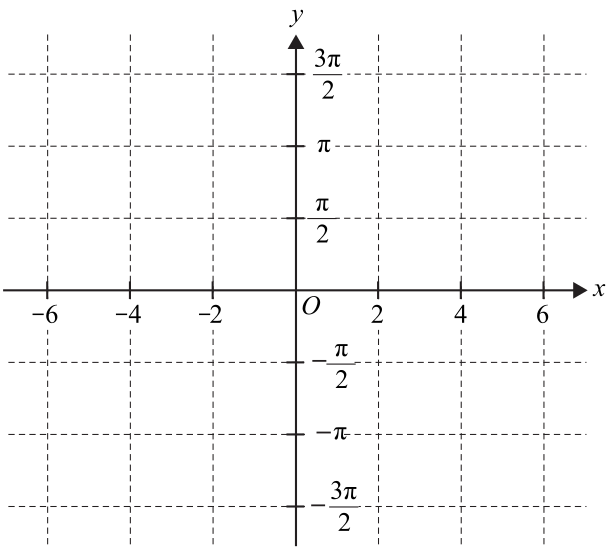
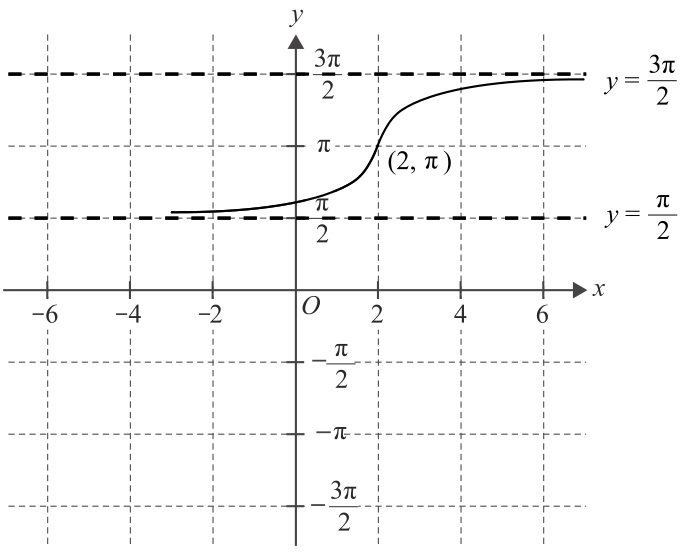
Let `f(x) = arctan (3x - 6) + pi`. --- 2 WORK AREA LINES (style=lined) --- --- 5 WORK AREA LINES (style=lined) --- --- 0 WORK AREA LINES (style=lined) ---
Aussie Maths & Science Teachers: Save your time with SmarterEd
Let `f(x) = arctan (3x - 6) + pi`. --- 2 WORK AREA LINES (style=lined) --- --- 5 WORK AREA LINES (style=lined) --- --- 0 WORK AREA LINES (style=lined) ---
b. `f^{\prime\prime}(x) = (3(18x – 36))/(9x^2 – 36x + 37)^2` `f^{\prime\prime}(x) = 0\ \ text(when)\ \ 18x – 36 = 0 \ => \ x = 2` `text(If)\ \ x < 2, 18x – 36 < 0 \ => \ f^{\prime\prime}(x) < 0` `text(If)\ \ x > 2, 18x – 36 > 0 \ => \ f^{\prime\prime}(x) > 0` `text(S) text(ince)\ \ f^{\prime\prime}(x)\ \ text(changes sign about)\ \ x = 2,` `text(a POI exists at)\ \ x = 2`
a.
`f^{\prime}(x)`
`= (d/(dx) (3x – 6))/(1 + (3x – 6)^2)`
`= 3/(9x^2 – 36x + 37)`
c.
Find the gradient of the curve with equation `x = sin (y/15)` when `x = 1/4`. Give your answer in the form `a sqrt b`, where `a, b \ in Z^+`. (3 marks)
`m = 4 sqrt 15`
| `x` | `= sin (y/15)` |
| `sin^(-1)x` | `= y/15` |
| `y` | `= 15 sin^(-1)x` |
| `dy/dx` | `= 15/(sqrt(1-x^2))` |
`text(When)\ \ x=1/4:`
| `dy/dx` | `= 15/(sqrt(1-(1/4)^2))` |
| `= 15/(sqrt(15/16))` | |
| `= 60/sqrt15` | |
| `=4sqrt15` |
`:. m = 4 sqrt 15`
Given that `(dy)/(dx) = e^x\ text(arctan)(y)`, the value of `(d^2y)/(dx^2)` at the point `(0,1)` is
`B`
| `(d^2y)/(dx^2)` | `= d/(dx)(e^x) xx text(arctan)(y) + d/(dx)(text(arctan)(y)) xx e^x` |
| `= e^xtext(arctan)(y) + e^x (1/(1 + y^2))(dy)/(dx)` |
| `(d^2y)/(dx^2)|_(text{(0, 1)})` | `= e^0text(arctan)(1) + e^0(1/(1 + 1^2)) xxe^0text(arctan)(1)` |
| `= 1 xx pi/4 + 1 xx 1/2 xx pi/4` | |
| `= (3pi)/8` |
`=>B`