The ratio of the dimensions of a model car to the dimensions of an actual car is \(1:64\). The actual car has a length of 4.9 m.
What is the length of the model car in cm, correct to 1 decimal place?
- 3.1
- 7.7
- 13.1
- 59.1
Aussie Maths & Science Teachers: Save your time with SmarterEd
The ratio of the dimensions of a model car to the dimensions of an actual car is \(1:64\). The actual car has a length of 4.9 m.
What is the length of the model car in cm, correct to 1 decimal place?
A topographic map has a scale of 1 : 250 000.
What is the actual distance between the two lookouts, in kilometres? (1 mark)
--- 3 WORK AREA LINES (style=lined) ---
--- 2 WORK AREA LINES (style=lined) ---
The diagram is a scale drawing of a paper plane.
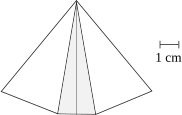
What is the actual wingspan of the paper plane?
A rectangular sportsground has been drawn to scale on a 1-cm grid as shown. The scale used is `1:3000`.

Kerry took 12 minutes to walk around the perimeter of this sportsground.
What was Kerry's average speed in kilometres per hour? (4 marks)
--- 8 WORK AREA LINES (style=lined) ---
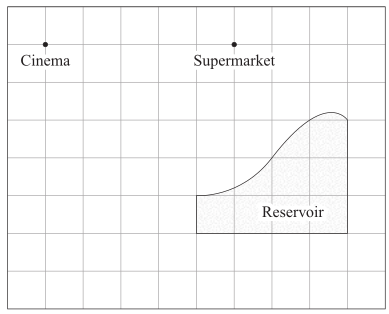
A map is drawn to scale, on 1-cm paper, showing the position of a supermarket and a cinema. A reservoir is also shown.
--- 6 WORK AREA LINES (style=lined) ---
With the aid of one application of the trapezoidal rule, estimate the amount of water in the reservoir immediately after the storm. Assume that all rain which falls over the reservoir is stored. Give your answer in cubic metres. (3 marks)
--- 6 WORK AREA LINES (style=lined) ---
a. `text(3 km/h = 3000 metres per 60 minutes)`♦ Mean mark part (a) 49%.
`text(In 10 minutes:)`
`text(Actual distance) = 3000 xx 10/60 = 500\ text(metres)`
`text(Distance on map = 5 cm)`
| `:.\ text(Scale 5 cm)` | `: 500\ text(metres)` |
| `text(1 cm)` | `: 100\ text(metres)` |
| b. |  |
`A~~ h/2(a + b)~~ 400/2(100 + 300)~~ 80\ 000\ text(m)^2`
`text(Converting mm to metres:)`♦♦ Mean mark part (b) 28%.
`text(20 mm) = 20/1000 text(m = 0.02 metres)`
`:.\ text(Volume of water)`
`= A xx h`
`= 80\ 000 xx 0.02`
`= 1600\ text(m)^3`
On a map, the distance between two towns is measured at 54 millimetres.
--- 1 WORK AREA LINES (style=lined) ---
--- 1 WORK AREA LINES (style=lined) ---
The scale on a given map is `1:80\ 000`.
If the actual distance between two points is 3.4 kilometres, how far apart on the map would be the two points be, in centimetres? (2 marks)
--- 4 WORK AREA LINES (style=lined) ---
The diagram is a scale drawing of a butterfly.

What is the actual wingspan of the butterfly?
A map has a scale of 1 : 500 000.
What is the actual distance between the two mountain peaks, in kilometres? (1 mark)
--- 3 WORK AREA LINES (style=lined) ---
--- 2 WORK AREA LINES (style=lined) ---
