SmarterEd

Aussie Maths & Science Teachers: Save your time with SmarterEd

  • Login
  • Get Help
  • About

Trigonometry, 2ADV T3 2024 HSC 28

Anna is sitting in a carriage of a Ferris wheel which is revolving. The height, \(A(t)\), in metres above the ground of the top of her carriage is given by

\(A(t)=c-k\,\cos\Big( \dfrac{\pi t}{24}\Big) \),

where \(t\) is the time in seconds after Anna's carriage first reaches the bottom of its revolution and \(c\) and \(k\) are constants.
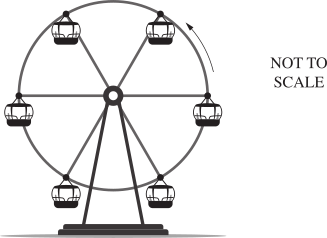
 

The top of each carriage reaches a greatest height of 39 metres and a smallest height of 3 metres.

  1. Find the value of \(c\) and \(k\).   (2 marks)

    --- 4 WORK AREA LINES (style=lined) ---

  2. How many seconds does it take for one complete revolution of the Ferris wheel?   (1 mark)

    --- 2 WORK AREA LINES (style=lined) ---

  3. Billie is in another carriage. The height, \(B(t)\), in metres above the ground of the top of her carriage is given by

\(B(t)=c-k\,\cos\Big( \dfrac{\pi}{24}(t-6)\Big) \),

  1. where \(c\) and \(k\) are as found in part (a).
  2. During each revolution, there are two occasions when Anna's and Billie's carriages are at the same heights. At what two heights does this occur? Give your answer correct to 2 decimal places.    (4 marks)

    --- 12 WORK AREA LINES (style=lined) ---

Show Answers Only

a.   \(c=\ \text{centre of motion}\ = \dfrac{39+3}{2} = 21\)

\(k=\ \text{amplitude}\ = \dfrac{39-3}{2}=18\)

b.  \(T= 48\ \text{seconds}\)

c.  \(h_1=4.37\ \text{m,}\ h_2=37.63\ \text{m}\)

Show Worked Solution

a.   \(c=\ \text{centre of motion}\ = \dfrac{39+3}{2} = 21\)

\(k=\ \text{amplitude}\ = \dfrac{39-3}{2}=18\)
 

b.  \(A(t)=21-18\,\cos\Big( \dfrac{\pi t}{24}\Big)\ \Rightarrow\ \ n=\dfrac{\pi}{24} \)

\(T=\dfrac{2\pi}{n} = 2\pi \times \dfrac{24}{\pi} = 48\ \text{seconds}\)
 

c.   \(\text{Strategy 1}\)

\(\text{Billie’s carriage is 6 seconds behind Anna’s.}\)

\(\text{When}\ t=0,\ \text{Anna’s carriage is at the lowest point}\ = 21-18=3\)

\(\text{When}\ t=3,\ \text{by symmetry, both carriages are at the same height:}\)

   \(h_1=21-18\cos(\dfrac{\pi}{8}) = 4.370… = 4.37\ \text{m (2 d.p.)}\)
 

\(\text{When}\ t=24,\ \text{Anna’s carriage is at the highest point}\ = 21+18=39\)

\(\text{When}\ t=27,\ \text{by symmetry, both carriages are at the same height:}\)

   \(h_2=21-18\cos(\dfrac{9\pi}{8}) = 37.629… = 37.63\ \text{m (2 d.p.)}\)
 

\(\text{Strategy 2}\)

\(\text{Angle between the 2 carriages}\ = \dfrac{\pi \times 6}{24} = \dfrac{\pi}{4} \)

\(\text{By inspection:}\)
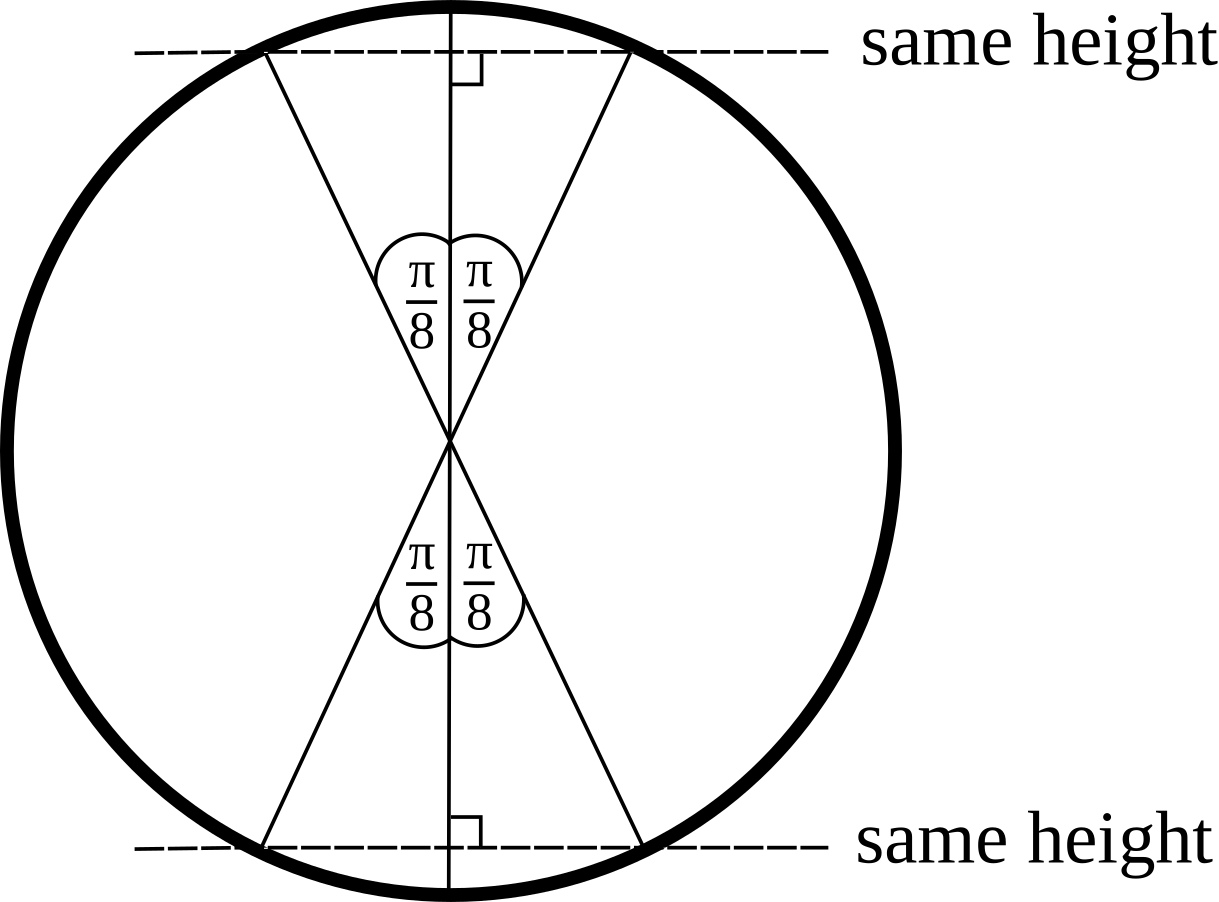
 

\(\text{Heights are the same:}\)

\(h_1=21-18\cos(\dfrac{\pi}{8}) = 4.370… = 4.37\ \text{m (2 d.p.)}\)

\(h_2=21-18\cos(\dfrac{7\pi}{8}) = 37.629… = 37.63\ \text{m (2 d.p.)}\)
♦♦ Mean mark (c) 38%.

Filed Under: Trig Applications (Y12) Tagged With: Band 4, Band 5, smc-1188-30-Other Applications

Trigonometry, 2ADV T3 2011 SPEC1 8

Find the coordinates of the points of intersection of the graph of the relation

`y = text(cosec)^2 ((pi x)/6)`  with the line  `y = 4/3`, for  `0 < x < 12.`  (3 marks)

--- 6 WORK AREA LINES (style=lined) ---

Show Answers Only

`(2, 4/3),(4, 4/3),(8, 4/3), (10, 4/3)`

Show Worked Solution

`text(Intersection occurs when:)`

`text(cosec)^2((pix)/6)` `=4/3`
`text(cosec)((pix)/6)` `= ±2/sqrt3`
`sin((pix)/6)` `= ±sqrt3/2`

 
`text(Given:)\ \ 0 < x < 12 \ \ =>\ \ 0 < (pix)/6 < 2pi`
 

`(pix)/6` `= pi/3, pi – pi/3, pi + pi/3, 2pi – pi/3`
  `= pi/3, (2pi)/3, (4pi)/3,(5pi)/3`
`x` `= 2, 4, 8, 10`

  
`=> y = 4/3\ text(for each)`

`:.\ text(Intersection at:)\ \ (2, 4/3),(4, 4/3),(8, 4/3), (10, 4/3)`

Filed Under: Trig Applications (Y12) Tagged With: Band 5, smc-1188-30-Other Applications

Trigonometry, 2ADV T3 SM-Bank 16

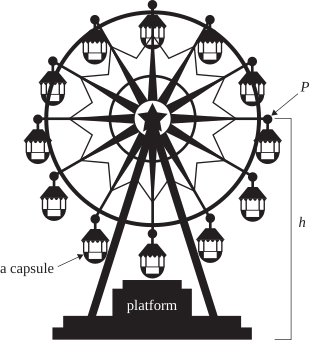
Sammy visits a giant Ferris wheel. Sammy enters a capsule on the Ferris wheel from a platform above the ground. The Ferris wheel is rotating anticlockwise. The capsule is attached to the Ferris wheel at point `P`. The height of `P` above the ground, `h`, is modelled by  `h(t) = 65 - 55cos((pit)/15)`, where `t` is the time in minutes after Sammy enters the capsule and `h` is measured in metres.

Sammy exits the capsule after one complete rotation of the Ferris wheel.


  1. State the minimum and maximum heights of `P` above the ground.  (1 mark)

    --- 2 WORK AREA LINES (style=lined) ---

  2. For how much time is Sammy in the capsule?  (1 mark)

    --- 1 WORK AREA LINES (style=lined) ---

  3. Find the rate of change of `h` with respect to `t` and, hence, state the value of `t` at which the rate of change of `h` is at its maximum.  (2 marks)

    --- 4 WORK AREA LINES (style=lined) ---

Show Answers Only
  1. `h_text(min) = 10\ text(m), h_text(max) = 120\ text(m)`
  2. `30\ text(min)`
  3. `t = 7.5`
Show Worked Solution
i.    `h_text(min)` `= 65 – 55` `h_text(max)` `= 65 + 55`
    `= 10\ text(m)`   `= 120\ text(m)`


ii.   `text(Period) = (2pi)/(pi/15) = 30\ text(min)`


iii.    `h′(t)` `=65 – 55cos((pit)/15)`
  `h′(t)` `=pi/15 xx 55sin(pi/15 t)`
    `= (11pi)/3\ sin(pi/15 t)`
     

`text(S)text(ince)\ \ sin(pi/15 t)_text(max) = sin (pi/2),`

 
`:. h′(t)_text(max)\ \ text(occurs when)`

`(pi t)/15` `=pi/2`  
`:. t` `=pi/2 xx 15/pi`  
  `=15/2\ text(minutes)\ \ (0<=t<=30)`  

Filed Under: Maxima and Minima (Y12), Trig Applications (Y12) Tagged With: Band 4, Band 5, smc-1188-30-Other Applications, smc-970-60-Other Themes

Trigonometry, 2ADV T3 SM-Bank 15

The graphs of  `y = cos (x) and y = a sin (x)`,  where `a` is a real constant, have a point of intersection at  `x = pi/3.`

  1. Find the value of `a`.  (2 marks)

    --- 4 WORK AREA LINES (style=lined) ---

  2. Find the  `x`-coordinate of the other point of intersection of the two graphs, given  `0<=x<= 2 pi`  (1 mark)

    --- 2 WORK AREA LINES (style=lined) ---

Show Answers Only
  1. `1/sqrt 3`
  2. `(4 pi)/3`
Show Worked Solution

i.   `text(Intersection occurs when)\ \ x=pi/3,`

`a sin(pi/3)` `= cos (pi/3)`
`tan(pi/3)` `= 1/a`
`sqrt 3` `=1/a`
`:. a` `=1/sqrt3`


ii.   `tan (x)` `= sqrt 3`
  `x` `= pi/3, (4 pi)/3, 2pi+ pi/3, …`
  `:. x` `= (4 pi)/3\ \ \ (0<= x<= 2 pi)`

Filed Under: Trig Applications (Y12) Tagged With: Band 3, Band 5, smc-1188-30-Other Applications

Trigonometry, 2ADV T3 SM-Bank 5 MC

The UV index, `y`, for a summer day in Newcastle East is illustrated in the graph below, where  `t`  is the number of hours after 6 am.


The graph is most likely to be the graph of

  1. `y = 5 + 5 cos ((pi t)/7)`
  2. `y = 5 - 5 cos ((pi t)/7)`
  3. `y = 5 + 5 cos ((pi t)/14)`
  4. `y = 5 - 5 cos ((pi t)/14)`
Show Answers Only

`B`

Show Worked Solution

`text{Centre line (median):}  \ y = 5`

`text(Amplitude) = 5`

`text(Period:)\ \ 14` `= (2 pi)/n`
`n` `= pi/7`


`:.\ text(Graph:)\ \ y = 5 – 5 cos ((pi t)/7)`

`=>   B`

Filed Under: Trig Applications (Y12) Tagged With: Band 4, smc-1188-30-Other Applications

Trigonometry, 2ADV T3 2018 HSC 15a

The length of daylight, `L(t)`, is defined as the number of hours from sunrise to sunset, and can be modelled by the equation

`L(t) = 12 + 2 cos ((2 pi t)/366)`,

where `t` is the number of days after 21 December 2015, for  `0 ≤ t ≤ 366`.

  1. Find the length of daylight on 21 December 2015.   (1 mark)

    --- 1 WORK AREA LINES (style=lined) ---

  2. What is the shortest length of daylight?  (1 mark)

    --- 1 WORK AREA LINES (style=lined) ---

  3. What are the two values of  `t`  for which the length of daylight is 11?  (2 marks)

    --- 4 WORK AREA LINES (style=lined) ---

Show Answers Only
  1. `14\ text(hours)`
  2. `10\ text(hours)`
  3. `t = 122 or 244`
Show Worked Solution

i.   `L(t) = 12 + 2 cos ((2 pi t)/366)`

`text(On 21 Dec 2015) => t = 0`

`:. L(0)` `= 12 + 2 cos 0`
  `= 14\ text(hours)`


ii.   `text(Shortest length of daylight occurs when)`

♦ Mean mark 43%.

`cos ((2 pi t)/366) = -1`
 

`:.\ text(Shortest length)` `= 12 + 2 (-1)`
  `= 10\ text(hours)`


iii.   `text(Find)\ \ t\ \ text(such that)\ \ L(t) = 11:`

`11 = 12 + 2 cos ((2 pi t)/366)`

`cos ((2 pi t)/366) = -1/2`
 

`(2 pi t)/366` `= (2 pi)/3` `qquad\ \ text(or)`     `(2 pi t)/366` `= (4 pi)/3`
`t` `= 366/3`   `t` `= (366 xx 2)/3`
  `= 122`     `= 244`

 
`:. t = 122 or 244`

Filed Under: Exact Trig Ratios and Other Identities, Trig Applications (Y12) Tagged With: Band 3, Band 4, Band 5, smc-1188-30-Other Applications

Copyright © 2014–2025 SmarterEd.com.au · Log in