SmarterEd

Aussie Maths & Science Teachers: Save your time with SmarterEd

  • Login
  • Get Help
  • About

Complex Numbers, EXT2 N1 2023 HSC 3 MC

A complex number \(z\) lies on the unit circle in the complex plane, as shown in the diagram.
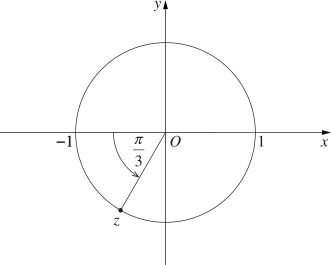
 

Which of the following complex numbers is equal to \(\bar{z}\) ?

  1. \(-z\)
  2. \(z^2\)
  3. \(-z^3\)
  4. \(z^4\)
Show Answers Only

\(B\)

Show Worked Solution

\(z=e^{-\small{\dfrac{2i \pi}{3}}}, \ \bar z=e^{\small{\dfrac{2i \pi}{3}}} \)
 

\(\text{By trial and error:}\)

\(z^2=e^{-\small{\dfrac{2 \times 2i \pi}{3}}} = e^{-\small{\dfrac{4i \pi}{3}}}=e^{\small{\dfrac{2i \pi}{3}}} =\bar z \)

\(\Rightarrow B\)

Filed Under: Exponential Form Tagged With: Band 4, smc-1191-50-Powers

Complex Numbers, EXT2 N1 2022 HSC 11c

  1. Write the complex number  \(-\sqrt{3}+i\) in exponential form.  (2 marks)

    --- 8 WORK AREA LINES (style=lined) ---

  2. Hence, find the exact value of  \((-\sqrt{3}+i)^{10}\) giving your answer in the form  \(x+i y\).  (2 marks)

    --- 5 WORK AREA LINES (style=lined) ---

Show Answers Only
  1. \(2 e^{\small{\dfrac{5 \pi}{6}} i}\)
  2. \(512+512 \sqrt{3} i\)
Show Worked Solution

i.   

\(\text {Let}\ \ z=-\sqrt{3}+i\)

\(\abs{z}=\sqrt{(-\sqrt{3})^2+1^2}=2\)

\(\text{Find}\ \ \arg (z):\)

\(\tan \theta=\dfrac{1}{\sqrt{3}} \Rightarrow \theta=\dfrac{\pi}{6}\)

\(\Rightarrow \arg (z)=\dfrac{5 \pi}{6}\)

\(\therefore z\) \(=2\left(\dfrac{\cos (5 \pi)}{6}+\dfrac{\sin (5 \pi)}{6} i\right)\)  
  \(=2 e^{\small{\dfrac{5 \pi}{6}} i}\)  


ii.    \((-\sqrt{3}+i)^{10}\) \(=\left(2 e^{\small{\dfrac{5 \pi}{6}} i}\right)^{10}\)
    \(=2^{10} e^{\small{\dfrac{50 \pi}{6}} i}\)
    \(=1024 e^{\small{\dfrac{\pi}{3}} i}\)
    \(=1024\left(\cos \left(\dfrac{\pi}{3}\right)+\sin \left(\dfrac{\pi}{3}\right) i\right)\)
    \(=1024\left(\dfrac{1}{2}+\dfrac{\sqrt{3}}{2} i\right)\)
    \(=512+512 \sqrt{3} i\)

Filed Under: Exponential Form Tagged With: Band 3, smc-1191-30-Cartesian - Exponential, smc-1191-50-Powers

Complex Numbers, EXT2 N1 2020 HSC 13d

  1. Show that for any integer `n`,  `e^(i n theta) + e^(-i n theta) = 2 cos (n theta)`.   (1 mark)

    --- 2 WORK AREA LINES (style=lined) ---

  2. By expanding  `(e^(i theta) + e^(-i theta))^4`  show that
     
       `cos^4 theta = frac{1}{8} ( cos (4 theta) + 4 cos (2 theta) + 3 )`.   (3 marks)

    --- 6 WORK AREA LINES (style=lined) ---

  3. Hence, or otherwise, find  `int_0^(frac{pi}{2}) cos^4 theta\ d theta`.   (2 marks)

    --- 4 WORK AREA LINES (style=lined) ---

Show Answers Only
  1. `text{See Worked Solution}`
  2. `text{See Worked Solution}`
  3. `text{See Worked Solution}`
Show Worked Solution
i.      `e^(i n theta) + e^(-i n theta)` `= cos(n theta) + i sin(n theta) + cos(-n theta) + i sin(-n theta)`
    `= cos(n theta) + i sin(n theta) + cos(n theta) – i sin(n theta)`
    `= 2 cos (n theta)`


ii.    `(e^{i theta} + e^{-i theta})^4` `= (2 cos theta)^4`
    `= 16 cos^4 theta`

 
`text{Expand} \ (e^{i theta} + e^{-i theta})^4 :`

`e^(i 4 theta) + 4 e^(i 3 theta) e^(-i theta) + 6 e^(i 2 theta) e^(-i 2 theta) + 4 e^(i theta) e^(-i 3 theta) + e^(-i 4 theta)`

`= e^(i 4 theta) + 4e^(i 2 theta) + 6 + 4^(-i 2 theta) + e^(-i 4 theta)`

`= e^(i 4 theta) + e^(i 4 theta) + 4 (e^{i 2 theta} + e^{-i 2 theta}) + 6`

`= 2 cos (4 theta) + 8 cos (2 theta) + 6`
 

`therefore \ 16 cos^4 theta` `= 2 cos (4 theta) + 8 cos (2 theta) + 6`
`cos^4 theta` `= frac{1}{8} cos(4 theta) + 1/2 cos(2 theta) + 3/8`
`cos^4 theta` `= frac{1}{8} (cos(4 theta) + 4 cos(2 theta) + 3)`


iii.    `int_0^(frac{pi}{2}) cos^4 theta\ d theta` `= frac{1}{8} int_0^(frac{pi}{2}) cos(4 theta) + 4 cos(2 theta) + 3\ d theta`
    `= frac{1}{8} [ frac{1}{4} sin(4 theta) + 2 sin (2 theta) + 3 theta ]_0^(frac{pi}{2}`
    `= frac{1}{8} [( frac{1}{4} sin (2 pi) + 2 sin pi  + frac{3 pi}{2}) – 0 ]`
    `= frac{1}{8} ( frac{3 pi}{2})`
    `= frac{3 pi}{16}`

Filed Under: Exponential Form, Trig Integration Tagged With: Band 2, Band 3, smc-1191-50-Powers, smc-1193-10-sin/cos

Copyright © 2014–2025 SmarterEd.com.au · Log in