It is given that \(\dfrac{d y}{d x}=\dfrac{5}{y}\) and \(y=-4\) when \(x=0\).
Find \(y\) as a function of \(x\). (3 marks)
--- 5 WORK AREA LINES (style=lined) ---
Aussie Maths & Science Teachers: Save your time with SmarterEd
It is given that \(\dfrac{d y}{d x}=\dfrac{5}{y}\) and \(y=-4\) when \(x=0\).
Find \(y\) as a function of \(x\). (3 marks)
--- 5 WORK AREA LINES (style=lined) ---
\(y=-\sqrt{10 x+16}\)
| \(\dfrac{dy}{dx}\) | \(=\dfrac{5}{y}\) |
| \(\displaystyle \int y\,dy\) | \(=\displaystyle \int 5 \,d x\) |
| \(\dfrac{y^2}{2}\) | \(=5 x+c\) |
\(\text{Given} \ \ y=-4 \ \ \text{when} \ \ x=0:\)
| \(\dfrac{(-4)^2}{2}\) | \(=0+c \ \Rightarrow \ c=8\) |
| \(\dfrac{y^2}{2}\) | \(=5 x+8\) |
| \(y^2\) | \(=10 x+16\) |
| \(y\) | \(=-\sqrt{10 x+16} \quad \text{(Since \((0,-4)\) lies on graph)}\) |
Find the solution of \(\dfrac{dy}{dx}=\sqrt{(2-y)(2+y)}\), given that \(y=1\) when \(x=0\). (3 marks)
--- 8 WORK AREA LINES (style=lined) ---
\(y=2\, \sin \left(x+\dfrac{\pi}{6}\right)\)
| \(\dfrac{d y}{d x}\) | \(=\sqrt{(2-y)(2+y)}\) | \(=\sqrt{4-y^2}\) |
| \(\dfrac{d x}{d y}\) | \(=\dfrac{1}{\sqrt{4-y^2}}\) | |
| \(\displaystyle \int d x\) | \(=\displaystyle \int \dfrac{1}{\sqrt{4-y^2}} d y\) | |
| \(x\) | \(=\sin ^{-1}\left(\dfrac{y}{2}\right)+c\) |
\(\text{When} \ \ x=0, y=1:\)
\(0=\sin ^{-1}\left(\dfrac{1}{2}\right)+c \ \ \Rightarrow \ \ c=-\dfrac{\pi}{6}\)
| \(x\) | \(=\sin ^{-1}\left(\dfrac{y}{2}\right)-\dfrac{\pi}{6}\) |
| \(\sin ^{-1}\left(\dfrac{y}{2}\right)\) | \(=x+\dfrac{\pi}{6}\) |
| \(\dfrac{y}{2}\) | \(=\sin \left(x+\dfrac{\pi}{6}\right)\) |
| \(y\) | \(=2\, \sin \left(x+\dfrac{\pi}{6}\right)\) |
Find the general solution to the differential equation \(y^{\prime}=e^{-y}\). (2 marks)
--- 6 WORK AREA LINES (style=lined) ---
\(\ln \left|x+c_1\right|\)
| \(\dfrac{d y}{d x}\) | \(=e^{-y}\) |
| \(\dfrac{d x}{d y}\) | \(=e^y\) |
| \(\displaystyle \int d x\) | \(=\displaystyle \int e^y\, d y\) |
| \(x\) | \(=e^y+c\) |
| \(e^y\) | \(=x+c_1\) |
| \(y\) | \(=\ln \left|x+c_1\right|\) |
Find an expression for `y` in terms of `x` given
`dy/dx=4y-3` and when `x=-2, \ y=1`. (3 marks)
--- 6 WORK AREA LINES (style=lined) ---
| `dy/dx` | `=4y-3` | |
| `(dy)/(4y-3)` | `=1\ dx` | |
| `int 1/(4y-3)\ dy` | `=int 1\ dx` | |
| `1/4ln abs(4y-3)` | `=x+c` |
`text{When}\ \ y=1, x=-2:`
| `1/4ln(4-3)` | `=-2+c` | |
| `c` | `=2` |
| `1/4ln abs(4y-3)` | `=x+2` | |
| `ln abs(4y-3)` | `=4(x+2)` | |
| `4y-3` | `=+-e^(4(x+2))` | |
| `4y-3` | `=e^(4(x+2)),\ \ (text{since}\ y(-2)=1)` | |
| `4y` | `=e^(4(x+2))+3` | |
| `y` | `=(e^(4(x+2))+3)/4` |
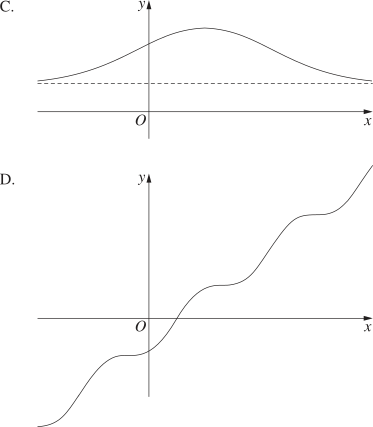
Which of the following could be the graph of a solution to the differential equation
`(dy)/(dx)=sin y+1?`
`B`
`text{One Strategy}`
`text{When}\ \ (dy)/(dx)=0:`
`siny=-1\ \ =>\ \ y=(3pi)/2 + 2kpi\ \ (kinZZ)`
`text{Graphically,}\ \ y=(3pi)/2 + 2kpi\ \ text{are horizontal asymptotes.}`
`=>B`
Solve `(dy)/(dx) = e^(2y)`, finding `x` as a function of `y`. (2 marks)
`x = −1/2 e^(−2y) + c`
| `(dy)/(dx)` | `= e^(2y)` |
| `(dx)/(dy)` | `= e^(−2y)` |
| `x` | `= int e^(−2y)\ dy` |
| `:. x` | `= −1/2 e^(−2y) + c` |
Let `(dy)/(dx) = (4 - y)^2`.
Express `y` in terms of `x`, where `y(0) = 3`. (3 marks)
--- 6 WORK AREA LINES (style=lined) ---
`y = 4-1/(x + 1)`
| `(dy)/(dx)` | `=(4-y)^2` |
| `(dx)/(dy)` | `= 1/(4-y)^2` |
| `x` | `= int 1/(4-y)^2\ dy` |
| `= int (4-y)^(-2) dy` | |
| `= (-1)(-1)(4-y)^(-1)+ c` | |
| `= 1/(4-y) + c` |
`text(When)\ \ x=0,\ \ y=3:`
| `0` | `= 1/(4-3) + c` |
| `:.c` | `= -1` |
| `x` | `= 1/(4-y) – 1` |
| `x + 1` | `= 1/(4-y)` |
| `1/(x + 1)` | `= 4-y` |
| `:. y` | `= 4-1/(x + 1)` |
Find `y` given `dy/dx = 1 - y/3` and `y = 4` when `x = 2`. (2 marks)
--- 6 WORK AREA LINES (style=lined) ---
`y= 3 + e^((2 – x)/3)`
| `(dy)/(dx)` | `= (3 – y)/3` |
| `(dx)/(dy)` | `= 3/(3 – y)` |
| `x` | `= int 3/(3 – y)\ dy` |
| `x/3` | `= -ln |3 – y| + c` |
`text(Given)\ \ y=4\ \ text(when)\ \ x=2:`
`2/3= -ln|-1| + c`
`c=2/3`
| ` x/3` | `=-ln |3 – y| +2/3` |
| `ln|3-y|` | `= (2-x)/3` |
| `3-y` | `= ±e^((2 – x)/3)` |
| `:. y` | `= 3 + e^((2 – x)/3)` |