SmarterEd

Aussie Maths & Science Teachers: Save your time with SmarterEd

  • Login
  • Get Help
  • About

Proof, EXT2 P1 2025 HSC 16a

Consider the equation

\(z^n \cos\left[n \theta\right]+z^{n-1} \cos \left[(n-1) \theta\right]+z^{n-2} \cos \left[(n-2) \theta\right]+\cdots+z\, \cos\left[\theta\right]=1\)

where  \(z \in \mathbb{C} , \theta \in \mathbb{R} \), and \(n\) is a positive integer.

Using a proof by contradiction and the triangle inequality, or otherwise, prove that all the solutions to the equation lie outside the circle  \(\abs{z}=\dfrac{1}{2}\)  on the complex plane.   (4 marks)

--- 14 WORK AREA LINES (style=lined) ---
Show Answers Only

\(\text{Proof by contradiction}\)

\(\text{Assume}\ \exists\ z \in \mathbb{C},\ \text{where}\ \abs{z} \in\left[0, \dfrac{1}{2}\right],\ \text{and}\)

\(z^n \cos \left[n \theta \right]+z^{n-1} \cos \left[(n-1) \theta \right] + \ldots +z\, \cos \theta=1\)
 

\(\text{Using the triangle inequality}\ \ \left(\abs{x}+\abs{y} \geqslant \abs{x+y}\right):\)

   \(\left|z^n \cos \left[n \theta\right] \right|+\left|z^{n-1} \cos \left[(n-1) \theta\right] \right|+\ldots+|z\, \cos \theta|\)

\(\geqslant\left|z^n \cos \left[n \theta \right] +z^{n-1} \cos \left[(n-1) \theta \right]+\ldots+z\, \cos \theta\right|\)
 

\(1 \leqslant\left|z^n \cos \left[n \theta \right]\right|+\left|z^{n-1} \cos \left[(n-1) \theta \right]\right|+\ldots+|z\, \cos \theta|\)

\(1 \leqslant|z|^n+|z|^{n-1}+\cdots+|z| \quad (\text{since}-1 \leqslant \cos (k \theta) \leqslant 1)\)

\(1 \leqslant (\frac{1}{2})^n+(\frac{1}{2})^{n-1}+\cdots+(\frac{1}{2}) \)

\(1 \leqslant \underbrace{2^{-n}+2^{-n+1}+\cdots+2^{-1}}_{\text{GP:}\  a=2^{-n}, r=2}\)

\(1 \leqslant \dfrac{2^{-n}\left(2^n-1\right)}{2-1}\)

\(1 \leqslant 1-2^{-n}\)

\(2^{-n} \leqslant 0 \ \ \text {(which is not true)}\)

\(\therefore \ \text{By contradiction, the original statement is correct}\)

Show Worked Solution

\(\text{Proof by contradiction}\)

\(\text{Assume}\ \exists\ z \in \mathbb{C},\ \text{where}\ \abs{z} \in\left[0, \dfrac{1}{2}\right],\ \text{and}\)

\(z^n \cos \left[n \theta \right]+z^{n-1} \cos \left[(n-1) \theta \right] + \ldots +z\, \cos \theta=1\)
 

\(\text{Using the triangle inequality}\ \ \left(\abs{x}+\abs{y} \geqslant \abs{x+y}\right):\)

   \(\left|z^n \cos \left[n \theta\right] \right|+\left|z^{n-1} \cos \left[(n-1) \theta\right] \right|+\ldots+|z\, \cos \theta|\)

\(\geqslant\left|z^n \cos \left[n \theta \right] +z^{n-1} \cos \left[(n-1) \theta \right]+\ldots+z\, \cos \theta\right|\)
 

\(1 \leqslant\left|z^n \cos \left[n \theta \right]\right|+\left|z^{n-1} \cos \left[(n-1) \theta \right]\right|+\ldots+|z\, \cos \theta|\)

\(1 \leqslant|z|^n+|z|^{n-1}+\cdots+|z| \quad (\text{since}-1 \leqslant \cos (k \theta) \leqslant 1)\)

\(1 \leqslant (\frac{1}{2})^n+(\frac{1}{2})^{n-1}+\cdots+(\frac{1}{2}) \)

\(1 \leqslant \underbrace{2^{-n}+2^{-n+1}+\cdots+2^{-1}}_{\text{GP:}\  a=2^{-n}, r=2}\)

\(1 \leqslant \dfrac{2^{-n}\left(2^n-1\right)}{2-1}\)

\(1 \leqslant 1-2^{-n}\)

\(2^{-n} \leqslant 0 \ \ \text {(which is not true)}\)

\(\therefore \ \text{By contradiction, the original statement is correct}\)

Filed Under: Converse, Contradiction and Contrapositive Proof, Proof and Inequalities Tagged With: Band 5, smc-1207-10-Contradiction, smc-1208-55-Triangle inequality

Proof, EXT2 P1 2022 HSC 15d

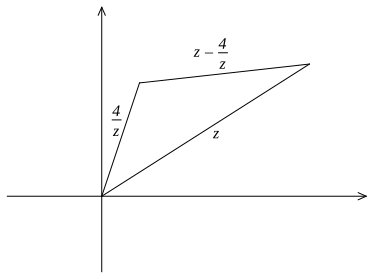
The complex number `z` satisfies `|z-(4)/(z)|=2`.  

Using the triangle inequality, or otherwise, show that `|z| <= sqrt5+1`.  (3 marks)

--- 8 WORK AREA LINES (style=lined) ---

Show Answers Only

`text{Proof (See Worked Solutions)}`

Show Worked Solution


♦♦♦ Mean mark 27%.

`text{Triangle Inequality:}\ \ absx+absy>=abs(x+y)`

`absz` `<=abs(z-z/4)+abs(4/z)`  
`absz` `<=2+4/absz\ \ \ (text{using}\ |z-(4)/(z)|=2)`  
`absz^2` `<=2absz+4`  
`absz^2-2absz-4` `<=0`  
`absz` `<=(2+sqrt(2^2+4xx4))/2\ \ \ (absz>=0)`  
`absz` `<=(2+sqrt20)/2`  
`absz` `<=1+sqrt5\ \ text{… as required}`  

Filed Under: Proof and Inequalities Tagged With: Band 5, smc-1208-55-Triangle inequality

Vectors, EXT2 V1 2021 HSC 16a

  1. The point  `P(x, y, z)`  lies on the sphere of radius 1 centred at the origin `O`.
  2. Using the position vector of `P, overset->{OP} = x underset~i + y underset~j + z underset~k` , and the triangle inequality, or otherwise, show that `| x | + | y | + |z | ≥ 1`.  (2 marks)

    --- 4 WORK AREA LINES (style=lined) ---

  3. Given the vectors  `underset~a = ((a_1),(a_2),(a_3))`  and  `underset~b = ((b_1),(b_2),(b_3))` , show that 
  4.    `|a_1 b_1 + a_2 b_2 + a_3 b_3 | ≤ sqrt{a_1^2 + a_2^2 + a_3^2 }\ sqrt{b_1^2 + b_2^2 + b_3^2}`.  (3 marks)

    --- 5 WORK AREA LINES (style=lined) ---

  5. As in part (i), the point  `P (x, y, z)`  lies on the sphere of radius 1 centred at the origin `O`.
  6. Using part (ii), or otherwise, show that  `| x | + | y | + | z | ≤ sqrt3`.  (2 marks)

    --- 3 WORK AREA LINES (style=lined) ---

Show Answers Only
  1. `text{See Worked Solution}`
  2. `text{See Worked Solution}`
  3. `text{See Worked Solution}`
Show Worked Solution
i.      `text{Triangle inequality:} \ |x| + |y| ≥ |x + y|`
♦ Mean mark (i) 50%.
`|x| + |y| + |z|` ` = |x_underset~i| + |y_underset~j| + |z_underset~k|`
  `≥ |x_underset~i + y_underset~j| + |z_underset~k|`
  `≥ |x_underset~i + y_underset~j + z_underset~k|`
  `≥ 1\ \ (|overset->{OP}| = | x_underset~i + y_underset~j + z_underset~k | = 1)`


ii.   `text{Using the dot product:}`

♦ Mean mark (ii) 42%.

`underset~a * underset~b = a_1 b_1 + a_2 b_2 + a_3 b_3`

`underset~a * underset~b = |underset~a| |underset~b| cos theta`


`a_1 b_1 + a_2 b_2 + a_3 b_3` `= sqrt{a_1^2 + a_2^2 + a_3^2} * sqrt{b_1^2 + b_2^2 + b_3^2} * cos theta`
`|a_1 b_1 + a_2 b_2 + a_3 b_3|` `= sqrt{a_1^2 + a_2^2 + a_3^2} * sqrt{b_1^2 + b_2^2 + b_3^2} * |cos theta|`


`text{S} text{ince} \ -1 ≤ cos theta ≤ 1 \ => \ |cos theta| ≤ 1`

`:. \ | a_1 b_1 + a_2 b_2 + a_3 b_3 | ≤ sqrt{a_1^2 + a_2^3 + a_3^2} * sqrt{b_1^2 + b_2^2 + b_3^2}`


iii.  `text{Using part (ii) with vectors:}`

♦♦♦ Mean mark (iii) 14%.

`underset~a = ((1),(1),(1)) \ , \ underset~b = (( | x| ),( |y| ),( |z| ))`

`|\ |x| + |y| + |z|\ |` `≤ sqrt{1^2 + 1^2 + 1^2} * sqrt{ x^2 + y^2 + z^2}`
`|x| + |y| + |z|` `≤ sqrt3`

Filed Under: Proof and Inequalities, Vectors and Geometry Tagged With: Band 5, Band 6, smc-1208-55-Triangle inequality, smc-1210-50-Circle/Sphere

Copyright © 2014–2025 SmarterEd.com.au · Log in