SmarterEd

Aussie Maths & Science Teachers: Save your time with SmarterEd

  • Login
  • Get Help
  • About

Vectors, EXT2 V1 2025 HSC 15a

The adjacent sides of a parallelogram are represented by the vectors  \(\underset{\sim}{a}=4 \underset{\sim}{i}+3 \underset{\sim}{j}-\underset{\sim}{k}\)  and  \(\underset{\sim}{b}=2 \underset{\sim}{i}-\underset{\sim}{j}+3 \underset{\sim}{k}\).

Show that the area of the parallelogram is \(6 \sqrt{10}\) square units.   (4 marks)

--- 10 WORK AREA LINES (style=lined) ---

Show Answers Only

\(A=\dfrac{1}{2}\abs{a}\abs{b} \sin \theta\)

\(\underset{\sim}{a}=4\underset{\sim}{i}+3\underset{\sim}{j}-\underset{\sim}{k} \  \Rightarrow \ \abs{\underset{\sim}{a}}=\sqrt{16+9+1}=\sqrt{26}\)

\(\underset{\sim}{b}=2\underset{\sim}{i}-\underset{\sim}{j}+3 \underset{\sim}{k} \ \Rightarrow \ \abs{\underset{\sim}{b}}=\sqrt{4+1+9}=\sqrt{14}\)

\(\underset{\sim}{a} \cdot \underset{\sim}{b}=\left(\begin{array}{c}4 \\ 3 \\ -1\end{array}\right)\left(\begin{array}{c}2 \\ -1 \\ 3\end{array}\right)=8-3-3=2\)

\(\cos \theta=\dfrac{\underset{\sim}{a} \cdot \underset{\sim}{b}}{\abs{\underset{\sim}{a}}\abs{\underset{\sim}{b}}}=\dfrac{2}{\sqrt{26} \sqrt{14}}=\dfrac{1}{\sqrt{91}}\)
 

\(\sin \theta=\dfrac{\sqrt{90}}{\sqrt{91}}\)

\(\therefore A=\dfrac{1}{2} \times \sqrt{26} \times \sqrt{14} \times \dfrac{\sqrt{90}}{\sqrt{91}}=6 \sqrt{10} \ \text{units}^2\)
Show Worked Solution

\(A=\dfrac{1}{2}\abs{a}\abs{b} \sin \theta\)

\(\underset{\sim}{a}=4\underset{\sim}{i}+3\underset{\sim}{j}-\underset{\sim}{k} \  \Rightarrow \ \abs{\underset{\sim}{a}}=\sqrt{16+9+1}=\sqrt{26}\)

\(\underset{\sim}{b}=2\underset{\sim}{i}-\underset{\sim}{j}+3 \underset{\sim}{k} \ \Rightarrow \ \abs{\underset{\sim}{b}}=\sqrt{4+1+9}=\sqrt{14}\)

\(\underset{\sim}{a} \cdot \underset{\sim}{b}=\left(\begin{array}{c}4 \\ 3 \\ -1\end{array}\right)\left(\begin{array}{c}2 \\ -1 \\ 3\end{array}\right)=8-3-3=2\)

\(\cos \theta=\dfrac{\underset{\sim}{a} \cdot \underset{\sim}{b}}{\abs{\underset{\sim}{a}}\abs{\underset{\sim}{b}}}=\dfrac{2}{\sqrt{26} \sqrt{14}}=\dfrac{1}{\sqrt{91}}\)
 

\(\sin \theta=\dfrac{\sqrt{90}}{\sqrt{91}}\)

\(\therefore A=\dfrac{1}{2} \times \sqrt{26} \times \sqrt{14} \times \dfrac{\sqrt{90}}{\sqrt{91}}=6 \sqrt{10} \ \text{units}^2\)
Filed Under: Vectors and Geometry Tagged With: Band 5, smc-1210-30-Quadrilateral, smc-1210-60-2D problems

Vectors, EXT2 V1 2023 HSC 11d

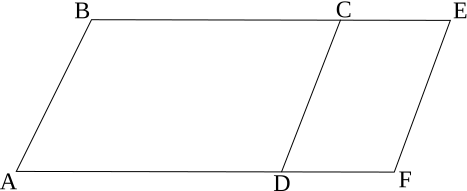
The quadrilaterals \(A B C D\) and \(A B E F\) are parallelograms.

By considering \(\overrightarrow{A B}\), show that \(C D F E\) is also a parallelogram.  (2 marks)

--- 7 WORK AREA LINES (style=lined) ---

Show Answers Only

\(\text{Proof (See Worked Solutions)} \)

Show Worked Solution

\(\text{Parrallelogram}\ \Rightarrow\ \text{Show opposite sides are equal} \)

\( \Big{|}\overrightarrow{A B} \Big{|} = \Big{|}\overrightarrow{CD} \Big{|} \ \ (ABCD\ \text{is a parallelogram}) \)

\( \Big{|}\overrightarrow{A B} \Big{|} = \Big{|}\overrightarrow{EF} \Big{|} \ \ (ABEF\ \text{is a parallelogram}) \)

\( \Rightarrow \Big{|}\overrightarrow{CD} \Big{|} = \Big{|}\overrightarrow{EF} \Big{|} \)
 

\( \Big{|}\overrightarrow{CE} \Big{|} = \Big{|}\overrightarrow{BE} \Big{|}-\Big{|}\overrightarrow{BC} \Big{|} \)

\(\text{Similarly,} \)

\( \Big{|}\overrightarrow{DF} \Big{|} = \Big{|}\overrightarrow{AF} \Big{|}-\Big{|}\overrightarrow{AD} \Big{|} \)

\( \text{Since}\ \ \Big{|}\overrightarrow{BE} \Big{|} = \Big{|}\overrightarrow{AF} \Big{|}\ \ \text{and}\ \ \Big{|}\overrightarrow{BC} \Big{|} = \Big{|}\overrightarrow{AD} \Big{|}\)

\( (ABCD\ \text{and}\ ABEF\ \text{are parallelograms}) \)

\( \Rightarrow\ \Big{|}\overrightarrow{DF} \Big{|} = \Big{|}\overrightarrow{CE} \Big{|} \)

\(\therefore CDFE\ \text{is a parallelogram} \)

Filed Under: Vectors and Geometry Tagged With: Band 4, smc-1210-30-Quadrilateral, smc-1210-60-2D problems

Vectors, EXT2 V1 EQ-Bank 9

A parallelogram is formed by joining the points  `P(-2,1,4), Q(1,4,5), R(0,2,3)` and `S(a,b,c)`.

Use vector methods to find `a,b` and `c`.  (2 marks)

--- 6 WORK AREA LINES (style=lined) ---

Show Answers Only

`a=-3, b=-1, c=2`

Show Worked Solution

`text{Opposite sides of a parallelogram are equal and parallel.}`

`=> vec(PQ)=vec(SR)`
 

`vec(PQ)=((1+2),(4-1),(5-4))=((3),(3),(1))`
 

`vec(SR)=((-a),(2-b),(3-c))`
 

`text{Equating coordinates:}`

`-a=3\ \ =>\ \ a=-3`

`2-b=3\ \ =>\ \ b=-1`

`3-c=1\ \ =>\ \ c=2`

Filed Under: Basic Concepts and Arithmetic, Vectors and Geometry Tagged With: Band 3, smc-1210-30-Quadrilateral, smc-1210-70-3D problems

Vectors, EXT2 V1 2020 HSC 15b

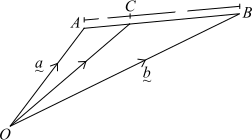
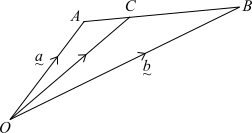
The point `C` divides the interval `AB` so that  `frac{CB}{AC} = frac{m}{n}`. The position vectors of `A` and `B` are `underset~a` and `underset~b` respectively, as shown in the diagram.
 

  1. Show that  `overset->(AC) = frac{n}{m + n} (underset~b - underset~a)`.  (2 marks)

    --- 6 WORK AREA LINES (style=lined) ---


  2. Prove that  `overset->(OC) = frac{m}{m + n} underset~a + frac{n}{m + n} underset~b`.  (1 mark)

    --- 5 WORK AREA LINES (style=lined) ---

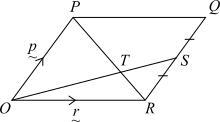
Let `OPQR` be a parallelogram with  `overset->(OP) = underset~p`  and  `overset->(OR) = underset~r`. The point `S` is the midpoint of `QR` and `T` is the intersection of `PR` and `OS`, as shown in the diagram.


  1. Show that  `overset->(OT) = frac{2}{3} underset~r + frac{1}{3} underset~p`.  (3 marks)

    --- 8 WORK AREA LINES (style=lined) ---

  2. Using parts (ii) and (iii), or otherwise, prove that `T` is the point that divides the interval `PR` in the ratio 2 :1.   (1 mark)

    --- 3 WORK AREA LINES (style=lined) ---

Show Answers Only
  1. `text{See Worked Solutions}`
  2. `text{See Worked Solutions}`
  3. `text{See Worked Solutions}`
  4. `text{See Worked Solutions}`
Show Worked Solution

i.  

`frac{overset->(AC)}{overset->(AB)}` `= frac{n}{m + n}`
`overset->(AC)` `= frac{n}{m + n} * overset->(AB)`
  `= frac{n}{m + n} (underset~b – underset~a)`


ii.    `overset->(OC)` `= overset->(OA) + overset->(AC)`
    `= underset~a + frac{n}{m + n} (underset~b – underset~a)`
    `= underset~a – frac{n}{m + n} underset~a + frac{n}{m + n} underset~b`
    `= (1 – frac{n}{m + n}) underset~a + frac{n}{m + n} underset~b`
    `= (frac{m + n – n}{m + n}) underset~a + frac{n}{m + n} underset~b`
    `= frac{m}{m + n} underset~a + frac{n}{m + n} underset~b`


iii.  `text{Show} \ \ overset->(OT) = frac{2}{3} underset~r + frac{1}{3} underset~p`

♦ Mean mark part (iii) 50%.


`text{Consider} \ \ Delta PTO \ \ text{and} \ \ Delta RTS:`

`angle PTO = angle RTS \ (text{vertically opposite})`

`angle OPT = angle SRT \ (text{vertically opposite})`

`therefore \ Delta PTO \ text{|||} \ Delta RTS\ \ text{(equiangular)}`
 

`OT : TS = OP : SR = 2 : 1`

`(text{corresponding sides in the same ratio})`

`frac{overset->(OT)}{overset->(OS)}` `= frac{2}{3}`
`overset->(OT)` `= frac{2}{3} overset->(OS)`
  `= frac{2}{3} ( underset~r + frac{1}{2} underset~p)`
  `= frac{2}{3} underset~r + frac{1}{3} underset~p`
Mean mark part (iv) 51%.


iv.   `text{Let} \ \ overset->(OT) \ text{divide} \ PR\ text{so that}\ \ frac{TR}{PT} = frac{m}{n}`

`text{Using part (ii):}`

`overset->(OT)` `= frac{m}{m + n} underset~p + frac{n}{m + n} c`
`overset->(OT)` `= frac{1}{3} underset~p + frac{2}{3} underset~r \ \ \ (text{part (iii)})`
`frac{m}{m + n}` `= frac{1}{3} , frac{n}{m + n} = frac{2}{3}`

 
`=> \ m = 1 \ , \ n = 2`
 

`therefore \ T \ text{divides} \ PR \ text{in ratio  2 : 1}.`

Filed Under: Vectors and Geometry Tagged With: Band 3, Band 4, Band 5, smc-1210-30-Quadrilateral, smc-1210-40-Triangle, smc-1210-55-Ratios, smc-1210-60-2D problems

Vectors, EXT2 V1 2019 SPEC2 4

The base of a pyramid is the parallelogram  `ABCD`  with vertices at points  `A(2,−1,3),  B(4,−2,1),  C(a,b,c)`  and  `D(4,3,−1)`. The apex (top) of the pyramid is located at  `P(4,−4,9)`.

  1. Find the values of  `a, b`  and  `c`.  (2 marks)

    --- 4 WORK AREA LINES (style=lined) ---

  2. Find the cosine of the angle between the vectors  `overset(->)(AB)`  and  `overset(->)(AD)`.  (2 marks)

    --- 4 WORK AREA LINES (style=lined) ---

  3. Find the area of the base of the pyramid.  (2 marks)

    --- 4 WORK AREA LINES (style=lined) ---

Show Answers Only
  1. `a = 6, b = 2, c = −3`
  2. `4/9`
  3. `2sqrt65\ text(u²)`
Show Worked Solution
i.    `overset(->)(AB)` `= (4 – 2)underset~i + (−2 + 1)underset~j + (1 – 3)underset~k`
    `= 2underset~i – underset~j – 2underset~k`

 
`text(S)text(ince)\ ABCD\ text(is a parallelogram)\ => \ overset(->)(AB)= overset(->)(DC)`

`overset(->)(DC) = (a – 4)underset~i + (b – 3)underset~j + (c + 1)underset~k`

`a – 4 = 2 \ => \ a = 6`

`b – 3 = −1 \ => \ b = 2`

`c + 1 = −2 \ => \ c = −3`


ii.   `overset(->)(AB) = 2underset~i – underset~j – 2underset~k`

`overset(->)(AD) = 2underset~i + 4underset~j – 4underset~k`

`cos angleBAD` `= (overset(->)(AB) · overset(->)(AD))/(|overset(->)(AB)| · |overset(->)(AD)|)`
  `= (4 – 4 + 8)/(sqrt(4 + 1 + 4) · sqrt(4 + 16 + 16))`
  `= 4/9`


iii.    `1/2 xx text(Area)_(ABCD)` `= 1/2 ab sin c`
  `text(Area)_(ABCD)` `= |overset(->)(AB)| · |overset(->)(AD)| *sin(cos^(−1)\ 4/9)`


`:. text(Area)_(ABCD)` `= 3 · 6 · sqrt65/9`
  `= 2sqrt65\ text(u²)`

Filed Under: Vectors and Geometry Tagged With: Band 3, Band 4, Band 5, smc-1210-20-Pyramid, smc-1210-30-Quadrilateral, smc-1210-70-3D problems

Vectors, EXT2 V1 SM-Bank 20

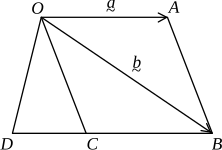
`OABD`  is a trapezium in which  `overset(->)(OA) = underset~a`  and  `overset(->)(OB) = underset~b`.

`OC`  is parallel to  `AB`  and  `DC : CB = 1:2`


Using vectors, express  `overset(->)(DA)`  in terms of  `underset~a`  and  `underset~b`.  (3 marks)

--- 6 WORK AREA LINES (style=lined) ---

Show Answers Only

`text(See Worked Solution)`

Show Worked Solution

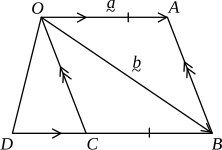
`overset(->)(DA) = overset(->)(DB) + overset(->)(BA)`

`overset(->)(BA) = underset~a – underset~b`
 
`text(S) text(ince) \  OC  ||  AB \ \ text(and) \ \ OA  ||  CB`

`=> OABC \ text(is a parallelogram)`

`overset(->)(OA)` `= overset(->)(CB) = underset~a`
`overset(->)(DC)` `= (1)/(2) \ underset~a `
`overset(->)(DB)` `= overset(->)(DC) + overset(->)(CB)`
  `= (3)/(2) \ underset~a`


`:. \ overset(->)(DA)` `= (3)/(2) \ underset~a + (underset~a – underset~b)`
  `= (5)/(2) \ underset~a – underset~b`

Filed Under: Vectors and Geometry Tagged With: Band 4, smc-1210-30-Quadrilateral, smc-1210-55-Ratios, smc-1210-60-2D problems

Vectors, EXT2 V1 2015 VCE 1

Consider the rhombus  `OABC`  shown below, where  `vec (OA) = a underset ~i`  and  `vec (OC) = underset ~i + underset ~j + underset ~k`, and `a` is a positive real constant.
 

VCAA 2015 spec 1a
 

  1. Find  `a.`  (1 mark)

    --- 2 WORK AREA LINES (style=lined) ---

  2. Show that the diagonals of the rhombus  `OABC`  are perpendicular.  (2 marks)

    --- 6 WORK AREA LINES (style=lined) ---

Show Answers Only
  1. `sqrt 3`
  2. `text(Proof)\ \ text{(See Worked Solutions)}`
Show Worked Solution

i.   `|\ vec(OA)\ | = |\ vec(OC)\ |,`

`:. a` `= sqrt (1^2 + 1^2 + 1^2)`
  `= sqrt 3`


ii.   `overset(->)(CB) = overset(->)(OA), \ \ overset(->)(AB) = overset(->)(OC)`

MARKER’S COMMENT: Vector notation was poor in many answers.

`overset(->)(OB) = overset(->)(OC) + overset(->)(CB)`

`= underset~i + underset~j + underset~k + sqrt3 underset~i`

`= (sqrt3 + 1)underset~i + underset~j + underset~k`
 

`overset(->)(AC) = overset(->)(AO) + overset(->)(OC)`

`= −sqrt3underset~i + underset~i + underset~j + underset~k`

`= (1 – sqrt3)underset~i + underset~j + underset~k`
 

`overset(->)(AC) · overset(->)(OB)` `= (1 + sqrt3)(1 – sqrt3) + 1 + 1`
  `= 1 – 3 + 1 + 1`
  `= 0`

 
`:. overset(->)(AC) ⊥ overset(->)(OB)`

Filed Under: Vectors and Geometry Tagged With: Band 4, smc-1210-30-Quadrilateral, smc-1210-60-2D problems

Copyright © 2014–2025 SmarterEd.com.au · Log in