SmarterEd

Aussie Maths & Science Teachers: Save your time with SmarterEd

  • Login
  • Get Help
  • About

Vectors, EXT2 V1 2024 HSC 14e

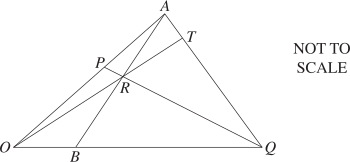
The diagram shows triangle \(O Q A\).

The point \(P\) lies on \(O A\) so that  \(O P: O A=3: 5\).

The point \(B\) lies on \(O Q\) so that  \(O B: O Q=1: 3\).

The point \(R\) is the intersection of \(A B\) and \(P Q\).

The point \(T\) is chosen on \(A Q\) so that \(O, R\) and \(T\) are collinear.
 

Let  \(\underset{\sim}{a}=\overrightarrow{O A}, \ \underset{\sim}{b}=\overrightarrow{O B}\)  and  \(\overrightarrow{P R}=k \overrightarrow{P Q}\)  where \(k\) is a real number.

  1. Show that  \(\overrightarrow{O R}=\dfrac{3}{5}(1-k) \underset{\sim}{a}+3 k \underset{\sim}{b}\).   (2 marks)

    --- 5 WORK AREA LINES (style=lined) ---

Writing  \(\overrightarrow{A R}=h \overrightarrow{A B}\), where \(h\) is a real number, it can be shown that  \(\overrightarrow{O R}=(1-h) \underset{\sim}{a}+h \underset{\sim}{b}\).  (Do NOT prove this.)

  1. Show that  \(k=\dfrac{1}{6}\).   (2 marks)

    --- 4 WORK AREA LINES (style=lined) ---
  2. Find \(\overrightarrow{O T}\) in terms of \(\underset{\sim}{a}\) and \(\underset{\sim}{b}\).   (2 marks)

    --- 4 WORK AREA LINES (style=lined) ---

Show Answers Only

i.    \(\underset{\sim}{a}=\overrightarrow{O A}, \ \underset{\sim}{b}=\overrightarrow{O B}, \ \overrightarrow{P R}=k \overrightarrow{P Q}\)

\(\overrightarrow{O P}: \overrightarrow{O A}=3: 5 \ \Rightarrow \ \overrightarrow{O P} = \dfrac{3}{5} \times \overrightarrow{O A} \)

\(\overrightarrow{O B}: \overrightarrow{O Q}=1: 3\ \Rightarrow \ \overrightarrow{O Q} = 3 \times \overrightarrow{OB} \)

\(\text {Show } \overrightarrow{O R}=\dfrac{3}{5}(1-k) \underset{\sim}{a}+3 k \underset{\sim}{b}\)

  \(\overrightarrow{O R}\) \(=\overrightarrow{O P}+k \overrightarrow{P Q}\)
    \(=\overrightarrow{O P}+k(\overrightarrow{O Q}-\overrightarrow{O P})\)
    \(=(1-k) \overrightarrow{O P}+k \overrightarrow{O Q}\)
    \(=\dfrac{3}{5}(1-k)\underset{\sim}{a}+3 k \underset{\sim}{b}\)


ii.    \(\overrightarrow{A R}=h \overrightarrow{A B}, \quad h \in \mathbb{R}\)

\(\overrightarrow{OR}=(1-h) \underset{\sim}{a}+h \underset{\sim}{b} \ \ \text{(given)}\)

\(\overrightarrow{O R}=\dfrac{3}{5}(1-k) \underset{\sim}{a}+3 k \underset{\sim}{b} \ \ \text{(part(i))}\)

\(\text{Vector }\underset{\sim}{a} \neq \lambda \underset{\sim}{b}\ (\lambda \in \mathbb{R})\ \Rightarrow \ \text{linearly independent and are basis vectors for } \overrightarrow{O R}\).

\(\text {Equating coefficients:}\)

   \(\dfrac{3}{5}(1-k)=1-h\ \ldots\ (1)\)

   \(h=3 k\ \ldots\ (2)\)

\(\text{Substituting (2) into (1)}\)

     \(\dfrac{3}{5}(1-k)\) \(=1-3 k\)
  \(3-3 k\) \(=5-15 k\)
  \(k\) \(=\dfrac{1}{6}\)

 
iii. 
   \(\overrightarrow{O T}=\dfrac{3}{4}(\underset{\sim}{a}+\underset{\sim}{b})\)

Show Worked Solution

i.    \(\underset{\sim}{a}=\overrightarrow{O A}, \ \underset{\sim}{b}=\overrightarrow{O B}, \ \overrightarrow{P R}=k \overrightarrow{P Q}\)

\(\overrightarrow{O P}: \overrightarrow{O A}=3: 5 \ \Rightarrow \ \overrightarrow{O P} = \dfrac{3}{5} \times \overrightarrow{O A} \)

\(\overrightarrow{O B}: \overrightarrow{O Q}=1: 3\ \Rightarrow \ \overrightarrow{O Q} = 3 \times \overrightarrow{OB} \)

\(\text {Show } \overrightarrow{O R}=\dfrac{3}{5}(1-k) \underset{\sim}{a}+3 k \underset{\sim}{b}\)

  \(\overrightarrow{O R}\) \(=\overrightarrow{O P}+k \overrightarrow{P Q}\)
    \(=\overrightarrow{O P}+k(\overrightarrow{O Q}-\overrightarrow{O P})\)
    \(=(1-k) \overrightarrow{O P}+k \overrightarrow{O Q}\)
    \(=\dfrac{3}{5}(1-k)\underset{\sim}{a}+3 k \underset{\sim}{b}\)


ii.    \(\overrightarrow{A R}=h \overrightarrow{A B}, \quad h \in \mathbb{R}\)

\(\overrightarrow{OR}=(1-h) \underset{\sim}{a}+h \underset{\sim}{b} \ \ \text{(given)}\)

\(\overrightarrow{O R}=\dfrac{3}{5}(1-k) \underset{\sim}{a}+3 k \underset{\sim}{b} \ \ \text{(part(i))}\)

\(\text{Vector }\underset{\sim}{a} \neq \lambda \underset{\sim}{b}\ (\lambda \in \mathbb{R})\ \Rightarrow \ \text{linearly independent and are basis vectors for } \overrightarrow{O R}\).

\(\text {Equating coefficients:}\)

   \(\dfrac{3}{5}(1-k)=1-h\ \ldots\ (1)\)

   \(h=3 k\ \ldots\ (2)\)

\(\text{Substituting (2) into (1)}\)

     \(\dfrac{3}{5}(1-k)\) \(=1-3 k\)
  \(3-3 k\) \(=5-15 k\)
  \(k\) \(=\dfrac{1}{6}\)


iii.    \(\overrightarrow{O T}=\lambda \overrightarrow{O R}\)

\(\text {Using parts (i) and (ii):}\)

\(\overrightarrow{O R}=\dfrac{3}{5}\left(1-\dfrac{1}{6}\right)\underset{\sim}{a}+3\left(\dfrac{1}{6}\right) \underset{\sim}{b}=\dfrac{1}{2}\left(\underset{\sim}{a}+\underset{\sim}{b}\right)\)

\(\overrightarrow{O T}=\dfrac{\lambda}{2}(\underset{\sim}{a}+\underset{\sim}{b})\)

♦ Mean mark (iii) 45%.
 

\(\text {Find } \lambda:\)

  \(\overrightarrow{O T}\) \(=\overrightarrow{O A}+\mu \overrightarrow{A Q}\)
  \(\dfrac{\lambda}{2}(\underset{\sim}{a}+\underset{\sim}{b})\) \(=\underset{\sim}{a}+\mu(3 \underset{\sim}{b}-\underset{\sim}{a}) \quad \Big(\text{noting}\ \overrightarrow{A Q}=\overrightarrow{O Q}-\overrightarrow{O A}=3 \underset{\sim}{b}-\underset{\sim}{a}\Big)\)
    \(=\underset{\sim}{a}(1-\mu)+3 \mu \underset{\sim}{b}\)

 
\(\text {Equating coefficients:}\)

\(\dfrac{\lambda}{2}=3 \mu \ \Rightarrow \ \mu=\dfrac{\lambda}{6}\)

  \(1-\dfrac{\lambda}{6}\) \(=\dfrac{\lambda}{2}\)
  \(6-\lambda\) \(=3 \lambda\)
  \(\lambda\) \(=\dfrac{3}{2}\)

 
\(\therefore \overrightarrow{O T}=\dfrac{3}{4}(\underset{\sim}{a}+\underset{\sim}{b})\)

Filed Under: Vectors and Geometry Tagged With: Band 3, Band 4, Band 5, smc-1210-40-Triangle, smc-1210-55-Ratios, smc-1210-60-2D problems

Vectors, EXT2 V1 EQ-Bank 14

Use vector methods to find the coordinates of the point that divides the interval joining the points  `A(7,-3,0)`  and  `B(2,2,-10)`  in the ratio `2:3`.  (3 marks)

--- 5 WORK AREA LINES (style=lined) ---

Show Answers Only

`(5,-1,-4)`

Show Worked Solution

`text{Method 1}`

`text{Let}\ \ underset~c =\ text{position vector of the dividing point}`

`underset~c` `=((7),(-3),(0)) + 2/5((2-7),(2-(-3)),(-10-0))`  
  `=((7),(-3),(0)) + ((-2),(2),(-4))`  
  `=((5),(-1),(-4))`  

 
`text{Method 2}`

`underset~c` `=((2),(2),(-10)) + 3/5((7-2),(-3-2),(0-(-10)))`  
  `=((2),(2),(-10)) + ((3),(-3),(6))`  
  `=((5),(-1),(-4))`  

Filed Under: Vectors and Geometry Tagged With: Band 3, smc-1210-55-Ratios

Vectors, EXT2 V1 EQ-Bank 6

Use vector methods to find the coordinates of the point that divides the interval joining the points  `A(-1,3,2)`  and  `B(7,-1,-6)`  in the ratio `1:3`.  (3 marks)

--- 4 WORK AREA LINES (style=lined) ---

Show Answers Only

`(1,2,0)`

Show Worked Solution

`text{Method 1}`

`text{Let}\ \ underset~c =\ text{position vector of the dividing point}`

`underset~c` `=((-1),(3),(2)) + 1/4((7-(-1)),(-1-3),(-6-2))`  
  `=((-1),(3),(2)) + ((2),(-1),(-2))`  
  `=((1),(2),(0))`  

 
`text{Method 2}`

`underset~c` `=((7),(-1),(-6)) + 3/4((-1-7),(3-(-1)),(2-(-6)))`  
  `=((7),(-1),(-6)) + ((-6),(3),(6))`  
  `=((1),(2),(0))`  

Filed Under: Basic Concepts and Arithmetic Tagged With: Band 3, smc-1210-55-Ratios

Vectors, EXT2 V1 EQ-Bank 5

Use two vector methods to locate the midpoint of the interval joining the points  `A(3,-2,1)`  and  `B(5,4,-3)`.  (3 marks)

--- 4 WORK AREA LINES (style=lined) ---

Show Answers Only

`(4,-1,-1)`

Show Worked Solution

`text{Method 1}`

`text{Let}\ \ underset~c =\ text{position vector of the midpoint}`

`underset~c` `=((3),(-2),(1)) + 1/2((5-3),(4-(-2)),(-3-1))`  
  `=((3),(-2),(1)) + ((1),(3),(-2))`  
  `=((4),(1),(-1))`  

 
`text{Method 2}`

`underset~c` `=((5),(4),(-3)) + 1/2((3-5),(-2-4),(1-(-3)))`  
  `=((5),(4),(-3)) + ((-1),(-3),(2))`  
  `=((4),(1),(-1))`  

Filed Under: Vectors and Geometry Tagged With: Band 3, smc-1210-55-Ratios

Vectors, EXT2 V1 2021 HSC 12e

The diagram shows the pyramid  `ABCDS`  where  `ABCD`  is a square. The diagonals of the square bisect each other at `H`.
 

  1. Show that  `overset->{HA} + overset->{HB} + overset->{HC} + overset->{HD} = underset~0`   (1 mark)

    --- 5 WORK AREA LINES (style=lined) ---

    Let `G` be the point such that  `overset->{GA} + overset->{GB} + overset->{GC} + overset->{GD} + overset->{GS}  =  underset~0`.

  1. Using part (i), or otherwise, show that  `4 overset->{GH} + overset->{GS}  =  underset~0`.   (2 marks)

    --- 8 WORK AREA LINES (style=lined) ---

  2. Find the value of  `λ`  such that  `overset->{HG} = λ overset->{HS}`   (1 mark)

    --- 5 WORK AREA LINES (style=lined) ---

Show Answers Only
  1. `text{See Worked Solution}`
  2. `text{See Worked Solution}`
  3. `1/5`
Show Worked Solution

i.    `text{S} text{ince diagonal} \ overset->{AC} \ text{is bisected by H:}`

`overset->{HA} =- overset->{HC}`

`text{Similarly for diagonal} \ overset->{BD}`

`overset->{HB} = – overset->{HD}`
 

`:. \ overset->{HA} + overset->{HB} + overset->{HC} + overset->{HD}` `= – overset->{HC} – overset->{HD} +  overset->{HC} + overset->{HD}`
  `= underset~0`
 
 
ii.    `overset->{GA} = overset->{GH} + overset->{HA} \ , \ overset->{GB} = overset->{GH} + overset->{HB}`
`overset->{GC} = overset->{GH} + overset->{HC} \ , \ overset->{GD} = overset->{GH} + overset->{HD}`
 
`overset->{GA} + overset->{GB} + overset->{GC} + overset->{GD} + overset->{GS}`
`= overset->{GH} + overset->{HA} + overset->{GH} + overset->{HB} + overset->{GH} + overset->{HC} + overset->{GH} + overset->{HD} + overset->{GS}`
`= 4 overset->{GH} + (overset->{HA} + overset->{HB} + overset->{HC} + overset->{HD} + overset->{GS})`
`= 4 overset->{GH} + overset->{GS}`
 
`overset->{GA} + overset->{GB} + overset->{GC} + overset->{GD} + overset->{GS} = underset~0\ \ \ text{(given)}`
`:. 4 overset->{GH} + overset->{GS} = underset~0`
 
iii.  `overset->{HS} = overset->{HG} + overset->{GS}`
`overset->{GS} = overset->{HS} + overset->{GH}`
♦ Mean mark 48%.


`text{Using part (ii):}`
`4 overset->{GH} + overset->{HS} + overset->{GH}` `= underset~0`
`5 overset->{GH}` `= overset->{SH}`
`overset->{GH}` `= 1/5 overset->{SH}`
`overset->{HG}` `= 1/5 overset->{HS}`

`:. \ λ = 1/5`

Filed Under: Vectors and Geometry Tagged With: Band 3, Band 4, Band 5, smc-1210-20-Pyramid, smc-1210-55-Ratios, smc-1210-70-3D problems

Vectors, EXT2 V1 2020 HSC 15b

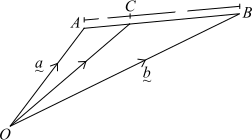
The point `C` divides the interval `AB` so that  `frac{CB}{AC} = frac{m}{n}`. The position vectors of `A` and `B` are `underset~a` and `underset~b` respectively, as shown in the diagram.
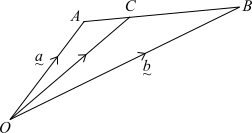
 

  1. Show that  `overset->(AC) = frac{n}{m + n} (underset~b - underset~a)`.  (2 marks)

    --- 6 WORK AREA LINES (style=lined) ---


  2. Prove that  `overset->(OC) = frac{m}{m + n} underset~a + frac{n}{m + n} underset~b`.  (1 mark)

    --- 5 WORK AREA LINES (style=lined) ---

Let `OPQR` be a parallelogram with  `overset->(OP) = underset~p`  and  `overset->(OR) = underset~r`. The point `S` is the midpoint of `QR` and `T` is the intersection of `PR` and `OS`, as shown in the diagram.
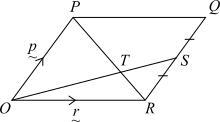


  1. Show that  `overset->(OT) = frac{2}{3} underset~r + frac{1}{3} underset~p`.  (3 marks)

    --- 8 WORK AREA LINES (style=lined) ---

  2. Using parts (ii) and (iii), or otherwise, prove that `T` is the point that divides the interval `PR` in the ratio 2 :1.   (1 mark)

    --- 3 WORK AREA LINES (style=lined) ---

Show Answers Only
  1. `text{See Worked Solutions}`
  2. `text{See Worked Solutions}`
  3. `text{See Worked Solutions}`
  4. `text{See Worked Solutions}`
Show Worked Solution

i.  

`frac{overset->(AC)}{overset->(AB)}` `= frac{n}{m + n}`
`overset->(AC)` `= frac{n}{m + n} * overset->(AB)`
  `= frac{n}{m + n} (underset~b – underset~a)`


ii.    `overset->(OC)` `= overset->(OA) + overset->(AC)`
    `= underset~a + frac{n}{m + n} (underset~b – underset~a)`
    `= underset~a – frac{n}{m + n} underset~a + frac{n}{m + n} underset~b`
    `= (1 – frac{n}{m + n}) underset~a + frac{n}{m + n} underset~b`
    `= (frac{m + n – n}{m + n}) underset~a + frac{n}{m + n} underset~b`
    `= frac{m}{m + n} underset~a + frac{n}{m + n} underset~b`


iii.  `text{Show} \ \ overset->(OT) = frac{2}{3} underset~r + frac{1}{3} underset~p`

♦ Mean mark part (iii) 50%.


`text{Consider} \ \ Delta PTO \ \ text{and} \ \ Delta RTS:`

`angle PTO = angle RTS \ (text{vertically opposite})`

`angle OPT = angle SRT \ (text{vertically opposite})`

`therefore \ Delta PTO \ text{|||} \ Delta RTS\ \ text{(equiangular)}`
 

`OT : TS = OP : SR = 2 : 1`

`(text{corresponding sides in the same ratio})`

`frac{overset->(OT)}{overset->(OS)}` `= frac{2}{3}`
`overset->(OT)` `= frac{2}{3} overset->(OS)`
  `= frac{2}{3} ( underset~r + frac{1}{2} underset~p)`
  `= frac{2}{3} underset~r + frac{1}{3} underset~p`
Mean mark part (iv) 51%.


iv.   `text{Let} \ \ overset->(OT) \ text{divide} \ PR\ text{so that}\ \ frac{TR}{PT} = frac{m}{n}`

`text{Using part (ii):}`

`overset->(OT)` `= frac{m}{m + n} underset~p + frac{n}{m + n} c`
`overset->(OT)` `= frac{1}{3} underset~p + frac{2}{3} underset~r \ \ \ (text{part (iii)})`
`frac{m}{m + n}` `= frac{1}{3} , frac{n}{m + n} = frac{2}{3}`

 
`=> \ m = 1 \ , \ n = 2`
 

`therefore \ T \ text{divides} \ PR \ text{in ratio  2 : 1}.`

Filed Under: Vectors and Geometry Tagged With: Band 3, Band 4, Band 5, smc-1210-30-Quadrilateral, smc-1210-40-Triangle, smc-1210-55-Ratios, smc-1210-60-2D problems

Vectors, EXT2 V1 SM-Bank 20

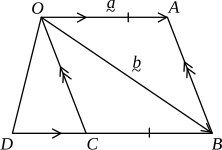
`OABD`  is a trapezium in which  `overset(->)(OA) = underset~a`  and  `overset(->)(OB) = underset~b`.

`OC`  is parallel to  `AB`  and  `DC : CB = 1:2`
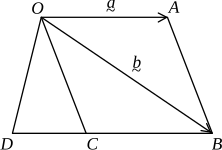


Using vectors, express  `overset(->)(DA)`  in terms of  `underset~a`  and  `underset~b`.  (3 marks)

--- 6 WORK AREA LINES (style=lined) ---

Show Answers Only

`text(See Worked Solution)`

Show Worked Solution

`overset(->)(DA) = overset(->)(DB) + overset(->)(BA)`

`overset(->)(BA) = underset~a – underset~b`
 
`text(S) text(ince) \  OC  ||  AB \ \ text(and) \ \ OA  ||  CB`

`=> OABC \ text(is a parallelogram)`

`overset(->)(OA)` `= overset(->)(CB) = underset~a`
`overset(->)(DC)` `= (1)/(2) \ underset~a `
`overset(->)(DB)` `= overset(->)(DC) + overset(->)(CB)`
  `= (3)/(2) \ underset~a`


`:. \ overset(->)(DA)` `= (3)/(2) \ underset~a + (underset~a – underset~b)`
  `= (5)/(2) \ underset~a – underset~b`

Filed Under: Vectors and Geometry Tagged With: Band 4, smc-1210-30-Quadrilateral, smc-1210-55-Ratios, smc-1210-60-2D problems

Copyright © 2014–2025 SmarterEd.com.au · Log in