SmarterEd

Aussie Maths & Science Teachers: Save your time with SmarterEd

  • Login
  • Get Help
  • About

Vectors, EXT1 V1 2022 SPEC1 6b

`OPQ` is a semicircle of radius `a` with equation  `y=sqrt(a^(2)-(x-a)^(2))`. `P(x,y)` is a point on the semicircle `OPQ`, as shown below.

  1. Express the vectors `vec(OP)` and `vec(QP)` in terms of  `a`, `x`, `y`, `underset~i` and `underset~j`, where `underset~i` is a unit vector in the direction of the positive `x`-axis and `underset~j` is a unit vector in the direction of the positive `y`-axis.   (1 mark)

    --- 3 WORK AREA LINES (style=lined) ---

  2. Hence, using the vector scalar (dot) product, determine whether `vec(OP)` is perpendicular to `vec(QP)`.   (3 marks)

    --- 8 WORK AREA LINES (style=lined) ---
Show Answers Only

i.    `vec(OP)= xunderset~i + sqrt(a^2-(x-a)^2 underset~j`

`vec(QP)= (x-2a) underset~i + sqrt(a^2-(x-a)^2) underset~j`
 

ii.   `vec(OP)* vec(QP)` `=x(x-2a)+a^(2)-(x-a)^(2)`
  `=x^(2)-2ax+a^(2)-x^(2)+2ax-a^(2)`
  `= 0`

 
`:. vec(OP)\ \text{and}\ vec(QP)\ \text{are perpendicular.}`

Show Worked Solution

i.    `vec(OP)= xunderset~i + sqrt(a^2-(x-a)^2 underset~j`

`vec(QP)= (x-2a) underset~i + sqrt(a^2-(x-a)^2) underset~j`
 

ii.   `vec(OP)* vec(QP)` `=x(x-2a)+a^(2)-(x-a)^(2)`
  `=x^(2)-2ax+a^(2)-x^(2)+2ax-a^(2)`
  `= 0`

 
`:. vec(OP)\ \text{and}\ vec(QP)\ \text{are perpendicular.}`

Filed Under: Vectors and Geometry (Ext1) Tagged With: Band 4, smc-1211-10-Triangle, smc-1211-50-(Semi)circle

Vectors, EXT1 V1 SM-Bank 31

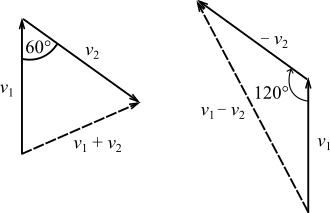
The sum of two unit vectors is a unit vector.

Determine the magnitude of the difference of the two vectors.   (3 marks)

Show Answers Only

\(D\)

Show Worked Solution

\(\text{Vectors can be drawn as two sides of an equilateral triangle.}\)

\(\text{Using the cosine rule for the difference between the two vectors:}\)

\(c^2\) \(=a^2+b^2-2ab\, \cos C\)  
  \(=1+1-2\times -\dfrac{1}{2} \)  
  \(=3\)  
\(c\) \(=\sqrt{3}\)  

 
\(\abs{v_1-v_2} = \sqrt{3}\)

Filed Under: Vectors and Geometry (Ext1) Tagged With: Band 5, smc-1211-10-Triangle, smc-1211-60-Other

Vectors, EXT1 V1 2023 HSC 14c

  1. Given a non-zero vector  \(\left(\begin{array}{l}p \\ q\end{array}\right)\),  it is known that the vector  \(\left(\begin{array}{c}q \\ -p\end{array}\right)\) is perpendicular to  \(\left(\begin{array}{l}p \\ q\end{array}\right)\)  and has the same magnitude. (Do NOT prove this.)
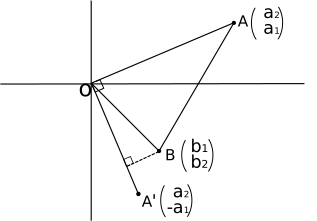
  2. Points \(A\) and \(B\) have position vectors  \(\overrightarrow{O A}=\left(\begin{array}{l}a_1 \\ a_2\end{array}\right)\)  and  \(\overrightarrow{O B}=\left(\begin{array}{l}b_1 \\ b_2\end{array}\right)\), respectively.
  3. Using the given information, or otherwise, show that the area of triangle  \(O A B\)  is  \(\dfrac{1}{2}\left|a_1 b_2-a_2 b_1\right|\).  (3 marks)

    --- 8 WORK AREA LINES (style=lined) ---
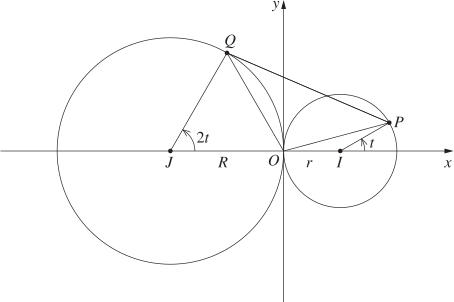
  4. The point \(P\) lies on the circle centred at  \(I(r, 0)\)  with radius  \(r>0\),  such that  \(\overrightarrow{I P}\)  makes an angle of \(t\) to the horizontal.

  5. The point \(Q\) lies on the circle centred at  \(J(-R, 0)\)  with radius  \(R>0\),  such that  \(\overrightarrow{J Q}\)  makes an angle of \(2 t\) to the horizontal.

  1. Note that  \(\overrightarrow{O P}=\overrightarrow{O I}+\overrightarrow{I P}\)  and  \(\overrightarrow{O Q}=\overrightarrow{O J}+\overrightarrow{J Q}\).
  2. Using part (i), or otherwise, find the values of \(t\), where  \(-\pi \leq t \leq \pi\), that maximise the area of triangle \(O P Q\).  (4 marks)

    --- 10 WORK AREA LINES (style=lined) ---

Show Answers Only

  1. \(\text{See Worked Solutions}\)
  2. \(t=\dfrac{\pi}{3}, \ – \dfrac{\pi}{3} \)

Show Worked Solution

i.   
     

♦♦♦ Mean mark (i) 18%.
\(\Big{|}\text{proj}_{\overrightarrow{OA^{′}}} \overrightarrow{OB} \Big{|}\) \(=\ \text{⊥ height of}\ \triangle OAB\ \text{from side}\ \overrightarrow{OA} \)  
  \(= \Bigg{|} \dfrac{\overrightarrow{OB} \cdot \overrightarrow{OA^{′}}}{|\overrightarrow{OA^{′}}|} \Bigg{|} \)  
  \(= \Bigg{|} \dfrac{b_1a_2-b_2a_1}{|\overrightarrow{OA^{′}}|} \Bigg{|} \)  


\(\text{Area}\ \triangle AOB\) \(=\dfrac{1}{2} \Bigg{|} \dfrac{b_1a_2-b_2a_1}{|\overrightarrow{OA^{′}}|} \Bigg{|} \cdot |\overrightarrow{OA} | \)  
  \(=\dfrac{1}{2}\left|a_1 b_2-a_2 b_1\right|\ \ \ (\text{noting}\ \ |\overrightarrow{OA} |=|\overrightarrow{OA^{′}} |) \)  


ii.    \(\overrightarrow{OP}\) \(=\overrightarrow{OI}+\overrightarrow{IP}\)
    \(= \left(\begin{array}{l}r \\ 0\end{array}\right) + \left(\begin{array}{c} r\ \cos \ t \\ r\ \sin \ t\end{array}\right) \)
    \(= \left(\begin{array}{c} r(1+ \cos \ t) \\ r\ \sin \ t\end{array}\right) \)
♦♦♦ Mean mark (ii) 8%.
\(\overrightarrow{OQ}\) \(=\overrightarrow{OJ}+\overrightarrow{JQ}\)
  \(= \left(\begin{array}{c} -R \\ 0 \end{array}\right) + \left(\begin{array}{l} R\ \cos\ 2t \\ R\ \sin\ 2t\end{array}\right) \)
  \(= \left(\begin{array}{c} R(\cos\ 2t-1) \\ R\ \sin\ 2t\end{array}\right) \)

 
\(\text{Using part (i):}\)

\(A_{\triangle OPQ}\)

\(=\dfrac{1}{2} \big{|} r(1+\cos\ t) \cdot R \sin\ 2t-r\ \sin\ t\ \cdot R(\cos\ 2t-1)\ \big{|} \)

 
  \(=\dfrac{rR}{2} \big{|} \sin\ 2t+\cos\ t\ \sin\ 2t-\sin\ t\ \cos\ 2t+\sin\ t\ \big{|} \)  
  \(=\dfrac{rR}{2} \big{|} \sin\ 2t+\sin\ t\ + \sin(2t-t) \big{|} \)  
  \(=\dfrac{rR}{2} \big{|} 2\sin\ t\ \cos\ t +2\sin\ t \big{|} \)  
  \(= rR \big{|} \sin\ t(\cos\ t+1) \big{|} \)  

 
\(\text{Let}\ \ f(t)=\sin\ t(\cos\ t+1) \)

\(f^{′}(t) \) \(=\cos\ t(\cos\ t+1)+\sin\ t(-\sin\ t) \)  
  \(=\cos^{2}t+\cos\ t-\sin^{2}t\)  
  \(=\cos^{2}t+\cos\ t-(1-\cos^{2}t) \)  
  \(=2\cos^{2}t+\cos\ t-1 \)  
  \(=(2\cos^{2}t-1)(\cos\ t+1) \)  

 
\(\text{SP’s when}\ \ f^{′}(t)=0:\)

\(\cos\ t\) \(=\dfrac{1}{2} \) \(\cos\ t\) \(=-1\)
\(t\) \(=\dfrac{\pi}{3}, \ – \dfrac{\pi}{3} \) \(t\) \(=\pi, \ -\pi \)

 
\(\text{Testing SP’s:}\)

\(f(\pi) = f(- \pi) = 0\)

\(\therefore A_{\triangle AOB}\ \text{is maximum when}\ \ t=\dfrac{\pi}{3}, \ – \dfrac{\pi}{3} \)

Filed Under: Vectors and Geometry (Ext1) Tagged With: Band 6, smc-1211-10-Triangle, smc-1211-70-Projections

Vectors, EXT1 V1 EQ-Bank 6

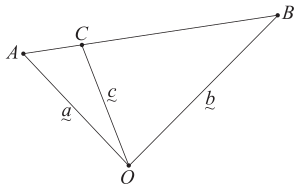
Point  `C`  lies on  `AB`  such that  `overset(->)(AC) = lambdaoverset(->)(AB)`.

  1.  Express  `underset~c`  in terms of  `underset~a`  and  `underset~b`.   (2 marks)

    --- 8 WORK AREA LINES (style=lined) ---
  2.  Hence or otherwise, show that  `overset(->)(BC) = (1-lambda)(underset~a-underset~b)`.   (1 mark)

    --- 4 WORK AREA LINES (style=lined) ---
Show Answers Only
  1. `lambdaunderset~b + (1-lambda)underset~a`
  2. `text{Proof (See Worked Solutions)}`
Show Worked Solution
i.      

`underset~c = underset~a + overset(->)(AC)`

`overset(->)(AB)` `= underset~b-underset~a`
`overset(->)(AC)` `= lambdaoverset(->)(AB)`
  `= lamda(underset~b-underset~a)`


`:.underset~c` `= underset~a + lambda(underset~b-underset~a)`
  `= lambdaunderset~b + (1-lambda)underset~a`


ii.    `overset(->)(BC)` `= underset~c-underset~b`
    `= lambdaunderset~b + (1-lambda)underset~a-underset~b`
    `=(1-lambda)underset~a +(lambda-1)underset~b`
    `=(1-lambda)underset~a -(1-lambda)underset~b`
    `= (1-lambda)(underset~a-underset~b)`

Filed Under: Vectors and Geometry (Ext1) Tagged With: Band 4, smc-1211-10-Triangle, smc-1211-40-Ratio/Scalar

Vectors, EXT1 V1 SPEC2 2009 17 MC

Vectors  `underset ~a, underset ~b`  and  `underset ~c`  are shown below.

VCAA 2009 spec2 17mc
From the diagram it follows that

  1. `|\ underset ~c\ |^2 = |\ underset ~a\ |^2 + |\ underset ~b\ |^2`
  2. `|\ underset ~c\ |^2 = |\ underset ~a\ |^2 + |\ underset ~b\ |^2-|\ underset ~a\ | |\ underset ~b\ |`
  3. `|\ underset ~c\ |^2 = |\ underset ~a\ |^2 + |\ underset ~b\ |^2 + |\ underset ~a * underset ~b\ |`
  4. `|\ underset ~c\ |^2 = |\ underset ~a\ |^2 + |\ underset ~b\ |^2 + |\ underset ~a\ | |\ underset ~b\ |`
Show Answers Only

`D`

Show Worked Solution

`underset~ c + underset~ b = underset~ a\ \ => \ underset~ c = underset~ a-underset~ b`

`:. underset~ c * underset~ c` `= (underset~ a-underset~ b) * (underset~ a-underset~ b)`
  `= underset~ a * underset~ a-underset~ a * underset~ b -underset~b*underset~a + underset~ b * underset~ b`
  `= underset~ a * underset~ a  + underset~ b * underset~ b-2underset~b*underset~a `

`:. |\ underset~ c\ |^2 = |\ underset~ a\ |^2 + |\ underset~ b\ |^2-2 |\ underset~ a\ | |\ underset~ b\ | cos 120^@`

`:. |\ underset~ c\ |^2 = |\ underset~ a\ |^2 + |\underset~ b\ |^2 + |\ underset~ a\ | |\ underset~ b\ |`

`=>   D`

Filed Under: Vectors and Geometry (Ext1) Tagged With: Band 5, smc-1211-10-Triangle

Vectors, EXT1 V1 SM-Bank 5

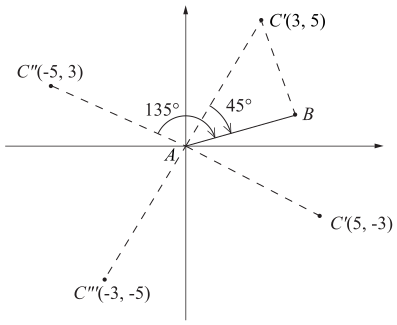
Points `A` and `B` are on the number plane. The vector  `overset(->)(AB)`  is  `((4),(1))`.

Point `C` is chosen so that the area of  `DeltaABC`  is  `17/2`  square units and  `|overset(->)(AC)| = sqrt34`.

Find all possible vectors  `overset(->)(AC)`.  (4 marks)

--- 10 WORK AREA LINES (style=lined) ---

Show Answers Only

`((3),(5)),((5),(−3)),((−3),(−5))\ text(and)\ ((−5),(3))`

Show Worked Solution

`|overset(->)(AB)| = sqrt(4^2 + 1^2) = sqrt17`

`text(Let)\ \ angleCAB = theta`

`text(Area)\ DeltaABC` `= 1/2 · |overset(->)(AB)| · |overset(->)(AC)| · sintheta`
`17/2` `= 1/2 · sqrt17 · sqrt34 sintheta`
`17` `= 17sqrt2 sintheta`
`sintheta` `= 1/sqrt2`
`theta` `= pi/4\ text(or)\ (3pi)/4\ \ (theta>0)`

 
`=> costheta = ±1/sqrt2`

`overset(->)(AB) · overset(->)(AC)` `= |overset(->)(AB)| · |overset(->)(AC)| · costheta`
  `= ±sqrt17 · sqrt34 · 1/sqrt2`
  `= ±17`

 
`text(Let)\ \ overset(->)(AC) = ((x),(y))`

`overset(->)(AB) · overset(->)(AC)` `= ((4),(1))((x),(y))`
  `= 4x + y`

 
`4x + y = ±17…\ \ (1)`

`|overset(->)(AC)|` `= sqrt(x^2 + y^2) = sqrt34`
`x^2 + y^2` `= 34\ …\ \ (2)`

 
`text(Solving simultaneously:)`

`4x + y = 17 \ => \ y = 17-4x`

`text{Substitute into (2)}`

`x^2 + (17-4x)^2` `= 34`
`x^2 + 289-136x + 16x^2` `= 34`
`17x^2-136x + 255` `= 0`
`x^2-8x + 15` `= 0`
`(x-3)(x-5)` `= 0`

 
`:. x = 3, y = 5\ \ text(or)\ \ x = 5, y = −3`

 
`text(Similarly for)\ \ 4x + y = −17 \ => \ y = −4x-17`

COMMENT: A diagram is highly recommended. Here, the possibility of 4 solutions is clearly shown.

`x^2 + (−4x-17)^2` `= 34`
`x^2 + 8x + 15` `= 0`
`(x + 3)(x + 5)` `= 0`

 
`:. x = −3, y = −5\ \ text(or)\ \ x = −5, y = 3`


`:. text(Possible vectors)\ overset(->)(AC)\ text(are)`

`((3),(5)),((5),(−3)),((−3),(−5))\ text(and)\ ((−5),(3))`

Filed Under: Vectors and Geometry (Ext1) Tagged With: Band 5, smc-1211-10-Triangle

Copyright © 2014–2025 SmarterEd.com.au · Log in