SmarterEd

Aussie Maths & Science Teachers: Save your time with SmarterEd

  • Login
  • Get Help
  • About

Calculus, 2ADV C4 2024 MET2 2 MC

A function \(g(x)\) has the derivative  \( { \displaystyle g^{\prime}(x)=x^3-x } \).

Given that  \(g(0)=5\), the value of \(g(2)\) is

  1. \(2\)
  2. \(3\)
  3. \(5\)
  4. \(7\)
Show Answers Only

\(D\)

Show Worked Solution
\({ \displaystyle g^{\prime}(x)}\) \(=x^3-x\)
\(g(x)\) \(=\dfrac{x^4}{4}-\dfrac{x^2}{2}+c\)

 
\(\text{Given }g(0)=5,\ c=5\) 

\(g(x)=\dfrac{x^4}{4}-\dfrac{x^2}{2}+5\)

\(\therefore\ g(2)=\dfrac{2^4}{4}-\dfrac{2^2}{2}+5=7\)

\(\Rightarrow D\)

Filed Under: Other Integration Applications (Y12) Tagged With: Band 4, smc-1213-25-Tangents/Primitive function

Calculus, 2ADV C4 2023 HSC 28

The curve  \(y=f(x)\)  is shown on the diagram. The equation of the tangent to the curve at point  \(T(-1,6)\)  is  \(y=x+7\). At a point \(R\), another tangent parallel to the tangent at \(T\) is drawn.
 

The gradient function of the curve is given by  \(\dfrac{dy}{dx}=3x^2-6x-8\).

Find the coordinates of \(R\).  (4 marks)

--- 8 WORK AREA LINES (style=lined) ---

Show Answers Only

\(R(3,-22)\)

Show Worked Solution

\(\text{Gradient at}\ R=1:\)

\(3x^2-6x-8\) \(=1\)  
\(3x^2-6x-9\) \(=0\)  
\(3(x^2-2x-3\) \(=0\)  
\(3(x+1)(x-3)\) \(=0\)  
♦ Mean mark 51%.

\(x\text{-coordinate of}\ R = 3\)

\(y\) \(=\int 3x^2-6x-8\ dx\)  
  \(=x^3-3x^2-8x+c\)  

 
\(\text{Graph passes through}\ (-1,6):\)

\(6\) \(=-1-3+8+c\)  
\(c\) \(=2\)  

 
\(y=x^3-3x^2-8x+2\)

\(\text{When}\ x=3:\)

\(y=27-27-24+2=-22\)

\(\therefore R(3,-22)\)

Filed Under: Other Integration Applications (Y12) Tagged With: Band 5, smc-1213-25-Tangents/Primitive function

Calculus, 2ADV C3 2017 HSC 9 MC

The graph of  `y = f^{′}(x)`  is shown.
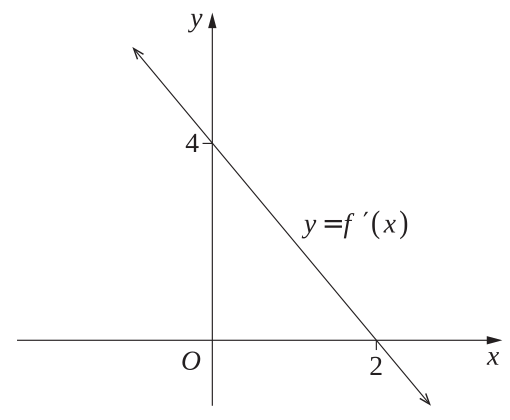
 

The curve  `y = f (x)`  has a maximum value of 12.

What is the equation of the curve  `y = f (x)`?

  1. `y = x^2-4x + 12`
  2. `y = 4 + 4x-x^2`
  3. `y = 8 + 4x-x^2`
  4. `y = x^2-4x + 16`
Show Answers Only

`C`

Show Worked Solution

`text(Find the equation of)\ \ f^{′}(x):`

`m = -2,\ \ y text(-int) = 4`

`y = -2x + 4`

`f(x)` `= int -2x + 4\ dx`
  `= -x^2 + 4x + c`


`text(Maximum)\ \ f(x) = 12\ \ text(when)\ \ f^{′}(x) = 0:`

`-2x + 4` `= 0`
`x` `= 2`

 
`text(Substitute)\ \ x=2\ \ text(into)\ \ f(x):`

`:. 12` `= -2^2 + 4 ⋅ 2 + c`
`c` `= 8`


`:. f(x) = 8 + 4x-x^2`

`=>  C`

Filed Under: Other Integration Applications (Y12) Tagged With: Band 5, smc-1213-25-Tangents/Primitive function

Calculus, 2ADV C4 2008 HSC 9c

A beam is supported at  `(-b, 0)`  and  `(b, 0)`  as shown in the diagram.
 

2008 9c

 
It is known that the shape formed by the beam has equation  `y = f(x)`, where  `f(x)`  satisfies

  `f^{″}(x)` `= k (b^2-x^2),\ \ \ \ \ `(`k` is a positive constant) 
and        `f^{′}(-b)` `= -f'(b)`.


  1. Show that  `f^{′}(x) = k (b^2x-(x^3)/3)`.   (2 marks)

    --- 5 WORK AREA LINES (style=lined) ---

  2. How far is the beam below the  `x`-axis at  `x = 0`?   (2 marks)

    --- 6 WORK AREA LINES (style=lined) ---

Show Answers Only
  1. `text(Proof)\ text{(See Worked Solutions)}`
  2. `(5kb^4)/12\ text(units)`
Show Worked Solution
i.    `text(Show)\ \ f^{′}(x) = k (b^2x-x^3/3)`
`f^{″}(x)` `= k (b^2 – x^2)`
`f^{′}(x)` `= int k (b^2-x^2)\ dx`
  `= k int b^2-x^2\ dx`
  `= k (b^2x-x^3/3) + c`


`text(S)text(ince S.P. exists at)\ \ x = 0`

`=> f^{′}(x)` `= 0\ \ text(when)\ \  x = 0`
`0` `= k (b^2 * 0-0) + c`
`c` `= 0`


`:.\ f^{′}(x) = k (b^2x-x^3/3)\ \ \ text(… as required)`


ii.   `f(x)` `= int f^{′}(x)\ dx`
    `= k int b^2x-x^3/3\ dx`
    `= k ((b^2x^2)/2-x^4/12) + c`


`text(We know)\ \ f(x) = 0\ \ text(when)\ \ x = b`

`=> 0` `= k ( (b^2*b^2)/2-b^4/12) + c`
`c` `= -k ( (6b^4)/12-b^4/12)`
  `= -k ( (5b^4)/12 )`
  `= -(5kb^4)/12`


`:.\ text(When)\ \ x = 0, text(the beam is)\ \ (5kb^4)/12\ \ text(units)`

`text(below the)\ x text(-axis.)`

Filed Under: Integrals, Other Integration Applications (Y12) Tagged With: Band 5, Band 6, page-break-before-solution, smc-1213-25-Tangents/Primitive function

Calculus, 2ADV C4 2008 HSC 5a

The gradient of a curve is given by  `dy/dx = 1-6 sin 3x`. The curve passes through the point  `(0, 7)`.

What is the equation of the curve?   (3 marks)

--- 6 WORK AREA LINES (style=lined) ---

Show Answers Only

`y = x + 2 cos 3x + 5`

Show Worked Solution
`dy/dx` `= 1-6 sin 3x`
`y` `= int 1-6 sin 3x\ dx`
  `= x + 2 cos 3x + c`


`text(Passes through)\ (0,7):`

`=> 0 + 2 cos 0 + c` `= 7`
`2 + c` `= 7`
`c` `= 5`


`:.\ text(Equation is)\ \ \ y = x + 2 cos 3x + 5`

Filed Under: Differentiation and Integration, Integrals, Other Integration Applications (Y12), Trig Integration Tagged With: Band 4, smc-1204-10-Sin, smc-1213-25-Tangents/Primitive function

Calculus, 2ADV C4 2014 HSC 11f

The gradient function of a curve  `y = f(x)`  is given by  `f^{′}(x) = 4x-5`.  The curve passes through the point  `(2, 3)`.

Find the equation of the curve.  (2 marks)

--- 6 WORK AREA LINES (style=lined) ---

Show Answers Only

`f(x) = 2x^2-5x + 5`

Show Worked Solution
`f^{′}(x)` `= 4x-5`
`f(x)` `= int 4x-5\ dx`
  `= 2x^2-5x + C`


`text(Given)\ \ f(x)\ text(passes through)\ (2,3):`

`3` `= 2(2^2)-5(2) + C`
`3` `= 8-10 + C`
`C` `= 5`

 
`:.\ f(x) = 2x^2-5x + 5`

Filed Under: Curve Sketching and The Primitive Function, Other Integration Applications (Y12) Tagged With: Band 4, smc-1213-25-Tangents/Primitive function

Calculus, 2ADV C4 2011 HSC 4c

The gradient of a curve is given by  `dy/dx = 6x-2`.  The curve passes through the point `(-1, 4)`. 

What is the equation of the curve?   (2 marks)

--- 5 WORK AREA LINES (style=lined) ---

Show Answers Only

 `y = 3x^2-2x-1`

Show Worked Solution

`dy/dx = 6x-2` 

`y` `= int 6x-2\ dx`
  `= 3x^2-2x + c`

 
`text{Since it passes through}\ (-1,4),`

`4` `= 3 (-1)^2-2(-1) + c`
`4` `= 3 + 2 + c`
`c` `= -1`

 
`:. y = 3x^2-2x-1`

Filed Under: Integrals, Other Integration Applications (Y12), Tangents and Normals Tagged With: Band 4, smc-1089-30-Find f(x) given f'(x), smc-1090-10-Quadratic Function, smc-1090-50-Find curve given tangent, smc-1213-25-Tangents/Primitive function

Calculus, 2ADV C4 2013 HSC 16a

The derivative of a function `f(x)` is  `f^{′}(x) = 4x-3`.  The line  `y = 5x-7`  is tangent to the graph `f(x)`.

Find the function `f(x)`.   (3 marks) 

--- 6 WORK AREA LINES (style=lined) ---

Show Answers Only

`f(x) = 2x^2-3x + 1`

Show Worked Solution

`text(Solution 1)`

`f^{′}(x)` `=4x-3`
`f(x)` `= int 4x-3\ dx`
  `= 2x^2-3x + c`

 
`text(Intersection when)`

`2x^2-3x + c = 5x-7`

`2x^2-8x + (7 + c) = 0`

  
`text(S)text(ince)\ \ y=5x-7\ \ text(is a tangent)\ => Delta =0`

`b^2-4ac` `=0`
`(-8)^2-[4xx2xx(7+c)]` `= 0`
`64-56-8c` `=8`
`8c` `=8`
`c` `=1`

 
`:.f(x) = 2x^2-3x + 1`

 
`text(Solution 2)`

`f^{′}(x)=4x-3`

`y=5x-7\ \ text{(Gradient = 5)}`

`=>4x-3` `=5`
`x` `=2`

 
`f(x) = 2x^2-3x + 1`

`f(x)\ text{passes through (2, 3)}`

`f(2)` `=2xx 2^2-3(2)+c`
`3` `=8-6+c`
`c` `=1`

 
`:.f(x) = 2x^2-3x + 1`

Filed Under: Other Integration Applications (Y12), Tangents and Normals Tagged With: Band 4, smc-1090-10-Quadratic Function, smc-1090-50-Find curve given tangent, smc-1213-25-Tangents/Primitive function

Copyright © 2014–2025 SmarterEd.com.au · Log in