Let `A` and `B` be two independent events from a sample space.
If `text{Pr} (A) = p , \ text{Pr}(B) = p^2` and `text{Pr} (A) + text{Pr} (B) = 1`, then `text{Pr}(A′ ∪ B)` is equal to
- `1-p-p^2`
- `p^2-p^3`
- `p-p^3`
- `1-p + p^3`
- `1-p-p^2 + p^3`
Aussie Maths & Science Teachers: Save your time with SmarterEd
Let `A` and `B` be two independent events from a sample space.
If `text{Pr} (A) = p , \ text{Pr}(B) = p^2` and `text{Pr} (A) + text{Pr} (B) = 1`, then `text{Pr}(A′ ∪ B)` is equal to
`A` and `B` are events from a sample space such that `text(Pr)(A) = p`, where `p > 0, \ text(Pr)(B\ text{|}\ A) = m` and `text(Pr)(B\ text{|}\ A prime) = n`.
`A` and `B` are independent events when
Two events, `A` and `B`, are independent, where `text(Pr) (B) = 2 text(Pr) (A)` and `text(Pr) (A uu B) = 0.52`
`text(Pr) (A)` is equal to
For events `A` and `B` from a sample space, `text(Pr)(A text(|)B) = 1/5` and `text(Pr)(B text(|)A) = 1/4`. Let `text(Pr)(A nn B) = p`. --- 3 WORK AREA LINES (style=lined) --- --- 5 WORK AREA LINES (style=lined) --- --- 4 WORK AREA LINES (style=lined) ---
b. `text(Consider the Venn diagram:)` `text(Pr)(A^{′} nn B^{′}) = 1-8p` c. `text(Given Pr)(A uu B) = 8p` `=> 0 < 8p <= 1/5` `:. 0 < p <= 1/40`Show Worked Solution
a.
`text(Pr)(A)`
`=(text(Pr)(A nn B))/(text(Pr)(B text(|) A))`
`=p/(1/4)`
`=4p`
♦ Mean mark 40%.
MARKER’S COMMENT: The most successful answers used a Venn diagram or table.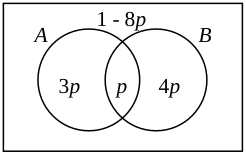 ♦ Mean mark 37%.
Events `A` and `B` are mutually exclusive events of a sample space with
`text(Pr) (A) = p and text(Pr) (B) = q\ \ text(where)\ \ 0 < p < 1 and 0 < q < 1.`
`text(Pr) (A prime nn B prime)` is equal to

| `text(Pr) (A prime nn B prime)` | `= 1 – p – q` |
| `= 1 – (p + q)` |
`=> C`
For two events, `P` and `Q`, `text(Pr)(P ∩ Q) = text(Pr)(P′ ∩ Q)`.
`P` and `Q` will be independent events exactly when

| `text(Let)\ \ text(Pr)(P ∩ Q)` | `= x = text(Pr)(P′ ∩ Q)` |
| `text(Let)\ \ text(Pr)(P ∩ Q′)` | `= y` |
`text(If)\ P, Q\ text(independent)`
| `text(Pr)(P) xx text(Pr)(Q)` | `= text(Pr)(P ∩ Q)` |
| `(y + x)(2x)` | `= x` |
| `:. 2(x + y)` | `= 1` |
| `x + y` | `= 1/2` |
| `text(Pr)(P)` | `= 1/2` |
`=> E`
Two events, `A` and `B`, from a given event space, are such that `text(Pr)(A) = 1/5` and `text(Pr)(B) = 1/3`. --- 5 WORK AREA LINES (style=lined) --- --- 5 WORK AREA LINES (style=lined) ---
a. `text(Sketch Venn diagram:)` `text(Mutually exclusive means)\ \ text(Pr)(A ∩ B)=0,` `:. text(Pr)(A^{′} ∩ B) = 1/3`Show Worked Solution
♦♦ Mean mark (a) 31%.
MARKER’S COMMENTS: Students who drew a Venn diagram or Karnaugh map were the most successful.
`:. text(Pr)(A^{′} ∩ B)`
`=text(Pr)(B)-text(Pr)(A ∩B)`
`=1/3-1/8`
`=5/24`
♦♦ Mean mark (b) 23%.
b.

Two events, `A` and `B`, are such that `text(Pr) (A) = 3/5` and `text(Pr) (B) = 1/4.` If `A^{′}` denotes the compliment of `A`, calculate `text(Pr) (A^{′} nn B)` when --- 5 WORK AREA LINES (style=lined) --- --- 4 WORK AREA LINES (style=lined) ---
a. `text(Sketch Venn Diagram)` `:.\ text(Pr) (A^{′} nn B) = 1/4-1/10 = 3/20` `text(Pr) (A∩ B)=0\ \ text{(mutually exclusive)},` `:.\ text(Pr) (A^{′} nn B) = text(Pr) (B) = 1/4`Show Worked Solution

`text(Pr) (A uu B)`
`= text(Pr) (A) + text(Pr) (B)-text(Pr) (A nn B)`
`3/4`
`= 3/5 + 1/4-text(Pr) (A nn B)`
`text(Pr) (A nn B)`
`= 1/10`
b.

For events `A` and `B,\ text(Pr)(A ∩ B) = p,\ text(Pr)(A′∩ B) = p - 1/8` and `text(Pr)(A ∩ B prime) = (3p)/5.`
If `A` and `B` are independent, then the value of `p` is
`A` and `B` are events of a sample space.
Given that `text(Pr)(A|B) = p,\ \ text(Pr)(B) = p^2` and `text(Pr)(A) = p^(1/3),\ text(Pr)(B|A)` is equal to
`A` and `B` are events of a sample space `S.`
`text(Pr)(A nn B) = 2/5` and `text(Pr)(A nn B prime) = 3/7`
`text(Pr)(B prime | A)` is equal to

| `text(Pr)(B prime | A)` | `= (text(Pr)(B prime nn A))/(text(Pr)(A))` |
| `= (text(Pr)(B prime nn A))/(text(Pr)(B prime nn A)+ text(Pr)(A nn B))` | |
| `= (3/7)/(3/7 + 2/5)` | |
| `= 15/29` |
`=> B`