SmarterEd

Aussie Maths & Science Teachers: Save your time with SmarterEd

  • Login
  • Get Help
  • About

BIOLOGY, M5 2025 HSC 1 MC

Amoeba reproduce by the process shown.
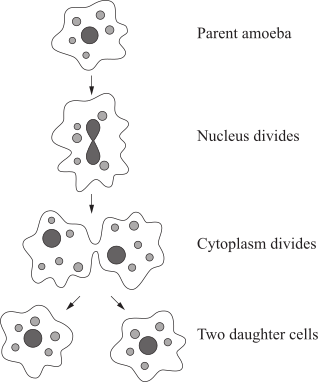


Which of the following is a characteristic of the daughter cells?

  1. Genetically different to parent amoeba
  2. Genetically identical to parent amoeba
  3. More organelles due to the cell division
  4. Fewer chromosomes than the parent amoeba
Show Answers Only

\(B\)

Show Worked Solution
  • B is correct: Asexual reproduction produces genetically identical offspring.

Other Options:

  • A is incorrect: Sexual reproduction produces genetic variation, not asexual.
  • C is incorrect: Cell division distributes existing organelles between daughter cells.
  • D is incorrect: Mitosis maintains the same chromosome number in offspring.

Filed Under: Reproduction Tagged With: Band 3, smc-3647-40-Sexual vs Asexual

BIOLOGY, M5 2024 HSC 21

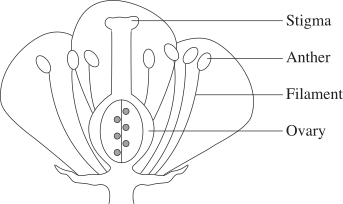
A diagram of the different parts of a flower is shown. 
 

  1. Identify the structures where pollen and ovules are located.   (2 marks)

    --- 2 WORK AREA LINES (style=lined) ---

  2. Complete the table to compare features of sexual and asexual reproduction.   (3 marks)

\begin{array} {|l|c|}
\hline
\rule{0pt}{2.5ex} \text{Feature} \rule[-1ex]{0pt}{0pt} & \quad \quad \text{Sexual}\quad \quad \rule[-1ex]{0pt}{0pt} & \quad \quad \text{Asexual}\quad \quad\\
\hline
\rule{0pt}{2.5ex} \text{Genetic variability} \\
\text{(yes/no)} \rule[-1ex]{0pt}{0pt} \\
\hline
\rule{0pt}{2.5ex} \text{Number of parents }  \\
\text{required} \rule[-1.5 ex]{0pt}{0pt}\\
\hline
\rule{0pt}{2.5ex} \text{Example of an organism }\\
\text{which uses this type of }& \text{}\\
\text{reproduction} \rule[-1ex]{0pt}{0pt}\\
\hline
\end{array}

--- 0 WORK AREA LINES (style=lined) ---

Show Answers Only

a.   Pollen: anther

Ovule: ovary

b.   Comparison of features

\begin{array} {|l|c|}
\hline
\rule{0pt}{2.5ex} \text{Feature} \rule[-1ex]{0pt}{0pt} & \ \ \ \ \ \ \ \ \text{Sexual}\ \ \ \ \ \ \ \  \rule[-1ex]{0pt}{0pt} & \ \ \ \ \ \ \ \text{Asexual}\ \ \ \ \ \ \  \\
\hline
\rule{0pt}{2.5ex} \text{Genetic variability} \rule[-1ex]{0pt}{0pt} & \text{Yes} \rule[-1ex]{0pt}{0pt} & \text{No} \\
\rule{0pt}{2.5ex} \text{(yes/no)} \rule[-1ex]{0pt}{0pt} & \text{} \rule[-1ex]{0pt}{0pt} & \text{} \\
\hline
\rule{0pt}{2.5ex} \text{Number of parents } \rule[-1ex]{0pt}{0pt} & \text{2} \rule[-1ex]{0pt}{0pt} & \text{1} \\
\rule{0pt}{2.5ex} \text{required} \rule[-1ex]{0pt}{0pt} & \text{} \rule[-1ex]{0pt}{0pt} & \text{} \\
\hline
\rule{0pt}{2.5ex} \text{Example of an organism } \rule[-1ex]{0pt}{0pt} & \text{} \rule[-1ex]{0pt}{0pt} & \text{} \\
\rule{0pt}{2.5ex} \text{which uses this type of } \rule[-1ex]{0pt}{0pt} & \text{Humans} \rule[-1ex]{0pt}{0pt} & \text{Bacteria} \\
\rule{0pt}{2.5ex} \text{reproduction} \rule[-1ex]{0pt}{0pt} & \text{} \rule[-1ex]{0pt}{0pt} & \text{} \\
\hline
\end{array}

Show Worked Solution

a.   Pollen: anther

Ovule: ovary 

b.   Comparison of features

\begin{array} {|l|c|}
\hline
\rule{0pt}{2.5ex} \text{Feature} \rule[-1ex]{0pt}{0pt} & \ \ \ \ \ \ \ \ \text{Sexual}\ \ \ \ \ \ \ \  \rule[-1ex]{0pt}{0pt} & \ \ \ \ \ \ \ \text{Asexual}\ \ \ \ \ \ \  \\
\hline
\rule{0pt}{2.5ex} \text{Genetic variability} \rule[-1ex]{0pt}{0pt} & \text{Yes} \rule[-1ex]{0pt}{0pt} & \text{No} \\
\rule{0pt}{2.5ex} \text{(yes/no)} \rule[-1ex]{0pt}{0pt} & \text{} \rule[-1ex]{0pt}{0pt} & \text{} \\
\hline
\rule{0pt}{2.5ex} \text{Number of parents } \rule[-1ex]{0pt}{0pt} & \text{2} \rule[-1ex]{0pt}{0pt} & \text{1} \\
\rule{0pt}{2.5ex} \text{required} \rule[-1ex]{0pt}{0pt} & \text{} \rule[-1ex]{0pt}{0pt} & \text{} \\
\hline
\rule{0pt}{2.5ex} \text{Example of an organism } \rule[-1ex]{0pt}{0pt} & \text{} \rule[-1ex]{0pt}{0pt} & \text{} \\
\rule{0pt}{2.5ex} \text{which uses this type of } \rule[-1ex]{0pt}{0pt} & \text{Humans} \rule[-1ex]{0pt}{0pt} & \text{Bacteria} \\
\rule{0pt}{2.5ex} \text{reproduction} \rule[-1ex]{0pt}{0pt} & \text{} \rule[-1ex]{0pt}{0pt} & \text{} \\
\hline
\end{array}

Filed Under: Reproduction Tagged With: Band 3, smc-3647-25-Plant, smc-3647-40-Sexual vs Asexual

BIOLOGY, M5 2023 HSC 33

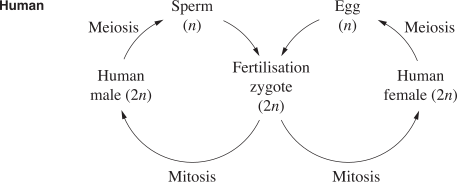
Mechanisms of reproduction for both humans and generalised fungi are shown in the diagrams.


Describe the similarities and differences of reproduction in humans and generalised fungi.  (4 marks)

Show Answers Only

Similarities

  • Both human and fungi reproduction use mitosis and meiosis.
  • Both human and fungi reproduction form zygotes with chromosomes from two different individuals.

Differences

  • Humans reproduce through sexual reproduction while fungi use asexual spores or sexual reproduction.
  • Humans produce egg and sperm cells which fuse to form a zygote, while fungi produce spores which germinate to produce mycelium which can be formed sexually or asexually.

Show Worked Solution

Similarities

  • Both human and fungi reproduction use mitosis and meiosis.
  • Both human and fungi reproduction form zygotes with chromosomes from two different individuals.

Differences

  • Humans reproduce through sexual reproduction while fungi use asexual spores or sexual reproduction.
  • Humans produce egg and sperm cells which fuse to form a zygote, while fungi produce spores which germinate to produce mycelium which can be formed sexually or asexually.
Mean mark 56%.

Filed Under: Reproduction Tagged With: Band 5, smc-3647-05-Human/Mammal, smc-3647-35-Fungi, smc-3647-40-Sexual vs Asexual

BIOLOGY, M5 EQ-Bank 1 MC

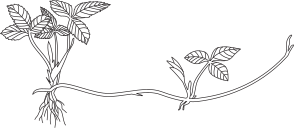
A strawberry plant will send out over the ground runners which will take root and grow a new plant as shown.
 

This method of growing a new plant is an example of

  1. budding.
  2. binary fission.
  3. external fertilisation.
  4. asexual reproduction.
Show Answers Only

`D`

Show Worked Solution
  • Runners are plant stems which grow and take root to produce a new plant.
  • This does not involve the use of pollen or seeds (sexual reproduction) and the new strawberry plant will be genetically identical to the first.

`=>D`

Filed Under: Reproduction Tagged With: Band 2, smc-3647-25-Plant, smc-3647-40-Sexual vs Asexual

BIOLOGY, M5 2019 HSC 27

Yeast is a single-celled fungus that can reproduce by budding.

  1. What type of reproduction is budding?   (1 mark)

    --- 2 WORK AREA LINES (style=lined) ---

  2. Outline a procedure that could be used to test the effect of temperature on reproduction in yeast.   (4 marks)

    --- 8 WORK AREA LINES (style=lined) ---

Show Answers Only

a.   Asexual.

b.   Steps of procedure:

  1. Prepare 4 water baths of 20, 30, 40 and 50 degrees Celsius.
  2. Add 10mL of yeast suspension in 12 different test tubes.
  3. Place 3 test tubes into each of the 4 water baths.
  4. Incubate for 3 hours.
  5. Take a drop from each test tube and inspect under a microscope using a mm grid and recording yeast counts for each.
  6. Compare the number of cells present at each temperature to see which temperature is most optimal for yeast reproduction.
Show Worked Solution

a.   Asexual.

b.   Steps of procedure:

  1. Prepare 4 water baths of 20, 30, 40 and 50 degrees Celsius.
  2. Add 10mL of yeast suspension in 12 different test tubes.
  3. Place 3 test tubes into each of the 4 water baths.
  4. Incubate for 3 hours.
  5. Take a drop from each test tube and inspect under a microscope using a mm grid and recording yeast counts for each.
  6. Compare the number of cells present at each temperature to see which temperature is most optimal for yeast reproduction.

♦♦ Mean mark (b) 45%.

Filed Under: Reproduction Tagged With: Band 3, Band 5, smc-3647-35-Fungi, smc-3647-40-Sexual vs Asexual

BIOLOGY, M5 2021 HSC 2 MC

Which of the following photographs shows an example of sexual reproduction?


Show Answers Only

`D`

Show Worked Solution

By Elimination

  • Budding in fungi, binary fission in bacteria and runners in plants are all examples of asexual reproduction (Eliminate A, B and C).
  • Frog spawning requires a female to lay eggs and a male frog to fertilise them with sperm.

`=>D`

Filed Under: Reproduction Tagged With: Band 3, smc-3647-05-Human/Mammal, smc-3647-10-Other animal, smc-3647-25-Plant, smc-3647-40-Sexual vs Asexual

Copyright © 2014–2025 SmarterEd.com.au · Log in