SmarterEd

Aussie Maths & Science Teachers: Save your time with SmarterEd

  • Login
  • Get Help
  • About

BIOLOGY, M5 2025 HSC 8 MC

When a red camellia flower is crossed with a white camellia flower, all the offspring are covered in both red and white petals.

What is the reason for this occurrence?

  1. One gene is controlling multiple characteristics.
  2. Environmental factors affect the phenotype of camellia flowers.
  3. Alleles for both red and white colour in camellia flowers are recessive.
  4. Petal colour in camellia flowers is controlled by a co-dominance pattern of inheritance.
Show Answers Only

\(D\)

Show Worked Solution
  • D is correct: Both alleles are expressed equally producing red and white petals.

Other Options:

  • A is incorrect: One gene controls one characteristic; this is pleiotropy not co-dominance.
  • B is incorrect: Environmental factors don’t explain both parental colours appearing in offspring.
  • C is incorrect: Both alleles are expressed, indicating co-dominance not recessive inheritance.

Filed Under: Genetic Variation / Inheritance Tagged With: Band 5, smc-3648-40-Co-Dominance

BIOLOGY, M5 2014 HSC 10 MC

Why do co-dominant alleles NOT produce simple Mendelian ratios?

  1. Both alleles are expressed in the phenotype.
  2. Neither allele is expressed in the phenotype.
  3. The recessive allele is only expressed in the homozygous genotype.
  4. The expression of the dominant allele is affected by the recessive allele.
Show Answers Only

`A`

Show Worked Solution
  • In regular Mendelian allele ratios, the heterozygous genotype means the dominant allele is expressed.
  • In co-dominance, the heterozygous individuals have both alleles expressed, with single alleles only expressed in homozygous genotypes.

`=>A`

Filed Under: Genetic Variation / Inheritance Tagged With: Band 4, smc-3648-40-Co-Dominance

BIOLOGY, M5 2018 HSC 28

  1. Define the terms genotype and phenotype.  (2 marks)

    --- 4 WORK AREA LINES (style=lined) ---

  2. A population of mammals living in a very cold climate have long, thick fur which assists their survival. At times, a widespread infestation of mites causes their fur to become thin, and bald patches appear in their coats. In this population some individuals are resistant to the mites. This is due to the presence of a co-dominant allele `(text{M}^text(R))`. Individuals that are homozygous for this allele `(text{M}^text(R)text{M}^text(R))` are infertile.
  3. Explain how both genotype and phenotype influence the inheritance of genes and natural selection in this population.  (4 marks)

    --- 10 WORK AREA LINES (style=lined) ---

Show Answers Only

a.   Definitions:

  • Genotype refers to the genetic makeup or combination of genes for a specific trait in an organism.
  • Phenotype refers to the physical manifestation of the genotype or how it appears, develops or behaves in the organism.

b.   Genotype and Phenotype influences:

  • The selection pressure for the mammals is long, thick fur to enable them to survive the cold climate.
  • Therefore the allele for long, thick hair is carried by most of the population.
  • The phenotype of these mammals has changed because of the mite infestation.
  • Even though they still have genes for long fur their survival fitness has been compromised as they develop bald patches.
  • The survival of the mammals should be improved during infestations because they possess the mite resistant gene.
  • However, they become infertile when they carry the two alleles – homozygous `(text{M}^text{R}text{M}^text{R})`.
  • Even though they are genetically better suited to the conditions, having long fur and mite resistance, they cannot pass the genes on as they are sterile.
  • Heterozygotes will have some mite resistance as the allele for mite resistance is co-dominant, so their survival rates will be better than those without the allele.
  • The allele can be kept in the population as it can be passed by heterozygotes to future generations.
Show Worked Solution

a.   Definitions:

  • Genotype refers to the genetic makeup or combination of genes for a specific trait in an organism.
  • Phenotype refers to the physical manifestation of the genotype or how it appears, develops or behaves in the organism.  

b.   Genotype and Phenotype influences:

  • The selection pressure for the mammals is long, thick fur to enable them to survive the cold climate.
  • Therefore the allele for long, thick hair is carried by most of the population.
  • The phenotype of these mammals has changed because of the mite infestation.
  • Even though they still have genes for long fur their survival fitness has been compromised as they develop bald patches.
  • The survival of the mammals should be improved during infestations because they possess the mite resistant gene.
  • However, they become infertile when they carry the two alleles – homozygous `(text{M}^text{R}text{M}^text{R})`.
  • Even though they are genetically better suited to the conditions, having long fur and mite resistance, they cannot pass the genes on as they are sterile.
  • Heterozygotes will have some mite resistance as the allele for mite resistance is co-dominant, so their survival rates will be better than those without the allele.
  • The allele can be kept in the population as it can be passed by heterozygotes to future generations.

♦ Mean mark (b) 44%.

Filed Under: Genetic Variation / Inheritance Tagged With: Band 4, Band 5, smc-3648-40-Co-Dominance

BIOLOGY, M5 2017 HSC 15 MC

A plant breeder crosses two plants of the same species. They are both pure-breeds for flower colour. The colour of the flowers of all the offspring is the same, but different to that of the parents.

What type of inheritance does this result show?

  1. Sex-linked
  2. Recessive
  3. Dominance
  4. Co-dominance
Show Answers Only

`D`

Show Worked Solution
  • Co-dominance occurs when both alleles are fully expressed in the genotype, and a colour different from either parent is produced.

`=>D`

Filed Under: Genetic Variation / Inheritance Tagged With: Band 4, smc-3648-40-Co-Dominance

BIOLOGY, M5 2019 HSC 30

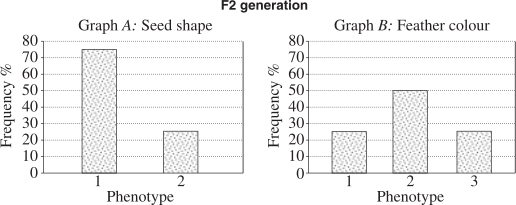
Experiments were conducted to obtain data on the traits 'seed shape' in plants and 'feather colour' in chickens. In each case, the original parents were pure breeding and produced the first generation (F1). The frequency data diagrams below relate to the second generation offspring (F2), produced when the F1 generations were bred together.
 

Explain the phenotypic ratios of the F2 generation in both the plant and chicken breeding experiments. Include Punnett squares and a key to support your answer.   (5 marks)

--- 12 WORK AREA LINES (style=lined) ---

Show Answers Only
  • Graph A shows a 3:1 phenotypic ratio. This is typical of a dominant/recessive allele phenotypic ratio of two heterozygous parents.
  • The Punnet square below supports this argument, where R refers to the dominant seed shape (e.g. round) and r is the recessive allele, producing another seed shape (e.g. wrinkled). The offspring have a 3:1 ratio of dominant : recessive seed shape.

\begin{array} {|c|c|c|}\hline  & \text{R} & \text{r} \\ \hline \text{R} & \text{RR} & \text{Rr} \\ \hline \text{r} & \text{Rr} & \text{rr} \\ \hline \end{array}

Key: R = Round     r = wrinkled

  • Graph B shows a 1:2:1 phenotypic ratio. Because both parents are heterozygous, this ratio is typical of a co-dominant or incomplete dominant trait.
  • If B is an allele referring to black colour feathers and W is the allele for white colour feathers then both parents will be BW, which is either grey colour feathers (co-dominance) or both black and white feathers (incomplete dominance). A cross between these genotypes will produce a phenotypic ratio of the same seen in the graph.

\begin{array} {|c|c|c|}\hline  & \text{B} & \text{W} \\ \hline \text{B} & \text{BB} & \text{BW} \\ \hline \text{W} & \text{BW} & \text{WW} \\ \hline \end{array}

Key: B = Black Feathers     W= White Feathers

Show Worked Solution
  • Graph A shows a 3:1 phenotypic ratio. This is typical of a dominant/recessive allele phenotypic ratio of two heterozygous parents.
  • The Punnet square below supports this argument, where R refers to the dominant seed shape (e.g. round) and r is the recessive allele, producing another seed shape (e.g. wrinkled). The offspring have a 3:1 ratio of dominant : recessive seed shape.

\begin{array} {|c|c|c|}\hline  & \text{R} & \text{r} \\ \hline \text{R} & \text{RR} & \text{Rr} \\ \hline \text{r} & \text{Rr} & \text{rr} \\ \hline \end{array}

Key: R = Round     r = wrinkled

  • Graph B shows a 1:2:1 phenotypic ratio. Because both parents are heterozygous, this ratio is typical of a co-dominant or incomplete dominant trait.
  • f B is an allele referring to black colour feathers and W is the allele for white colour feathers then both parents will be BW, which is either grey colour feathers (co-dominance) or both black and white feathers (incomplete dominance). A cross between these genotypes will produce a phenotypic ratio of the same seen in the graph.

\begin{array} {|c|c|c|}\hline  & \text{B} & \text{W} \\ \hline \text{B} & \text{BB} & \text{BW} \\ \hline \text{W} & \text{BW} & \text{WW} \\ \hline \end{array}

Key: B = Black Feathers     W= White Feathers


♦♦ Mean mark 44%.

Filed Under: Genetic Variation / Inheritance Tagged With: Band 5, Band 6, smc-3648-20-Punnet Squares, smc-3648-35-Autosomal, smc-3648-40-Co-Dominance, smc-3648-45-Incomplete Dominance

Copyright © 2014–2025 SmarterEd.com.au · Log in