SmarterEd

Aussie Maths & Science Teachers: Save your time with SmarterEd

  • Login
  • Get Help
  • About

BIOLOGY, M5 2025 HSC 31

Congenital amegakaryocytic thrombocytopenia (CAMT) is a rare, inherited disorder where bone marrow no longer makes platelets that are important for clotting and preventing bleeding. The pedigree below shows the inheritance of CAMT in a family.
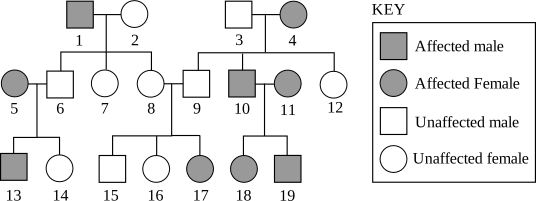
 

  1. What type of inheritance is shown in the pedigree above? Justify your answer?   (3 marks)
Type of Inheritance:  

--- 7 WORK AREA LINES (style=lined) ---

  1. A CAMT mutation was found to produce the following amino acid sequence:
    1. Glutamine – Tyrosine – Isoleucine – Aspartic acid.
  2. The same DNA fragment has been sequenced from an unaffected individual.
  3. Template strand           GTC ATA CAG CTG.
  4. The following codon chart displays all the codons and corresponding amino acids. The chart translates mRNA sequences into amino acids.
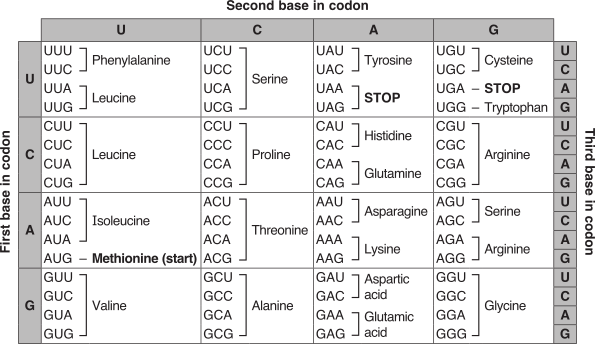
      

  5. Use the codon chart shown to explain the type of mutation which causes CAMT.   (3 marks)

    --- 7 WORK AREA LINES (style=lined) ---

Show Answers Only

a.    Type of inheritance: Autosomal recessive

  • Both males and females are affected equally, ruling out sex-linked inheritance.
  • Two affected parents (10 and 11) produce only affected offspring (17, 18, 19). This is consistent with autosomal recessive inheritance (aa × aa = all aa).
  • The disorder skips generations. Unaffected carriers can pass on the recessive allele without expressing the phenotype.
  • Affected individual 5 and unaffected individual 6 produce affected child 13, confirming individual 6 is a heterozygous carrier.

b.   Type of mutation causing CAMT

  • The template strand transcribes to mRNA CAG UAU GUC GAC, which translates to Glutamine-Tyrosine-Valine-Aspartic acid in unaffected individuals.
  • In CAMT, Isoleucine replaces Valine at position 3. This results from a single nucleotide substitution changing the codon from GUC to an Isoleucine codon.
  • This is a point mutation (missense mutation). This causes one amino acid replacement, which affects protein function and leads to impaired platelet production.
Show Worked Solution

a.    Type of inheritance: Autosomal recessive

  • Both males and females are affected equally, ruling out sex-linked inheritance.
  • Two affected parents (10 and 11) produce only affected offspring (17, 18, 19). This is consistent with autosomal recessive inheritance (aa × aa = all aa).
  • The disorder skips generations. Unaffected carriers can pass on the recessive allele without expressing the phenotype.
  • Affected individual 5 and unaffected individual 6 produce affected child 13, confirming individual 6 is a heterozygous carrier.

b.   Type of mutation causing CAMT

  • The template strand transcribes to mRNA CAG UAU GUC GAC, which translates to Glutamine-Tyrosine-Valine-Aspartic acid in unaffected individuals.
  • In CAMT, Isoleucine replaces Valine at position 3. This results from a single nucleotide substitution changing the codon from GUC to an Isoleucine codon.
  • This is a point mutation (missense mutation). This causes one amino acid replacement, which affects protein function and leads to impaired platelet production.

Filed Under: Genetic Variation / Inheritance Tagged With: Band 4, Band 5, smc-3648-10-Pedigrees, smc-3648-75-Inheritance Patterns

BIOLOGY, M5 2024 HSC 28

Cystic fibrosis is an inherited disorder that causes damage to the lungs, digestive system and other organs in the body. A person with cystic fibrosis will have two faulty recessive alleles for the cystic fibrosis gene (CFTR) on chromosome 7.

  1. Two healthy parents, heterozygous for cystic fibrosis, have a child that does not have cystic fibrosis. They are planning to have a second child.

    Using a Punnett square, determine the probability of their second child being born with the condition. Use \(R\) for the normal CFTR allele, and \(r\) for the faulty CFTR allele.   (3 marks)

--- 3 WORK AREA LINES (style=lined) ---
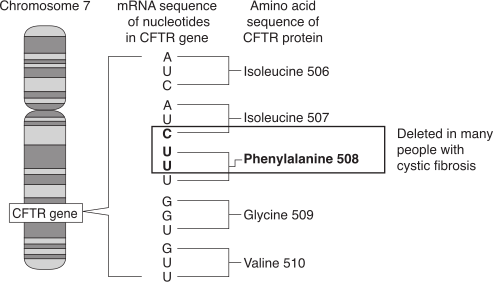
The defect that creates the faulty CFTR allele is often caused by the deletion of three nucleotides. The following diagram illustrates a small section of the CFTR gene and the corresponding amino acid sequence of the CFTR protein.
 
 
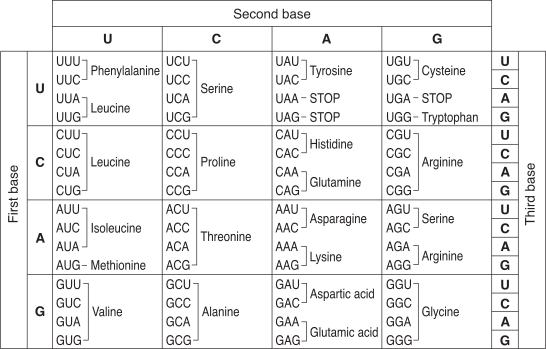
The following codon chart displays all the codons and the corresponding amino acids. The chart translates mRNA sequences into amino acids.
 
  1. Explain how the deletion of nucleotides in the CFTR gene removes only one amino acid. Include reference to the nucleotides that code for isoleucine and phenylalanine amino acids.   (4 marks)

--- 8 WORK AREA LINES (style=lined) ---
Show Answers Only

a.    Punnett square:

\begin{array} {|c|c|c|}
\hline
\rule{0pt}{2.5ex} \text{} \rule[-1ex]{0pt}{0pt} & \boldsymbol{R} & \boldsymbol{r} \\
\hline
\rule{0pt}{2.5ex} \boldsymbol{R} \rule[-1ex]{0pt}{0pt} & \textit{RR} & \textit{Rr} \\
\hline
\rule{0pt}{2.5ex} \boldsymbol{r}\rule[-1ex]{0pt}{0pt} & \textit{Rr} & \textit{rr} \\
\hline
\end{array}

Probability of 2nd child having cystic fibrosis = 25%.
 

b.    Deletion of nucleotides in CFTR gene:

  • Three mRNA nucleotides (a codon) spell out instructions for one amino acid. The deletion here stretches across two codons that normally code for isoleucine and phenylalanine.
  • At first glance, you’d expect losing nucleotides from both codons would mess up both amino acids.
  • In isoleucine however, multiple different triplet codes can signal for its production. Its original code was AUC and after the deletion it became AUU – which still makes isoleucine.
  • Only phenylalanine gets knocked out of the protein sequence, while isoleucine stays put thanks to its flexible coding options.

Show Worked Solution

a.    Punnett square:

\begin{array} {|c|c|c|}
\hline
\rule{0pt}{2.5ex} \text{} \rule[-1ex]{0pt}{0pt} & \boldsymbol{R} & \boldsymbol{r} \\
\hline
\rule{0pt}{2.5ex} \boldsymbol{R} \rule[-1ex]{0pt}{0pt} & \textit{RR} & \textit{Rr} \\
\hline
\rule{0pt}{2.5ex} \boldsymbol{r}\rule[-1ex]{0pt}{0pt} & \textit{Rr} & \textit{rr} \\
\hline
\end{array}

Probability of 2nd child having cystic fibrosis = 25%.
 

b.    Deletion of nucleotides in CFTR gene:

  • Three mRNA nucleotides (a codon) spell out instructions for one amino acid. The deletion here stretches across two codons that normally code for isoleucine and phenylalanine.
  • At first glance, you’d expect losing nucleotides from both codons would mess up both amino acids.
  • In isoleucine however, multiple different triplet codes can signal for its production. Its original code was AUC and after the deletion it became AUU – which still makes isoleucine.
  • Only phenylalanine gets knocked out of the protein sequence, while isoleucine stays put thanks to its flexible coding options.
♦ Mean mark (b) 56%.

Filed Under: Genetic Variation / Inheritance Tagged With: Band 3, Band 5, smc-3648-20-Punnet Squares, smc-3648-75-Inheritance Patterns, smc-3652-45-Deletions

BIOLOGY, M5 2020 VCE 11a

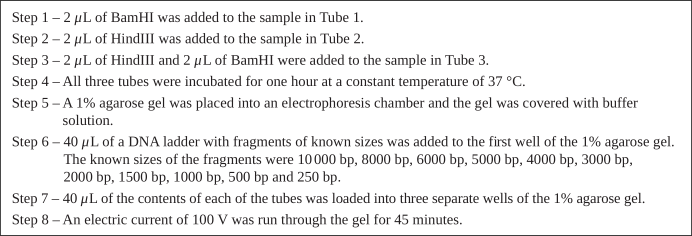
A student wanted to investigate the effect of two different endonucleases (restriction enzymes) on a linear DNA fragment.

The student used three tubes containing a buffered solution of linear DNA fragments, each fragment being 9500 base pairs in length.

Two different endonucleases were available: BamHI and HindIII.

The student followed the steps below.

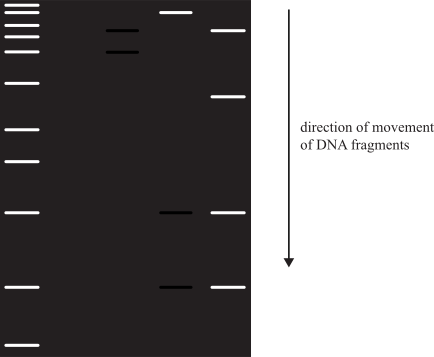
After 45 minutes the student obtained the results shown below

    Tube 1 Rube 2 Tube 3
DNA   BamHI HindIII BamHI
ladder       HindIII

Analyse the results of the experiment performed by the student.   (5 marks)

--- 10 WORK AREA LINES (style=lined) ---

Show Answers Only

Answers could include 5 of the following:

  • Smaller DNA fragments tend to migrate further during gel electrophoresis compared to larger fragments.
  • A standard or marker is used as a point of comparison and reference to determine the size of unknown DNA fragments.
  • The restriction enzyme BamH1 cuts the DNA molecule at a single location, resulting in the formation of two DNA fragments.
  • The restriction enzyme HindIII cuts the DNA molecule at two distinct locations, producing three DNA fragments.
  • When the DNA is cut with the HindIII enzyme, it results in the largest and smallest DNA fragments compared to other restriction enzyme digestions.
  • The DNA fragments generated by the BamH1 enzyme are 4000 bp and 5500 bp in length, while the fragments produced by HindIII are 8000 bp,1000 bp, and 500 bp. 
  • When the DNA is digested with both BamH1 and HindIII enzymes, a total of four DNA fragments are produced, with sizes of 5500 bp, 2500 bp, 1000 bp, and 500 bp.

Show Worked Solution

Answers could include 5 of the following:

  • aller DNA fragments tend to migrate further during gel electrophoresis compared to larger fragments.
  • A standard or marker is used as a point of comparison and reference to determine the size of unknown DNA fragments.
  • The restriction enzyme BamH1 cuts the DNA molecule at a single location, resulting in the formation of two DNA fragments.
  • The restriction enzyme HindIII cuts the DNA molecule at two distinct locations, producing three DNA fragments.
  • When the DNA is cut with the HindIII enzyme, it results in the largest and smallest DNA fragments compared to other restriction enzyme digestions.
  • The DNA fragments generated by the BamH1 enzyme are 4000 bp and 5500 bp in length, while the fragments produced by HindIII are 8000 bp,1000 bp, and 500 bp. 
  • When the DNA is digested with both BamH1 and HindIII enzymes, a total of four DNA fragments are produced, with sizes of 5500 bp, 2500 bp, 1000 bp, and 500 bp.


♦♦ Mean mark 50%.
COMMENT: 39% of responses received 0 or 1 mark

Filed Under: Genetic Variation / Inheritance Tagged With: Band 5, smc-3648-75-Inheritance Patterns

BIOLOGY, M5 2023 HSC 25d

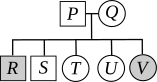
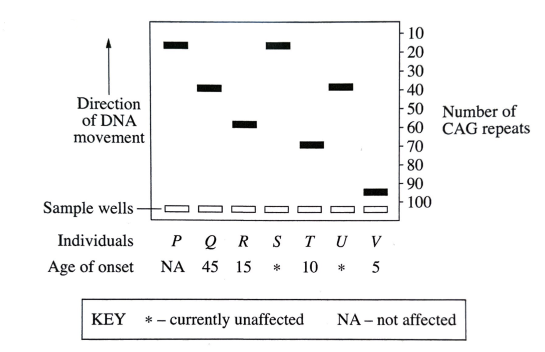
The normal Huntingtin protein has 10−26 repeats of CAG. In Huntington’s 2 disease there are 37−80 repeats.

Diagram 1 shows a pedigree of a family known to be affected by Huntington's disease. Diagram 2 shows the results of gel electrophoresis on fragments of DNA from chromosome four, known to be altered in Huntington's disease.

Diagram 1

Diagram 2

Predict whether individuals \(S\) and \(U\) will be affected by Huntington's disease, and if so, at what age. Use data from the diagrams to justify your answer.   (3 marks) 

--- 6 WORK AREA LINES (style=lined) ---

Show Answers Only
  • Individual \(U\) has the same number of CAG repeats as individual \(Q\) and therefore would be expected to be affected by Huntington’s at the same age, 45.
  • Individual \(S\) has a normal number of repeats (between 10-26) and much like individual \(P\) who has the same number of repeats, he is not expected to be affected by Huntington’s.
Show Worked Solution
  • Individual \(U\) has the same number of CAG repeats as individual \(Q\) and therefore would be expected to be affected by Huntington’s at the same age, 45.
  • Individual \(S\) has a normal number of repeats (between 10-26) and much like individual \(P\) who has the same number of repeats, he is not expected to be affected by Huntington’s.

Filed Under: Genetic Variation / Inheritance Tagged With: Band 4, smc-3648-75-Inheritance Patterns

BIOLOGY, M5 SM-Bank 23

Explain the purpose of gel electrophoresis in DNA profiling.  (2 marks)

Show Answers Only
  • Gel electrophoresis separates DNA segments based on size.
  • This process produces characteristic banding patterns.
Show Worked Solution
  • Gel electrophoresis separates DNA segments based on size.
  • This process produces characteristic banding patterns.

Filed Under: Genetic Variation / Inheritance Tagged With: Band 4, smc-3648-75-Inheritance Patterns

BIOLOGY, M5 EQ-Bank 25

A student plans to investigate whether the development of insulin has affected the prevalence of Type 1 diabetes in the human population and subsequently influenced human evolution. She has access to data on Australians with diabetes extending back to 1973 .

  1. Propose a suitable hypothesis for this investigation.   (2 marks)

    --- 4 WORK AREA LINES (style=lined) ---

  2. Identify TWO variables that need to be controlled for this investigation and explain their importance.   (4 marks)

    --- 10 WORK AREA LINES (style=lined) ---

Show Answers Only

a.   Two possible hypotheses include:

  • The development of insulin has led to a decrease in the prevalence of Type 1 diabetics.
  • The use of insulin by people who have Type 1 diabetes has increased the prevalence of Type 1 diabetes in the human population.
     

b.  Variables to be controlled:

  • The growth of the Australian population in general will statistically lead to a bias in more recent years, where higher a number of individuals with Type 1 diabetes is to be expected.
  • To control this variable, the investigation should be measured using a fixed rate such as ‘per 100 000’.
  • The time of diagnosis and length of time an individual has used insulin can impact the trend of the obtained data.
  • This data must be obtained and accounted for to be able to increase the validity of findings.
Show Worked Solution

a.   Two possible hypotheses include:

  • The development of insulin has led to a decrease in the prevalence of Type 1 diabetics.
  • The use of insulin by people who have Type 1 diabetes has increased the prevalence of Type 1 diabetes in the human population.

b.  Variables to be controlled

  • The growth of the Australian population in general will statistically lead to a bias in more recent years, where higher a number of individuals with Type 1 diabetes is to be expected.
  • To control this variable, the investigation should be measured using a fixed rate such as ‘per 100 000’.
  • The time of diagnosis and length of time an individual has used insulin can impact the trend of the obtained data.
  • This data must be obtained and accounted for to be able to increase the validity of findings.

Filed Under: Genetic Variation / Inheritance Tagged With: Band 4, Band 5, smc-3648-75-Inheritance Patterns

BIOLOGY, M5 EQ-Bank 16 MC

A student conducted a survey to determine the phenotype prevalence of cats that had long hair in comparison to the number that had short hair in a population of cats.

She asked her classmates to describe the coat length of their cats and tallied the results. Out of 26 cats that were counted, she found that 42% of the cats had long hair and 58% had short hair, and that the trait did not follow a Mendelian ratio.

Which of the following best explains why the results did not follow a Mendelian ratio?

  1. The student tallied the numbers incorrectly.
  2. The length of cat hair may be determined by more than one gene.
  3. The student cannot determine the genotype from the phenotype alone.
  4. The students were unclear about whether their cat had long or short hair.
Show Answers Only

`B`

Show Worked Solution

By Elimination

  • A and D relate to human error and cannot be deemed a valid reason for an experiment not appealing to a hypothesis (Eliminate A and D).
  • Many characteristics (phenotypes) are controlled by a variety of genes, including standard Mendelian alleles, sex-linked genes, multiple alleles and incomplete dominance/co-dominace. A combination of these may relate to the length of hair in cats, and is the best explanation of the results.

`=>B`

Filed Under: Genetic Variation / Inheritance Tagged With: Band 5, smc-3648-75-Inheritance Patterns

BIOLOGY, M5 2021 HSC 27

Sickle cell anaemia is a genetic disorder. In a family, the parents are both known to be heterozygous for the mutation that causes sickle cell anaemia. The couple has two unaffected children and is now expecting a third child. They have had an allele screening test to determine whether the child will have sickle cell anaemia.

A part of the DNA profile is shown. It shows the alleles present.
 

Use the DNA profile provided to justify whether Child 3 will have sickle cell anaemia.   (3 marks)

Show Answers Only
  • Sickle cell anaemia is a condition which affects homozygous recessive (aa) individuals for a particular allele, which is depicted by the bands in the DNA profile.
  • The mother, father and child 2 are heterozygous (Aa) for sickle cell anaemia, and are unaffected. Child 1 is unaffected and homozygous, proving the bottom band is the dominant allele.
  • Child 3 is homozygous for the other allele, meaning he is homozygous recessive and will  have sickle cell anaemia.
Show Worked Solution
  • Sickle cell anaemia is a condition which affects homozygous recessive (aa) individuals for a particular allele, which is depicted by the bands in the DNA profile.
  • The mother, father and child 2 are heterozygous (Aa) for sickle cell anaemia, and are unaffected. Child 1 is unaffected and homozygous, proving the bottom band is the dominant allele.
  • Child 3 is homozygous for the other allele, meaning he is homozygous recessive and will  have sickle cell anaemia.
Mean mark 51%.

Filed Under: Genetic Variation / Inheritance Tagged With: Band 5, smc-3648-75-Inheritance Patterns

Copyright © 2014–2025 SmarterEd.com.au · Log in