SmarterEd

Aussie Maths & Science Teachers: Save your time with SmarterEd

  • Login
  • Get Help
  • About

BIOLOGY, M5 2025 HSC 33

The following diagram shows the cell division processes occurring in two related individuals.
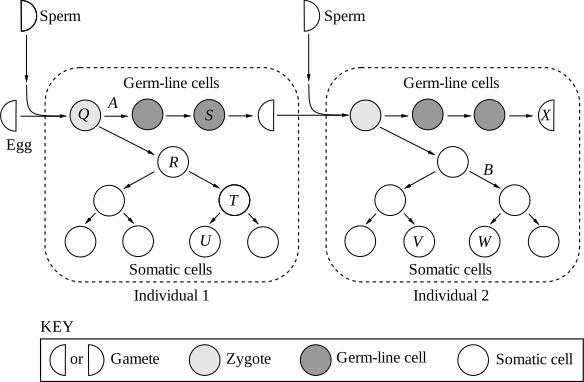
 

  1. Compare the cell division processes carried out by cells \(R\) and \(S\) in Individual 1.   (3 marks)

    --- 8 WORK AREA LINES (style=lined) ---

  2. Explain the relationship between Individuals 1 and 2.   (2 marks)

    --- 3 WORK AREA LINES (style=lined) ---

  3. \(A\) and \(B\) are two separate mutations. Analyse how mutations \(A\) and \(B\) affect the genetic information present in cells  \(U\), \(V\), \(W\) and \(X\).   (4 marks)

    --- 12 WORK AREA LINES (style=lined) ---
Show Answers Only

a.    Similarities:

  • Both cell R and cell S undergo cell division to produce daughter cells.

Differences:

  • Cell R undergoes mitosis producing two genetically identical diploid somatic cells (T and U).
  • Cell S undergoes meiosis producing four genetically different haploid gametes.
  • Mitosis in R maintains chromosome number for growth and repair.
  • Meiosis in S reduces chromosome number by half for sexual reproduction and genetic variation.

b.    Relationship between Individuals 1 and 2

  • Individual 2 is the offspring of Individual 1.
  • This is because Individual 1’s germ-line cell S produces a gamete (sperm) which fertilises an egg to form the zygote that develops into Individual 2.

c.    Mutation’s affect on genetic information

  • Mutation A occurs in the germ-line pathway after zygote Q. This means that mutation A is present in cell S and is passed to cell X.
  • Mutation A does not affect cells U, V or W because it occurred after the R/S split, so the R lineage and Individual 2’s somatic cells lack it.
  • Mutation B occurs in Individual 2’s somatic pathway. This results in mutation B being present in cells V and W only.
  • The significance is that only mutation A can be inherited by offspring, while mutation B cannot.
Show Worked Solution

a.    Similarities:

  • Both cell R and cell S undergo cell division to produce daughter cells.

Differences:

  • Cell R undergoes mitosis producing two genetically identical diploid somatic cells (T and U).
  • Cell S undergoes meiosis producing four genetically different haploid gametes.
  • Mitosis in R maintains chromosome number for growth and repair.
  • Meiosis in S reduces chromosome number by half for sexual reproduction and genetic variation.

b.    Relationship between Individuals 1 and 2

  • Individual 2 is the offspring of Individual 1.
  • This is because Individual 1’s germ-line cell S produces a gamete (sperm) which fertilises an egg to form the zygote that develops into Individual 2.

c.    Mutation’s affect on genetic information

  • Mutation A occurs in the germ-line pathway after zygote Q. This means that mutation A is present in cell S and is passed to cell X.
  • Mutation A does not affect cells U, V or W because it occurred after the R/S split, so the R lineage and Individual 2’s somatic cells lack it.
  • Mutation B occurs in Individual 2’s somatic pathway. This results in mutation B being present in cells V and W only.
  • The significance is that only mutation A can be inherited by offspring, while mutation B cannot.

Filed Under: Cell Replication, Mutation Tagged With: Band 5, Band 6, smc-3649-20-Meiosis, smc-3649-30-Mitosis, smc-3652-20-Somatic vs. Germ-Line

BIOLOGY, M5 EQ-Bank 28

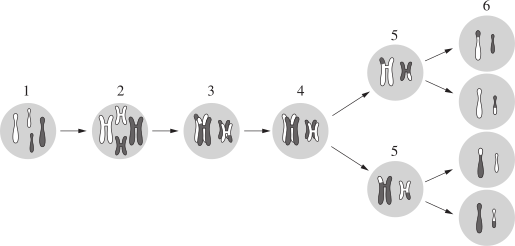
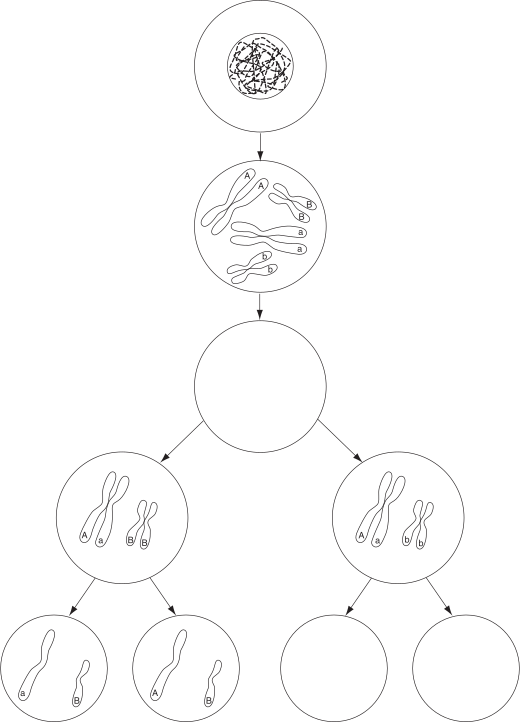
  1. Complete the following diagram to show the process by which gametes are formed.   (3 marks)


  2. How does the segregation of chromosomes during meiosis lead to a wide variety of gametes being produced?   (2 marks)

    --- 5 WORK AREA LINES (style=lined) ---

Show Answers Only

a.   


b.    Process creating wide variety of gametes

  • Independent assortment is the process by which homologous pairs are separated during meiosis into daughter cells.
  • During this process, daughter cell orientation and the cell they are separated into is random and not dependent on any factors.
  • This leads to a great variety in gametes due to the numerous combinations of chromosomes.
Show Worked Solution

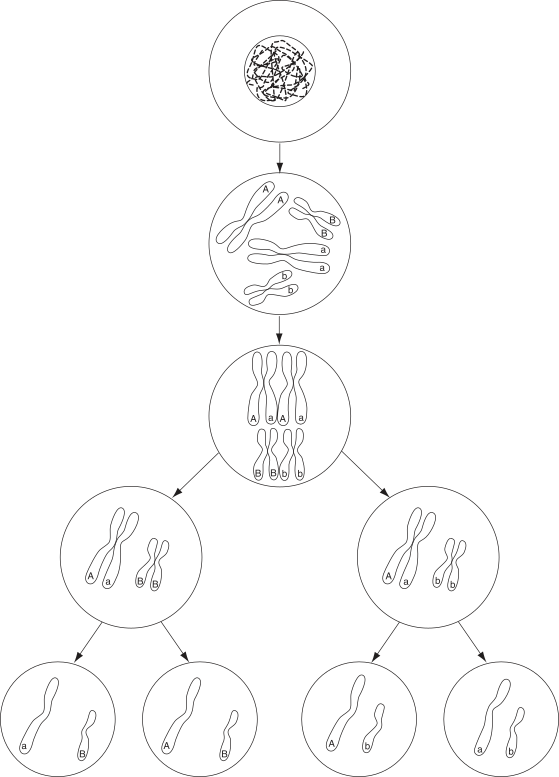
a.   


b.    Process creating wide variety of gametes

  • Independent assortment is the process by which homologous pairs are separated during meiosis into daughter cells.
  • During this process, daughter cell orientation and the cell they are separated into is random and not dependent on any factors.
  • This leads to a great variety in gametes due to the numerous combinations of chromosomes.

Filed Under: Cell Replication Tagged With: Band 5, Band 6, smc-3649-20-Meiosis

BIOLOGY, M5 EQ-Bank 4 MC

A student constructed a model of meiosis as shown. However, there is an error in the model.
 

Which aspect of this model does NOT fit with observations of meiosis?

  1. Separation of chromatids has not been shown in the model.
  2. The chromosomes have not independently assorted in stage 2 .
  3. The chromosomes in stage 4 should have duplicated before stage 5 .
  4. The chromosomes have undergone crossing over before sister chromosome alignment in stage 3 .
Show Answers Only

`D`

Show Worked Solution
  • Stage 4 and 5 have to switch to fix the error. All other aspects are correct.

`=>D`

Filed Under: Cell Replication Tagged With: Band 3, smc-3649-20-Meiosis

BIOLOGY, M5 2018 HSC 29

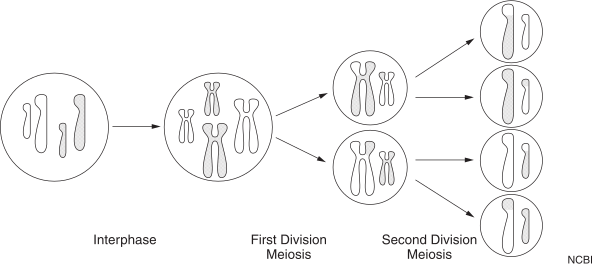
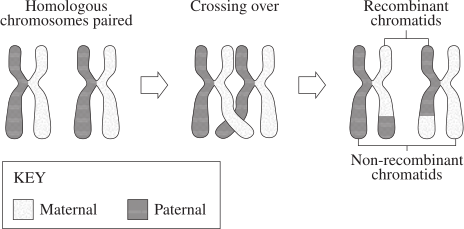
The diagram models the process of meiosis.
 

  1. Describe the process that accounts for the changes shown in the model during interphase.   (2 marks)

    --- 5 WORK AREA LINES (style=lined) ---

  2. Explain the structure and behaviour of chromosomes in the first division of meiosis. Include detailed reference to the model.   (5 marks)

    --- 12 WORK AREA LINES (style=lined) ---
Show Answers Only

a.   Interphase:

  • In preparation for cell division, DNA is replicated during interphase with the cell.
  • During replication the bonds between the hydrogen bases are broken and the DNA strands (double helix) are unwound into separate strands.
  • Polymerase enzymes add complementary nucleotides to each strand until the strands are identical DNA copies.
  • Half of the original strand is contained in each copy.

b.   The first division of meiosis:

  • Homologous chromosomes are represented in the model as the same size.
  • Different shading is used to distinguish between paternal or maternal origins.
  • Individual chromosomes form homologous pairs during the first division of meiosis.
  • These pairs have the same genes but the alleles are not identical.
  • Pairing results in crossing over and an exchange in genetic material between non-sister chromatids takes place.
  • The shading in the diagram illustrates these new combinations.
  • Half the number of chromosomes are possessed by the two resultant daughter cells (diploid cells ⇒ haploid cells).
  • These are randomly assigned, one from each homologous pair.
  • Therefore, when they return to the diploid number, new combinations of chromosomes and greater genetic variation results.
Show Worked Solution

a.   Interphase:

  • In preparation for cell division, DNA is replicated during interphase with the cell.
  • During replication the bonds between the hydrogen bases are broken and the DNA strands (double helix) are unwound into separate strands.
  • Polymerase enzymes add complementary nucleotides to each strand until the strands are identical DNA copies.
  • Half of the original strand is contained in each copy.

♦♦ Mean mark (a) 23%.

b.   The first division of meiosis:

  • Homologous chromosomes are represented in the model as the same size.
  • Different shading is used to distinguish between paternal or maternal origins.
  • Individual chromosomes form homologous pairs during the first division of meiosis.
  • These pairs have the same genes but the alleles are not identical.
  • Pairing results in crossing over and an exchange in genetic material between non-sister chromatids takes place.
  • The shading in the diagram illustrates these new combinations.
  • Half the number of chromosomes are possessed by the two resultant daughter cells (diploid cells ⇒ haploid cells).
  • These are randomly assigned, one from each homologous pair.
  • Therefore, when they return to the diploid number, new combinations of chromosomes and greater genetic variation results.

♦ Mean mark (b) 45%.

Filed Under: Cell Replication Tagged With: Band 5, Band 6, smc-3649-20-Meiosis

BIOLOGY, M5 2016 HSC 13-14 MC

Refer to the following information to answer Questions 13 and 14.

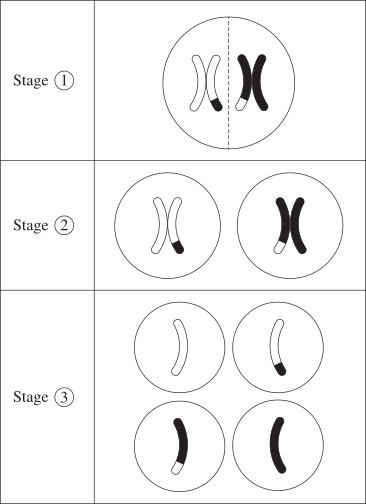
The diagram shows some chromosomes during some stages of meiosis.
 

Question 13

When does the segregation of homologous chromosomes occur?

  1. Before stage (1)
  2. Between stages (1) and (2)
  3. Between stages (2) and (3)
  4. Between stages (1) and (2) and again between stages (2) and (3)

 
Question 14

The chromosomes shown carry

  1. different genes and different alleles.
  2. different genes and the same alleles.
  3. the same genes and different alleles.
  4. the same genes and the same alleles.
Show Answers Only

Question 13: `B`

Question 14: `C`

Show Worked Solution

Question 13

  • Stage 1 shows homologous chromosomes, therefore segregation occurs between stages 1 and 2 (meiosis).

`=>B`


♦♦ Mean mark (Q13) 24%.

Question 14

  • The chromosomes carry the same genes as they are homologous, however, an exchange of alleles has taken place.

`=>C`


Mean mark (Q14) 51%.

Filed Under: Cell Replication Tagged With: Band 5, Band 6, smc-3649-20-Meiosis

BIOLOGY, M5 2022 HSC 17 MC

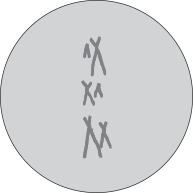
A student constructed a model of the phases of meiosis in an organism with six chromosomes in its somatic cells. One of the early phases is shown.
 

Which of the following identifies an error in the model?

  1. Chromosomes are not lined up single file on the metaphase plate.
  2. Chromosomes of matching size and structure are not paired.
  3. There are no homologous chromosomes.
  4. There are too many chromosomes.
Show Answers Only

`B`

Show Worked Solution
  • The student has tried to show metaphase I, as indicated by the chromosomes being lined up in the centre.
  • However, the model does not show that they must be aligned in tetrads.

`=>B`


♦ Mean mark 50%.

Filed Under: Cell Replication Tagged With: Band 5, smc-3649-20-Meiosis

BIOLOGY, M5 2020 HSC 28

  1. A student drew a diagram to model part of the process of meiosis.
     

  1. Explain the misunderstanding of meiosis shown in this model.   (3 marks)

    --- 6 WORK AREA LINES (style=lined) ---
  2. Explain the effect of meiosis on genetic variation.   (3 marks)

    --- 6 WORK AREA LINES (style=lined) ---
Show Answers Only

a.


  • In the diagram above, the paired homologous chromosomes are incorrectly drawn.
  • Prior to crossing over, each chromosome duplicates forming the sister chromatids with one being maternal and one being paternal.
  • In the model above, they are shown as a mix of both, when in actuality the sister chromatids should be identical.
     

b.   The Effect of Meiosis on Genetic Variation

Independent Assortment

  • when chromosomes are lined up along the cells equator in independent order and orientation to all other chromosomes.

Random Segregation  

  • different combinations of maternal and paternal chromosomes end up in resulting gametes, increasing variability amongst them.

Crossing Over

  • the process of exchanging genetic material between chromatids of homologous chromosomes during Meiosis I, leading to unique combinations of alleles on each chromatid.
Show Worked Solution

a.


  • In the diagram above, the paired homologous chromosomes are incorrectly drawn.
  • Prior to crossing over, each chromosome duplicates forming the sister chromatids with one being maternal and one being paternal.
  • In the model above, they are shown as a mix of both, when in actuality the sister chromatids should be identical.

♦♦♦ Mean mark (a) 25%.

b.   The Effect of Meiosis on Genetic Variation

Independent Assortment

  • when chromosomes are lined up along the cells equator in independent order and orientation to all other chromosomes.

Random Segregation  

  • different combinations of maternal and paternal chromosomes end up in resulting gametes, increasing variability amongst them.

Crossing Over

  • the process of exchanging genetic material between chromatids of homologous chromosomes during Meiosis I, leading to unique combinations of alleles on each chromatid.

♦ Mean mark (b) 43%.

Filed Under: Cell Replication, Genetic Variation / Inheritance Tagged With: Band 5, Band 6, smc-3648-50-Meiosis, smc-3649-20-Meiosis

Copyright © 2014–2025 SmarterEd.com.au · Log in