SmarterEd

Aussie Maths & Science Teachers: Save your time with SmarterEd

  • Login
  • Get Help
  • About

BIOLOGY, M5 EQ-Bank 21

There are some significant differences in the form that DNA has in prokaryotic and eukaryotic cells.

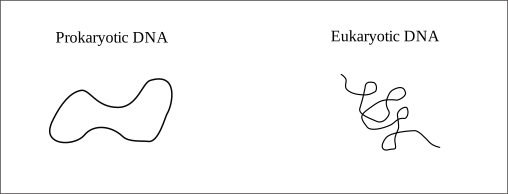
In the space provided draw a labelled diagram demonstrating the difference in the form of DNA between prokaryotic and eukaryotic cells.   (3 marks)

 

--- 0 WORK AREA LINES (style=lined) ---

Show Answers Only
Show Worked Solution

Points to note on images:

  • Prokaryotic DNA is in the form of a loop
  • Eukaryotic DNA has two loose ends and is tightly coiled in the body

Filed Under: DNA and Polypeptide Synthesis Tagged With: Band 3, smc-3650-40-Eukaryotes and Prokaryotes

BIOLOGY, M5 2022 HSC 28c

Outline the ways in which the DNA of prokaryotes and eukaryotes differ.   (3 marks)

--- 6 WORK AREA LINES (style=lined) ---

Show Answers Only
  • DNA of Prokaryotes is found in loops whereas the DNA of Eukaryotes is linear.
  • DNA of Prokaryotes is found in the nucleoid region whereas the DNA of Eukaryotes is found as multiple chromosomes in the nucleus (membrane).
  • Prokaryotes have extra “non-nucleoid” DNA in form of plasmids, non-coding fragments found within the cytoplasm, whereas Eukaryotes have non-nuclear DNA within mitochondria (animals) or chloroplasts (plants).
  • Prokaryotes contain nucleoid associated proteins which make DNA form looped structures, while Eukaryotic DNA contains histones, proteins which DNA can wrap around to condense into chromatin and chromosomes.
  • Eukaryotes have Introns, sections of DNA which are non-coding for polypeptides, where Prokaryotic DNA does not contain any non-coding regions.
Show Worked Solution
  • DNA of Prokaryotes is found in loops whereas the DNA of Eukaryotes is linear.
  • DNA of Prokaryotes is found in the nucleoid region whereas the DNA of Eukaryotes is found as multiple chromosomes in the nucleus (membrane).
  • Prokaryotes have extra “non-nucleoid” DNA in form of plasmids, non-coding fragments found within the cytoplasm, whereas Eukaryotes have non-nuclear DNA within mitochondria (animals) or chloroplasts (plants).
  • Prokaryotes contain nucleoid associated proteins which make DNA form looped structures, while Eukaryotic DNA contains histones, proteins which DNA can wrap around to condense into chromatin and chromosomes.
  • Eukaryotes have Introns, sections of DNA which are non-coding for polypeptides, where Prokaryotic DNA does not contain any non-coding regions.

♦♦♦ Mean mark 24%.

Filed Under: DNA and Polypeptide Synthesis Tagged With: Band 6, smc-3650-40-Eukaryotes and Prokaryotes

BIOLOGY, M5 2020 HSC 5 MC

Which row of the table best describes DNA in both prokaryotic and eukaryotic cells?

\begin{align*}
\begin{array}{l}
\rule{0pt}{2.5ex}\ \rule[-1ex]{0pt}{0pt}& \\
\rule{0pt}{2.5ex} \textbf{A.}\rule[-1ex]{0pt}{0pt}\\
\rule{0pt}{2.5ex} \textbf{B.}\rule[-1ex]{0pt}{0pt}\\
\rule{0pt}{2.5ex} \textbf{C.}\rule[-1ex]{0pt}{0pt}\\
\rule{0pt}{2.5ex} \textbf{D.}\rule[-1ex]{0pt}{0pt}\\
\end{array}
\begin{array}{|c|c|}
\hline \rule{0pt}{2.5ex} \textit{Prokaryotic } \rule[-1ex]{0pt}{0pt}& \textit{Eukaryotic} \\
\hline \rule{0pt}{2.5ex} \text {Circular} \rule[-1ex]{0pt}{0pt}& \text {Circular} \\
\hline \rule{0pt}{2.5ex} \text {Circular} \rule[-1ex]{0pt}{0pt}& \text {Linear} \\
\hline \rule{0pt}{2.5ex} \text {Linear} \rule[-1ex]{0pt}{0pt}& \text {Circular} \\
\hline \rule{0pt}{2.5ex}  \text {Linear} \rule[-1ex]{0pt}{0pt}& \text {Linear} \\
\hline
\end{array}
\end{align*}

Show Answers Only

\(B\)

Show Worked Solution
  • DNA for prokaryotes is contained in a single circular chromosome, as well as in circular plasmids.
  • Eukaryotes have their main coding DNA within densely packed linear chromosomes.

\(\Rightarrow B\)

Filed Under: DNA and Polypeptide Synthesis Tagged With: Band 4, smc-3650-40-Eukaryotes and Prokaryotes

Copyright © 2014–2025 SmarterEd.com.au · Log in