SmarterEd

Aussie Maths & Science Teachers: Save your time with SmarterEd

  • Login
  • Get Help
  • About

BIOLOGY, M8 2015 HSC 28

A group of students hypothesised that the height of plants decreases with increased elevation.

The students planted ten plant cuttings from the same plant at each of five locations. The locations were at varying elevations in the same mountain range. All the cuttings were provided with the same volume of water on planting, and no fertiliser was applied. The students returned after the same growth period and measured the height of the plants.

The cross-section shown indicates the average height of the plants in metres after the growth period at each location in the mountain range.
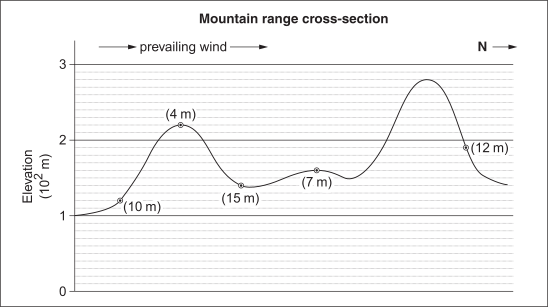
 

  1. Evaluate the validity of the experiment.   (3 marks)

    --- 8 WORK AREA LINES (style=lined) ---

  2. Complete both columns of the table to best present the data for the analysis of any trend.   (2 marks)

      

--- 0 WORK AREA LINES (style=lined) ---

Show Answers Only

a.    Factors affecting experiment validity:

  • There are many variables in this experiment that are not controlled, hence the experiment is invalid.
  • There is no real evidence that the differences in plant heights observed in the different locations are due to elevation alone.
  • Variables with adequate controls in the experiment include planting methods and genotype.
  • Factors other than these can affect plant growth and should have been considered.
  • Variables not controlled well include exposure to the prevailing wind, available sunlight at the various locations and size and health of cuttings at time of planting.
      

b.   Mountain Range cross-section data

\begin{array} {|c|c|}
\hline \text{Elevation (10² m)} & \text{Plant Height (m)} \\
\hline \ 1.2 & 10 \\
\hline \ 1.4 & 15 \\
\hline \ 1.6 & 7 \\
\hline \ 1.9 & 12 \\
\hline \ 2.2 & 4 \\
\hline \end{array}

Show Worked Solution

a.    Factors affecting experiment validity:

  • There are many variables in this experiment that are not controlled, hence the experiment is invalid.
  • There is no real evidence that the differences in plant heights observed in the different locations are due to elevation alone.
  • Variables with adequate controls in the experiment include planting methods and genotype.
  • Factors other than these can affect plant growth and should have been considered.
  • Variables not controlled well include exposure to the prevailing wind, available sunlight at the various locations and size and health of cuttings at time of planting.  

♦ Mean mark (a) 47%.

b.   Mountain Range cross-section data

\begin{array} {|c|c|}
\hline \text{Elevation (10² m)} & \text{Plant Height (m)} \\
\hline \ 1.2 & 10 \\
\hline \ 1.4 & 15 \\
\hline \ 1.6 & 7 \\
\hline \ 1.9 & 12 \\
\hline \ 2.2 & 4 \\
\hline \end{array}


Mean mark (b) 55%.

Filed Under: DNA and Polypeptide Synthesis Tagged With: Band 5, smc-3650-50-Environment

BIOLOGY, M5 2015 HSC 11 MC

Environment can affect phenotype by altering the sequence of bases in DNA.

Which of the following is an example of this?

  1. High protein diets making children taller than their parents
  2. Stress causing the expression of one set of genes instead of another
  3. Language and music lessons improving intelligence in young children
  4. Nuclear fallout from atomic bombs increasing birth defects in populations
Show Answers Only

`D`

Show Worked Solution
  • Mutation in genes is commonly caused by radiation

`=>D`

Filed Under: DNA and Polypeptide Synthesis Tagged With: Band 3, smc-3650-50-Environment

BIOLOGY, M5 2020 HSC 20 MC

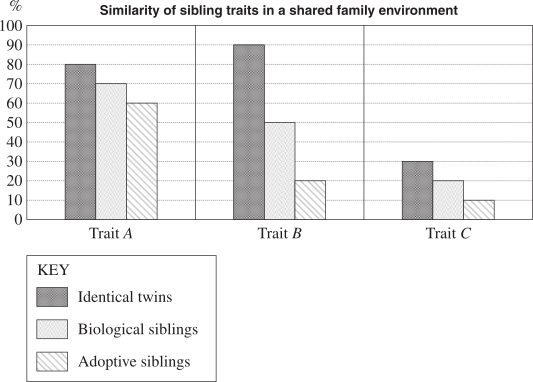
This chart illustrates three correlation patterns indicating the influence of genes and environment on different traits in individuals.
 

What does the data show about how genes and family environment affect the three traits?
 

Show Answers Only

`A`

Show Worked Solution
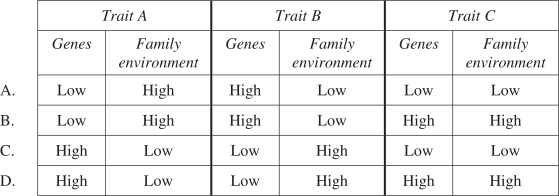
  • Trait `A` is similar in adoptive siblings that do not share much genetics.
  • Trait `B` is very similar in identical twins with identical genetics.
  • Trait `C` has little similarity between close relations or adoptive siblings.

`=>A`

Filed Under: DNA and Polypeptide Synthesis Tagged With: Band 4, smc-3650-50-Environment

Copyright © 2014–2025 SmarterEd.com.au · Log in