SmarterEd

Aussie Maths & Science Teachers: Save your time with SmarterEd

  • Login
  • Get Help
  • About

BIOLOGY, M5 2025 HSC 33

The following diagram shows the cell division processes occurring in two related individuals.
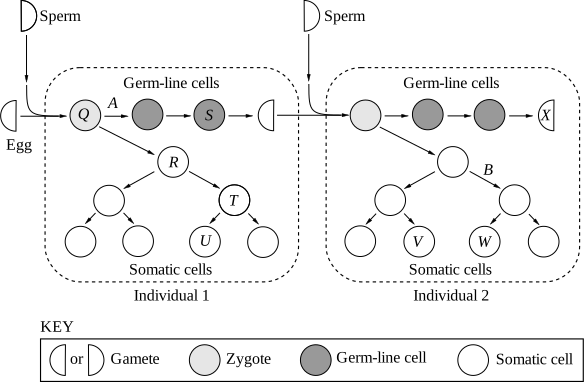
 

  1. Compare the cell division processes carried out by cells \(R\) and \(S\) in Individual 1.   (3 marks)

    --- 8 WORK AREA LINES (style=lined) ---

  2. Explain the relationship between Individuals 1 and 2.   (2 marks)

    --- 3 WORK AREA LINES (style=lined) ---

  3. \(A\) and \(B\) are two separate mutations. Analyse how mutations \(A\) and \(B\) affect the genetic information present in cells  \(U\), \(V\), \(W\) and \(X\).   (4 marks)

    --- 12 WORK AREA LINES (style=lined) ---
Show Answers Only

a.    Similarities:

  • Both cell R and cell S undergo cell division to produce daughter cells.

Differences:

  • Cell R undergoes mitosis producing two genetically identical diploid somatic cells (T and U).
  • Cell S undergoes meiosis producing four genetically different haploid gametes.
  • Mitosis in R maintains chromosome number for growth and repair.
  • Meiosis in S reduces chromosome number by half for sexual reproduction and genetic variation.

b.    Relationship between Individuals 1 and 2

  • Individual 2 is the offspring of Individual 1.
  • This is because Individual 1’s germ-line cell S produces a gamete (sperm) which fertilises an egg to form the zygote that develops into Individual 2.

c.    Mutation’s affect on genetic information

  • Mutation A occurs in the germ-line pathway after zygote Q. This means that mutation A is present in cell S and is passed to cell X.
  • Mutation A does not affect cells U, V or W because it occurred after the R/S split, so the R lineage and Individual 2’s somatic cells lack it.
  • Mutation B occurs in Individual 2’s somatic pathway. This results in mutation B being present in cells V and W only.
  • The significance is that only mutation A can be inherited by offspring, while mutation B cannot.
Show Worked Solution

a.    Similarities:

  • Both cell R and cell S undergo cell division to produce daughter cells.

Differences:

  • Cell R undergoes mitosis producing two genetically identical diploid somatic cells (T and U).
  • Cell S undergoes meiosis producing four genetically different haploid gametes.
  • Mitosis in R maintains chromosome number for growth and repair.
  • Meiosis in S reduces chromosome number by half for sexual reproduction and genetic variation.

b.    Relationship between Individuals 1 and 2

  • Individual 2 is the offspring of Individual 1.
  • This is because Individual 1’s germ-line cell S produces a gamete (sperm) which fertilises an egg to form the zygote that develops into Individual 2.

c.    Mutation’s affect on genetic information

  • Mutation A occurs in the germ-line pathway after zygote Q. This means that mutation A is present in cell S and is passed to cell X.
  • Mutation A does not affect cells U, V or W because it occurred after the R/S split, so the R lineage and Individual 2’s somatic cells lack it.
  • Mutation B occurs in Individual 2’s somatic pathway. This results in mutation B being present in cells V and W only.
  • The significance is that only mutation A can be inherited by offspring, while mutation B cannot.

Filed Under: Cell Replication, Mutation Tagged With: Band 5, Band 6, smc-3649-20-Meiosis, smc-3649-30-Mitosis, smc-3652-20-Somatic vs. Germ-Line

BIOLOGY, M6 2024 HSC 23

Outline how ONE type of electromagnetic radiation can cause a germline mutation.   (2 marks)

--- 4 WORK AREA LINES (style=lined) ---

Show Answers Only

Answers could include one of the following:

X-Ray Radiation

  • X-rays can cause damage to DNA, breaking chemical bonds and leading to mutations.
  • When this occurs in gametes (sex cells), the mutation will be passed on to future generations.

UV radiation

  • UV radiation can cause adjacent thymine bases in DNA to form incorrect bonds called dimers.
  • When this damage occurs in sperm or egg cells, these mutations can be inherited by offspring.
Show Worked Solution

Answers could include one of the following:

X-Ray Radiation

  • X-rays can cause damage to DNA, breaking chemical bonds and leading to mutations.
  • When this occurs in gametes (sex cells), the mutation will be passed on to future generations.

UV radiation

  • UV radiation can cause adjacent thymine bases in DNA to form incorrect bonds called dimers.
  • When this damage occurs in sperm or egg cells, these mutations can be inherited by offspring.
Mean mark 56%.

Filed Under: Mutation Tagged With: Band 4, smc-3652-20-Somatic vs. Germ-Line, smc-3652-55-Mutation in Reproduction

BIOLOGY, M6 2019 HSC 22

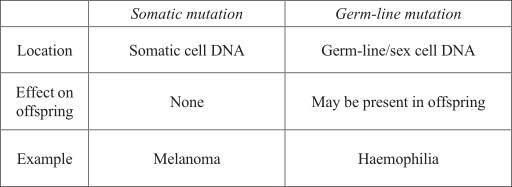
Complete the table to show the differences between somatic and germ-line mutations.   (3 marks)

\begin{array}{|c|c|c|}
\hline
\rule{0pt}{2.5ex}\ \rule[-1ex]{0pt}{0pt}& \quad \quad \textit{Somatic mutation} \quad \quad & \quad \quad\textit{Germ-line mutation}\quad \quad \\
\hline
\rule{0pt}{5ex}\text { Location } \rule[-4.5ex]{0pt}{0pt}& & \\
\hline
\rule{0pt}{4ex}\text {Effect on} \\
\rule[-4ex]{0pt}{0pt}\text {offspring} \\
\hline
\rule{0pt}{5ex}\text {Example } \rule[-4.5ex]{0pt}{0pt}& & \\
\hline
\end{array}

--- 0 WORK AREA LINES (style=lined) ---

Show Answers Only

Show Worked Solution


Mean mark 52%.

Filed Under: Mutation Tagged With: Band 5, smc-3652-20-Somatic vs. Germ-Line

BIOLOGY, M6 2019 HSC 15 MC

A germ-line mutation is known to have occurred.

How is it possible that there has been no noticeable change in the phenotype of the offspring?

  1. The mutation occurred in a stretch of RNA.
  2. The mutation occurred in a protein-coding region.
  3. The mutation occurred in a stretch of non-coding DNA.
  4. The mutation did not affect the DNA sequence of any gametes.
Show Answers Only

`C`

Show Worked Solution
  • For the mutation to not be noticeable in the offspring, it must have occurred within junk DNA (i.e. large sections of non-coding DNA with no known purpose).

`=>C`

Filed Under: Mutation Tagged With: Band 4, smc-3652-20-Somatic vs. Germ-Line, smc-3652-50-Non-Coding DNA

BIOLOGY, M6 2022 HSC 25

Offspring are rarely identical to their parents.

Compare the ways in which genetic variation can arise from asexual and sexual reproduction.   (6 marks)

--- 18 WORK AREA LINES (style=lined) ---

Show Answers Only

Asexual reproduction:

  • To produce offspring, this method is often undergone by single celled, colonial or very simple multicellular organisms, including fungi (budding/spores) and bacteria (binary fission).
  • It involves mitotic divisions resulting in offspring which are often genetically identical to the parent.
  • Variation may arise if a mutation occurs in the first cell of the division, leading to offspring with that mutation.

Sexual reproduction:

  • The reproduction method involves the fusion of male and female gametes to form offspring with genetical material from both parents.
  • Many processes are responsible for producing offspring with genetical variability which include:-
  • Processes in producing the gametes which lead to variability amongst them, including crossing over, independent assortment and random segregation.
  • Germ line mutations, which affect offspring but not the parent.
  • The randomness associated with fertilisation, where each unique gamete can combine, meaning many genetically varied offspring can be produced.
  • As a result of these processes, sexual reproduction often produces higher variability compared to asexually reproduced offspring.
Show Worked Solution

Asexual reproduction:

  • To produce offspring, this method is often undergone by single celled, colonial or very simple multicellular organisms, including fungi (budding/spores) and bacteria (binary fission).
  • It involves mitotic divisions resulting in offspring which are often genetically identical to the parent.
  • Variation may arise if a mutation occurs in the first cell of the division, leading to offspring with that mutation.

Sexual reproduction:

  • The reproduction method involves the fusion of male and female gametes to form offspring with genetical material from both parents.
  • Many processes are responsible for producing offspring with genetical variability which include:-
  • Processes in producing the gametes which lead to variability amongst them, including crossing over, independent assortment and random segregation.
  • Germ line mutations, which affect offspring but not the parent.
  • The randomness associated with fertilisation, where each unique gamete can combine, meaning many genetically varied offspring can be produced.
  • As a result of these processes, sexual reproduction often produces higher variability compared to asexually reproduced offspring.

♦ Mean mark 46%.

Filed Under: Mutation Tagged With: Band 5, smc-3652-20-Somatic vs. Germ-Line

BIOLOGY, M6 2020 HSC 29

Explain how TWO processes that affect the gene pool of populations can lead to evolution.   (5 marks)

Show Answers Only
  • A gene pool is the total genetic diversity of a population. It includes various genotypes and phenotypes which are a result of variability within offspring, the individual and the population. This process as a whole can be referred to as evolution.

Gene Flow

  • The movement of alleles in or out of a population, usually as a result of migration.
  • For example, immigration of an animal into a population as a result of environmental pressures or predators can result in the introduction of that animal’s unique phenotype into the gene pool of the population. 

Genetic Drift

  • The change in allele frequency as a result of a random event.
  • For example, an earthquake or other natural disaster eliminates organisms regardless of their genotype. The remaining individuals will then carry a small sample of the alleles present in the original population, some which might be eliminated.

Other answers could include

  • Mutation
  • Natural Selection
  • Sexual reproduction
Show Worked Solution
  • A gene pool is the total genetic diversity of a population. It includes various genotypes and phenotypes which are a result of variability within offspring, the individual and the population. This process as a whole can be referred to as evolution.

Gene Flow

  • The movement of alleles in or out of a population, usually as a result of migration.
  • For example, immigration of an animal into a population as a result of environmental pressures or predators can result in the introduction of that animal’s unique phenotype into the gene pool of the population. 

Genetic Drift

  • The change in allele frequency as a result of a random event.
  • For example, an earthquake or other natural disaster eliminates organisms regardless of their genotype. The remaining individuals will then carry a small sample of the alleles present in the original population, some which might be eliminated.

Other answers could include

  • Mutation
  • Natural Selection
  • Sexual reproduction

Mean mark 53%.

Filed Under: Mutation Tagged With: Band 4, Band 5, smc-3652-10-Mechanisms of Change/Variation, smc-3652-20-Somatic vs. Germ-Line, smc-3652-55-Mutation in Reproduction

BIOLOGY, M6 2020 HSC 18 MC

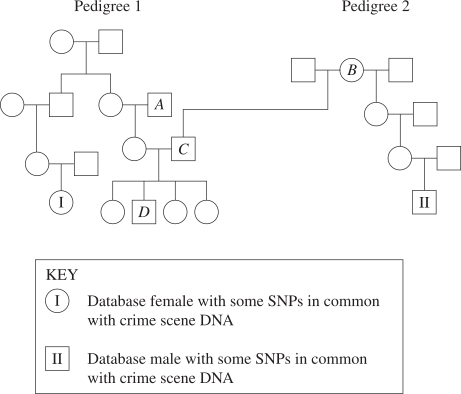
SNP databases have been used in forensic investigations. One is outlined below.

  1. DNA was collected at a crime scene 30 years ago.
  2. Recently the crime scene DNA was analysed at 700 000 SNP locations.
  3. An SNP profile was created and uploaded to a genealogy database.
  4. The SNP profile from the crime scene indicated some shared SNPs with two individuals (who did not have SNPs in common).
  5. The pedigrees were constructed for the two individuals.
     

Which person is most likely to be the suspect who should be investigated?

  1. `A`
  2. `B`
  3. `C`
  4. `D`
Show Answers Only

`D`

Show Worked Solution
  • Individual `D` is the only individual that shares DNA with both I and II and is the most likely suspect.

`=>D`

♦♦♦ Mean mark 17%.

Filed Under: Mutation Tagged With: Band 6, smc-3652-20-Somatic vs. Germ-Line

BIOLOGY, M6 2021 HSC 24b

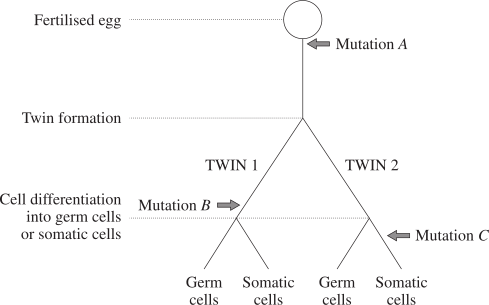
The diagram shows the early stages of embryonic development from a fertilised egg. The developing ball of cells has split and monozygotic (identical) twins have formed. Mutations can occur at different times during embryonic development, for example Mutation `A` would result in both twins having the mutation in all their cells.


Explain the effects of Mutation `B` and Mutation `C` on each twin and on any offspring that they may have.   (4 marks)

--- 8 WORK AREA LINES (style=lined) ---

Show Answers Only
  • Mutation B occurred after twin formation but prior to cell differentiation, affecting just Twin 1’s somatic and germ-line cells.
  • Through affecting germ-line cells, it will then affect the offspring.
  • Mutation C occurred after twin formation and after cell differentiation, only affecting Twin 2’s somatic cells.
  • Because it doesn’t affect germ-line cells, this mutation cannot be passed onto offspring.
Show Worked Solution
  • Mutation B occurred after twin formation but prior to cell differentiation, affecting just Twin 1’s somatic and germ-line cells.
  • Through affecting germ-line cells, it will then affect the offspring.
  • Mutation C occurred after twin formation and after cell differentiation, only affecting Twin 2’s somatic cells.
  • Because it doesn’t affect germ-line cells, this mutation cannot be passed onto offspring.

Filed Under: Mutation Tagged With: Band 4, smc-3652-20-Somatic vs. Germ-Line, smc-3652-55-Mutation in Reproduction

BIOLOGY, M5 2021 HSC 24a

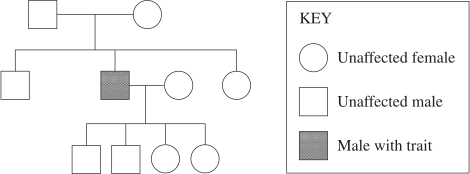
An incidence of an autosomal dominant trait is shown in the pedigree.


Is this trait likely to be the result of a somatic or a germ-line mutation? Justify your answer.   (3 marks)

--- 5 WORK AREA LINES (style=lined) ---

Show Answers Only
  • The mutation must be somatic as the trait is not present in the parents.
  • If the mutation were germ-line, occurring in cells that produce gametes, then the trait would most likely be seen in the parents and offspring as it is dominant.
Show Worked Solution
  • The mutation must be somatic as the trait is not present in the parents.
  • If the mutation were germ-line, occurring in cells that produce gametes, then the trait would most likely be seen in the parents and offspring as it is dominant.

Filed Under: Genetic Variation / Inheritance Tagged With: Band 4, smc-3652-20-Somatic vs. Germ-Line

Copyright © 2014–2025 SmarterEd.com.au · Log in