SmarterEd

Aussie Maths & Science Teachers: Save your time with SmarterEd

  • Login
  • Get Help
  • About

BIOLOGY, M6 2023 HSC 35

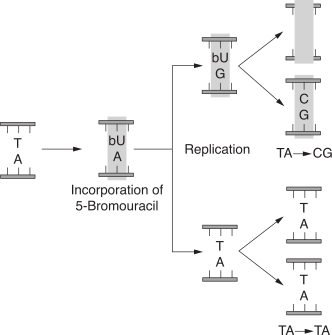
5-Bromouracil (bU) is a synthetic chemical mutagen. It bonds with adenine in place of thymine in DNA. During replication, it then binds with guanine.

This will then make a guanine-cytosine pair on one strand of DNA instead of an adenine-thymine pair.
 

  1. Identify the type of mutation that is caused by bU.   (1 mark)

    --- 2 WORK AREA LINES (style=lined) ---

  2. Describe the possible effects on a protein if this mutation occurred within a gene.   (4 marks)

    --- 8 WORK AREA LINES (style=lined) ---
Show Answers Only

a.   Point mutation or substitution mutation

b.   Protein effects if mutation within gene:

  • If this mutation occurred within coding DNA, then the RNA produced would be G–C instead of A–T (depending on the strand).
  • As a result, when it is read by a ribosome a different codon will be read, which may or may not code for the same amino-acid.
  • If the mutation codes for a different amino-acid, a different polypeptide chain will form. 
  • This mutation process could cause the protein to fold differently which can alter it’s function or render it completely dysfunctional.
  • Alternatively, the new codon could also be interpreted as a stop codon, pre-emptively stopping production of the rest of the polypeptide chain. 

Show Worked Solution

a.   Point mutation or substitution mutation

b.   Protein effects if mutation within gene:

  • If this mutation occurred within coding DNA, then the RNA produced would be G–C instead of A–T (depending on the strand).
  • As a result, when it is read by a ribosome a different codon will be read, which may or may not code for the same amino-acid.
  • If the mutation codes for a different amino-acid, a different polypeptide chain will form. 
  • This mutation process could cause the protein to fold differently which can alter it’s function or render it completely dysfunctional.
  • Alternatively, the new codon could also be interpreted as a stop codon, pre-emptively stopping production of the rest of the polypeptide chain. 
♦ Mean mark (b) 46%.

Filed Under: DNA and Polypeptide Synthesis, Mutation Tagged With: Band 4, Band 5, smc-3650-20-Translation, smc-3650-30-Transcription, smc-3650-60-Proteins, smc-3652-30-Point Mutations, smc-3652-60-Mutagens

BIOLOGY, M6 EQ-Bank 27

Compare the processes and effects of point mutations and chromosomal mutations. Include examples in your answer.   (8 marks)

--- 20 WORK AREA LINES (style=lined) ---

Show Answers Only
  • Mutations are the change in an individuals genome. Their effects are dependent on
    • the location of the mutation. Mutations in coding DNA can affect proteins and have adverse physiological affects while mutations in non-coding DNA often have no affect, however may slightly impact cell activity.
    • the type of cell it occurs in. Somatic cell mutations only affect the individual, while germ-line mutations occur in germ-line cells which go on to produce gametes, thus potentially affecting offspring. 
  • Point mutations are mutations which change only a single base in a DNA sequence. They can be a single base substitution or the deletion or insertion of an extra base. Deletion or insertions are referred to as ‘frameshift’ mutations as they impact all codons proceeding it.
  • Sometimes substitution mutations are neutral and occur in non-coding DNA, code for an amino acid of very similar chemical composition or even code for the same amino acid. When a mutation does code for a dissimilar amino acid or a stop codon causing premature termination, this interferes with the shape of the polypeptide chain and the protein it becomes part of, rendering it faulty or completely unusable (e.g. sickle cell anaemia, NRAS mutation). The nature of frameshift mutations affecting every codon proceeding it are often more severe, as there is more potential to cause a faulty polypeptide chain (e.g. cystic fibrosis).
  • Chromosomal mutations can refer to the removal, insertion, translocation or inversion of large sections of a chromosome. These often affect genes by either splitting them up or relocating them to a new chromosome.
  • Chromosomal mutations can also refer to the relocation of entire chromosomes during meiosis of germ-line cells where they fail to separate. This is called non-disjunction and results in aneuploidy of two gametes, one which will result in having an extra chromosome (trisomy) and one will lack a chromosome (monosomy). Conditions such as Down’s syndrome (trisomy-21) or Turner syndrome (XO) are aneuploidy conditions but most often cause a miscarriage or unsuccessful zygote development.
  • Polyploidy is the complete development of an entirely new set of chromosomes. This is known to occur in strawberries which have 8 sets of chromosomes but cannot occur in humans.
  • While both can cause radical health defects, it is important to note that these mutations are the basis of evolution. Beneficial mutations are more likely to be carried through a species through generations according to natural selection.
Show Worked Solution
  • Mutations are the change in an individuals genome. Their effects are dependent on
    • the location of the mutation. Mutations in coding DNA can affect proteins and have adverse physiological affects while mutations in non-coding DNA often have no affect, however may slightly impact cell activity.
    • the type of cell it occurs in. Somatic cell mutations only affect the individual, while germ-line mutations occur in germ-line cells which go on to produce gametes, thus potentially affecting offspring. 
  • Point mutations are mutations which change only a single base in a DNA sequence. They can be a single base substitution or the deletion or insertion of an extra base. Deletion or insertions are referred to as ‘frameshift’ mutations as they impact all codons proceeding it.
  • Sometimes substitution mutations are neutral and occur in non-coding DNA, code for an amino acid of very similar chemical composition or even code for the same amino acid. When a mutation does code for a dissimilar amino acid or a stop codon causing premature termination, this interferes with the shape of the polypeptide chain and the protein it becomes part of, rendering it faulty or completely unusable (e.g. sickle cell anaemia, NRAS mutation). The nature of frameshift mutations affecting every codon proceeding it are often more severe, as there is more potential to cause a faulty polypeptide chain (e.g. cystic fibrosis).
  • Chromosomal mutations can refer to the removal, insertion, translocation or inversion of large sections of a chromosome. These often affect genes by either splitting them up or relocating them to a new chromosome.
  • Chromosomal mutations can also refer to the relocation of entire chromosomes during meiosis of germ-line cells where they fail to separate. This is called non-disjunction and results in aneuploidy of two gametes, one which will result in having an extra chromosome (trisomy) and one will lack a chromosome (monosomy). Conditions such as Down’s syndrome (trisomy-21) or Turner syndrome (XO) are aneuploidy conditions but most often cause a miscarriage or unsuccessful zygote development.
  • Polyploidy is the complete development of an entirely new set of chromosomes. This is known to occur in strawberries which have 8 sets of chromosomes but cannot occur in humans.
  • While both can cause radical health defects, it is important to note that these mutations are the basis of evolution. Beneficial mutations are more likely to be carried through a species through generations according to natural selection.

Filed Under: Mutation Tagged With: Band 4, Band 5, smc-3652-30-Point Mutations, smc-3652-40-Chromosomal Mutations, smc-3652-55-Mutation in Reproduction

BIOLOGY, M6 EQ-Bank 22

The flow chart illustrates the effect of a point mutation on an organism.
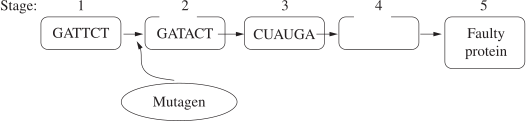
 

  1. Outline the series of events from stages 2 to 4 that resulted in the faulty protein.   (3 marks)

    --- 5 WORK AREA LINES (style=lined) ---

  2. Describe how a type of mutagen may have caused the changes observed in stage 2.   (2 marks)

    --- 5 WORK AREA LINES (style=lined) ---

  3. Given the information in the chart shown, describe the effect caused by the mutation in stage 4 and the effect this would have on the organism.   (3 marks)


    --- 6 WORK AREA LINES (style=lined) ---

Show Answers Only

a.    Events causing faulty protein:

  • Stage 2: A mutagen causes a point mutation in the DNA.
  • Stage 3: The mutated DNA transcription into mRNA.
  • Stage 4: The translation of the mRNA into a polypeptide chain which is not functional due to the mutation.

b.    Possible causes of Stage 2 observed changes:

  • High frequency photons including gamma and X-rays are regarded as ionising radiation due to their extremely high energy.
  • They can interfere with DNA undergoing replication causing misalignment and a possible substation change.
  • High energy gamma radiation may also cause mutation when directly striking a nitrogenous base.  

Answers could also include

  • Chemical mutagens (alkylating, delaminating and structurally similar chemicals).
  • Carcinogenic metals/elements (radon, cadmium)

c.   Effects of Stage 4 mutation:

  • When considering the above sequence as 2 codons, the chart shows us that this mutation results in an arginine amino becoming a stop codon.
  • This mutation will hence cause a premature termination of the polypeptide and result in a non-functional polypeptide/protein it forms a part of.
  • Due to the severity of this type of mutation it usually results in extensive health complications for affected individuals.
Show Worked Solution

a.    Events causing faulty protein:

  • Stage 2: A mutagen causes a point mutation in the DNA.
  • Stage 3: The mutated DNA transcription into mRNA.
  • Stage 4: The translation of the mRNA into a polypeptide chain which is not functional due to the mutation.

b.    Possible causes of Stage 2 observed changes:

  • High frequency photons including gamma and X-rays are regarded as ionising radiation due to their extremely high energy.
  • They can interfere with DNA undergoing replication causing misalignment and a possible substation change.
  • High energy gamma radiation may also cause mutation when directly striking a nitrogenous base.  

Answers could also include

  • Chemical mutagens (alkylating, delaminating and structurally similar chemicals).
  • Carcinogenic metals/elements (radon, cadmium)

c.   Effects of Stage 4 mutation:

  • When considering the above sequence as 2 codons, the chart shows us that this mutation results in an arginine amino becoming a stop codon.
  • This mutation will hence cause a premature termination of the polypeptide and result in a non-functional polypeptide/protein it forms a part of.
  • Due to the severity of this type of mutation it usually results in extensive health complications for affected individuals.

Filed Under: Mutation Tagged With: Band 3, Band 4, Band 5, smc-3652-30-Point Mutations, smc-3652-60-Mutagens

BIOLOGY, M6 EQ-Bank 14 MC

Which of the following is true of a mutation that produces an allele that is dominant?

  1. It would be expected to cause death.
  2. It could give an observable phenotype in a heterozygous genotype.
  3. It could give an observable phenotype only in a homozygous genotype.
  4. It would be expected to spread more quickly through a population than a recessive mutation.
Show Answers Only

`B`

Show Worked Solution

By Elimination

  • Mutations are not expected to cause death as death is dependant on the location and type of mutation (Eliminate A).
  • A dominant allele mutation vs recessive has no impact on spread in a population (Eliminate D).
  • The change in phenotype is not only possible in homozygous recessive phenotypes but also in heterozygous individuals (Eliminate C).

`=>B`

Filed Under: Mutation Tagged With: Band 5, smc-3652-30-Point Mutations, smc-3652-40-Chromosomal Mutations

BIOLOGY, M6 EQ-Bank 7 MC

The following events occur after DNA is subjected to radiation. The events are listed in no specific order.

1:  Mutation
2: Change in cell activity
3: Change in protein structure
4: Change in polypeptide sequence

What is the correct sequence of steps?

  1. 1, 2, 3, 4
  2. 4, 2, 1, 3
  3. 4, 3, 2, 1
  4. 1, 4, 3, 2
Show Answers Only

`D`

Show Worked Solution

`=>D`

Filed Under: Mutation Tagged With: Band 4, smc-3652-30-Point Mutations, smc-3652-60-Mutagens

BIOLOGY, M6 EQ-Bank 12 MC

The bread mould, Neurospora crassa, normally produces its own amino acids from raw materials through a system of enzymes.
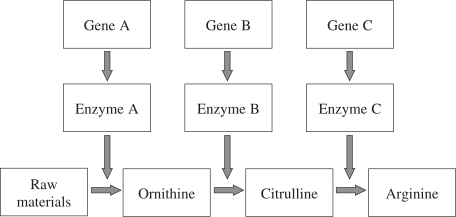
 

If a mutation occurred in gene B, the bread mould would still produce arginine if supplied with

  1. citrulline.
  2. ornithine.
  3. enzyme C.
  4. raw materials.
Show Answers Only

`A`

Show Worked Solution
  • Enzyme B only aids the production of ornithine to citrulline.
  • If the mould was directly supplied with citrulline, this would bypass enzyme B and it would be able to still produce arginine.

`=>A`

Filed Under: Mutation Tagged With: Band 4, smc-3652-30-Point Mutations, smc-3652-40-Chromosomal Mutations

BIOLOGY, M6 2014 HSC 33d

The data compare a segment of the eye control gene in mice to the equivalent gene segment in a range of different species. The expression of these genes is necessary for eye development to begin.
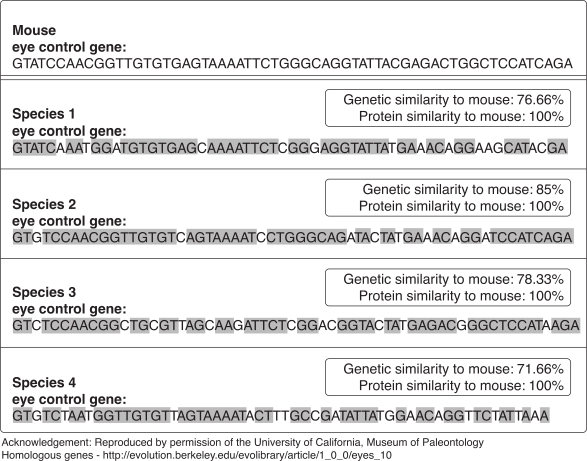
 

Note: grey highlighted bases are the same as those in the mouse gene.

  1. With reference to the data in the table, explain why it is possible for different gene sequences to produce the same protein.   (2 marks)

    --- 5 WORK AREA LINES (style=lined) ---

  2. Discuss ONE strength and ONE limitation of using the data shown to determine the evolutionary relationships between these species.   (4 marks)

    --- 8 WORK AREA LINES (style=lined) ---

Show Answers Only

i.    Different gene sequences → same protein

  • Differences in base sequences can still code for the same amino acid, and therefore the same protein will be produced. This is often referred to as a silent change.
  • A change producing a different amino acid can have no effect on the protein if the amino acids are chemically similar. For example leucine and isoleucine are so similar that a change in DNA sequence resulting in this change will have no effect on the protein it codes for. This is called a neutral change.

ii.   Strengths could include:

  • Despite having different sequences, each polypeptide chain/protein it is a part of will go on to initiate eye development.
  • This provides evidence that a once common ancestor had the eye development gene similar to that of all species, providing evidence of their close ancestry.
  • The average rate of mutation can also be used as a measure of time since divergence from the common ancestor. For example, species 2 may have more recently diverted as it has a genetic similarity of 85% when compared to species 4, which only has 71.66% similarity.  

Limitations could include:

  • The study only shows the relationship of one gene which is very small in comparison to the whole genome. This is a weak comparison as the rest of the genome may have intense variation and just studying this gene could provide false information.
  • Studying only one gene also increases the risk of encountering back mutations, mutations of a variation which revert back to the original sequence, making the species seem more closely related. This can also give false information about evolutionary relationships and ancestry.
Show Worked Solution

i.    Different gene sequences → same protein

  • Differences in base sequences can still code for the same amino acid, and therefore the same protein will be produced. This is often referred to as a silent change.
  • A change producing a different amino acid can have no effect on the protein if the amino acids are chemically similar. For example leucine and isoleucine are so similar that a change in DNA sequence resulting in this change will have no effect on the protein it codes for. This is called a neutral change.

♦♦ Mean mark (i) 40%.

ii.   Strengths could include:

  • Despite having different sequences, each polypeptide chain/protein it is a part of will go on to initiate eye development.
  • This provides evidence that a once common ancestor had the eye development gene similar to that of all species, providing evidence of their close ancestry.
  • The average rate of mutation can also be used as a measure of time since divergence from the common ancestor. For example, species 2 may have more recently diverted as it has a genetic similarity of 85% when compared to species 4, which only has 71.66% similarity.  

Limitations could include:

  • The study only shows the relationship of one gene which is very small in comparison to the whole genome. This is a weak comparison as the rest of the genome may have intense variation and just studying this gene could provide false information.
  • Studying only one gene also increases the risk of encountering back mutations, mutations of a variation which revert back to the original sequence, making the species seem more closely related. This can also give false information about evolutionary relationships and ancestry.

♦♦ Mean mark (ii) 41%.

Filed Under: Mutation Tagged With: Band 5, smc-3652-10-Mechanisms of Change/Variation, smc-3652-30-Point Mutations

BIOLOGY, M6 2022 HSC 13 MC

The section of DNA shown in Question 12 came into contact with a mutagen, resulting in a change in the cytosine. The effect on the DNA after several replication cycles is shown.
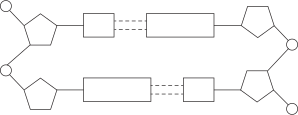
 

The mutagen has resulted in

  1. a frame-shift mutation.
  2. an increase in cytosine.
  3. a change in one base pair.
  4. a change in one nucleotide.
Show Answers Only

`C`

Show Worked Solution
  • The Guanine-Cytosine bond has changed to a Thymine-Adenine bond, resulting in the change in that base pair.

`=>C`


♦ Mean mark 40%.

Filed Under: Mutation Tagged With: Band 5, smc-3652-30-Point Mutations

BIOLOGY, M6 2020 HSC 23

The following diagram shows a mutation.
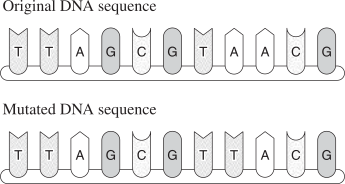
 

  1. What type of mutation is shown in the diagram?   (1 mark)

    --- 1 WORK AREA LINES (style=lined) ---

  2. Outline another type of mutation.   (2 marks)

    --- 3 WORK AREA LINES (style=lined) ---

Show Answers Only

a.   Point mutation (substitution of adenosine to thymine, base number 8).

b.   Chromosomal mutation:

  • This occurs when there is a change in the number or structure of chromosomes within an individual’s genome.
Show Worked Solution

a.   Point mutation (substitution of adenosine to thymine, base number 8).

b.   Chromosomal mutation:

  • This occurs when there is a change in the number or structure of chromosomes within an individual’s genome.

♦ Mean mark (b) 46%.

Filed Under: Mutation Tagged With: Band 4, Band 5, smc-3652-30-Point Mutations, smc-3652-40-Chromosomal Mutations

Copyright © 2014–2025 SmarterEd.com.au · Log in