SmarterEd

Aussie Maths & Science Teachers: Save your time with SmarterEd

  • Login
  • Get Help
  • About

BIOLOGY, M6 2024 HSC 23

Outline how ONE type of electromagnetic radiation can cause a germline mutation.   (2 marks)

--- 4 WORK AREA LINES (style=lined) ---

Show Answers Only

Answers could include one of the following:

X-Ray Radiation

  • X-rays can cause damage to DNA, breaking chemical bonds and leading to mutations.
  • When this occurs in gametes (sex cells), the mutation will be passed on to future generations.

UV radiation

  • UV radiation can cause adjacent thymine bases in DNA to form incorrect bonds called dimers.
  • When this damage occurs in sperm or egg cells, these mutations can be inherited by offspring.
Show Worked Solution

Answers could include one of the following:

X-Ray Radiation

  • X-rays can cause damage to DNA, breaking chemical bonds and leading to mutations.
  • When this occurs in gametes (sex cells), the mutation will be passed on to future generations.

UV radiation

  • UV radiation can cause adjacent thymine bases in DNA to form incorrect bonds called dimers.
  • When this damage occurs in sperm or egg cells, these mutations can be inherited by offspring.
Mean mark 56%.
Filed Under: Mutation Tagged With: Band 4, smc-3652-20-Somatic vs. Germ-Line, smc-3652-55-Mutation in Reproduction

BIOLOGY, M6 EQ-Bank 27

Compare the processes and effects of point mutations and chromosomal mutations. Include examples in your answer.   (8 marks)

--- 20 WORK AREA LINES (style=lined) ---

Show Answers Only
  • Mutations are the change in an individuals genome. Their effects are dependent on
    • the location of the mutation. Mutations in coding DNA can affect proteins and have adverse physiological affects while mutations in non-coding DNA often have no affect, however may slightly impact cell activity.
    • the type of cell it occurs in. Somatic cell mutations only affect the individual, while germ-line mutations occur in germ-line cells which go on to produce gametes, thus potentially affecting offspring. 
  • Point mutations are mutations which change only a single base in a DNA sequence. They can be a single base substitution or the deletion or insertion of an extra base. Deletion or insertions are referred to as ‘frameshift’ mutations as they impact all codons proceeding it.
  • Sometimes substitution mutations are neutral and occur in non-coding DNA, code for an amino acid of very similar chemical composition or even code for the same amino acid. When a mutation does code for a dissimilar amino acid or a stop codon causing premature termination, this interferes with the shape of the polypeptide chain and the protein it becomes part of, rendering it faulty or completely unusable (e.g. sickle cell anaemia, NRAS mutation). The nature of frameshift mutations affecting every codon proceeding it are often more severe, as there is more potential to cause a faulty polypeptide chain (e.g. cystic fibrosis).
  • Chromosomal mutations can refer to the removal, insertion, translocation or inversion of large sections of a chromosome. These often affect genes by either splitting them up or relocating them to a new chromosome.
  • Chromosomal mutations can also refer to the relocation of entire chromosomes during meiosis of germ-line cells where they fail to separate. This is called non-disjunction and results in aneuploidy of two gametes, one which will result in having an extra chromosome (trisomy) and one will lack a chromosome (monosomy). Conditions such as Down’s syndrome (trisomy-21) or Turner syndrome (XO) are aneuploidy conditions but most often cause a miscarriage or unsuccessful zygote development.
  • Polyploidy is the complete development of an entirely new set of chromosomes. This is known to occur in strawberries which have 8 sets of chromosomes but cannot occur in humans.
  • While both can cause radical health defects, it is important to note that these mutations are the basis of evolution. Beneficial mutations are more likely to be carried through a species through generations according to natural selection.
Show Worked Solution
  • Mutations are the change in an individuals genome. Their effects are dependent on
    • the location of the mutation. Mutations in coding DNA can affect proteins and have adverse physiological affects while mutations in non-coding DNA often have no affect, however may slightly impact cell activity.
    • the type of cell it occurs in. Somatic cell mutations only affect the individual, while germ-line mutations occur in germ-line cells which go on to produce gametes, thus potentially affecting offspring. 
  • Point mutations are mutations which change only a single base in a DNA sequence. They can be a single base substitution or the deletion or insertion of an extra base. Deletion or insertions are referred to as ‘frameshift’ mutations as they impact all codons proceeding it.
  • Sometimes substitution mutations are neutral and occur in non-coding DNA, code for an amino acid of very similar chemical composition or even code for the same amino acid. When a mutation does code for a dissimilar amino acid or a stop codon causing premature termination, this interferes with the shape of the polypeptide chain and the protein it becomes part of, rendering it faulty or completely unusable (e.g. sickle cell anaemia, NRAS mutation). The nature of frameshift mutations affecting every codon proceeding it are often more severe, as there is more potential to cause a faulty polypeptide chain (e.g. cystic fibrosis).
  • Chromosomal mutations can refer to the removal, insertion, translocation or inversion of large sections of a chromosome. These often affect genes by either splitting them up or relocating them to a new chromosome.
  • Chromosomal mutations can also refer to the relocation of entire chromosomes during meiosis of germ-line cells where they fail to separate. This is called non-disjunction and results in aneuploidy of two gametes, one which will result in having an extra chromosome (trisomy) and one will lack a chromosome (monosomy). Conditions such as Down’s syndrome (trisomy-21) or Turner syndrome (XO) are aneuploidy conditions but most often cause a miscarriage or unsuccessful zygote development.
  • Polyploidy is the complete development of an entirely new set of chromosomes. This is known to occur in strawberries which have 8 sets of chromosomes but cannot occur in humans.
  • While both can cause radical health defects, it is important to note that these mutations are the basis of evolution. Beneficial mutations are more likely to be carried through a species through generations according to natural selection.

Filed Under: Mutation Tagged With: Band 4, Band 5, smc-3652-30-Point Mutations, smc-3652-40-Chromosomal Mutations, smc-3652-55-Mutation in Reproduction

BIOLOGY, M6 2019 HSC 25

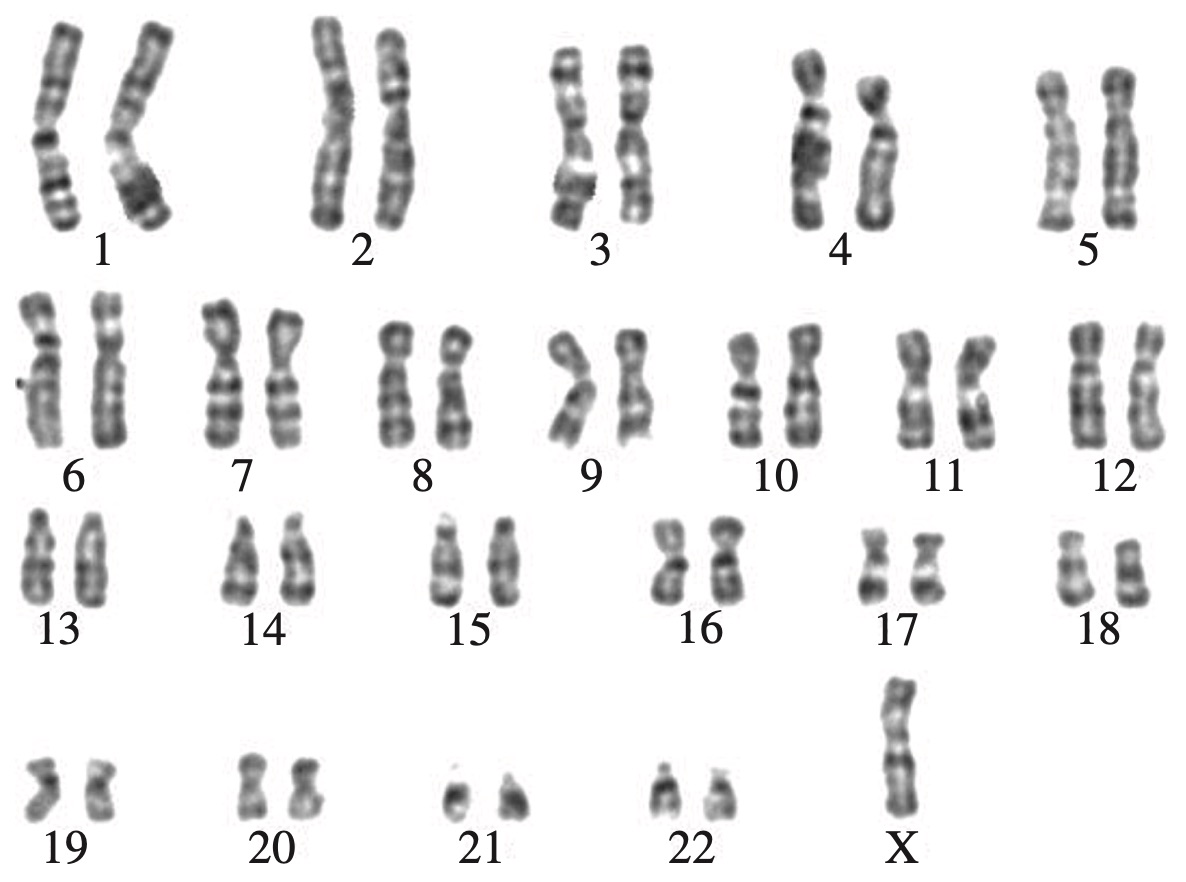
A human karyotype that shows evidence of chromosomal mutation is shown.

  1. Identify the evidence of chromosomal mutation in the karyotype.  (1 mark)

    --- 1 WORK AREA LINES (style=lined) ---

  2. Explain how cell division and fertilisation could lead to the production of this karyotype.  (4 marks)

    --- 8 WORK AREA LINES (style=lined) ---

Show Answers Only

a.   There is only one copy of the sex chromosome (Monosomy, Turner Syndrome).

b.    Process of producing karyotype:

  • During meiosis to produce a gamete, homologous chromosomes (during meiosis I) or sister chromatids (during meiosis II) may fail to separate.
  • This can occur with sex chromosomes, producing one gamete with 2 copies of the sex chromosome, and one without.
  • When the gamete without any sex cells undergoes fertilisation with a normal gamete with only one sex cell, the zygote will have only one sex cell, like the karyotype above.
Show Worked Solution

a.   There is only one copy of the sex chromosome (Monosomy, Turner Syndrome).

b.    Process of producing karyotype:

  • During meiosis to produce a gamete, homologous chromosomes (during meiosis I) or sister chromatids (during meiosis II) may fail to separate.
  • This can occur with sex chromosomes, producing one gamete with 2 copies of the sex chromosome, and one without.
  • When the gamete without any sex cells undergoes fertilisation with a normal gamete with only one sex cell, the zygote will have only one sex cell, like the karyotype above.

♦ Mean mark (a) 47%
♦♦♦ Mean mark (b) 24%.

Filed Under: Mutation Tagged With: Band 5, Band 6, smc-3652-40-Chromosomal Mutations, smc-3652-55-Mutation in Reproduction

BIOLOGY, M6 2022 HSC 32

Researchers have identified a gene that determines the inflammatory response of lung cells to infection with a virus. An allele of this gene is associated with increased inflammation and increased chance of death from the virus.

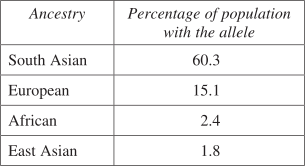
The table shows the percentage presence of the allele in people with different ancestries.
 

Explain how mutation, natural selection, genetic drift and gene flow could have led to these differences in the gene pools of populations with differing ancestry.   (7 marks)

--- 15 WORK AREA LINES (style=lined) ---

Show Answers Only

Mutation

  • A mutation is a mechanism of change which permanently alters DNA, changing genotype and phenotype of the ‘host’.
  • In this case, a mutation has occurred which has altered the gene responsible for the inflammatory response in the lungs in response to a virus, making death more common for people who contract the virus as the gene is now faulty.
  • Other mechanisms of variation such as natural selection, gene flow and genetic drift, are responsible for the allele frequency distribution.

Natural selection

  • Refers to the process where selection pressures such as predators, climate, or in this case the lung virus, favour certain individuals, which then means that their alleles can be carried into further generations.
  • It is highly likely that the virus was never present in South Asia, hence the high frequency in South Asian people (60.3%); the allele was negligible.
  • The virus most likely was present in Europe, Africa and East Asia (<15%) and was responsible for almost eliminating the allele in these populations.

Gene flow

  • Gene Flow is the movement of alleles into new populations, usually via migration.
  • Interbreeding between the migrated individual in the new population with the allele, in conjunction with processes such as natural selection can cause the allele to be prominent in the new population.
  • The allele could have originated in South Asia, and gene flow may be responsible for the other frequencies, especially in Europe.

Genetic drift

  • This occurs when populations experience drastic changes in allele frequencies due to random chance events.
  • These events, such as a natural disaster or re-establishing a new population, can eliminate or change the allele frequency and do not cater towards any genotype. 
  • It is possible genetic drift is responsible for the comparatively high allele frequency in South Asia, or the relatively low frequency in Africa and East Asia.
Show Worked Solution

Mutation

  • A mutation is a mechanism of change which permanently alters DNA, changing genotype and phenotype of the ‘host’.
  • In this case, a mutation has occurred which has altered the gene responsible for the inflammatory response in the lungs in response to a virus, making death more common for people who contract the virus as the gene is now faulty.
  • Other mechanisms of variation such as natural selection, gene flow and genetic drift, are responsible for the allele frequency distribution.

Natural selection

  • Refers to the process where selection pressures such as predators, climate, or in this case the lung virus, favour certain individuals, which then means that their alleles can be carried into further generations.
  • It is highly likely that the virus was never present in South Asia, hence the high frequency in South Asian people (60.3%); the allele was negligible.
  • The virus most likely was present in Europe, Africa and East Asia (<15%) and was responsible for almost eliminating the allele in these populations.

Gene flow

  • Gene Flow is the movement of alleles into new populations, usually via migration.
  • Interbreeding between the migrated individual in the new population with the allele, in conjunction with processes such as natural selection can cause the allele to be prominent in the new population.
  • The allele could have originated in South Asia, and gene flow may be responsible for the other frequencies, especially in Europe.

Genetic drift

  • This occurs when populations experience drastic changes in allele frequencies due to random chance events.
  • These events, such as a natural disaster or re-establishing a new population, can eliminate or change the allele frequency and do not cater towards any genotype. 
  • It is possible genetic drift is responsible for the comparatively high allele frequency in South Asia, or the relatively low frequency in Africa and East Asia.

♦♦♦ Mean mark 32%.

Filed Under: Genetic Variation / Inheritance, Mutation Tagged With: Band 5, Band 6, smc-3648-70-Allele Frequency Data, smc-3652-10-Mechanisms of Change/Variation, smc-3652-55-Mutation in Reproduction

BIOLOGY, M6 2020 HSC 29

Explain how TWO processes that affect the gene pool of populations can lead to evolution.   (5 marks)

Show Answers Only
  • A gene pool is the total genetic diversity of a population. It includes various genotypes and phenotypes which are a result of variability within offspring, the individual and the population. This process as a whole can be referred to as evolution.

Gene Flow

  • The movement of alleles in or out of a population, usually as a result of migration.
  • For example, immigration of an animal into a population as a result of environmental pressures or predators can result in the introduction of that animal’s unique phenotype into the gene pool of the population. 

Genetic Drift

  • The change in allele frequency as a result of a random event.
  • For example, an earthquake or other natural disaster eliminates organisms regardless of their genotype. The remaining individuals will then carry a small sample of the alleles present in the original population, some which might be eliminated.

Other answers could include

  • Mutation
  • Natural Selection
  • Sexual reproduction
Show Worked Solution
  • A gene pool is the total genetic diversity of a population. It includes various genotypes and phenotypes which are a result of variability within offspring, the individual and the population. This process as a whole can be referred to as evolution.

Gene Flow

  • The movement of alleles in or out of a population, usually as a result of migration.
  • For example, immigration of an animal into a population as a result of environmental pressures or predators can result in the introduction of that animal’s unique phenotype into the gene pool of the population. 

Genetic Drift

  • The change in allele frequency as a result of a random event.
  • For example, an earthquake or other natural disaster eliminates organisms regardless of their genotype. The remaining individuals will then carry a small sample of the alleles present in the original population, some which might be eliminated.

Other answers could include

  • Mutation
  • Natural Selection
  • Sexual reproduction

Mean mark 53%.

Filed Under: Mutation Tagged With: Band 4, Band 5, smc-3652-10-Mechanisms of Change/Variation, smc-3652-20-Somatic vs. Germ-Line, smc-3652-55-Mutation in Reproduction

BIOLOGY, M6 2021 HSC 24b

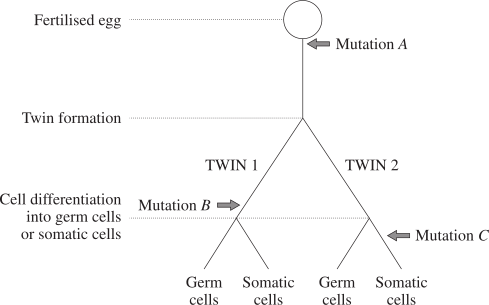
The diagram shows the early stages of embryonic development from a fertilised egg. The developing ball of cells has split and monozygotic (identical) twins have formed. Mutations can occur at different times during embryonic development, for example Mutation `A` would result in both twins having the mutation in all their cells.


Explain the effects of Mutation `B` and Mutation `C` on each twin and on any offspring that they may have.   (4 marks)

--- 8 WORK AREA LINES (style=lined) ---

Show Answers Only
  • Mutation B occurred after twin formation but prior to cell differentiation, affecting just Twin 1’s somatic and germ-line cells.
  • Through affecting germ-line cells, it will then affect the offspring.
  • Mutation C occurred after twin formation and after cell differentiation, only affecting Twin 2’s somatic cells.
  • Because it doesn’t affect germ-line cells, this mutation cannot be passed onto offspring.
Show Worked Solution
  • Mutation B occurred after twin formation but prior to cell differentiation, affecting just Twin 1’s somatic and germ-line cells.
  • Through affecting germ-line cells, it will then affect the offspring.
  • Mutation C occurred after twin formation and after cell differentiation, only affecting Twin 2’s somatic cells.
  • Because it doesn’t affect germ-line cells, this mutation cannot be passed onto offspring.

Filed Under: Mutation Tagged With: Band 4, smc-3652-20-Somatic vs. Germ-Line, smc-3652-55-Mutation in Reproduction

Copyright © 2014–2025 SmarterEd.com.au · Log in