SmarterEd

Aussie Maths & Science Teachers: Save your time with SmarterEd

  • Login
  • Get Help
  • About

BIOLOGY, M6 2023 HSC 31

Describe a named genetic technology and its use in a medical application.   (4 marks)
Show Answers Only

  • A polymerase chain reaction (PCR) is a process which allows scientists to replicate billions of copies of a specific gene.
  • The PCR process involves denaturing a DNA sample by heating it to around 98°C. The sample is then cooled to 60°C where DNA primers, polymerase enzymes and free nucleotides are added, making a copy of the original sample.
  • By repeating this process, the amount of copies acquired will increase exponentially.
  • This process is used in COVID-19 testing centres.
  • An individual’s DNA is swabbed and a PCR test is used to multiply it for COVID testing. PCR can also be used in other medical scenarios where gene cloning is required, such as in the production of mRNA vaccines. 

Other answers could include

  • IVF.
  • Recombinant DNA in bacteria to produce insulin.

Show Worked Solution

  • A polymerase chain reaction (PCR) is a process which allows scientists to replicate billions of copies of a specific gene.
  • The PCR process involves denaturing a DNA sample by heating it to around 98°C. The sample is then cooled to 60°C where DNA primers, polymerase enzymes and free nucleotides are added, making a copy of the original sample.
  • By repeating this process, the amount of copies acquired will increase exponentially.
  • This process is used in COVID-19 testing centres.
  • An individual’s DNA is swabbed and a PCR test is used to multiply it for COVID testing. PCR can also be used in other medical scenarios where gene cloning is required, such as in the production of mRNA vaccines. 

Other answers could include

  • IVF.
  • Recombinant DNA in bacteria to produce insulin.
♦ Mean mark 48%.

Filed Under: Genetic Technologies Tagged With: Band 5, smc-3654-30-Benefits

BIOLOGY, M6 EQ-Bank 28

Describe how technological developments led to the advancement of our knowledge and understanding of inheritance. Support your answer with examples.   (7 marks)

--- 16 WORK AREA LINES (style=lined) ---

Show Answers Only
  • Artificial pollination is the process by which pollen with known characteristics is manually applied to another plant with known genotypes anther.
  • This is used in agriculture to preserve favourable characteristics in plants. However, it can also be used to study inheritance patterns and genotype/phenotype relationships.
  • Mendel used this process to investigate ‘pure-breeding’ individuals/plants (ones which always produce the same offspring) to develop the idea of recessive and dominant alleles and the offspring they produced depending on the genotype. This laid the basis for the concept of ‘Mendelian ratios’.
  • Mendel used artificial pollination on purple and white pea plants which were known pure-breeding plants and found that all the offspring (F1 Generation) were purple, determining that the purple allele was dominant.
  • When he again used artificial pollination between F1 Generation plants, he found that it always produced 3/4 of purple plants and 1/4 white. This showed that F1 Generation purple plants were not pure-breed and instead ‘heterozygous’ and contained a masked allele for the white colour. This 3:1 ratio is what became known as a Mendelian ratio. 

Other suggested examples include:

  • Gene editing technology CRISPR
  • Microscopy and staining – behaviour of chromosomes (Sutton and Boveri)
  • X‐ray crystallography and DNA structure (Rosalind Franklin)
  • Radiation – one gene, one polypeptide (Beadle and Tatum)
Show Worked Solution
  • Artificial pollination is the process by which pollen with known characteristics is manually applied to another plant with known genotypes anther.
  • This is used in agriculture to preserve favourable characteristics in plants. However, it can also be used to study inheritance patterns and genotype/phenotype relationships.
  • Mendel used this process to investigate ‘pure-breeding’ individuals/plants (ones which always produce the same offspring) to develop the idea of recessive and dominant alleles and the offspring they produced depending on the genotype. This laid the basis for the concept of ‘Mendelian ratios’.
  • Mendel used artificial pollination on purple and white pea plants which were known pure-breeding plants and found that all the offspring (F1 Generation) were purple, determining that the purple allele was dominant.
  • When he again used artificial pollination between F1 Generation plants, he found that it always produced 3/4 of purple plants and 1/4 white. This showed that F1 Generation purple plants were not pure-breed and instead ‘heterozygous’ and contained a masked allele for the white colour. This 3:1 ratio is what became known as a Mendelian ratio. 

Other suggested examples include:

  • Gene editing technology CRISPR
  • Microscopy and staining – behaviour of chromosomes (Sutton and Boveri)
  • X‐ray crystallography and DNA structure (Rosalind Franklin)

Filed Under: Genetic Technologies Tagged With: Band 4, Band 5, smc-3654-30-Benefits, smc-3654-51-Reproductive Technologies

BIOLOGY, M6 2014 HSC 33e

The text below summarises some recent scientific experiments.

\begin{array} {|l|}
\hline
\ \ \rule{0pt}{4ex}  \text{Scientists, studying the development of human female embryos, recently }\\
\ \ \text{discovered a gene called XIST. This gene silences one of the two }\\
\ \ \text{X chromosomes so that they do not over-function in normal human females. }\\
\ \ \text{ }\\
\ \ \text{The scientists were then able to insert the XIST gene into human cells }\\
\ \ \text{grown in tissue culture to successfully silence other chromosomes. }\\
\ \ \text{ }\\
\ \ \text{Scientists are now attempting to insert the XIST gene into the extra }\\
\ \ \text{chromosome of mice that have trisomy. }\rule[-3ex]{0pt}{0pt}\\
\hline
\end{array}

With reference to genetics and gene technologies, explain these experiments and their implications.   (7 marks)

--- 15 WORK AREA LINES (style=lined) ---

Show Answers Only
  • The XIST gene is a gene which can ‘switch off’ whole chromosomes. This occurs naturally in females, where one X chromosome is shut off to prevent over-function.
  • With modern genetic technologies, this chromosome is able to be cut out of female embryos using restriction enzymes, then multiplied to produce adequate copies by PCR or recombinant DNA gene cloning in bacteria.
  • It is then able to silence any chromosome it is then inserted into.
  • This has potential to be a new form of gene therapy for people with conditions involving trisomy, where an individual is born with an extra chromosome.
  • This includes diseases such as Down syndrome (trisomy 21) and Klinefelter syndrome (XXY), which result in decreased quality of life, as well as shorter life span.
  • If successful, the XSIT gene will provide sufferers of these diseases with a normal phenotype by silencing one of their extra chromosomes.
  • This will facilitate a longer lifespan and a normal quality of life as if no abnormal gene was present for people with trisomy conditions, as well as being an effective gene therapy method in reducing international incidence of trisomies.
Show Worked Solution
  • The XIST gene is a gene which can ‘switch off’ whole chromosomes. This occurs naturally in females, where one X chromosome is shut off to prevent over-function.
  • With modern genetic technologies, this chromosome is able to be cut out of female embryos using restriction enzymes, then multiplied to produce adequate copies by PCR or recombinant DNA gene cloning in bacteria.
  • It is then able to silence any chromosome it is then inserted into.
  • This has potential to be a new form of gene therapy for people with conditions involving trisomy, where an individual is born with an extra chromosome.
  • This includes diseases such as Down syndrome (trisomy 21) and Klinefelter syndrome (XXY), which result in decreased quality of life, as well as shorter life span.
  • If successful, the XSIT gene will provide sufferers of these diseases with a normal phenotype by silencing one of their extra chromosomes.
  • This will facilitate a longer lifespan and a normal quality of life as if no abnormal gene was present for people with trisomy conditions, as well as being an effective gene therapy method in reducing international incidence of trisomies.

♦♦♦ Mean mark 29%.

Filed Under: Genetic Technologies Tagged With: Band 6, smc-3654-30-Benefits, smc-3654-80-Gene Cloning

BIOLOGY, M6 2021 HSC 33b

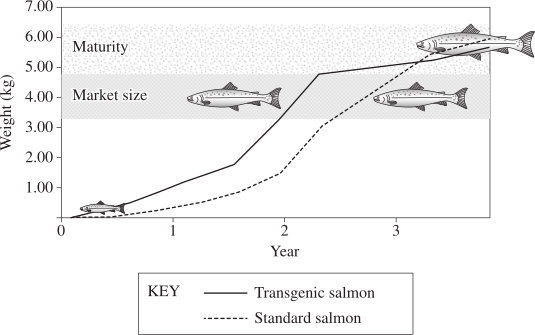
Genetically engineered Atlantic salmon have been produced and approved for aquaculture in the US.

The graph summarises the growth of standard salmon and transgenic salmon.


  1.  
    Explain ONE potential benefit of using transgenic salmon in aquaculture. Support your answer with data from the graph.   (3 marks)

    --- 6 WORK AREA LINES (style=lined) ---

Show Answers Only
  • The graph shows that transgenic salmon grow faster than standard salmon in the first two years.
  • Consequently, they reach market size 5 months earlier than standard salmon.
  • This saves money in producing fish for market size as there are lower food and maintenance costs.
Show Worked Solution
  • The graph shows that transgenic salmon grow faster than standard salmon in the first two years.
  • Consequently, they reach market size 5 months earlier than standard salmon.
  • This saves money in producing fish for market size as there are lower food and maintenance costs.

Filed Under: Genetic Technologies Tagged With: Band 4, smc-3654-05-Transgenic Organisms, smc-3654-20-Agriculture, smc-3654-30-Benefits

BIOLOGY, M7 2020 HSC 30

Explain the impact that genetic technologies have had on the management of both infectious and non-infectious diseases.   (7 marks)

--- 16 WORK AREA LINES (style=lined) ---

Show Answers Only

Non Infectious diseases

  • Down syndrome and diabetes are examples of non-infectious diseases that are not caused by pathogens and are not contagious.
  • Recombinant DNA: This technology delivers replacement genes by creating recombinant plasmids in bacteria which then multiply via binary fission.
  • This has been used to produce insulin by inserting a copy of the human insulin gene for the treatment of diabetic patients.
  • Pre-Implantation Genetic Testing: before IVF, eggs can be tested for various genetic diseases, such as down syndrome or cystic fibrosis.

Infectious diseases

  • These diseases are caused by pathogens.
  • The genetic makeup of organisms can be altered to lower risk of such diseases.
  • Transgenic Organisms involve technology that combines genes from other species to incorporate certain characteristics.
  • For example, Recombinant Bt corn contains a gene that is toxic to the destructive European corn borer. This will protect the corn and reduce the occurence of the associated infectious disease in humans.
Show Worked Solution

Non Infectious diseases

  • Down syndrome and diabetes are examples of non-infectious diseases that are not caused by pathogens and are not contagious.
  • Recombinant DNA: This technology delivers replacement genes by creating recombinant plasmids in bacteria which then multiply via binary fission.
  • This has been used to produce insulin by inserting a copy of the human insulin gene for the treatment of diabetic patients.
  • Pre-Implantation Genetic Testing: before IVF, eggs can be tested for various genetic diseases, such as down syndrome or cystic fibrosis.

Infectious diseases

  • These diseases are caused by pathogens.
  • The genetic makeup of organisms can be altered to lower risk of such diseases.
  • Transgenic Organisms involve technology that combines genes from other species to incorporate certain characteristics.
  • For example, Recombinant Bt corn contains a gene that is toxic to the destructive European corn borer. This will protect the corn and reduce the occurence of the associated infectious disease in humans.

♦♦ Mean mark 44%.

Filed Under: Genetic Technologies, Prevention Tagged With: Band 5, smc-3654-05-Transgenic Organisms, smc-3654-30-Benefits, smc-3654-80-Gene Cloning, smc-3662-20-Genetic Engineering

Copyright © 2014–2025 SmarterEd.com.au · Log in