SmarterEd

Aussie Maths & Science Teachers: Save your time with SmarterEd

  • Login
  • Get Help
  • About

BIOLOGY, M6 2025 HSC 30a

PAI-1 protein is encoded by the SERPINE 1 gene in humans. Anopheles mosquitoes have been genetically modified to express PAI-1, which blocks the entry of the malarial Plasmodium into the mosquito gut. This disrupts the Plasmodium life cycle, resulting in reduced transmission of malaria. 

Describe a process that could be used to produce mosquitoes which express PAI-1.   (4 marks)

--- 11 WORK AREA LINES (style=lined) ---
Show Answers Only

Mosquito Production

  • The SERPINE 1 gene is isolated from human DNA using restriction enzymes that cut at specific recognition sites.
  • The same restriction enzymes are used to cut mosquito DNA, creating complementary sticky ends.
  • The human PAI-1 gene is inserted into the mosquito DNA using DNA ligase to form recombinant DNA.
  • The recombinant DNA is introduced into mosquito eggs or embryos using a vector or microinjection technique.
  • Modified mosquitoes are screened to confirm PAI-1 gene expression and successful integration into the genome.
  • Transgenic mosquitoes produce PAI-1 protein that blocks Plasmodium entry into the gut, disrupting malaria transmission.
Show Worked Solution

Mosquito Production

  • The SERPINE 1 gene is isolated from human DNA using restriction enzymes that cut at specific recognition sites.
  • The same restriction enzymes are used to cut mosquito DNA, creating complementary sticky ends.
  • The human PAI-1 gene is inserted into the mosquito DNA using DNA ligase to form recombinant DNA.
  • The recombinant DNA is introduced into mosquito eggs or embryos using a vector or microinjection technique.
  • Modified mosquitoes are screened to confirm PAI-1 gene expression and successful integration into the genome.
  • Transgenic mosquitoes produce PAI-1 protein that blocks Plasmodium entry into the gut, disrupting malaria transmission.

♦ Mean mark 53%.

Filed Under: Genetic Technologies Tagged With: Band 4, Band 5, smc-3654-05-Transgenic Organisms, smc-3654-90-Other Recombinant DNA

BIOLOGY, M6 2024 HSC 19 MC

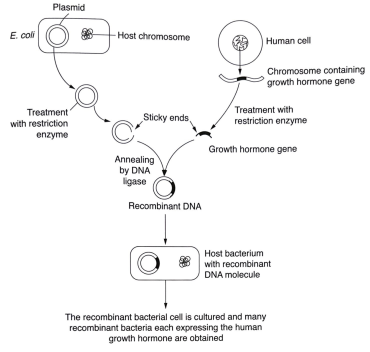
The diagram represents some experimental steps used in the production of large amounts of human growth hormone.
 

What makes this technology successful?

  1. DNA ligase can cut human growth hormone genes from human cells.
  2. Human growth hormone can cause E. coli to grow and mature rapidly.
  3. Human plasmids containing the gene of interest can be inserted into bacteria.
  4. Restriction enzymes can produce sticky ends on both bacterial and human DNA.
Show Answers Only

\(D\)

Show Worked Solution
  • The technology is possible because restriction enzymes create compatible sticky ends on both the bacterial plasmid and human DNA containing the growth hormone gene.
  • This allows them to be joined together via complementary base pairing before DNA ligase permanently connects them, which is essential for successful gene transfer.

\(\Rightarrow D\)

♦ Mean mark 53%.

Filed Under: Genetic Technologies Tagged With: Band 5, smc-3654-90-Other Recombinant DNA

Copyright © 2014–2026 SmarterEd.com.au · Log in