SmarterEd

Aussie Maths & Science Teachers: Save your time with SmarterEd

  • Login
  • Get Help
  • About

BIOLOGY, M7 2024 HSC 27

Milk pasteurisation (heating to approximately 70°C) was gradually introduced in America from the early 1900s. The graph shows the number of disease outbreaks in relation to raw (unpasteurised) and pasteurised milk in America from 1900-1975.
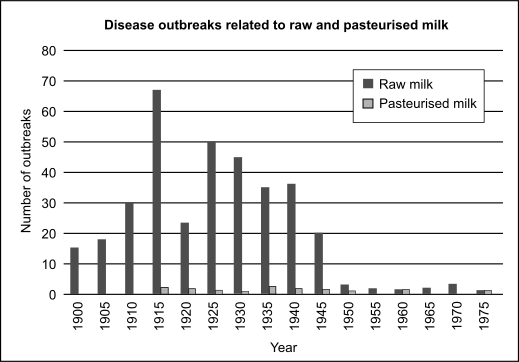
 

Explain the trends observed in the graph. In your response, refer to the role of Pasteur's work in pasteurisation.   (5 marks)

--- 13 WORK AREA LINES (style=lined) ---

Show Answers Only
  • Louis Pasteur’s research was pivotal in debunking the theory of spontaneous generation and establishing our understanding of microorganisms.
  • His work revealed that microbes present in milk could be responsible for disease outbreaks.
  • He demonstrated that exposing substances to high temperatures effectively kills microorganisms, which is why heating milk to 70°C eliminates many harmful bacteria.
  • This scientific foundation – the presence of microbes in milk and their vulnerability to heat – explains the effectiveness of milk pasteurisation in preventing disease outbreaks.
  • The historical data presented in the graph supports this, showing significantly fewer disease outbreaks linked to pasteurised milk compared to raw milk.
  • A notable decline in raw milk-related outbreaks occurred after 1945, though this may also be attributed to decreased raw milk consumption during that period.
  • While pasteurised milk has generally proven safer, some disease outbreaks have still occurred with pasteurised products. These cases typically result from issues in the pasteurisation process itself or problems during subsequent storage and transportation of the milk.
Show Worked Solution
  • Louis Pasteur’s research was pivotal in debunking the theory of spontaneous generation and establishing our understanding of microorganisms.
  • His work revealed that microbes present in milk could be responsible for disease outbreaks.
  • He demonstrated that exposing substances to high temperatures effectively kills microorganisms, which is why heating milk to 70°C eliminates many harmful bacteria.
  • This scientific foundation – the presence of microbes in milk and their vulnerability to heat – explains the effectiveness of milk pasteurisation in preventing disease outbreaks.
  • The historical data presented in the graph supports this, showing significantly fewer disease outbreaks linked to pasteurised milk compared to raw milk.
  • A notable decline in raw milk-related outbreaks occurred after 1945, though this may also be attributed to decreased raw milk consumption during that period.
  • While pasteurised milk has generally proven safer, some disease outbreaks have still occurred with pasteurised products. These cases typically result from issues in the pasteurisation process itself or problems during subsequent storage and transportation of the milk.

Filed Under: Causes of Infectious Disease, Prevention, Treatment and Control Tagged With: Band 4, Band 5, smc-3655-60-Louis Pasteur, smc-3658-30-Procedures to Prevent Spread, smc-3658-40-Interpreting Data

BIOLOGY, M7 2014 HSC 12-13 MC

Refer to the following information to answer Questions 12 and 13.

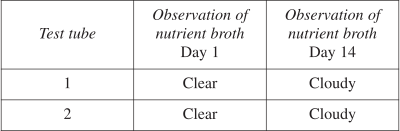
A student conducted a first-hand investigation using nutrient broth, beakers and an S-shaped delivery tube in an attempt to model Pasteur's experiment.

The equipment and data collected are shown.
 

Question 12

The data collected by the student are

  1. quantitative because data were collected for fourteen days.
  2. qualitative because the appearance of the broth is described.
  3. qualitative because this is a model of a past scientific experiment.
  4. quantitative because the results were recorded for two different beakers.

 
Question 13

The student's results were different from Pasteur's results.

Which of the following provides the best explanation for the difference?

  1. The nutrient broth was different from Pasteur's.
  2. The nutrient broth always goes cloudy as it ages.
  3. The nutrient broth was not boiled thoroughly on Day 1 .
  4. The nutrient broths were both exposed to oxygen from the outside air.
Show Answers Only

Question 12: \(B\)

Question 13: \(C\)

Show Worked Solution

Question 12

By Elimination

  • Quantitative data is one in which numerical values are obtained for comparison. (Eliminate A and D).
  • The data then must be qualitative as it includes a description of the broth’s appearance.

\(\Rightarrow B\)
 

Question 13

  • The apparatus matches that of Pasteur’s, so the best explanation for flask 2 also going cloudy would be due to not thoroughly boiling the broth before the experiment, and therefore not eliminating any bacteria already present.

\(\Rightarrow C\)


♦ Mean mark Q13 53%.

Filed Under: Causes of Infectious Disease Tagged With: Band 4, Band 5, smc-3655-60-Louis Pasteur

BIOLOGY, M7 2018 HSC 22a

Pasteur performed an experiment to identify the role of microbes in decay.

Justify a conclusion that can be drawn from his results.  (2 marks)

Show Answers Only

Pasteur’s swan-neck flask experiment

  • The straight necked flask became contaminated after a few days, whereas, the sterile swan-neck flask confined the germs in the curved section of the neck and no contamination occurred.
  • This proved that microbes are produced from pre-existing microbes and not from the air itself.
Show Worked Solution

Pasteur’s swan-neck flask experiment

  • The straight necked flask became contaminated after a few days, whereas, the sterile swan-neck flask confined the germs in the curved section of the neck and no contamination occurred.
  • This proved that microbes are produced from pre-existing microbes and not from the air itself.

♦ Mean mark (b)(i) 41%.

Mean mark (b)(ii) 51%

Filed Under: Causes of Infectious Disease Tagged With: Band 4, smc-3655-60-Louis Pasteur

BIOLOGY, M8 2018 HSC 30

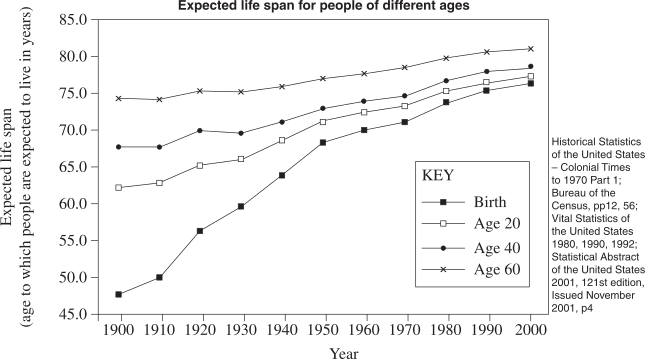
The graph shows the expected life span (the age to which people are expected to live in years) for people of different ages during the 20th century in one country.
 

There have been many biological developments that have contributed to our understanding of the identification, treatment and prevention of disease.

Evaluate the impact of these developments on the expected life span. In your answer, include reference to trends in the data provided.  (8 marks)

--- 18 WORK AREA LINES (style=lined) ---

Show Answers Only
  • For all ages listed in the graph, life expectancy increased during the 20th century.
  • The lifespan from birth has increased more significantly than other ages ~ 48 to 74 years.
  • The smallest increase being for 60 year olds at ~ 5 years.
  • The ability to understand pathogens and the causes of infectious disease (Koch and Pasteur) has led to early identification and treatment of childhood illnesses such as rubella, polio and whooping cough.
  • Koch and Pasteur established germ theory, culture techniques and a set of postulates to follow in order to create the link between a particular pathogen and disease.
  • Vaccines to combat childhood illnesses were developed through a knowledge of germ theory.
  • The infant/childhood mortality rate has improved significantly, and hence life expectancy, due to the immunity provided by vaccines.
  • An understanding of inherited disorders has also improved lifespans with early diagnosis and prenatal genetic screening for genetic disorders and illnesses.
  • Antibiotic remedies were developed to combat bacterial diseases such as Staphylococcus aureus, due to an understanding of the difference between prokaryotic and eukaryotic cells.
  • With the use of antibiotics many diseases were then no longer life threatening, leading to improved mortality rates across all ages.
  • However, bacterial resistance has resulted with the overuse of antibiotics, so some diseases are now unresponsive to antibiotic treatment.
  • Epidemiology studies involving intricate planning and design, control groups and large scale analysis of data have lead to improvements in the treatment of non-infectious diseases such as cancer.
  • For example the discovery of links between smoking and lung cancer, sun exposure and melanoma, obesity and type II diabetes, has lead to widespread public health campaigns to inform people of the health risks and lowered the associated mortality rates.
  • Improved hygiene, food storage and preservation, and water filtration also occurred in the 20th century leading to fewer preventable diseases and hence increased life spans for all age groups.
  • Improved quarantine requirements have helped prevent the spread of plant, animal and human diseases via international travel.
  • In conclusion, developments in biology have lead to increased life expectancy across all age groups, with the biggest improvements for babies and children.
  • These benefits are not necessarily a worldwide phenomenon as poor living conditions and access to medical treatment is not available in many poor socioeconomic communities.
Show Worked Solution
  • For all ages listed in the graph, life expectancy increased during the 20th century.
  • The lifespan from birth has increased more significantly than other ages ~ 48 to 74 years.
  • The smallest increase being for 60 year olds at ~ 5 years.
  • The ability to understand pathogens and the causes of infectious disease (Koch and Pasteur) has led to early identification and treatment of childhood illnesses such as rubella, polio and whooping cough.
  • Koch and Pasteur established germ theory, culture techniques and a set of postulates to follow in order to create the link between a particular pathogen and disease.
  • Vaccines to combat childhood illnesses were developed through a knowledge of germ theory.
  • The infant/childhood mortality rate has improved significantly, and hence life expectancy, due to the immunity provided by vaccines.
  • An understanding of inherited disorders has also improved lifespans with early diagnosis and prenatal genetic screening for genetic disorders and illnesses.
  • Antibiotic remedies were developed to combat bacterial diseases such as Staphylococcus aureus, due to an understanding of the difference between prokaryotic and eukaryotic cells.
  • With the use of antibiotics many diseases were then no longer life threatening, leading to improved mortality rates across all ages.
  • However, bacterial resistance has resulted with the overuse of antibiotics, so some diseases are now unresponsive to antibiotic treatment.
  • Epidemiology studies involving intricate planning and design, control groups and large scale analysis of data have lead to improvements in the treatment of non-infectious diseases such as cancer.
  • For example the discovery of links between smoking and lung cancer, sun exposure and melanoma, obesity and type II diabetes, has lead to widespread public health campaigns to inform people of the health risks and lowered the associated mortality rates.
  • Improved hygiene, food storage and preservation, and water filtration also occurred in the 20th century leading to fewer preventable diseases and hence increased life spans for all age groups.
  • Improved quarantine requirements have helped prevent the spread of plant, animal and human diseases via international travel.
  • In conclusion, developments in biology have lead to increased life expectancy across all age groups, with the biggest improvements for babies and children.
  • These benefits are not necessarily

♦♦ Mean mark 35%.

Filed Under: Causes of Infectious Disease, Epidemiology, Prevention, Treatment and Control Tagged With: Band 5, Band 6, smc-3655-60-Louis Pasteur, smc-3655-70-Robert Koch, smc-3658-11-Pharmaceuticals, smc-3658-20-Vaccines, smc-3658-30-Procedures to Prevent Spread, smc-3661-10-Analysing Results

BIOLOGY, M7 2016 HSC 25

Rabies is a disease caused by a virus that affects mammals.

In 1880 Louis Pasteur investigated dogs that were suffering from rabies in order to find the cause. He believed rabies was caused by a microorganism but could not culture it in broth nor observe it under the light microscope. However, he could cause the disease in healthy dogs by injecting them with saliva from infected dogs. He was able to repeat the disease cycle in this way.

  1. Why was Pasteur NOT able to observe the rabies virus?   (2 marks)

    --- 3 WORK AREA LINES (style=lined) ---
  2. Explain why Pasteur needed to identify and culture the microorganism in order to meet the scientific standards for establishing the cause of rabies.   (4 marks)

    --- 8 WORK AREA LINES (style=lined) ---

Show Answers Only

a.    Rabies virus unobservable:

  • The rabies virus is very small in size.
  • It is unable to be seen by the naked eye under light microscopes. 

b.    Dog saliva contains many microorganisms.

  • Any of these could have been responsible for causing rabies.
  • It was necessary for Pasteur to isolate and culture the specific microorganism he believed to be causing the disease.
  • A healthy host without symptoms needed to be injected with one of the isolated  microorganisms and develop the disease.
  • By trial and error of this process, Pasteur could deduce which microorganism had caused the rabies.
Show Worked Solution

a.    Rabies virus unobservable:

  • The rabies virus is very small in size.
  • It is unable to be seen by the naked eye under light microscopes.  

Mean mark (a) 52%.

b.    Dog saliva contains many microorganisms.

  • Any of these could have been responsible for causing rabies.
  • It was necessary for Pasteur to isolate and culture the specific microorganism he believed to be causing the disease.
  • A healthy host without symptoms needed to be injected with one of the isolated  microorganisms and develop the disease.
  • By trial and error of this process, Pasteur could deduce which microorganism had caused the rabies.

Mean mark (b) 54%.

Filed Under: Causes of Infectious Disease Tagged With: Band 5, smc-3655-10-Classifying Pathogens, smc-3655-60-Louis Pasteur

BIOLOGY, M7 2022 HSC 10-11 MC

Refer to the following information to answer Questions 10 – 11.

Pasteur used swan neck flasks to conduct experiments on microbial contamination of broth. One of Pasteur's investigations is shown.
 

Question 10

Which of the following was the independent variable in this investigation?

  1. The air
  2. The flask
  3. The broth
  4. The microbes

 
Question 11

What is the best explanation for Pasteur's results?

  1. Cells arise from existing cells
  2. Heating prevents broth spoiling
  3. Gases in the air cause broth to spoil
  4. Cells arise by spontaneous generation
Show Answers Only

Question 10: `B`

Question 11: `A`

Show Worked Solution

Question 10

  • The flask was changed in each test therefore it is the independent variable.

`=>B`
 

Question 11

  • Pasteur’s experiment was conducted to show that microbes arise from existing cells in the air, disproving spontaneous generation.

`=>A`


♦ Mean mark (Q11) 40%.

Filed Under: Causes of Infectious Disease Tagged With: Band 4, Band 5, smc-3655-60-Louis Pasteur

Copyright © 2014–2025 SmarterEd.com.au · Log in