SmarterEd

Aussie Maths & Science Teachers: Save your time with SmarterEd

  • Login
  • Get Help
  • About

BIOLOGY, M7 2023 HSC 15 MC

A pharmaceutical was tested for its effectiveness in treating a viral infection. A symptom severity score of zero indicates no symptoms.
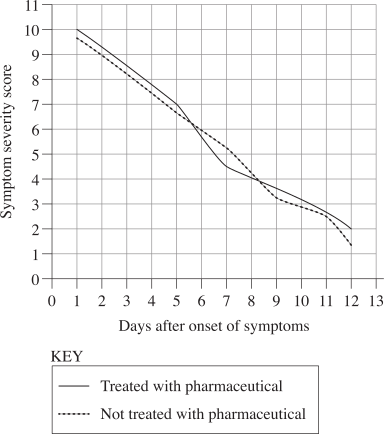
 

What conclusion can be drawn from the graph?

  1. The pharmaceutical tested had no antiviral properties.
  2. The pharmaceutical tested did not reduce the severity of symptoms.
  3. The pharmaceutical tested increased symptoms in patients in the study.
  4. Pharmaceuticals do not reduce symptoms in patients suffering from viral infections.
Show Answers Only

\(B\)

Show Worked Solution

By Elimination:

  • Option C is an incorrect statement as symptoms did decrease (Eliminate C).
  • This test cannot be used to make a generalised statement about the ineffectiveness of all pharmaceuticals (Eliminate D).
  • The tested pharmaceutical may have antiviral properties against other viruses (Eliminate A).
  • The similarity between administering the antiviral and not treating someone were very similar, and therefore the drug did not reduce the severity of symptoms.

\(\Rightarrow B\)

♦ Mean mark 49%.

Filed Under: Prevention, Treatment and Control Tagged With: Band 4, smc-3658-11-Pharmaceuticals

BIOLOGY, M7 2014 HSC 11 MC

What is a likely adverse impact of the evolution of bacteria on the management of infectious disease?

  1. Viruses become resistant to antibiotics.
  2. Some treatments lose their effectiveness.
  3. Inherited diseases become more common.
  4. Quarantine of infected individuals no longer works.
Show Answers Only

`B`

Show Worked Solution
  • The evolution of bacteria coupled with their ability to allow horizontal gene transfer between themselves means that many treatments, particularly pharmaceuticals such as antibiotics, become ineffective.

`=>B`

Filed Under: Prevention, Treatment and Control Tagged With: Band 4, smc-3658-11-Pharmaceuticals

BIOLOGY, M8 2018 HSC 30

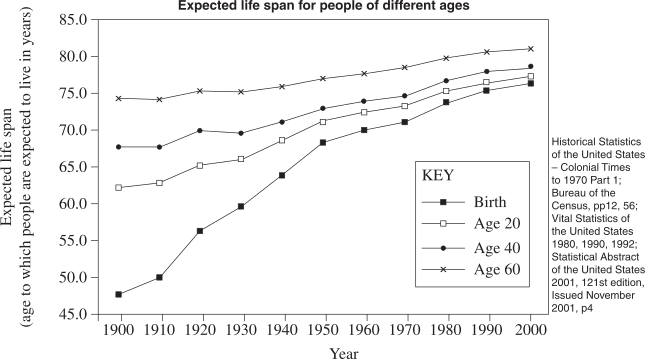
The graph shows the expected life span (the age to which people are expected to live in years) for people of different ages during the 20th century in one country.
 

There have been many biological developments that have contributed to our understanding of the identification, treatment and prevention of disease.

Evaluate the impact of these developments on the expected life span. In your answer, include reference to trends in the data provided.  (8 marks)

--- 18 WORK AREA LINES (style=lined) ---

Show Answers Only
  • For all ages listed in the graph, life expectancy increased during the 20th century.
  • The lifespan from birth has increased more significantly than other ages ~ 48 to 74 years.
  • The smallest increase being for 60 year olds at ~ 5 years.
  • The ability to understand pathogens and the causes of infectious disease (Koch and Pasteur) has led to early identification and treatment of childhood illnesses such as rubella, polio and whooping cough.
  • Koch and Pasteur established germ theory, culture techniques and a set of postulates to follow in order to create the link between a particular pathogen and disease.
  • Vaccines to combat childhood illnesses were developed through a knowledge of germ theory.
  • The infant/childhood mortality rate has improved significantly, and hence life expectancy, due to the immunity provided by vaccines.
  • An understanding of inherited disorders has also improved lifespans with early diagnosis and prenatal genetic screening for genetic disorders and illnesses.
  • Antibiotic remedies were developed to combat bacterial diseases such as Staphylococcus aureus, due to an understanding of the difference between prokaryotic and eukaryotic cells.
  • With the use of antibiotics many diseases were then no longer life threatening, leading to improved mortality rates across all ages.
  • However, bacterial resistance has resulted with the overuse of antibiotics, so some diseases are now unresponsive to antibiotic treatment.
  • Epidemiology studies involving intricate planning and design, control groups and large scale analysis of data have lead to improvements in the treatment of non-infectious diseases such as cancer.
  • For example the discovery of links between smoking and lung cancer, sun exposure and melanoma, obesity and type II diabetes, has lead to widespread public health campaigns to inform people of the health risks and lowered the associated mortality rates.
  • Improved hygiene, food storage and preservation, and water filtration also occurred in the 20th century leading to fewer preventable diseases and hence increased life spans for all age groups.
  • Improved quarantine requirements have helped prevent the spread of plant, animal and human diseases via international travel.
  • In conclusion, developments in biology have lead to increased life expectancy across all age groups, with the biggest improvements for babies and children.
  • These benefits are not necessarily a worldwide phenomenon as poor living conditions and access to medical treatment is not available in many poor socioeconomic communities.
Show Worked Solution
  • For all ages listed in the graph, life expectancy increased during the 20th century.
  • The lifespan from birth has increased more significantly than other ages ~ 48 to 74 years.
  • The smallest increase being for 60 year olds at ~ 5 years.
  • The ability to understand pathogens and the causes of infectious disease (Koch and Pasteur) has led to early identification and treatment of childhood illnesses such as rubella, polio and whooping cough.
  • Koch and Pasteur established germ theory, culture techniques and a set of postulates to follow in order to create the link between a particular pathogen and disease.
  • Vaccines to combat childhood illnesses were developed through a knowledge of germ theory.
  • The infant/childhood mortality rate has improved significantly, and hence life expectancy, due to the immunity provided by vaccines.
  • An understanding of inherited disorders has also improved lifespans with early diagnosis and prenatal genetic screening for genetic disorders and illnesses.
  • Antibiotic remedies were developed to combat bacterial diseases such as Staphylococcus aureus, due to an understanding of the difference between prokaryotic and eukaryotic cells.
  • With the use of antibiotics many diseases were then no longer life threatening, leading to improved mortality rates across all ages.
  • However, bacterial resistance has resulted with the overuse of antibiotics, so some diseases are now unresponsive to antibiotic treatment.
  • Epidemiology studies involving intricate planning and design, control groups and large scale analysis of data have lead to improvements in the treatment of non-infectious diseases such as cancer.
  • For example the discovery of links between smoking and lung cancer, sun exposure and melanoma, obesity and type II diabetes, has lead to widespread public health campaigns to inform people of the health risks and lowered the associated mortality rates.
  • Improved hygiene, food storage and preservation, and water filtration also occurred in the 20th century leading to fewer preventable diseases and hence increased life spans for all age groups.
  • Improved quarantine requirements have helped prevent the spread of plant, animal and human diseases via international travel.
  • In conclusion, developments in biology have lead to increased life expectancy across all age groups, with the biggest improvements for babies and children.
  • These benefits are not necessarily

♦♦ Mean mark 35%.

Filed Under: Causes of Infectious Disease, Epidemiology, Prevention, Treatment and Control Tagged With: Band 5, Band 6, smc-3655-60-Louis Pasteur, smc-3655-70-Robert Koch, smc-3658-11-Pharmaceuticals, smc-3658-20-Vaccines, smc-3658-30-Procedures to Prevent Spread, smc-3661-10-Analysing Results

BIOLOGY, M7 2018 HSC 17 MC

The diagram shows the life cycle of the malaria parasite, Plasmodium sp. Five stages in this life cycle are numbered on the diagram.


To prevent malaria, the following four strategies have been used:

    • taking anti-malarial drugs
    • spraying swamps with insecticides
    • using mosquito nets over beds
    • administering a malaria vaccine.

Which row in the table shows the stage in the life cycle in which each of these strategies would be most effective?
 

\begin{align*}
\begin{array}{l}
\rule{0pt}{2.5ex} \ & \\
 \rule[-2ex]{0pt}{0pt}& \\
\rule{0pt}{2.5ex}\textbf{A.}\rule[-1ex]{0pt}{0pt}\\
\rule{0pt}{2.5ex}\textbf{B.}\rule[-1ex]{0pt}{0pt}\\
\rule{0pt}{2.5ex}\textbf{C.}\rule[-1ex]{0pt}{0pt}\\
\rule{0pt}{2.5ex}\textbf{D.}\rule[-1ex]{0pt}{0pt}\\
\end{array}
\begin{array}{|c|c|c|}
\hline
\rule{0pt}{2.5ex}\textit{Taking}\rule[-1ex]{0pt}{0pt}& \textit{Spraying swamps} & \textit{Using mosquito}& \textit{Adminstering a}\\
\textit{anti-malarial drugs}\rule[-1.5ex]{0pt}{0pt}& \textit{with insecticides} & \textit{nets over beds}& \textit{malaria vaccine}\\
\hline
\rule{0pt}{2.5ex}5\rule[-1ex]{0pt}{0pt}&1& 3& 2\\
\hline
\rule{0pt}{2.5ex}2\rule[-1ex]{0pt}{0pt}&5& 1& 3\\
\hline
\rule{0pt}{2.5ex}1\rule[-1ex]{0pt}{0pt}& 4& 2& 5 \\
\hline
\rule{0pt}{2.5ex}2\rule[-1ex]{0pt}{0pt}& 3 & 5&1\\
\hline
\end{array}
\end{align*}

Show Answers Only

\(D\)

Show Worked Solution
  • Vaccines are most effective when administered before the parasite enters the cell (1).
  • Mosquito nets are only useful if utilised prior to the injection of the parasite into a human (5).
  • Insecticides help prevent the vectors from breeding (3).
  • Anti-malarial drugs may be useful once the disease is present (2).

\(\Rightarrow D\)

Filed Under: Prevention, Treatment and Control Tagged With: Band 4, smc-3658-11-Pharmaceuticals, smc-3658-20-Vaccines, smc-3658-30-Procedures to Prevent Spread, smc-3658-50-Malaria

BIOLOGY, M7 2016 HSC 28

Bacteriophages are viruses that use bacteria as host cells. One type of bacteriophage infects only one species of bacterial cell. The infected cells are destroyed as the bacteriophage particles burst out of them, completing their life cycle.

Bacteriophages can be used to fight bacterial infections. As bacteria evolve, bacteriophages also evolve.

  1. Explain TWO advantages of using bacteriophage treatment compared to antibiotic treatment for bacterial infections.   (4 marks)

    --- 8 WORK AREA LINES (style=lined) ---

  2. Describe a possible disadvantage of using bacteriophage treatment.   (2 marks)

    --- 3 WORK AREA LINES (style=lined) ---

Show Answers Only

a.   Include two of the following advantages:

  • Bacterial pathogens have become resistant to antibiotics and so antibiotics can be less effective.
  • Bacteriophages can mutate, therefore phenotypes can evolve that stay pathogenic to mutated bacteria.
  • There is the risk of killing useful bacteria when using antibiotics as well as pathogens.
  • Bacteriophages specifically target the pathogen.  

b.   Include one of the following disadvantages:

  • Residual bacteriophages may have unknown side effects.
  • As they can mutate there is the possibility that bacteriophages could damage and infect a non-target bacteria or human cells, leading to disease.
Show Worked Solution

a.   Include two of the following advantages:

  • Bacterial pathogens have become resistant to antibiotics and so antibiotics can be less effective.
  • Bacteriophages can mutate, therefore phenotypes can evolve that stay pathogenic to mutated bacteria.
  • There is the risk of killing useful bacteria when using antibiotics as well as pathogens.
  • Bacteriophages specifically target the pathogen.    

Mean mark (a) 59%.

b.   Include one of the following disadvantages:

  • Residual bacteriophages may have unknown side effects.
  • As they can mutate there is the possibility that bacteriophages could damage and infect a non-target bacteria or human cells, leading to disease.

Mean mark (b) 56%.

Filed Under: Prevention, Treatment and Control Tagged With: Band 4, smc-3658-11-Pharmaceuticals

BIOLOGY, M7 2019 HSC 7 MC

Two types of bacteria were isolated from a patient's throat swab and grown in pure culture on separate agar plates. On each plate there were FOUR different antibiotic discs, `W, X, Y` and `Z`.

The photograph shows the plates seven days later.
 

Which antibiotic should be used to treat the patient?

  1. `W`
  2. `X`
  3. `Y`
  4. `Z`
Show Answers Only

`A`

Show Worked Solution
  • The area of each circle shows the amount of bacterial growth each antibiotic has inhibited.
  • The larger the circle, the more effective that antibiotic is at inhibiting bacterial growth.
  • Antibiotic `W` has the most consistently large disc, and should be used to treat the patient.

`=>A`

Filed Under: Causes of Infectious Disease, Prevention, Treatment and Control Tagged With: Band 4, smc-3655-50-Microbial Tests, smc-3658-11-Pharmaceuticals

BIOLOGY, M7 2022 HSC 26

Jelly Bush honey has been used by Aboriginal Peoples to treat cuts, sores and burns. Recent studies have shown that Jelly Bush honey has a very high level of methylglyoxal which is known to help fight infection.

A scientist wants to test the effectiveness of Jelly Bush honey using agar plates.

Design a safe procedure that the scientist could use in a laboratory to investigate the effectiveness of Jelly Bush honey as a pharmaceutical to inhibit bacterial growth.  (5 marks)

Show Answers Only

STEP 1: Sterilise 5 agar plates to remove contamination.

STEP 2: Set up the 5 agar plates as 1 blank (control), 1 with just bacteria* (control), 1 with bacteria and Jelly Bush honey, 1 with pure methylglyoxal and 1 with bacteria and a known antibiotic which will inhibit the bacterial growth.

*Bacteria must be a pathogen encountered during infection that is also native to Australia.

STEP 3: Store all agar plates in an incubator at 37°C and 1 atm for 5 days.

STEP 4: Record the amount of bacterial growth in each agar plate in comparison to the pure bacteria plate.

STEP 5: Repeat 3 times to ensure no other variables are responsible for inhibiting bacterial growth. 

Experiment summary:

  • This experiment is a valid way of determining Jelly Bush honey as a pharmaceutical as it tests it against pure methylglyoxal (and 2 controls).
  • This experiment should show evidence whether methylglyoxal or some other factor(s) within the honey contribute to its ability to fight infection.
Show Worked Solution

STEP 1: Sterilise 5 agar plates to remove contamination.

STEP 2: Set up the 5 agar plates as 1 blank (control), 1 with just bacteria* (control), 1 with bacteria and Jelly Bush honey, 1 with pure methylglyoxal and 1 with bacteria and a known antibiotic which will inhibit the bacterial growth.

  • *Bacteria must be a pathogen encountered during infection that is also native to Australia.

STEP 3: Store all agar plates in an incubator at 37°C and 1 atm for 5 days.

STEP 4: Record the amount of bacterial growth in each agar plate in comparison to the pure bacteria plate.

STEP 5: Repeat 3 times to ensure no other variables are responsible for inhibiting bacterial growth. 

Experiment summary:

  • This experiment is a valid way of determining Jelly Bush honey as a pharmaceutical as it tests it against pure methylglyoxal (and 2 controls).
  • This experiment should show evidence whether methylglyoxal or some other factor(s) within the honey contribute to its ability to fight infection.

♦ Mean mark 54%.

Filed Under: Prevention, Treatment and Control Tagged With: Band 4, Band 5, smc-3658-11-Pharmaceuticals, smc-3658-60-Indigenous

BIOLOGY, M7 2020 HSC 22

Outline a benefit and a limitation of using pharmaceuticals such as antibiotics to treat infectious disease.   (3 marks)

Show Answers Only
  • Antibiotics can be used to treat bacterial infections as they inhibit bacterial growth.
  • Excessive, but at times necessary use can lead to antibiotic resistance amongst bacterial strains, reducing antibiotic effectiveness.

Other benefits can include:

  • Antibiotics are quick to administer and readily available.
  • Their usage can often lead to a rapid recovery of patients.
Show Worked Solution
  • Antibiotics can be used to treat bacterial infections as they inhibit bacterial growth.
  • Excessive, but at times necessary use can lead to antibiotic resistance amongst bacterial strains, reducing antibiotic effectiveness.

Other benefits can include:

  • Antibiotics are quick to administer and readily available.
  • Their usage can often lead to a rapid recovery of patients.

Mean mark 53%.
COMMENT: A surprisingly low mean mark that warrants attention.

Filed Under: Prevention, Treatment and Control Tagged With: Band 4, smc-3658-11-Pharmaceuticals

BIOLOGY, M7 2020 HSC 15 MC

Four antiviral drugs have been tested in a culture of human cells for their effectiveness in inhibiting infection from a new virus. The toxicity of the antivirals to human cells was also tested.

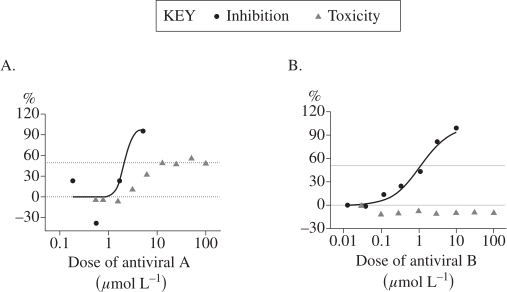
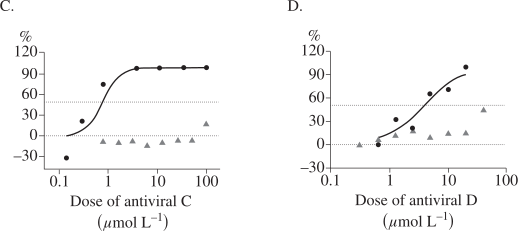
The ability of the drugs to inhibit viral entry to the cells (% inhibition) and the proportion of the cells killed by the drugs (% toxicity) were recorded at different doses of each drug and shown in the graphs.

From the results shown, which antiviral drug is the safest and most effective at a dose of  1 `mu`mol L¯1?
 

Show Answers Only

`C`

Show Worked Solution
  • At 1 `mu`mol L¯1, Drug C inhibited 50% of viral entry, the highest of all antivirals.
  • It was also relatively non-toxic, proving it to be the most effective at that dosage.

`=>C`

Mean mark 52%.

Filed Under: Prevention, Treatment and Control Tagged With: Band 5, smc-3658-11-Pharmaceuticals

BIOLOGY, M5 2021 HSC 9 MC

Streptomycin is an antibiotic that kills bacteria by interfering with the function of their ribosomes.

The primary effect of the antibiotic is that it prevents the bacteria from producing 

  1. tRNA.
  2. mRNA.
  3. amino acids.
  4. polypeptides.
Show Answers Only

`D`

Show Worked Solution
  • Ribosomes form polypeptide chains as part of protein synthesis.
  • By interfering with the function of ribosomes, Streptomycin prevents bacteria from producing polypeptides.

`=>D`

♦♦ Mean mark 34%.

Filed Under: DNA and Polypeptide Synthesis, Prevention, Treatment and Control Tagged With: Band 5, smc-3650-30-Transcription, smc-3658-11-Pharmaceuticals

BIOLOGY, M7 2021 HSC 8 MC

Howard Florey conducted a breakthrough experiment in the development and use of antibiotics. He infected eight mice with Streptococcus bacteria. Four mice were given penicillin and survived while the four untreated mice died.

What conclusion could be drawn from the data obtained?

  1. The experiment should be repeated with more mice.
  2. The use of penicillin causes antibiotic resistance in mice.
  3. Penicillin may be used on humans safely to treat bacterial infections.
  4. Penicillin may have played a role in the survival of the four treated mice.
Show Answers Only

`D`

Show Worked Solution
  • Conclusion must be directed to the research problem.
  • Option A is not a conclusion.
  • Options B and C are definitive beyond the supporting data.

`=>D`

Filed Under: Prevention, Treatment and Control Tagged With: Band 4, smc-3658-11-Pharmaceuticals

Copyright © 2014–2025 SmarterEd.com.au · Log in