SmarterEd

Aussie Maths & Science Teachers: Save your time with SmarterEd

  • Login
  • Get Help
  • About

BIOLOGY, M7 2025 HSC 10 MC

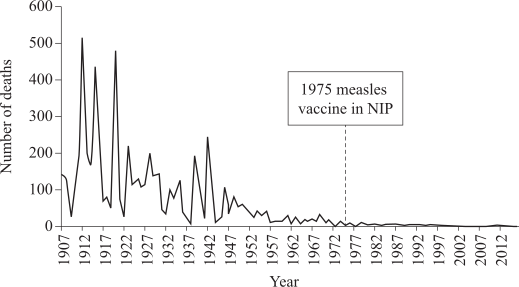
The graph shows the number of recorded deaths, due to measles, before and after the measles vaccine was included in the National Immunisation Program (NIP).
  

Which of the following is a trend shown in the graph?

  1. Most people have been immunised against measles since 1975.
  2. Over the last 100 years the number of deaths has consistently fallen.
  3. The number of measles-induced deaths has fallen to near zero since measles vaccine was added to the NIP.
  4. The National Immunisation Program was the primary reason for the great reduction in measle-induced deaths.
Show Answers Only

\(C\)

Show Worked Solution
  • C is correct: Graph clearly shows deaths fell to near zero after 1975.

Other Options:

  • A is incorrect: Graph shows deaths, not immunisation rates; cannot infer this.
  • B is incorrect: Deaths fluctuated considerably before 1975, not consistent decline.
  • D is incorrect: Deaths were already declining before NIP; cannot claim it’s primary reason.

Filed Under: Prevention, Treatment and Control Tagged With: Band 5, smc-3658-20-Vaccines, smc-3658-40-Interpreting Data

BIOLOGY, M7 2025 HSC 5 MC

An infectious disease is spread through direct contact between hosts.

Under which conditions will this disease spread most rapidly?

  1. Low population density with infected individuals rarely dying from the disease
  2. High population density with infected individuals rarely dying from the disease
  3. Low population density with infected individuals quickly dying from the disease
  4. High population density with infected individuals quickly dying from the disease
Show Answers Only

\(B\)

Show Worked Solution
  • B is correct: High density increases contact rate and slow death maintains infectious individuals.

Other Options:

  • A is incorrect: Low population density reduces contact frequency between hosts.
  • C is incorrect: Low density and quick death both limit disease transmission.
  • D is incorrect: Quick death reduces time for infected individuals to spread disease.

Filed Under: Prevention, Treatment and Control Tagged With: Band 4, smc-3658-40-Interpreting Data

BIOLOGY, M7 2024 HSC 27

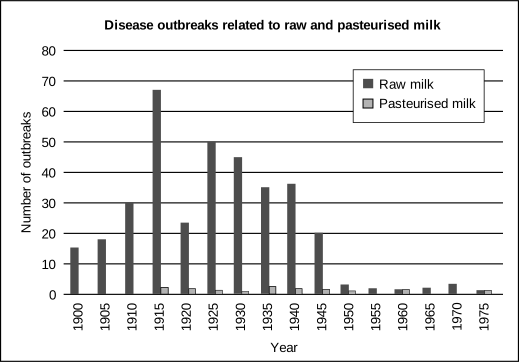
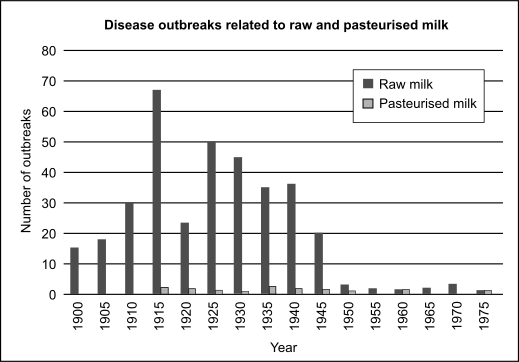
Milk pasteurisation (heating to approximately 70°C) was gradually introduced in America from the early 1900s. The graph shows the number of disease outbreaks in relation to raw (unpasteurised) and pasteurised milk in America from 1900-1975.
 

Explain the trends observed in the graph. In your response, refer to the role of Pasteur's work in pasteurisation.   (5 marks)

--- 13 WORK AREA LINES (style=lined) ---

Show Answers Only
  • Louis Pasteur’s research was pivotal in debunking the theory of spontaneous generation and establishing our understanding of microorganisms.
  • His work revealed that microbes present in milk could be responsible for disease outbreaks.
  • He demonstrated that exposing substances to high temperatures effectively kills microorganisms, which is why heating milk to 70°C eliminates many harmful bacteria.
  • This scientific foundation – the presence of microbes in milk and their vulnerability to heat – explains the effectiveness of milk pasteurisation in preventing disease outbreaks.
  • The historical data presented in the graph supports this, showing significantly fewer disease outbreaks linked to pasteurised milk compared to raw milk.
  • A notable decline in raw milk-related outbreaks occurred after 1945, though this may also be attributed to decreased raw milk consumption during that period.
  • While pasteurised milk has generally proven safer, some disease outbreaks have still occurred with pasteurised products. These cases typically result from issues in the pasteurisation process itself or problems during subsequent storage and transportation of the milk.
Show Worked Solution
  • Louis Pasteur’s research was pivotal in debunking the theory of spontaneous generation and establishing our understanding of microorganisms.
  • His work revealed that microbes present in milk could be responsible for disease outbreaks.
  • He demonstrated that exposing substances to high temperatures effectively kills microorganisms, which is why heating milk to 70°C eliminates many harmful bacteria.
  • This scientific foundation – the presence of microbes in milk and their vulnerability to heat – explains the effectiveness of milk pasteurisation in preventing disease outbreaks.
  • The historical data presented in the graph supports this, showing significantly fewer disease outbreaks linked to pasteurised milk compared to raw milk.
  • A notable decline in raw milk-related outbreaks occurred after 1945, though this may also be attributed to decreased raw milk consumption during that period.
  • While pasteurised milk has generally proven safer, some disease outbreaks have still occurred with pasteurised products. These cases typically result from issues in the pasteurisation process itself or problems during subsequent storage and transportation of the milk.

Filed Under: Causes of Infectious Disease, Prevention, Treatment and Control Tagged With: Band 4, Band 5, smc-3655-60-Louis Pasteur, smc-3658-30-Procedures to Prevent Spread, smc-3658-40-Interpreting Data

BIOLOGY, M7 SM-Bank 23

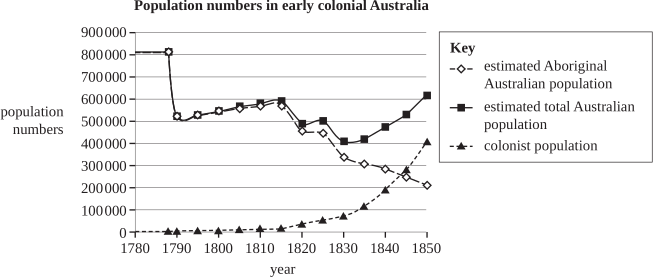
Smallpox is widely believed to be the cause of the significant population decline in Indigenous populations during early European arrival in Australia. Recent research suggests that it may have been chickenpox that caused the change in population numbers rather than smallpox. It is thought that chickenpox did not exist in Aboriginal and Torres Strait Islander communities before European arrival. Chickenpox is fairly mild in young children and is easily transmitted. It can be a fatal disease in adults who were not infected as children.

The graph below shows population numbers during the period 1780 –1850:

    • the estimated Aboriginal Australian population
    • the colonist population
    • the estimated total Australian population
       

With reference to chickenpox, explain how infection may have caused such a large impact on the Aboriginal Australian population and yet did not affect the population numbers of the colonists significantly, and why the Aboriginal population increased from 1790 to 1810.  (3 marks)

Show Answers Only
  • Childhood immunity existed in colonists due to previous exposure prior to arrival in Australia.
  • No immunity existed for the Aboriginal Australian population due to no previous exposure.
  • Aboriginal children became mildly ill when exposed in the early days of colonialism and became immune.
  • Aboriginal adults caught chickenpox in the early days of colonialism and died in disproportionately high numbers.
  • The initial exposure caused a steep decline in overall Aboriginal population. However, once Aboriginal children were immune and susceptible adults had died, there was an increase of population numbers over the next 30 years, from 1790 – 1810.
Show Worked Solution
  • Childhood immunity existed in colonists due to previous exposure prior to arrival in Australia.
  • No immunity existed for the Aboriginal Australian population due to no previous exposure.
  • Aboriginal children became mildly ill when exposed in the early days of colonialism and became immune.
  • Aboriginal adults caught chickenpox in the early days of colonialism and died in disproportionately high numbers.
  • The initial exposure caused a steep decline in overall Aboriginal population. However, once Aboriginal children were immune and susceptible adults had died, there was an increase of population numbers over the next 30 years, from 1790 – 1810.

Filed Under: Prevention, Treatment and Control Tagged With: Band 4, smc-3658-40-Interpreting Data, smc-3658-60-Indigenous

BIOLOGY, M7 EQ-Bank 9 MC

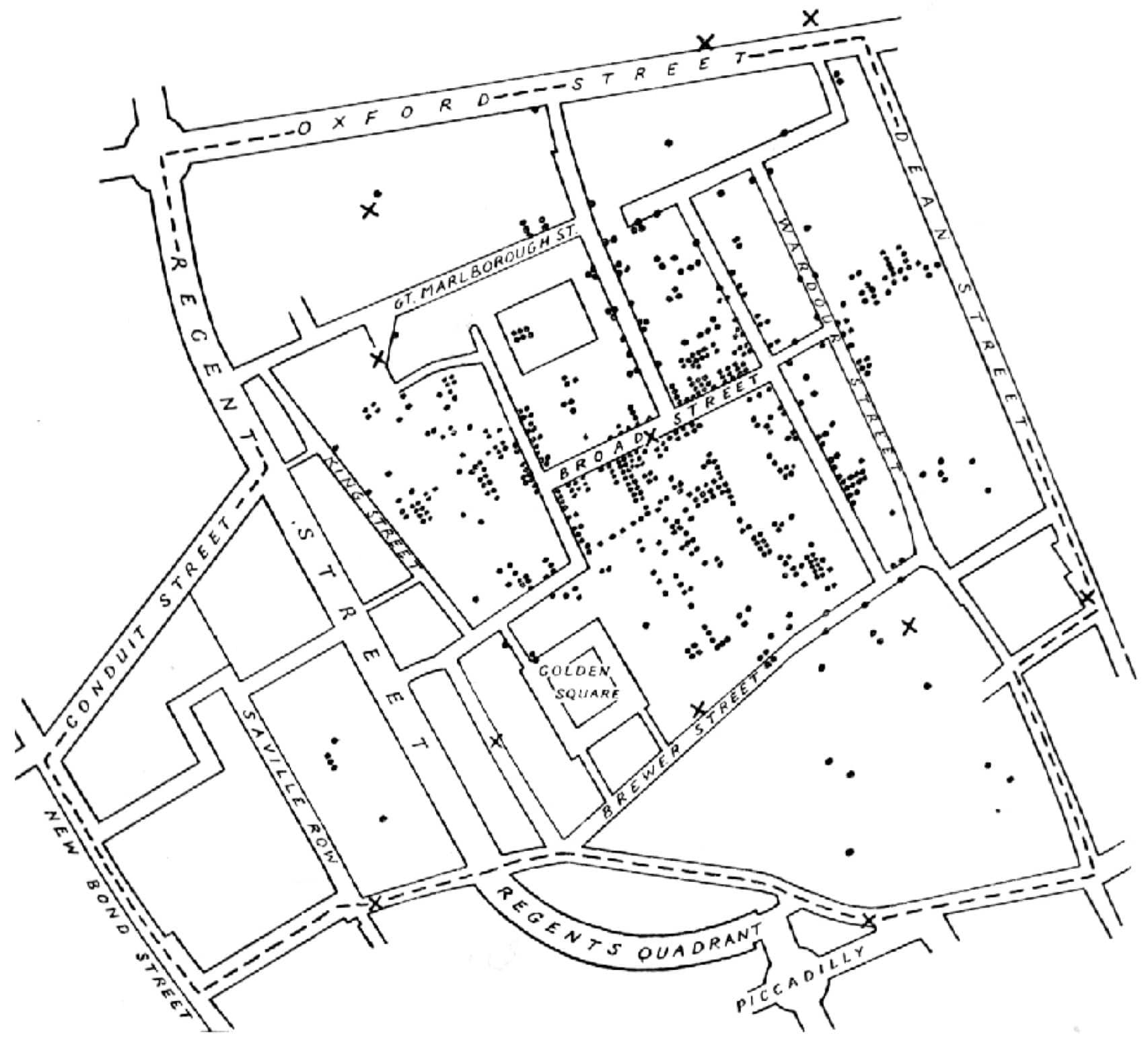
The map shown was drawn by Dr John Snow during the 1854 London cholera epidemic.
 

The dots indicate people who died from cholera and the crosses indicate the location of water pumps.

Which of the following is the most likely hypothesis for which Dr John Snow was gathering evidence?

  1. That the outbreak of cholera was caused by people living near each other
  2. That the people who died from cholera drank water from the Broad Street pump
  3. That cholera was caused by an infectious agent that can be found and transmitted in water
  4. That the cause of a disease can be determined by mapping the location of infected patients
Show Answers Only

`C`

Show Worked Solution
  • The outbreak was mainly centralised around the Broad Street water pump.
  • Snow therefore hypothesised that cholera may be caused by a pathogen in the water, hence mainly affecting people that used and drank the water from the infected pump.

`=>C`

Filed Under: Prevention, Treatment and Control Tagged With: Band 4, smc-3658-40-Interpreting Data

BIOLOGY, M7 2018 HSC 24

A new flu vaccine is prepared each year to protect the population against the current strains of influenza virus. The effectiveness of flu vaccines varies from year to year and can be measured using the overall vaccination effectiveness (VE) index. A VE of 60% means that a vaccinated individual's chance of getting the flu is reduced by 60%.

The following data show the VE over a 10-year period.

\begin{array}{|c|c|}
\hline \rule{0pt}{2.5ex}\textit{Influenza season } & \rule[-1ex]{0pt}{0pt}\quad \textit{VE(%)} \quad \\
\hline \rule{0pt}{2.5ex}2006-2007 & \rule[-1ex]{0pt}{0pt}52 \\
\hline \rule{0pt}{2.5ex}2008-2009 & \rule[-1ex]{0pt}{0pt}41 \\
\hline \rule{0pt}{2.5ex}2010-2011 & \rule[-1ex]{0pt}{0pt}60 \\
\hline \rule{0pt}{2.5ex}2012-2013 & \rule[-1ex]{0pt}{0pt}49 \\
\hline \rule{0pt}{2.5ex}2014-2015 & \rule[-1ex]{0pt}{0pt}19 \\
\hline
\end{array}

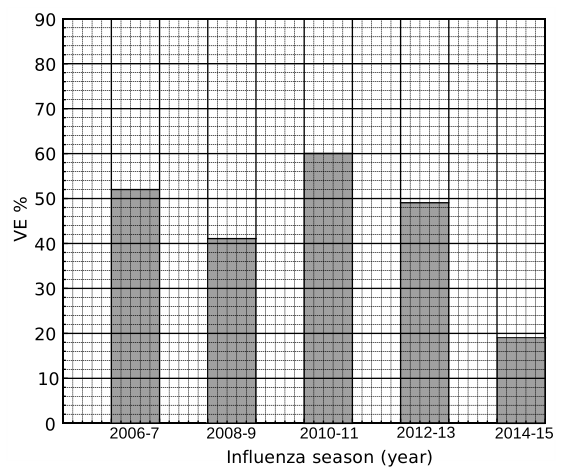
  1. Draw an appropriate graph to represent the data on the following grid.   (3 marks)


  2. Provide a possible explanation for the vaccination effectiveness (VE) index in 2014-2015.   (3 marks)

    --- 6 WORK AREA LINES (style=lined) ---

Show Answers Only

a.


b.    The vaccine was less effective between 2014-15 (at 19%).

  • When vaccines are administered the production of antibodies specific to a particular antigen is triggered.
  • If the pathogen mutates after the production of the vaccine the vaccine will not be effective.
  • Therefore, mutation of the virus may be responsible for the vaccine being less effective in 2014-15 and hence the lower VE %.
Show Worked Solution

a.


b.    The vaccine was less effective between 2014-15 (at 19%).

  • When vaccines are administered the production of antibodies specific to a particular antigen is triggered.
  • If the pathogen mutates after the production of the vaccine the vaccine will not be effective.
  • Therefore, mutation of the virus may be responsible for the vaccine being less effective in 2014-15 and hence the lower VE %.

♦ Mean mark (b) 40%.

Filed Under: Prevention, Treatment and Control Tagged With: Band 4, Band 5, smc-3658-40-Interpreting Data

BIOLOGY, M7 2019 HSC 32

Use the following data to answer parts (a) and (b).

Dengue fever and malaria are examples of infectious diseases transmitted between humans by mosquitoes. Dengue fever is caused by a virus transmitted by mosquitoes of the genus Aedes. Malaria is caused by a single-celled organism transmitted by mosquitoes of the genus Anopheles.

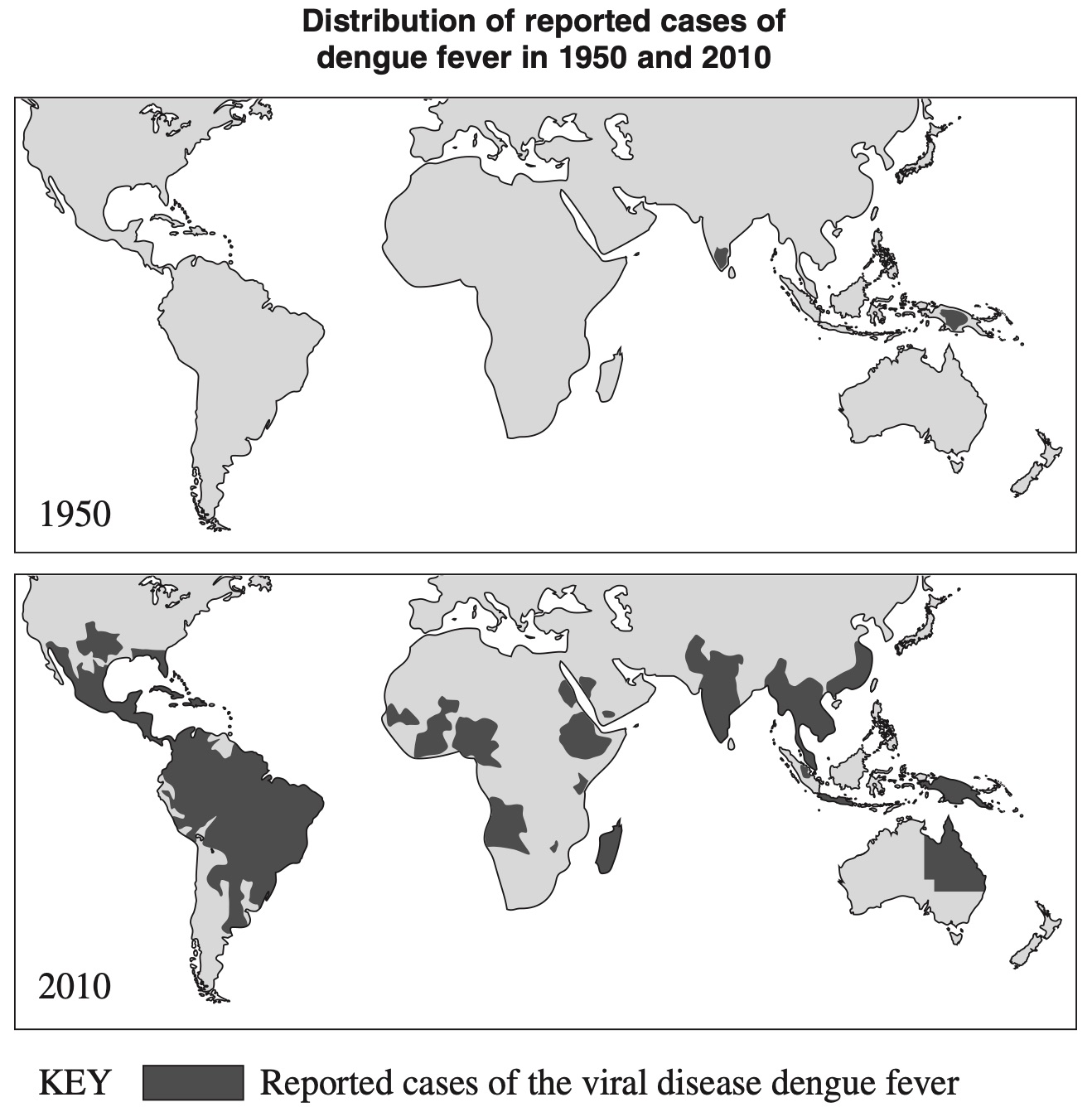
The following data provide information about the global incidence of these two diseases over time.


  1. Based on the data provided, identify trends in the global disease burden for both malaria and dengue fever.   (3 marks)

    --- 8 WORK AREA LINES (style=lined) ---

  2. Analyse factors that could have contributed to the change in global distribution of both dengue fever and malaria over the last 100 years. Support your answer with reference to the data provided.   (7 marks)

    --- 16 WORK AREA LINES (style=lined) ---

Show Answers Only

a.   Trends in global disease burden:

  • The distribution on Dengue Fever has significantly increased since 1950, with continents such as Australia, Europe, South America and Africa now having a significant number of reported cases.
  • This spread is seen both north and south of the equator.
  • Malaria has a declining number of countries with reported cases of the disease.
  • However, population growth means the number of individuals at risk is increasing, having almost doubled between 1965 and 2010.
  • We can conclude however, that there is an increasing number of people at risk of malaria, but representing a smaller portion of the global population. 

b.  Analysis of factors that could have contributed to the change in global distribution of both dengue fever and malaria

Both diseases are transmitted by a mosquito vector. The prevalence of mosquitoes in each area would therefore have a large influence on the number of infected individuals.

  • The increase in international travel allows mosquitoes to spread across the world.
  • The increasing population of the world along with rapid urbanisation gives rise to more urban mosquito habitats.

These factors can be associated with the distribution seen on the Dengue Fever map, however the countries with reported cases of Malaria has shrunk.

  • The mosquitoes responsible for Dengue Fever and Malaria respectively, are from a different genus of mosquito. It is likely that more is known about Anopheles than Aedes.
  • The use of quarantine and pesticides on the Anopheles is most likely being used to contain the spread of malaria.

Medical advances such as vaccines also have the potential to be an effective measure of containing diseases.

  • From both data sets, it would be accurate to conclude, however, that medicinal products had better results when maintaining malaria compared to dengue fever.
  • Antimalarial tablets or a malaria vaccine may be types of malaria medicinal products that may be used to maintain the disease.
  • The rapid evolution of the dengue virus, ineffective antivirals or potentially that there is no known vaccine may be some of the reasons why medicinals may not be effective for dengue fever.
Show Worked Solution

a.   Trends in global disease burden:

  • The distribution on Dengue Fever has significantly increased since 1950, with continents such as Australia, Europe, South America and Africa now having a significant number of reported cases.
  • This spread is seen both north and south of the equator.
  • Malaria has a declining number of countries with reported cases of the disease.
  • However, population growth means the number of individuals at risk is increasing, having almost doubled between 1965 and 2010.
  • We can conclude however, that there is an increasing number of people at risk of malaria, but representing a smaller portion of the global population. 

b.  Analysis of factors that could have contributed to the change in global distribution of both dengue fever and malaria

Both diseases are transmitted by a mosquito vector. The prevalence of mosquitoes in each area would therefore have a large influence on the number of infected individuals.

  • The increase in international travel allows mosquitoes to spread across the world.
  • The increasing population of the world along with rapid urbanisation gives rise to more urban mosquito habitats.

These factors can be associated with the distribution seen on the Dengue Fever map, however the countries with reported cases of Malaria has shrunk.

  • The mosquitoes responsible for Dengue Fever and Malaria respectively, are from a different genus of mosquito. It is likely that more is known about Anopheles than Aedes.
  • The use of quarantine and pesticides on the Anopheles is most likely being used to contain the spread of malaria.

Medical advances such as vaccines also have the potential to be an effective measure of containing diseases.

  • From both data sets, it would be accurate to conclude, however, that medicinal products had better results when maintaining malaria compared to dengue fever.
  • Antimalarial tablets or a malaria vaccine may be types of malaria medicinal products that may be used to maintain the disease.
  • The rapid evolution of the dengue virus, ineffective antivirals or potentially that there is no known vaccine may be some of the reasons why medicinals may not be effective for dengue fever.

♦ Mean mark (b) 52%.

Filed Under: Prevention, Treatment and Control Tagged With: Band 4, Band 5, smc-3658-40-Interpreting Data, smc-3658-50-Malaria

BIOLOGY, M7 2022 HSC 9 MC

A new vaccine against an infectious disease was developed. The effectiveness of the vaccine in preventing infection in humans was plotted over time in three different age groups.
 

Which of the following is a valid conclusion that can be drawn from the data in the graph?

  1. The vaccine is ineffective after six months.
  2. The younger the person the more effective the vaccine.
  3. The younger the person, the faster the immunity to infection declines.
  4. The vaccine offers more protection to younger people than those over 65 .
Show Answers Only

`D`

Show Worked Solution
  • The graph shows that the vaccine has a lower effectiveness against infection for people aged over 65 than for the younger age groups over the whole period.

`=>D`

Filed Under: Prevention, Treatment and Control Tagged With: Band 3, smc-3658-20-Vaccines, smc-3658-40-Interpreting Data

BIOLOGY, M8 2022 HSC 5 MC

Data for incidence of notifiable infectious diseases in Australia are shown in the table.

\begin{array}{|l|c|}
\hline
\rule{0pt}{2.5ex}\textit{Disease} & \textit{Percent of all cases of infectious} \\
\textit{} & \textit{disease notified for 2019} \\
\hline
\rule{0pt}{2.5ex}\text{Influenza}\rule[-1ex]{0pt}{0pt}&\text{53}\\
\hline
\rule{0pt}{2.5ex}\text{Sexually transmitted infections}\rule[-1ex]{0pt}{0pt}& \text{25}\\
\hline
\rule{0pt}{2.5ex}\text{Gastrointestinal diseases}\rule[-1ex]{0pt}{0pt}& \text{10} \\
\hline
\rule{0pt}{2.5ex}\text{Vaccine preventable diseases}\rule[-1ex]{0pt}{0pt}& \text{9} \\
\text{excluding influenza}\rule[-1ex]{0pt}{0pt}& \text{} \\
\hline
\rule{0pt}{2.5ex}\text{Other}\rule[-1ex]{0pt}{0pt}& \text{3} \\
\hline
\end{array}

Which type of graph should be chosen to best represent these data?

  1. A column graph because percentages are continuous.
  2. A column graph because diseases are categorical.
  3. A line graph because percentages are continuous.
  4. A line graph because diseases are categorical.
Show Answers Only

`B`

Show Worked Solution
  • A column graph would be the most appropriate as the diseases are divided into categories.

`=>B`

Filed Under: Epidemiology, Prevention, Treatment and Control Tagged With: Band 3, smc-3658-40-Interpreting Data, smc-3661-10-Analysing Results

BIOLOGY, M7 2021 HSC 30

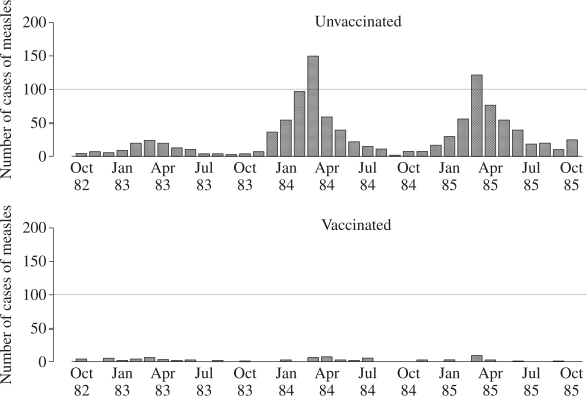
A study compared the incidence of disease and survival of 8134 children who had received the measles vaccine with 8134 children from a neighbouring area who remained unvaccinated against measles. Children in each group were matched for age, sex, size of dwelling, number of siblings and maternal education. The graphs show the number of measles cases among the two groups over three years.


The table compares the cause of death and number of deaths of the two groups over the same three years.
 

'A vaccine only protects the community against a specific disease.'

Analyse the data with reference to this statement.   (7 marks)

--- 17 WORK AREA LINES (style=lined) ---

Show Answers Only
  • These two studies show proof that the vaccine protects against measles.
  • The graphs show the incidence of measles in vaccinated children is extremely low, occasionally zero, compared to unvaccinated children. Since these children are matched for age and other sociocultural/socioeconomic factors, it is highly likely the vaccine is responsible for this difference.
  • The table also supports this conclusion, where 40 children who were unvaccinated died due to measles compared to the 2 who died who were vaccinated.
  • The table also provides evidence that the vaccine may protect children from dying from other diseases, contradicting the statement.
  • The table also uses the same groups as the graph, again, keeping cultural/socioeconomic factors similar. It shows that children vaccinated against measles died at half the rate of unvaccinated children due to diarrhoea and dysentery, and at about a quarter of the rate for oedema.
  • However, the small differences between groups with respect to fever and the small sample size for oedema mean that further research is required.
  • In general, the vaccinated group had less than half the mortality of the unvaccinated group, supporting the conclusion that the vaccine provides a wider protection.
  • However, this statement needs qualification as the data is only with respect to the measles vaccine. 
Show Worked Solution
  • These two studies show proof that the vaccine protects against measles.
  • The graphs show the incidence of measles in vaccinated children is extremely low, occasionally zero, compared to unvaccinated children. Since these children are matched for age and other sociocultural/socioeconomic factors, it is highly likely the vaccine is responsible for this difference.
  • The table also supports this conclusion, where 40 children who were unvaccinated died due to measles compared to the 2 who died who were vaccinated.
  • The table also provides evidence that the vaccine may protect children from dying from other diseases, contradicting the statement.
  • The table also uses the same groups as the graph, again, keeping cultural/socioeconomic factors similar. It shows that children vaccinated against measles died at half the rate of unvaccinated children due to diarrhoea and dysentery, and at about a quarter of the rate for oedema.
  • However, the small differences between groups with respect to fever and the small sample size for oedema mean that further research is required.
  • In general, the vaccinated group had less than half the mortality of the unvaccinated group, supporting the conclusion that the vaccine provides a wider protection.
  • However, this statement needs qualification as the data is only with respect to the measles vaccine. 

Filed Under: Prevention, Treatment and Control Tagged With: Band 4, Band 5, smc-3658-20-Vaccines, smc-3658-40-Interpreting Data

Copyright © 2014–2025 SmarterEd.com.au · Log in