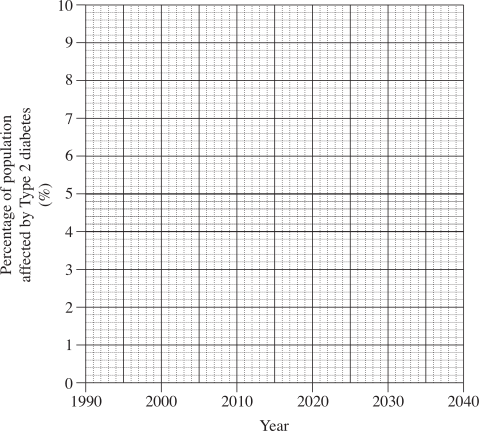
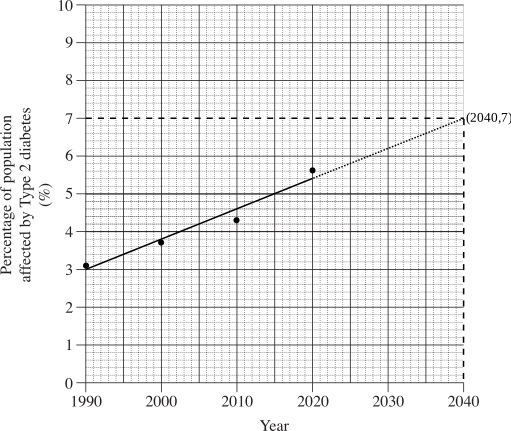
An epidemiological study was conducted to help model how many people will be affected by Type 2 diabetes globally in the future. Continuous data were collected from 1990 to 2020. From that data, the following data points were chosen to demonstrate the trend. \begin{array} {|c|c|} A prediction of the global population numbers suggests there will be about 9 billion \((9\ 000\ 000\ 000)\) people on the planet by 2040. Predict the number of people that will be affected by diabetes in 2040. Show working on your graph on the previous page and your calculations. (3 marks) --- 3 WORK AREA LINES (style=lined) --- a. b. 630 000 000 (630 million) a. b. Using the LOBF on the graph: Population (%) with diabetes in 2040 = 7% People with diabetes in 2040 = \(\dfrac{7}{100} \times 9\ 000\ 000\ 000 = 630\ 000\ 000\)
\hline
\rule{0pt}{2.5ex} \textit{Year} \rule[-1ex]{0pt}{0pt} & \textit{Percentage of population affected} \\
\rule{0pt}{2.5ex} \textit{} \rule[-1ex]{0pt}{0pt} & \textit{by Type 2 diabetes (%)} \\
\hline
\rule{0pt}{2.5ex} \text{1990} \rule[-1ex]{0pt}{0pt} & \text{3.1} \\
\hline
\rule{0pt}{2.5ex} \text{2000} \rule[-1ex]{0pt}{0pt} & \text{3.7} \\
\hline
\rule{0pt}{2.5ex} \text{2010} \rule[-1ex]{0pt}{0pt} & \text{4.3} \\
\hline
\rule{0pt}{2.5ex} \text{2010} \rule[-1ex]{0pt}{0pt} & \text{5.6} \\
\hline
\end{array}
BIOLOGY, M8 2022 HSC 24
Birth defects in humans can be caused by chromosomal abnormalities.
\begin{array}{|c|c|}
\hline
\rule{0pt}{2.5ex}\quad \textit{Maternal} \quad & \textit{Prevalence of}\\
\textit{age} & \textit{chromosomal}\\
\text{(years)} & \textit{abnormalities}\\
\text{} & \rule[-1ex]{0pt}{0pt}\text{(per 1000 births)}\\
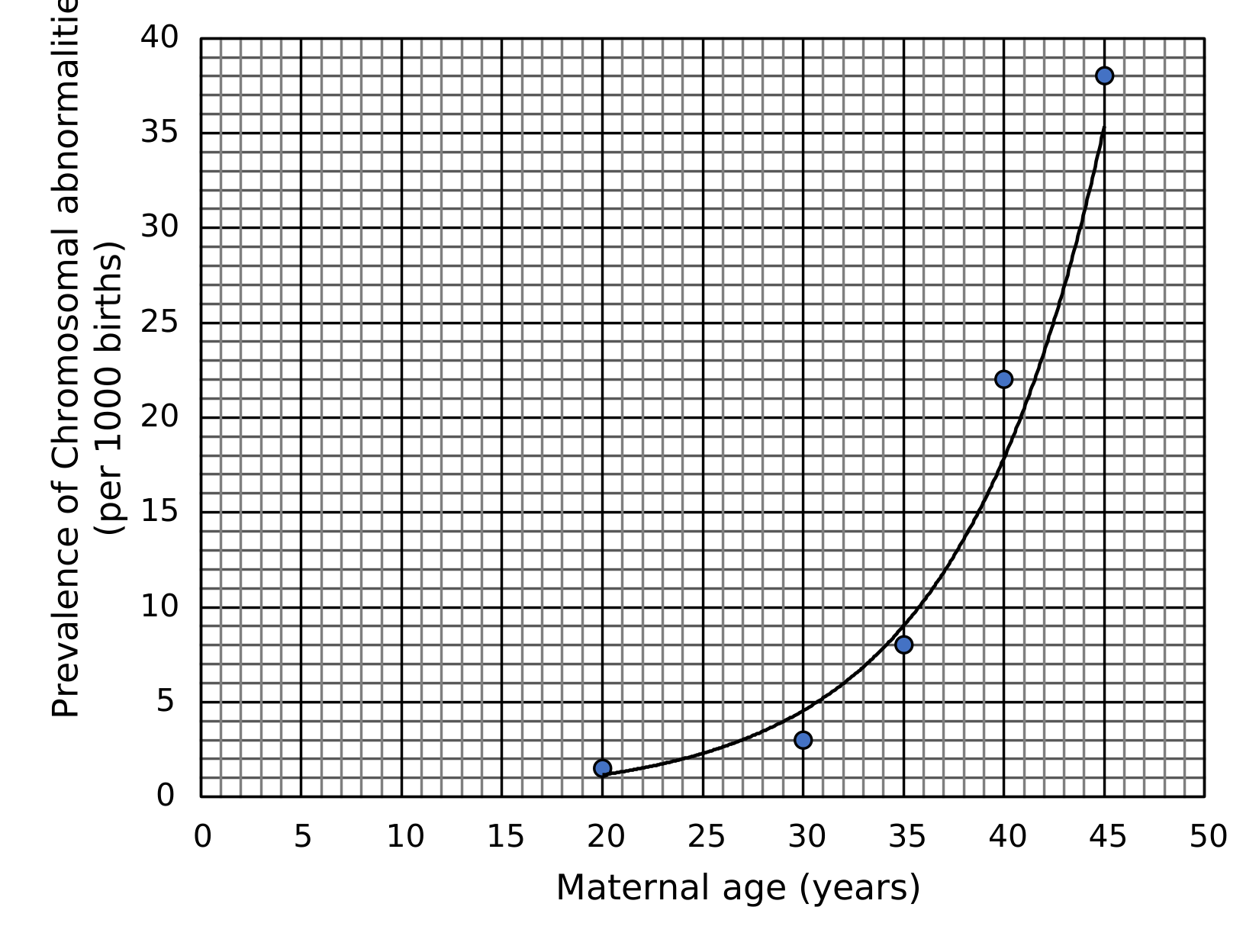
\hline \rule{0pt}{2.5ex}20 \rule[-1ex]{0pt}{0pt}& 1.5 \\
\hline \rule{0pt}{2.5ex}30 \rule[-1ex]{0pt}{0pt}& 3 \\
\hline \rule{0pt}{2.5ex}35 \rule[-1ex]{0pt}{0pt}& 8 \\
\hline \rule{0pt}{2.5ex}40 \rule[-1ex]{0pt}{0pt}& 22 \\
\hline \rule{0pt}{2.5ex}45 \rule[-1ex]{0pt}{0pt}& 38 \\
\hline
\end{array}
- Draw a suitable graph of the data provided in the table. Include a suitable line of best fit. (3 marks)
- Outline the trend shown in the data. (2 marks)
--- 3 WORK AREA LINES (style=lined) ---
- Explain the cause of a type of chromosomal mutation. (3 marks)
--- 6 WORK AREA LINES (style=lined) ---
Show Answers Only
a.
b. Data trend:
- After 20 years of age, the older a woman is when she gives birth, the chance of her child having a chromosomal abnormality increases exponentially.
c. Cause of chromosomal mutation:
- Aneuploidy is a chromosomal mutation where the child contains either an extra or a deficit of a chromosome.
- This is a result of non-disjunction, where in meiosis, chromosomes fail to separate.
- This can produce a gamete with an extra chromosome (trisomy, 2N+1) or one missing a certain chromosome (monosomy, 2N-1).
- Down Syndrome (Trisomy 21) is the result of a child containing an extra chromosome 21.
Other answers could include
- Polyploidy, duplications of whole sets of chromosomes (XN).
- Rearrangement, deletion, insertion, translocation or duplications of sections of a chromosome.
Show Worked Solution
a.
b. Data trend:
- After 20 years of age, the older a woman is when she gives birth, the chance of her child having a chromosomal abnormality increases exponentially.
♦ Mean mark (a) 54%.
Mean mark (b) 56%.
Mean mark (b) 56%.
c. Cause of chromosomal mutation:
- Aneuploidy is a chromosomal mutation where the child contains either an extra or a deficit of a chromosome.
- This is a result of non-disjunction, where in meiosis, chromosomes fail to separate.
- This can produce a gamete with an extra chromosome (trisomy, 2N+1) or one missing a certain chromosome (monosomy, 2N-1).
- Down Syndrome (Trisomy 21) is the result of a child containing an extra chromosome 21.
Other answers could include
- Polyploidy, duplications of whole sets of chromosomes (XN).
- Rearrangement, deletion, insertion, translocation or duplications of sections of a chromosome.
♦♦ Mean mark (c) 32%.