SmarterEd

Aussie Maths & Science Teachers: Save your time with SmarterEd

  • Login
  • Get Help
  • About

BIOLOGY, M8 EQ-Bank 15

The diagram shows a rural coastal area and the towns, rivers and associated industry for each of the townships.
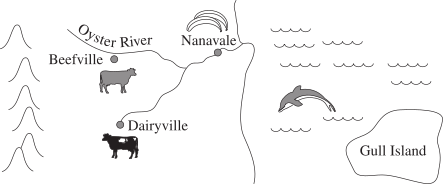
 

An epidemic of a disease has broken out in Nanavale. The symptoms are stomach ache, vomiting and tiredness. Many families in Nanavale have only one member with the disease, therefore it appears to be non-infectious. The symptoms are worse in infants than in adults.

Isolated cases of this disease have occurred in the nearby towns of Dairyville and Beefville. No cases have been reported on Gull Island.

Design an epidemiological study to investigate the origin of the disease. Refer to features of validity and reliability in your answer.   (7 marks)

--- 16 WORK AREA LINES (style=lined) ---

Show Answers Only
  • When planning an epidemiological study it is important to first analyse all the initial evidence to better construct an effective study.
  • The disease is most likely infectious as an outbreak that affects many people is very unlikely to be due to a previously masked non-infectious disease.
  • The fact that the disease is not present on gull island also supports this and may indicate that the disease is not waterborne and may spread through physical touch, close proximity, food or radioactive toxic elements.
  • The disease also affects children more severely. This fact must be addressed in the study and measures taken to protect and monitor this vulnerable group.
  • The study should survey affected families to try to pinpoint the transmission of the disease.
  • Appropriate fact finding questions should include
    • Where have you travelled to?
    • What have you eaten/drunk and where did you get it from?
    • Who else have you been in contact with and where are they from?
  • These results should be analysed for common factors and then compared to results from the same set of questions asked of unaffected families, thus increasing the study’s validity.
  • The more people that can be reached and questioned, the more accurate the findings of the study will be.
  • Geiger readings, screening and soil extraction may pinpoint whether the disease is caused by a carcinogen on the coastal area.
  • Common factors found in the study may also reveal an antidote or treatment for affected individuals.
Show Worked Solution
  • When planning an epidemiological study it is important to first analyse all the initial evidence to better construct an effective study.
  • The disease is most likely infectious as an outbreak that affects many people is very unlikely to be due to a previously masked non-infectious disease.
  • The fact that the disease is not present on gull island also supports this and may indicate that the disease is not waterborne and may spread through physical touch, close proximity, food or radioactive toxic elements.
  • The disease also affects children more severely. This fact must be addressed in the study and measures taken to protect and monitor this vulnerable group.
  • The study should survey affected families to try to pinpoint the transmission of the disease.
  • Appropriate fact finding questions should include
    • Where have you travelled to?
    • What have you eaten/drunk and where did you get it from?
    • Who else have you been in contact with and where are they from?
  • These results should be analysed for common factors and then compared to results from the same set of questions asked of unaffected families, thus increasing the study’s validity.
  • The more people that can be reached and questioned, the more accurate the findings of the study will be.
  • Geiger readings, screening and soil extraction may pinpoint whether the disease is caused by a carcinogen on the coastal area.
  • Common factors found in the study may also reveal an antidote or treatment for affected individuals.

Filed Under: Epidemiology Tagged With: Band 4, Band 5, Band 6, smc-3661-20-Evaluating the Method, smc-3661-30-Benefits

BIOLOGY, M8 EQ-Bank 7 MC

For many years, some cigarette companies have denied that there were increased risks of lung cancer as a result of cigarette smoking.

How can an epidemiological study into lung cancer be useful in this situation?

  1. It can show that the chemicals in cigarette smoke cause cancer.
  2. It can demonstrate that second-hand smoke has no impact on lung cancer rates.
  3. It can provide evidence that people who smoke are more likely to develop lung cancer.
  4. It can show that the cigarette companies have been lying about the cause of lung cancer.
Show Answers Only

`C`

Show Worked Solution
  • An epidemiological study will gather statistics surrounding smoking and lung cancer.
  • The data will then be analysed and conclusions drawn to show that a link between them exists.

`=>C`

Filed Under: Epidemiology Tagged With: Band 4, smc-3661-30-Benefits

BIOLOGY, M8 2015 HSC 16 MC

Why might epidemiology be considered more essential for the study of non-infectious diseases than for the study of infectious diseases?

  1. The causes of infectious diseases have already been determined.
  2. Only non-infectious diseases are affected by patterns of behaviour.
  3. Epidemiology cannot be used to find the causes of infectious diseases.
  4. Koch's postulates are not useful in finding the causes of non-infectious diseases.
Show Answers Only

`D`

Show Worked Solution
  • Options A – C can be shown to be false.
  • Koch’s postulates are only useful when identifying infectious diseases.

`=>D`


♦♦♦ Mean mark 23%.

Filed Under: Epidemiology Tagged With: Band 6, smc-3661-30-Benefits

Copyright © 2014–2025 SmarterEd.com.au · Log in