SmarterEd

Aussie Maths & Science Teachers: Save your time with SmarterEd

  • Login
  • Get Help
  • About

BIOLOGY, M8 2025 HSC 26

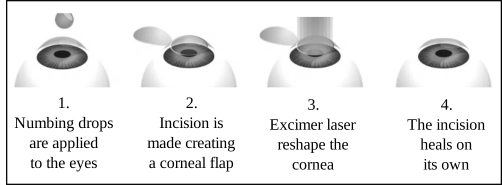
The diagram shows the steps in LASIK (Laser-Assisted In Situ Keratomileusis) surgery.
 

Compare the LASIK technology shown with ONE other technology that can be used to treat a named visual disorder.   (4 marks)

Visual disorder:  

--- 10 WORK AREA LINES (style=lined) ---
Show Answers Only

Visual disorder: Myopia (short-sightedness)

Similarities:

  • Both LASIK surgery and corrective spectacles correct refractive errors by changing light focus.
  • Both technologies enable clear vision at distance for myopia patients.

Differences:

  • LASIK permanently reshapes the cornea using laser ablation to correct vision.
  • Spectacles use external convex or concave lenses to refract light without altering eye structure.
  • LASIK requires surgical procedure with recovery time whilst spectacles require no invasive procedure.
  • LASIK provides permanent correction whereas spectacles require continuous wear for vision correction.

Show Worked Solution

Visual disorder: Myopia (short-sightedness)

Similarities:

  • Both LASIK surgery and corrective spectacles correct refractive errors by changing light focus.
  • Both technologies enable clear vision at distance for myopia patients.

Differences:

  • LASIK permanently reshapes the cornea using laser ablation to correct vision.
  • Spectacles use external convex or concave lenses to refract light without altering eye structure.
  • LASIK requires surgical procedure with recovery time whilst spectacles require no invasive procedure.
  • LASIK provides permanent correction whereas spectacles require continuous wear for vision correction.

Filed Under: Technologies and Disorders Tagged With: Band 4, Band 5, smc-3663-20-Eyes

BIOLOGY, M8 2024 HSC 16 MC

In a person with a particular visual disorder, light from a distant object focuses in front of the retina.
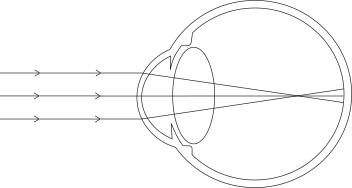
 

How can this disorder be corrected?

  1. Laser surgery to reshape the retina
  2. Use of a diverging lens in front of the eye
  3. Use of a converging lens in front of the eye
  4. Laser surgery to make the cornea more curved
Show Answers Only

\(B\)

Show Worked Solution
  • A diverging (concave) lens will spread light rays slightly before they enter the eye, moving the focal point back to the retina.

\(\Rightarrow B\)

♦ Mean mark 53%.

Filed Under: Technologies and Disorders Tagged With: Band 5, smc-3663-20-Eyes

BIOLOGY, M8 2023 HSC 24

  1. Explain how problems with the structure and function of the eye can cause a named visual disorder.  (3 marks)

    --- 6 WORK AREA LINES (style=lined) ---

  2. Describe ONE technology that is used to assist with the effects of a named visual disorder.  (3 marks)

    --- 6 WORK AREA LINES (style=lined) ---

Show Answers Only

a.   The front of the eye is made up of the cornea, lens and pupil.

  • These work together to direct light onto the retina at the back of the eye so that we can see.
  • The lens is controlled by ligaments which change the shape of the lens to allow the focus of light onto the retina from objects at varying distances.
  • If someone suffers from myopia (short-sightedness) their lens is too large or their ligaments are unable to bend the lens correctly, causing the focal point to fall short of the retina.

b.   Glasses are a technology that help people with myopia.

  • Glasses with a concave lens will diverge light rays before they hit the eye lens, allowing the focal point to fall further back. 
  • Lens technology fine tunes this effect so the focal point hits the retina optimally and perfect sight is restored.

Answers could also include

  • A convex lens to address hyperopia (long-sightedness).
  • Laser surgery (LASIK) which uses a laser to flatten or steepen the cornea, addressing myopia, hyperopia and astigmatism.
  • Cataract surgery to replace a clouded/yellow lens.

Show Worked Solution

a.   The front of the eye is made up of the cornea, lens and pupil.

  • These work together to direct light onto the retina at the back of the eye so that we can see.
  • The lens is controlled by ligaments which change the shape of the lens to allow the focus of light onto the retina from objects at varying distances.
  • If someone suffers from myopia (short-sightedness) their lens is too large or their ligaments are unable to bend the lens correctly, causing the focal point to fall short of the retina.

b.   Glasses are a technology that help people with myopia.

  • Glasses with a concave lens will diverge light rays before they hit the eye lens, allowing the focal point to fall further back. 
  • Lens technology fine tunes this effect so the focal point hits the retina optimally and perfect sight is restored.

Answers could also include

  • A convex lens to address hyperopia (long-sightedness).
  • Laser surgery (LASIK) which uses a laser to flatten or steepen the cornea, addressing myopia, hyperopia and astigmatism.
  • Cataract surgery to replace a clouded/yellow lens.

Filed Under: Technologies and Disorders Tagged With: Band 4, smc-3663-20-Eyes

BIOLOGY, M8 EQ-Bank 7 MC

A patient has experienced an injury that affected the retina of her eye. She asked her doctor if LASIK eye surgery could help restore her sight. The doctor said that LASIK eye surgery would have no impact on her condition.

Why did the doctor give this advice?

  1. LASIK eye surgery is a replacement of the lens in the eye and cannot repair a retina
  2. LASIK eye surgery will only temporarily repair her retina and her vision problems would return
  3. LASIK eye surgery is only used for people who have a damaged cornea and cannot repair a retina
  4. LASIK eye surgery is only used to change the shape of the cornea to enhance vision and cannot repair a retina
Show Answers Only

`D`

Show Worked Solution

`=>D`

Filed Under: Technologies and Disorders Tagged With: Band 4, smc-3663-20-Eyes

BIOLOGY, M8 2018 HSC 31d

A person with normal vision and a person with myopia are both looking at an object in the distance.

Construct THREE labelled diagrams of an eye to show the light path through the eye of the person with:   (5 marks)

    • normal vision
    • myopia
    • myopia corrected with a suitable lens.
Show Answers Only

Show Worked Solution


Mean mark 51%.

Filed Under: Technologies and Disorders Tagged With: Band 5, smc-3663-20-Eyes

BIOLOGY, M8 2018 HSC 31a

  1. Identify TWO structures that refract light as it passes through the eye.   (2 marks)

    --- 1 WORK AREA LINES (style=lined) ---

  2. The diagram shows the human eye. The two lines labelled `A` and `B` represent two beams of light passing through the eye and stimulating different areas of the retina.   
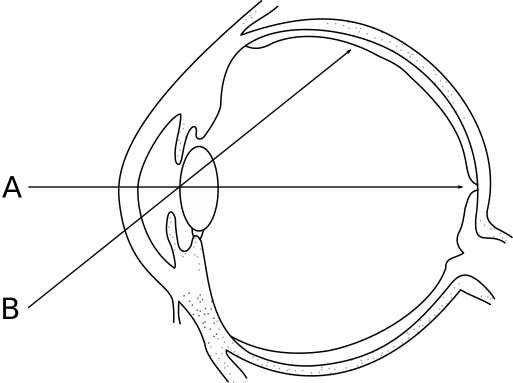
 

  1. The visual perception will be different at the two stimulated areas.
  2. Identify TWO of these differences.  (2 marks)

    --- 5 WORK AREA LINES (style=lined) ---

Show Answers Only

i.    Cornea and lens

ii.   Differences in visual perception at `A` and `B`.

  • At the fovea (where `A` strikes), there is a high concentration of cones, so more detail will be detected and better colour perceived than at the periphery.
  • At the periphery (where `B` strikes) there is low visual acuity (detail) and less colour perception, however, there is good distinction between black and white due to the high proportion of rods.
Show Worked Solution

i.    Cornea and lens

ii.   Differences in visual perception at `A` and `B`.

  • At the fovea (where `A` strikes), there is a high concentration of cones, so more detail will be detected and better colour perceived than at the periphery.
  • At the periphery (where `B` strikes) there is low visual acuity (detail) and less colour perception, however, there is good distinction between black and white due to the high proportion of rods.

♦♦ Mean mark (ii) 32%.

Filed Under: Technologies and Disorders Tagged With: Band 3, Band 5, smc-3663-20-Eyes

BIOLOGY, M8 2022 HSC 19 MC

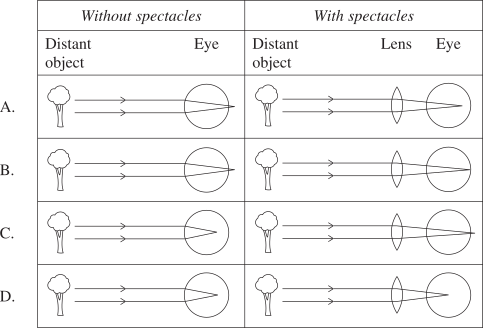
A person with short-sighted vision (myopia) was incorrectly given a pair of spectacles with convex lenses.

Which row of the table demonstrates what happens?
 

Show Answers Only

`D`

Show Worked Solution

By Elimination:

  • People with myopia have shortened focal length, causing the focal point to fall short of the retina (eliminate A and B).
  • Convex lenses would further shorten the length, hence they are the incorrect shape.

`=>D`


♦ Mean mark 53%.

Filed Under: Technologies and Disorders Tagged With: Band 5, smc-3663-20-Eyes

BIOLOGY, M8 2020 HSC 11 MC

The diagram shows a model of the human eye.
 

Which of the following correctly identifies a labelled part and its function?
 

\begin{align*}
\begin{array}{l}
\rule{0pt}{2.5ex} \ \rule[-1ex]{0pt}{0pt}& \\
\rule{0pt}{2.5ex}\textbf{A.}\rule[-1ex]{0pt}{0pt}\\
\rule{0pt}{2.5ex}\textbf{B.}\rule[-1ex]{0pt}{0pt}\\
\rule{0pt}{2.5ex}\textbf{C.}\rule[-1ex]{0pt}{0pt}\\
\rule{0pt}{2.5ex}\textbf{D.}\rule[-1ex]{0pt}{0pt}\\
\end{array}
\begin{array}{|c|c|}
\hline
\rule{0pt}{2.5ex}\quad \textit{Label} \quad \rule[-1ex]{0pt}{0pt}& \quad \textit{Name} \quad & \textit{Function} \\
\hline
\rule{0pt}{2.5ex}\text{I}\rule[-1ex]{0pt}{0pt}&\text{Cornea}&\text{Refract light}\\
\hline
\rule{0pt}{2.5ex}\text{I}\rule[-1ex]{0pt}{0pt}& \text{Retina}&\quad \text{Transmit light}\quad \\
\hline
\rule{0pt}{2.5ex}\text{II}\rule[-1ex]{0pt}{0pt}& \text{Retina} &\text{Focus light}\\
\hline
\rule{0pt}{2.5ex}\text{II}\rule[-1ex]{0pt}{0pt}& \text{Cornea} &\text{Absorb light}\\
\hline
\end{array}
\end{align*}

Show Answers Only

\(A\)

Show Worked Solution
  • The cornea is the clear disc at the front of the eye, which helps protect the eye as well as refract incoming light rays.

\(\Rightarrow A\)

Filed Under: Technologies and Disorders Tagged With: Band 4, smc-3663-20-Eyes

Copyright © 2014–2025 SmarterEd.com.au · Log in