SmarterEd

Aussie Maths & Science Teachers: Save your time with SmarterEd

  • Login
  • Get Help
  • About

CHEMISTRY, M5 2025 HSC 5 MC

\(\ce{PCl3}\) and \(\ce{Cl2}\) were introduced to an empty sealed vessel.

\(\ce{PCl3}\) reacted with \(\ce{Cl2}\) to produce \(\ce{PCl5}\).

\(\ce{PCl3(g) + Cl2(g) \rightleftharpoons PCl5(g)}\)

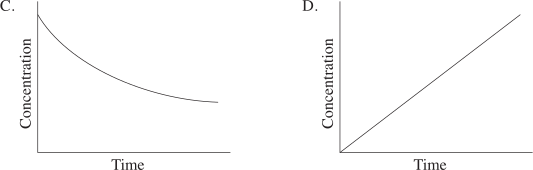
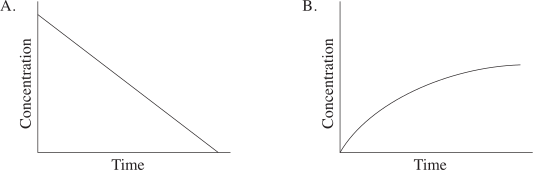
Which graph best represents the changing concentration of \(\ce{Cl2}\) as the system approached the equilibrium point?


Show Answers Only

\(C\)

Show Worked Solution
  • The initial concentration of \(\ce{Cl2}\) is postive it is introduced into the system.
  • The concentration of \(\ce{Cl2}\) will decrease with the rate of decrease slowing down over time as the system reaches a dynamic equilibrium.
  • Hence the concentration of \(\ce{Cl2}\) will be non-zero when the system reaches dynamic equilibrium.

\(\Rightarrow C\)

Filed Under: Static and Dynamic Equilibrium Tagged With: Band 3, smc-3669-10-Static/Dynamic Models

CHEMISTRY, M5 2023 HSC 33

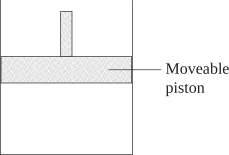
Gases \( \ce{A_2} \) and \( \ce{B_2} \) are placed in a closed container of variable volume, as shown.

The reaction between these substances is as follows.

\( \ce{A2(g) + 2B_2(g) \rightleftharpoons 2AB_2(g) \quad \Delta \textit{H} = -10 \text{kJ mol}^{-1}} \)

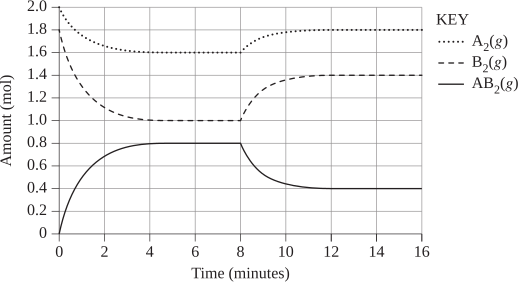
The following graph shows changes in the amounts (in mol) of these three substances over time in this container.
 

  1. Explain what is happening in this system between 6 minutes and 8 minutes.  (2 marks)

--- 4 WORK AREA LINES (style=lined) ---

  1. Explain TWO different factors that could result in the disturbance at 8 minutes.  (4 marks)

--- 8 WORK AREA LINES (style=lined) ---

Show Answers Only

a.   Between 6 and 8 minutes:

  • The system is in equilibrium.
  • The horizontal lines of each reactant in the graph indicate that the amount of reactants and products remain constant and hence the forward and reverse reactions are proceeding at the same rate.

b.    After 8 minutes \(\ce{AB2}\) is consumed, and \(\ce{A2}\) and \(\ce{B2}\) are produced. 

Factor 1:

  • An increase in temperature that decreases the equilibrium constant, \(\text{K}\).
  • In this case, the reaction quotient \(\text{Q}\) will be greater than \(\text{K}\). This will result in \(\ce{AB2}\) being consumed and \(\ce{A2}\) and \(\ce{B2}\) being produced until \(\text{Q}\) approaches \(\text{K}\) and the system reaches equilibrium again.

Factor 2:

  • Increase in volume of the container.
  • This will increase the reaction quotient \(\text{Q}\) while \(\text{K}\) stays the same. Again, this will cause \(\ce{AB2}\) to be consumed and \(\ce{A2}\) and \(\ce{B2}\) to be produced until \(\text{Q}\) approaches \(\text{K}\) and the system reaches equilibrium again.
Show Worked Solution

a.   Between 6 and 8 minutes:

  • The system is in equilibrium.
  • The horizontal lines of each reactant in the graph indicate that the amount of reactants and products remain constant and hence the forward and reverse reactions are proceeding at the same rate.

b.    After 8 minutes \(\ce{AB2}\) is consumed, and \(\ce{A2}\) and \(\ce{B2}\) are produced. 

Factor 1:

  • An increase in temperature that decreases the equilibrium constant, \(\text{K}\).
  • In this case, the reaction quotient \(\text{Q}\) will be greater than \(\text{K}\). This will result in \(\ce{AB2}\) being consumed and \(\ce{A2}\) and \(\ce{B2}\) being produced until \(\text{Q}\) approaches \(\text{K}\) and the system reaches equilibrium again.

Factor 2:

  • Increase in volume of the container.
  • This will increase the reaction quotient \(\text{Q}\) while \(\text{K}\) stays the same. Again, this will cause \(\ce{AB2}\) to be consumed and \(\ce{A2}\) and \(\ce{B2}\) to be produced until \(\text{Q}\) approaches \(\text{K}\) and the system reaches equilibrium again.

Filed Under: Factors that Affect Equilibrium, Static and Dynamic Equilibrium Tagged With: Band 4, smc-3669-10-Static/Dynamic Models, smc-3670-10-Temperature, smc-3670-35-Volume, smc-3670-60-Concentration diagrams

CHEMISTRY, M5 EQ-Bank 4 MC

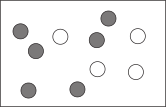
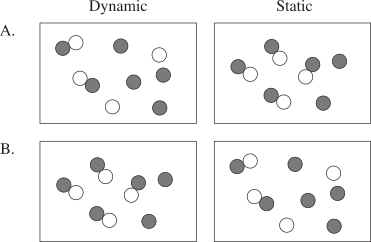
Particle reacts with particle to form the molecule . The system comes to an equilibrium.

The diagram shows the initial reactants.
 

Which combination of diagrams best represents the molecule in a dynamic equilibrium and a static equilibrium?
 

Show Answers Only

`A`

Show Worked Solution
  • In dynamic state, some particles have not yet combined to form a molecule.
  • In static state, all particles that could react have formed molecules.

`=>A`

Filed Under: Static and Dynamic Equilibrium Tagged With: Band 3, smc-3669-10-Static/Dynamic Models

CHEMISTRY, M5 2015 HSC 12 MC

A transuranic element can be produced in a nuclear reactor according to this equation:

\({ }_{94}^{239} \text{Pu}+2 \text{X} \rightarrow{ }_{94}^{241} \text{Pu} \rightarrow{ }_{95}^{241} \text{Am} +\text{Y}\)

Which row of the table correctly identifies \(\text{X}\) and \(\text{Y}\)?

\begin{align*} 
\begin{array}{l}
\rule{0pt}{1.5ex} \ \rule[-0.5ex]{0pt}{0pt}& \\
\rule{0pt}{2.5ex}\textbf{A.}\rule[-1ex]{0pt}{0pt}\\
\rule{0pt}{2.5ex}\textbf{B.}\rule[-1ex]{0pt}{0pt}\\
\rule{0pt}{2.5ex}\textbf{C.}\rule[-1ex]{0pt}{0pt}\\
\rule{0pt}{2.5ex}\textbf{D.}\rule[-1ex]{0pt}{0pt}\\
\end{array}
\begin{array}{|c|c|}
\hline
\rule{0pt}{1.5ex}\text{X}\rule[-0.5ex]{0pt}{0pt}& \text{Y} \\
\hline
\rule{0pt}{2.5ex}\quad \text{Neutron}\quad \rule[-1ex]{0pt}{0pt}&\quad \text{Electron}\quad \\
\hline
\rule{0pt}{2.5ex}\text{Proton}\rule[-1ex]{0pt}{0pt}& \text{Neutron}\\
\hline
\rule{0pt}{2.5ex}\text{Neutron}\rule[-1ex]{0pt}{0pt}& \text{Proton} \\
\hline
\rule{0pt}{2.5ex}\text{Proton}\rule[-1ex]{0pt}{0pt}& \text{Electron} \\
\hline
\end{array}
\end{align*}

Show Answers Only

\(A\)

Show Worked Solution
  • A balanced equation requires the sum of top and bottom numbers to be equal on both sides.
  • \(\text{X}\) is a neutron \(\left({ }_0^1 n \right)\)
  • \(\text{Y}\) is an electron \(\left({ }_{-1}^0 e\right)\)

\(\Rightarrow A\)

Filed Under: Static and Dynamic Equilibrium Tagged With: Band 4, smc-3669-10-Static/Dynamic Models

CHEMISTRY, M5 2019 HSC 11 MC

A saturated solution of barium carbonate was stored in a flask. Solid barium carbonate containing radioactive carbon-14 was added to the solution. The mixture was allowed to stand for several days and was then filtered.

Radioactivity could reasonably be expected to be found in

  1. the filtrate only.
  2. the residue only.
  3. both residue and filtrate.
  4. neither residue nor filtrate.
Show Answers Only

`C`

Show Worked Solution

\( \ce{BaCO3(s) \rightleftharpoons Ba^2+(aq) + CO3^2-(aq)} \)

  • In a saturated solution, a dynamic equilibrium exists whereby the solid barium carbonate is dissolving into the solution and the solution is depositing back onto the solid.
  • If the solid barium carbonate contains a radioactive isotope, such as carbon–14, this isotope will be present in both the solid residue and the filtrate solution due to the process of the dynamic equilibrium described above.

`=>C`

Filed Under: Static and Dynamic Equilibrium Tagged With: Band 4, smc-3669-10-Static/Dynamic Models

CHEMISTRY, M5 2020 HSC 26

Nitric oxide gas (`text{NO}`) can be produced from the direct combination of nitrogen gas and oxygen gas in a reversible reaction.

  1. Write the balanced chemical equation for this reaction.   (1 mark)

    --- 1 WORK AREA LINES (style=lined) ---

  2. The energy profile diagram for this reaction is shown. 


  1. Explain, using collision theory, how an increase in temperature would affect the value of `K_{eq}` for this system. Refer to the diagram in your answer.   (4 marks)

    --- 8 WORK AREA LINES (style=lined) ---

Show Answers Only

a.   \(\ce{N2(g) + O2(g) \rightleftharpoons 2NO(g) }\)
 

b.    Increased temperature’s effect on `K_{eq}`:

  • From the graph, the forward reaction is endothermic.
  • The activation energy of the forward endothermic reaction is greater than the activation energy of the reverse exothermic reaction.
  • An increase in temperature would cause the rates of both the forward and reverse reaction due to the higher average kinetic energy, resulting in a larger likelihood of a successful collisions.
  • However, the rate of the forward reaction would increase to a higher extent than the reverse reaction, since it is an endothermic reaction.
  • Using  `K_(eq) = ([text{NO}]^2)/([text{N}_2][text{O}_2])`, as the equilibrium shifts right, the equilibrium constant would increase.
Show Worked Solution

a.   \(\ce{N2(g) + O2(g) \rightleftharpoons 2NO(g) }\)
 

b.    Increased temperature’s effect on `K_{eq}`:

  • From the graph, the forward reaction is endothermic.
  • The activation energy of the forward endothermic reaction is greater than the activation energy of the reverse exothermic reaction.
  • An increase in temperature would cause the rates of both the forward and reverse reaction due to the higher average kinetic energy, resulting in a larger likelihood of a successful collisions.
  • However, the rate of the forward reaction would increase to a higher extent than the reverse reaction, since it is an endothermic reaction.
  • Using  `K_(eq) = ([text{NO}]^2)/([text{N}_2][text{O}_2])`, as the equilibrium shifts right, the equilibrium constant would increase.

Filed Under: Factors that Affect Equilibrium, Static and Dynamic Equilibrium Tagged With: Band 3, Band 4, smc-3669-10-Static/Dynamic Models, smc-3669-20-Entropy/Enthalpy, smc-3669-50-Collision Theory, smc-3670-10-Temperature, smc-3670-40-Collision theory

CHEMISTRY, M5 2022 HSC 3 MC

Which of the following features is NOT a characteristic of a state of equilibrium?

  1. Equilibrium is achieved in a closed system.
  2. Equilibrium position depends on temperature.
  3. Equilibrium can be reached from either direction.
  4. Equilibrium concentrations of reactants and products are equal.
Show Answers Only

`D`

Show Worked Solution
  • The concentration of the reactants and products remains constant but is not required to be equal at equilibrium.

`=> D`

Filed Under: Static and Dynamic Equilibrium Tagged With: Band 3, smc-3669-10-Static/Dynamic Models

CHEMISTRY, M5 2021 HSC 1 MC

Which pair of components must be equal for a chemical system to be at equilibrium?

  1. The rate of the forward reaction and the rate of the reverse reaction
  2. The concentrations of the reactants and the concentrations of the products
  3. The enthalpy of the forward reaction and the enthalpy of the reverse reaction
  4. The time that an atom exists in a reactant molecule and in a product molecule
Show Answers Only

`A`

Show Worked Solution
  • Rate of forward = rate of reverse reaction (dynamic equilibrium)

`=>A`

Filed Under: Static and Dynamic Equilibrium Tagged With: Band 2, smc-3669-10-Static/Dynamic Models

Copyright © 2014–2025 SmarterEd.com.au · Log in