SmarterEd

Aussie Maths & Science Teachers: Save your time with SmarterEd

  • Login
  • Get Help
  • About

CHEMISTRY, M5 2024 HSC 7 MC

The following equilibrium was established in a container.

\(\ce{2SO_2(g) + O_2(g) \rightleftharpoons 2SO_3(g) \quad \Delta H= -198 kJ mol^{-1}}\)

Which of the following would increase the yield of \(\ce{SO_3(g)}\)?

  1. Increasing the volume
  2. Increasing the temperature
  3. Removing the product as it is formed
  4. Keeping temperature and volume constant
Show Answers Only

\(C\)

Show Worked Solution
  • \(A\): Increasing the volume decreases the pressure of the system → favours the reverse reaction, decreasing yield.
  • \(B\): Increasing the temperature will favour the reverse endothermic reaction, decreasing yield.
  • \(C\): Removing \(\ce{SO3(g)}\) as it is formed decreases the concentration of \(\ce{SO3(g)}\). By Le Chatelier’s principle, the equilibrium system will shift to increase the concentration of \(\ce{SO3(g)}\), increasing the yield.
  • \(D\): Keeping temp and volume constant will have no impact on the equilibrium system.

\(\Rightarrow C\)

Filed Under: Factors that Affect Equilibrium Tagged With: Band 4, smc-3670-30-Concentration, smc-3670-70-Max yield conditions

CHEMISTRY, M5 2023 HSC 12 MC

The industrial production of ammonia is represented by the Haber process reaction shown.

\( \ce{N2(g)} + 3 \ce{H2(g)} \rightleftharpoons \ce{2NH3(g)} \quad \Delta H=-91.8 \ \text{kJ} \ \text{mol}^{-1}\)

Factors such as temperature and pressure need to be considered in order to maximise yield.

Which of the following is correct?

  1. A lower pressure would result in a higher yield.
  2. A higher pressure would result in a higher yield.
  3. A lower temperature would result in a lower yield.
  4. A higher temperature would result in a higher yield.
Show Answers Only

\(B\)

Show Worked Solution
  • Increasing the pressure would shift the position of equilibrium to the side of the equation with less moles (as per Le Chatelier’s principle).
  • This would increase the yield of \(\ce{NH3}\)

\(\Rightarrow B\)

Filed Under: Chemical Synthesis and Design, Factors that Affect Equilibrium Tagged With: Band 3, smc-3670-70-Max yield conditions, smc-3684-30-Yield and purity

CHEMISTRY, M5 2016 HSC 14 MC

Consider the following endothermic reaction taking place in a closed vessel.

\(\ce{N_2O_4($g$) \rightleftharpoons 2NO_2($g$)}\)

Which of the following actions would cause more \(\ce{N_2O_4}\) to be produced?

  1. Adding a catalyst
  2. Decreasing the volume
  3. Decreasing the pressure
  4. Increasing the temperature
Show Answers Only

`B`

Show Worked Solution
  • By decreasing the volume, the equilibrium will shift to the left so that less gas molecules are present (Le Chatelier’s principle).

`=>B`

Filed Under: Factors that Affect Equilibrium Tagged With: Band 4, smc-3670-10-Temperature, smc-3670-29-Pressure, smc-3670-35-Volume, smc-3670-70-Max yield conditions, smc-3670-90-Catalyst

CHEMISTRY, M5 2015 HSC 16 MC

The equation describes an equilibrium reaction occurring in a closed system.

\(\ce{X(g) + Y(g) \rightleftharpoons 4Z(g)}\hspace{1.5em}\Delta{H} = +58 \:\text{kJ} \) 

Under which set of conditions would the highest yield of `\text{Z}(g)` be obtained?

\begin{align*}
\begin{array}{l}
\rule{0pt}{1.5ex} \ \rule[-0.5ex]{0pt}{0pt}& \\
\rule{0pt}{2.5ex}\textbf{A.}\rule[-1ex]{0pt}{0pt}\\
\rule{0pt}{2.5ex}\textbf{B.}\rule[-1ex]{0pt}{0pt}\\
\rule{0pt}{2.5ex}\textbf{C.}\rule[-1ex]{0pt}{0pt}\\
\rule{0pt}{2.5ex}\textbf{D.}\rule[-1ex]{0pt}{0pt}\\
\end{array}
\begin{array}{|c|c|}
\hline
\rule{0pt}{1.5ex}\textit{Temperature}\  \text{(°C)} \rule[-0.5ex]{0pt}{0pt}& \textit{Pressure}\  \text{(kPa)}\\
\hline
\rule{0pt}{2.5ex}50\rule[-1ex]{0pt}{0pt}&100\\
\hline
\rule{0pt}{2.5ex}50\rule[-1ex]{0pt}{0pt}& 200\\
\hline
\rule{0pt}{2.5ex}300\rule[-1ex]{0pt}{0pt}& 100 \\
\hline
\rule{0pt}{2.5ex}300\rule[-1ex]{0pt}{0pt}& 200 \\
\hline
\end{array}
\end{align*}

Show Answers Only

`C`

Show Worked Solution
  • Forward reaction is endothermic `(DeltaH=+58\ text{kJ})`
  • High temperature will shift reaction to the right.
  • Right hand side has more gas molecules (4 vs 2) and therefore the forward reaction will benefit from lower pressure.
  • Highest yield of `\text{Z}(g)` when temperature is higher and pressure lower.

`=>C`

Filed Under: Factors that Affect Equilibrium Tagged With: Band 4, smc-3670-10-Temperature, smc-3670-29-Pressure, smc-3670-70-Max yield conditions

CHEMISTRY, M5 2019 HSC 12 MC

Methanol can be produced from the reaction of carbon monoxide and hydrogen, according to the following equation:

\( \ce{CO(g) + 2H2(g) \rightleftharpoons CH3OH(g)}\ \  \ \ \ \ \text{Δ}H_r ^{\ \ominus} =-90\ \text{kJ mol}^{-1} \)

Which set of conditions will produce the maximum yield of methanol?

  1. Low pressure and low temperature
  2. Low pressure and high temperature
  3. High pressure and low temperature
  4. High pressure and high temperature
Show Answers Only

`C`

Show Worked Solution
  • To maximise the methanol yield, the equation must shift towards the right hand side.
  • Pressure: If the pressure is increased, the system will shift to reduce this increase. In this reaction, a shift to the right hand side will occur because there are fewer gas molecules (1 on right vs 3 on the left).
  • Temperature: If the temperature is decreased, the equilibrium will shift to the exothermic side which absorbs heat (right hand side). This compensation will result in more methanol.

`=>C`

Filed Under: Factors that Affect Equilibrium Tagged With: Band 4, smc-3670-10-Temperature, smc-3670-29-Pressure, smc-3670-70-Max yield conditions

CHEMISTRY, M5 2020 HSC 16 MC

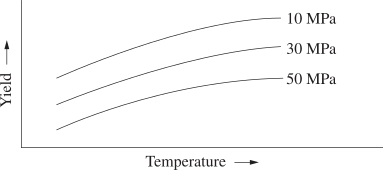
Compounds `text{X}`, `text{Y}` and `text{Z}` are in equilibrium. The diagram shows the effects of temperature and pressure on the equilibrium yield of compound `text{Z}`.


Which equation would be consistent with this data?

  1. `text{X}(g)+3 text{Y}(g) ⇌ 2 text{Z}(g) qquad Delta text{H} > 0`
  2. `text{X}(g)+3 text{Y}(g) ⇌ 2 text{Z}(g) qquad Delta text{H} < 0`
  3. `2 text{X}(g) ⇌ 2 text{Y}(g) + text{Z}(g) qquad Delta text{H} > 0`
  4. `2 text{X}(g) ⇌ 2 text{Y}(g)+ text{Z}(g) qquad Delta text{H} < 0`
Show Answers Only

`C`

Show Worked Solution
  • The yield of `Z` increases as temperature increases, thus, endothermic reaction `Delta text{H} > 0`.
  • The yield of `Z` increases as pressure decreases, thus more gaseous moles on the product side. 

`=> C`


♦ Mean mark 49%.

Filed Under: Factors that Affect Equilibrium Tagged With: Band 5, smc-3670-10-Temperature, smc-3670-29-Pressure, smc-3670-70-Max yield conditions

Copyright © 2014–2025 SmarterEd.com.au · Log in