SmarterEd

Aussie Maths & Science Teachers: Save your time with SmarterEd

  • Login
  • Get Help
  • About

CHEMISTRY, M5 2018 HSC 25

The graph shows the number of molecules of \(\ce{N2}\) and \(\ce{H2}\) that possess a certain kinetic energy at two different temperatures.
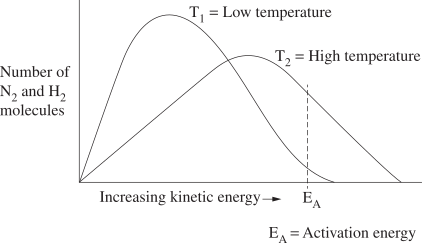
 

With reference to the graph, explain why changing the temperature and adding a catalyst would change the rate of production of ammonia.  (4 marks)

--- 10 WORK AREA LINES (style=lined) ---

Show Answers Only
  • Gas particles need to attain activation energy \( \text{E}_\text{A} \) in order to react when they collide.
  • \( \text{E}_\text{A} \) is a level of kinetic energy that is sufficient for reactions to occur.
  • Some \(\ce{N2}\) and \(\ce{H2}\) particles have a kinetic energy above \( \text{E}_\text{A} \) when the temperature is lower at \(\text{T}_1\) (see graph above).
  • However, the number of \(\ce{N2}\) and \(\ce{H2}\) particles with enough energy to react and produce ammonia is significantly greater at the higher temperature \(\text{T}_2\), where the graph has shifted to the right.
  • A catalyst lowers the \( \text{E}_\text{A} \). On the graph, this would shift the dotted \( \text{E}_\text{A} \) line to the left.
  • In the presence of a catalyst, both graphs show there will be a greater number of particles that can react in a given time and therefore the rate of ammonia production will increase in both cases.
Show Worked Solution
  • Gas particles need to attain activation energy \( \text{E}_\text{A} \) in order to react when they collide.
  • \( \text{E}_\text{A} \) is a level of kinetic energy that is sufficient for reactions to occur.
  • Some \(\ce{N2}\) and \(\ce{H2}\) particles have a kinetic energy above \( \text{E}_\text{A} \) when the temperature is lower at \(\text{T}_1\) (see graph above).
  • However, the number of \(\ce{N2}\) and \(\ce{H2}\) particles with enough energy to react and produce ammonia is significantly greater at the higher temperature \(\text{T}_2\), where the graph has shifted to the right.
  • A catalyst lowers the \( \text{E}_\text{A} \). On the graph, this would shift the dotted \( \text{E}_\text{A} \) line to the left.
  • In the presence of a catalyst, both graphs show there will be a greater number of particles that can react in a given time and therefore the rate of ammonia production will increase in both cases.

Mean mark 53%.

Filed Under: Factors that Affect Equilibrium Tagged With: Band 4, Band 5, smc-3670-10-Temperature, smc-3670-40-Collision theory, smc-3670-80-Other graphs

Copyright © 2014–2025 SmarterEd.com.au · Log in