SmarterEd

Aussie Maths & Science Teachers: Save your time with SmarterEd

  • Login
  • Get Help
  • About

CHEMISTRY, M5 2025 HSC 35

A purple solution at 25°C contains a mixture of two different cobalt\(\text{(II)}\) complexes which are at equilibrium.

\(\underset{\text{(blue)}}{\ce{CoCl4^{2-}(aq)}} \ce{+ 6H2O(l)} \rightleftharpoons
\underset{\text{(pink)}}{\ce{Co(H2O)6^{2+}(aq)}} \ce{+ 4Cl^{-}(aq)}\)

The results of heating and cooling a sample of this solution are given in the table.

\begin{array}{|l|c|c|}
\hline\rule{0pt}{2.5ex} \textit{Temperature} \ \text{(°C)} \rule[-1ex]{0pt}{0pt}& 80 & 0 \\
\hline \rule{0pt}{2.5ex}\textit{Colour of solution} \rule[-1ex]{0pt}{0pt} & \quad \text{blue} \quad  & \quad  \text{pink} \quad \\
\hline
\end{array}

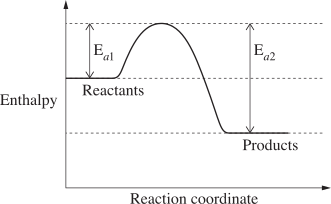
The energy profile diagram for this reaction is shown.
 

How do collision theory and Le Chatelier's principle account for the colour change to pink when the solution is cooled? Refer to the energy profile diagram in your answer.   (5 marks)

--- 22 WORK AREA LINES (style=lined) ---
Show Answers Only

Energy Profile Diagram 

  • The energy profile diagram shows that the forward reaction is exothermic, as the products have lower enthalpy than the reactants. The forward activation energy \((\text{E}_{a1})\) is smaller than the reverse activation energy \((\text{E}_{a2})\).

Le Chatelier’s Principle

  • Le Chatelier’s Principle says that if something disrupts a system in dynamic equilibrium, the system will shift in a way that works against that change.
  • Cooling the solution from 80 °C to 0 °C causes the system to favour the forward exothermic reaction, producing heat in response to the lowered temperature.
  • This shifts the equilibrium to the right, increasing \(\left[ \ce{Co(H2O)6^{2+}}\right]\) and turning the solution pink.

Collision Theory

  • Collision theory states that for a reaction to occur, particles must collide with sufficient energy (above the activation energy) and correct orientation.
  • When the solution is cooled, the average kinetic energy of all particles decreases, reducing both the collision frequency and the proportion of successful collisions.
  • In this way, both forward and reverse reaction rates decrease.
  • However, the reverse reaction has a higher activation energy \((\text{E}_{a2})\) than the forward reaction \((\text{E}_{a1})\), as shown in the energy profile diagram.
  • Cooling causes a greater proportion of particles to fall below \((\text{E}_{a2})\) than \((\text{E}_{a1})\), so the reverse reaction rate decreases more significantly than the forward rate.
  • This causes a net shift toward products, increasing \(\left[ \ce{Co(H2O)6^{2+}}\right]\) and changing the solution colour to pink.
Show Worked Solution

Energy Profile Diagram 

  • The energy profile diagram shows that the forward reaction is exothermic, as the products have lower enthalpy than the reactants. The forward activation energy \((\text{E}_{a1})\) is smaller than the reverse activation energy \((\text{E}_{a2})\).

Le Chatelier’s Principle

  • Le Chatelier’s Principle says that if something disrupts a system in dynamic equilibrium, the system will shift in a way that works against that change.
  • Cooling the solution from 80 °C to 0 °C causes the system to favour the forward exothermic reaction, producing heat in response to the lowered temperature.
  • This shifts the equilibrium to the right, increasing \(\left[ \ce{Co(H2O)6^{2+}}\right]\) and turning the solution pink.

Collision Theory

  • Collision theory states that for a reaction to occur, particles must collide with sufficient energy (above the activation energy) and correct orientation.
  • When the solution is cooled, the average kinetic energy of all particles decreases, reducing both the collision frequency and the proportion of successful collisions.
  • In this way, both forward and reverse reaction rates decrease.
  • However, the reverse reaction has a higher activation energy \((\text{E}_{a2})\) than the forward reaction \((\text{E}_{a1})\), as shown in the energy profile diagram.
  • Cooling causes a greater proportion of particles to fall below \((\text{E}_{a2})\) than \((\text{E}_{a1})\), so the reverse reaction rate decreases more significantly than the forward rate.
  • This causes a net shift toward products, increasing \(\left[ \ce{Co(H2O)6^{2+}}\right]\) and changing the solution colour to pink.

Filed Under: Factors that Affect Equilibrium Tagged With: Band 4, smc-3670-10-Temperature, smc-3670-40-Collision theory, smc-3670-80-Other graphs

CHEMISTRY, M5 2018 HSC 25

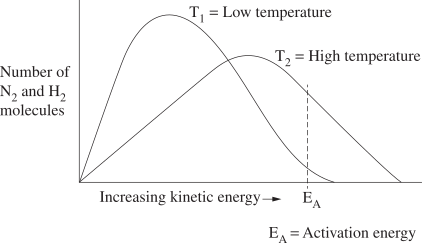
The graph shows the number of molecules of \(\ce{N2}\) and \(\ce{H2}\) that possess a certain kinetic energy at two different temperatures.
 

With reference to the graph, explain why changing the temperature and adding a catalyst would change the rate of production of ammonia.  (4 marks)

--- 10 WORK AREA LINES (style=lined) ---

Show Answers Only
  • Gas particles need to attain activation energy \( \text{E}_\text{A} \) in order to react when they collide.
  • \( \text{E}_\text{A} \) is a level of kinetic energy that is sufficient for reactions to occur.
  • Some \(\ce{N2}\) and \(\ce{H2}\) particles have a kinetic energy above \( \text{E}_\text{A} \) when the temperature is lower at \(\text{T}_1\) (see graph above).
  • However, the number of \(\ce{N2}\) and \(\ce{H2}\) particles with enough energy to react and produce ammonia is significantly greater at the higher temperature \(\text{T}_2\), where the graph has shifted to the right.
  • A catalyst lowers the \( \text{E}_\text{A} \). On the graph, this would shift the dotted \( \text{E}_\text{A} \) line to the left.
  • In the presence of a catalyst, both graphs show there will be a greater number of particles that can react in a given time and therefore the rate of ammonia production will increase in both cases.
Show Worked Solution
  • Gas particles need to attain activation energy \( \text{E}_\text{A} \) in order to react when they collide.
  • \( \text{E}_\text{A} \) is a level of kinetic energy that is sufficient for reactions to occur.
  • Some \(\ce{N2}\) and \(\ce{H2}\) particles have a kinetic energy above \( \text{E}_\text{A} \) when the temperature is lower at \(\text{T}_1\) (see graph above).
  • However, the number of \(\ce{N2}\) and \(\ce{H2}\) particles with enough energy to react and produce ammonia is significantly greater at the higher temperature \(\text{T}_2\), where the graph has shifted to the right.
  • A catalyst lowers the \( \text{E}_\text{A} \). On the graph, this would shift the dotted \( \text{E}_\text{A} \) line to the left.
  • In the presence of a catalyst, both graphs show there will be a greater number of particles that can react in a given time and therefore the rate of ammonia production will increase in both cases.

Mean mark 53%.

Filed Under: Factors that Affect Equilibrium Tagged With: Band 4, Band 5, smc-3670-10-Temperature, smc-3670-40-Collision theory, smc-3670-80-Other graphs

Copyright © 2014–2026 SmarterEd.com.au · Log in