SmarterEd

Aussie Maths & Science Teachers: Save your time with SmarterEd

  • Login
  • Get Help
  • About

CHEMISTRY, M5 2024 HSC 30

An equilibrium mixture of hydrogen, carbon dioxide, water and carbon monoxide is in a closed, 1 L container at a fixed temperature as shown:

\(\ce{H2(g) +CO_2(g) \rightleftharpoons H2O(g) +CO(g)} \quad \quad K_{eq}=1.600\)

The initial concentrations are  \(\left[\ce{H2}\right]=1.000 \text{ mol L}^{-1}, \left[ \ce{CO2}\right]=0.500\ \text{mol L}^{-1},\ \left[\ce{H2O}\right]=0.400 \text{ mol L}^{-1}\)  and  \([ \ce{CO} ]=2.000 \text{ mol L} ^{-1}\).

An unknown amount of \(\ce{CO(g)}\) was added to the same container, and the temperature was kept constant. After the new equilibrium had been established, the concentration of \(\ce{H2O(g)}\) was found to be 0.200 mol L\(^{-1}\).

Using this information, calculate the unknown amount (in mol) of \(\ce{CO(g)}\) that was added to the container.   (4 marks)

--- 10 WORK AREA LINES (style=lined) ---

Show Answers Only

\(4.92\ \text{mol}\)

Show Worked Solution
  • \(\ce{n_{intial}(CO(g))} = 0.400 \text{ and } \ce{n_{final}(CO(g))} = 0.200\).
  • \(\text{Change in the number of moles in } \ce{CO(g)} = 0.400-0.200 = 0.200\ \text{mol in } 1\ \text{L}\)

\begin{array} {|c|c|c|c|c|}
\hline & \ce{H2(g)} & \ce{CO2(g)} & \ce{H2O(g)} & \ce{CO2(g)} \\
\hline \text{Initial} & 1 & 0.5 & 0.4 & 2 + x \\
\hline \text{Change} & +0.2 & +0.2 & -0.2 & -0.2 \\
\hline \text{Equilibrium} & 1.2 & 0.7 & 0.2 & 1.8 + x \\
\hline \end{array}

  • Since all substances are present in a 1 L container, the concentrations of each substance is equal to the number of moles of that substance present at equilibrium
\(K_{eq}\) \(=\dfrac{\ce{[H2O(g)][CO(g)]}}{\ce{[H2(g)][CO2(g)]}}\)  
\(1.600\) \(=\dfrac{0.2 \times (1.8+x)}{1.2 \times 0.7}\)  
\(1.8 + x\) \(=1.6 \times \dfrac{1.2 \times 0.7}{0.2}\)  
\(x\) \(=6.72-1.8\)  
  \(=4.92\ \text{mol}\)  


  • 4.92 mol of \(\ce{CO(g)}\) were added to the container.
♦ Mean mark 55%.

Filed Under: Equilibrium Constant Tagged With: Band 5, smc-3671-20-Calcs given K(eq), smc-3671-35-Chemical equation given

CHEMISTRY, M5 2024 HSC 18 MC

A reaction mixture, not at equilibrium, is composed of both \(\ce{N_2O_4(g)}\) and \(\ce{NO_2(g)}\) in a closed container. The reaction quotient for the system, \(Q\), is given.

\(Q=\dfrac{\left[\ce{NO_2}\right]^2}{\left[\ce{N_2O_4}\right]}\)

The rate of the forward reaction is initially greater than the rate of the reverse reaction.

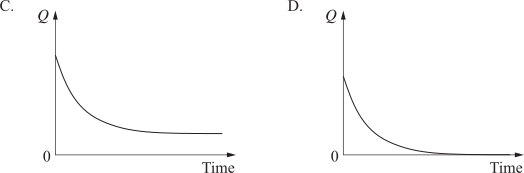
Which diagram shows how \(Q\) changes over time for this mixture?
 

Show Answers Only

\(B\)

Show Worked Solution
  • When calculating the reaction quotient of a chemical reaction, the formula is \(\dfrac{products}{reactants}\).
  • The equation for the reaction taking place is:
  •    \(\ce{N2O4(g) \rightleftharpoons 2NO2(g)}\)
  • As the rate of the forward reaction is greater than the rate of the reverse reaction, \(\ce{[NO2]^2}\) will increase and \(\ce{[N2O4]}\) will decrease.
  • Hence the value for the reaction quotient, \(\dfrac{\left[\ce{NO_2}\right]^2}{\left[\ce{N_2O_4}\right]}\), will increase.
  • As it states both \(\ce{N2O4(g)}\) and \(\ce{NO2(g)}\) are present in the intial system, the value for \(Q\) will not be zero.

\(\Rightarrow B\)

♦ Mean mark 43%.

Filed Under: Equilibrium Constant Tagged With: Band 5, smc-3671-20-Calcs given K(eq), smc-3671-30-Deduce chemical equation

CHEMISTRY, M5 2024 HSC 15 MC

The thermal decomposition of lithium peroxide \(\ce{(Li_2O_2)}\) is given by the equation shown.

\(\ce{2Li_2O_2(s)\rightleftharpoons 2 Li_2 O(s) + O_2(g)}\)

Mixtures of \(\ce{Li_2O_2}\), \(\ce{Li_2O}\) and \(\ce{O_2}\) were allowed to reach equilibrium in two identical, closed containers, \(\text{P}\) and \(\text{Q}\), at the same temperature. The amount of \(\ce{Li_2O_2(s)}\) in container \(\text{P}\) is double that in container \(\text{Q}\) . The amount of \(\ce{Li_2O(s)}\) is the same in each container.

What is the ratio of \(\left[ \ce{O_2(g)}\right]\) in container \(\text{P}\) to \(\left[\ce{O_2(g)}\right]\) in container \(\text{Q}\)?

  1. \(1: 1\)
  2. \(2: 1\)
  3. \(3: 2\)
  4. \(5: 4\)
Show Answers Only

\(A\)

Show Worked Solution
  • When calculating the \(K_{eq}\) of a system, substances in solid states are all given a value of \(1\).
  • The equilibrium constant of the above reaction is \(K_{eq} = \ce{[O_2(g)]}\).
  • As both mixtures reached equilibrium, the \(K_{eq}\) values for each mixture is the same, hence the ratio of \(\ce{[O2(g)]}\) in each container is \(1:1\).

\(\Rightarrow A\)

♦♦ Mean mark 39%.

Filed Under: Equilibrium Constant Tagged With: Band 5, smc-3671-10-Find K(eq), smc-3671-20-Calcs given K(eq)

CHEMISTRY, M5 2023 HSC 20 MC

Nitrogen monoxide and oxygen combine to form nitrogen dioxide, according to the following equation.

\( \ce{2NO(g) + O2(g) \rightleftharpoons 2NO2(g) \quad $K$_{e q}=2.47 \times 10^{12}} \)

A 2.00 L vessel is filled with 1.80 mol of \( \ce{NO2(g)} \) and the system is allowed to reach equilibrium.

What is the equilibrium concentration of \( \ce{NO(g)} \)?

  1. \( \text{0.00 mol L}^{-1}\)
  2. \( 4.34 \times 10^{-5}\  \text{mol L}^{-1} \)
  3. \(6.90 \times 10^{-5}\  \text{mol L}^{-1}\)
  4. \(8.69 \times10^{-5}\  \text{mol L}^{-1}\)
Show Answers Only

\(D\)

Show Worked Solution
  • As 1.80 mol of \( \ce{NO2(g)} \) is added to the solution, the reverse reaction can be used to determine the equilibrium concentration of \( \ce{NO(g)} \).
  •    \(\ce{2NO2(g) \rightleftharpoons 2NO(g) + O2(g)}\)
  • Reverse reaction  \(K_{eq} = \dfrac{\ce{[O_2][NO]^2}}{\ce{[NO_2]^2}}\)
  • Forward reaction  \(K_{eq}\) is the inverse of \(K_{eq}\) of the reverse reaction:
  •    \(K_{eq}=\dfrac{1}{2.47 \times 10^{12}}=4.0486 \times 10^{-13}\)

\begin{array} {|l|c|c|c|}
\hline  & \ce{2NO_2(g)} & \ce{2NO(g)} & \ce{O_2(g)} \\
\hline \text{Initial} & \ \ \ \ 0.9 & \ \ \ \ 0 & 0 \\
\hline \text{Change} & -2x & +2x & \ \ \ +x \\
\hline \text{Equilibrium} & \ \ \ \ 0.9 -2x & \ \ \ \ 2x & \ \ \ \ \ \ x \\
\hline \end{array}

  • \(-2x\) is very small as the \(K_{eq}\) for the reaction is very small, thus  \(0.9-2x \approx 0.9\).
  • By substituting the values into the \(K_{eq}\) for the reverse reaction: 
\(4.0486 \times 10^{-13}\) \(=\dfrac{(x)(2x)^2}{(0.9)^2}\)  
\(4.0486 \times 10^{-13}\) \(=\dfrac{4x^3}{(0.9)^2}\)  
\(4x^3\) \(=3.279 \times 10^{-13}\)  
\(x\) \(=4.344 \times 10^{-5}\)  


  • \(\ce{[NO2] = 2 \times 4.344 \times 10^{-5} = 8.69 \times 10^{-5}\ \text{mol L}^{-1}}\)

\(\Rightarrow D\)

♦♦ Mean mark 34%.

Filed Under: Equilibrium Constant Tagged With: Band 5, smc-3671-20-Calcs given K(eq), smc-3671-35-Chemical equation given

CHEMISTRY, M5 2023 HSC 7 MC

A mixture of 0.8 mol of \( \ce{CO} \text{(g)} \) and 0.8 mol of \( \ce{H2} \text{(g)} \) was placed in a sealed 1.0 L container. The following reaction occurred.

\( \ce{CO} \text{(g)} + 2 \ce{H2} \text{(g)} \rightleftharpoons \ce{CH3} \ce{OH}\text{(g)} \)

When equilibrium was established, the mixture contained 0.5 mol of \( \ce{CO} \text{(g)} \).

What amount of \( \ce{H2} \text{(g)} \) was present at equilibrium?

  1. 0.2 mol
  2. 0.4 mol
  3. 0.6 mol
  4. 1.0 mol
Show Answers Only

\(A\)

Show Worked Solution

\( \ce{CO} \text{(g)} + 2 \ce{H2} \text{(g)} \rightleftharpoons \ce{CH3} \ce{OH}\text{(g)} \)

\begin{array} {|l|c|c|c|}
\hline  & \ce{CO(g)} & \ce{2H2(g)} & \ce{CH3OH} \\
\hline \text{Initial} & 0.8 & 0.8 & 0 \\
\hline \text{Change} & -x & -2x & +x \\
\hline \text{Equilibrium} & 0.5 & 0.2 & 0.03 \\
\hline \end{array}

\(x = 0.3\)

\(\Rightarrow A\)

Filed Under: Equilibrium Constant Tagged With: Band 4, smc-3671-20-Calcs given K(eq)

CHEMISTRY, M5 2023 HSC 37

When performing industrial reductions with \(\mathrm{CO}(\mathrm{g})\), the following equilibrium is of great importance.

\( \ce{2CO(g) \rightleftharpoons CO2(g) + C(s) \quad \quad $K$_{e q}  = 10.00  at 1095 K } \)

A 1.00 L sealed vessel at a temperature of 1095 K contains \( \ce{CO(g)} \) at a concentration of 1.10 × 10\(^{-2}\) mol L\(^{-1}\), \(\ce{CO2(g)} \) at a concentration of 1.21 × 10\(^{-3}\) mol L\(^{-1}\), and excess solid carbon.

  1. Is the system at equilibrium? Support your answer with calculations.   (2 marks)

--- 3 WORK AREA LINES (style=lined) ---

  1. Carbon dioxide gas is added to the system above and the mixture comes to equilibrium. The equilibrium concentrations of \( \ce{CO(g)}\) and \(\ce{CO2(g)} \) are equal. Excess solid carbon is present and the temperature remains at 1095 K.

    Calculate the amount (in mol) of carbon dioxide added to the system.   (3 marks)

--- 14 WORK AREA LINES (style=lined) ---

Show Answers Only

a.    \(Q=\dfrac{\ce{[CO2]}}{\ce{[CO]^2}}=\dfrac{1.21 \times 10^{-3}}{(1.10 \times 10^{-2})^2}=10.0\)

\(\text{Since}\ \ Q=K_{eq},\ \text{system is in equilibrium.}\)
 

b.    \(0.143\ \text{mol} \)

Show Worked Solution

a.    \(Q=\dfrac{\ce{[CO2]}}{\ce{[CO]^2}}=\dfrac{1.21 \times 10^{-3}}{(1.10 \times 10^{-2})^2}=10.0\)

\(\text{Since}\ \ Q=K_{eq},\ \text{system is in equilibrium.}\)
 

b.    \(\ce{\text{Given}\ \ [CO]=[CO2]}, \)

\(K_{eq} =\dfrac{\ce{[CO2]}}{\ce{[CO]^2}} =\dfrac{1}{\ce{[CO]}} = 10.00\)

\(\Rightarrow \ce{[CO] = \dfrac{1}{10.00} = 0.1000 \text{mol L}^{-1}} \)

\(\Rightarrow \ce{[CO2] = 0.1000 \text{mol L}^{-1}} \)

From this point, the change in \(\ce{CO}\) and \(\ce{CO2}\) concentrations can be calculated…

♦♦♦ Mean mark (b) 24%.

\begin{array} {|l|c|c|c|}
\hline  & \ce{2CO(g)} & \ce{CO2(g)} & \ce{C(s)} \\
\hline \text{Initial} & 1.10 \times 10^{-2} &  1.21 \times 10^{-3} &  \\
\hline \text{Change} & +0.0890 & +0.0988 &  \\
\hline \text{Equilibrium} & \ \ \ 0.1000 & \ \ \ 0.1000 &  \\
\hline \end{array}

However, the change in moles of \(\ce{CO2}\) in the system consists of:

  • Change in \(\ce{CO2}\) concentration
  • Change in \(\ce{CO}\) concentration (as some of the added \(\ce{CO2}\) was converted into \(\ce{CO}\))

\(\ce{n(CO2)\ \text{required to increase}\ [CO] by 0.0988\ \text{mol}\ \ \ \text{(1 litre vessel)}}\)

\(\ce{\text{Formula ratio shows}\ \ CO2:CO = 1\ \text{mol} : 2\ \text{mol}} \)

\(\ce{n(CO2)\ \text{to add to increase}\ [CO2] = 0.0988\ \text{mol}\ \ \ \text{(1 litre vessel)}}\)

\(\ce{n(CO2)_{\text{total to add}} = 0.0988\ \text{mol} + n(CO2\ \text{to make CO)}} \)

\(\ce{n(CO2)\ \text{to add to increase}\ [CO] = \dfrac{0.0890}{2} = 0.0445\ \text{mol}}\)

\(\ce{n(CO2)_{\text{total to add}} = 0.0988 + 0.0445 = 0.143\ \text{mol}} \)

Filed Under: Equilibrium Constant Tagged With: Band 4, Band 6, smc-3671-20-Calcs given K(eq), smc-3671-35-Chemical equation given

CHEMISTRY, M5 EQ-Bank 10 MC

At a certain temperature, the \(\ce{$K_{eq}$}\) for the following reaction is 75.

\( \ce{2O3(g) \rightleftharpoons 3O2(g)}\)

0.4 mol of \(\ce{O3}\) and 1.2 mol of \(\ce{O2}\) were introduced to a 5 L reaction vessel.

Which row of the table correctly identifies the direction of the equilibrium shift and the reason for the shift?

\begin{align*}
\begin{array}{l}
\rule{0pt}{2.5ex} \ \rule[-1ex]{0pt}{0pt}& \\
\rule{0pt}{2.5ex}\textbf{A.}\rule[-1ex]{0pt}{0pt}\\
\rule{0pt}{2.5ex}\textbf{B.}\rule[-1ex]{0pt}{0pt}\\
\rule{0pt}{2.5ex}\textbf{C.}\rule[-1ex]{0pt}{0pt}\\
\rule{0pt}{2.5ex}\textbf{D.}\rule[-1ex]{0pt}{0pt}\\
\end{array}
\begin{array}{|c|c|}
\hline
\rule{0pt}{2.5ex}\textit{Direction favoured}\rule[-1ex]{0pt}{0pt}& \quad \quad \textit{Reason} \quad \quad \\
\hline
\rule{0pt}{2.5ex}\text{Left}\rule[-1ex]{0pt}{0pt}&Q>K_{e q}\\
\hline
\rule{0pt}{2.5ex}\text{Left}\rule[-1ex]{0pt}{0pt}& Q<K_{e q}\\
\hline
\rule{0pt}{2.5ex}\text{Right}\rule[-1ex]{0pt}{0pt}&Q>K_{e q} \\
\hline
\rule{0pt}{2.5ex}\text{Right}\rule[-1ex]{0pt}{0pt}& Q<K_{e q}\\
\hline
\end{array}
\end{align*}

Show Answers Only

\(D\)

Show Worked Solution

\[\ce{O2: c = \frac{n}{V} = \frac{1.2}{5} = 0.24 mol L^{-1}} \]

\[\ce{O3: c = \frac{n}{V} = \frac{0.4}{5} = 0.08 mol L^{-1}} \]

\[\ce{$K_{eq}$ = \frac{[O2]^{3}}{[O2]^{2}} = 75 (given)}\]

\[\ce{$Q$ = \frac{0.24^{3}}{0.08^{2}} = 2.16} \]

\(\ce{Since $Q<K_{eq}$, the reaction will shift right to favour the products until  $Q = K_{eq}$} \)

\(\Rightarrow D\)

Filed Under: Equilibrium Constant Tagged With: Band 4, smc-3671-20-Calcs given K(eq)

CHEMISTRY, M5 2019 HSC 31

The following reaction occurs in an aqueous solution.

   \(\ce{HgCl4^2-(aq) + Cu^2+(aq) \rightleftharpoons CuCl4^2-(aq) + Hg^2+\ \ \ \ \ \ $K_{eq}$ = 4.55 \times 10^{-11}}\)

A solution containing a mixture of \(\ce{HgCl4^2-(aq)}\) and \(\ce{Cu^2+(aq)}\) ions is prepared. The initial concentration of each ion is 0.100 mol L ¯1 and there are no other ions present.

Calculate the concentration of \(\ce{Hg^2+(aq)}\) ions once the system has reached equilibrium.   (4 marks)

--- 14 WORK AREA LINES (style=lined) ---

Show Answers Only

\(\ce{[Hg^2+] = 6.75 \times 10^{-7} mol L^{-1}}\)

Show Worked Solution

\[\ce{$K_{eq}$ = \frac{[CuCl4^2-][Hg^2+]}{[HgCl4^2-][Cu^2+]}}\]

\begin{array} {|l|c|c|c|c|}
\hline  & \ce{[HgCl4^2-]} & \ce{[Cu^2+]} & \ce{[CuCl4^2-]} & \ce{[Hg^2+]} \\
\hline \text{Initial} & 0.100 & 0.100 & 0 & 0 \\
\hline \text{Change} & -x & -x & +x & +x \\
\hline \text{Equilibrium} & 0.100-x & 0.100-x & x & x \\
\hline \end{array}

Since `x` is small  `=> 0.100-x~~0.100`

`4.55 xx 10^{-11}` `=(x xx x)/((0.100-x)(0.100-x))`  
`4.55 xx 10^{-11}` `=x^2/(0.100)^2`  
`x^2` `=4.55 xx 10^{-11} xx (0.100)^2`  
`x` `=sqrt(4.55 xx 10^{-11} xx (0.100)^2)`  
  `=6.75 xx 10^{-7}\ text{mol L}^{-1}`  

 
\(\therefore \ce{[Hg^2+] = 6.75 \times 10^{-7} mol L^{-1}}\)

Filed Under: Equilibrium Constant Tagged With: Band 4, smc-3671-20-Calcs given K(eq), smc-3671-35-Chemical equation given, smc-3671-60-Ionic solutions

CHEMISTRY, M5 2019 HSC 17 MC

A student makes a solution with a final volume of 200 mL by mixing 100 mL of 0.0500 mol L ¯1 barium nitrate solution with 100 mL of 0.100 mol L ¯1 sodium hydroxide solution.

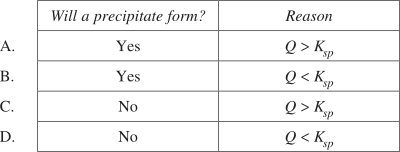
Which row of the table correctly identifies if a precipitate will form under these conditions and the reason?
 

Show Answers Only

\(D\)

Show Worked Solution

\(\ce{Ba(OH)2(s) \rightleftharpoons Ba^2+(aq) + 2OH-(aq)}\)

\(K_{sp}=2.55 \times 10^{-4}\)

\[\ce{[Ba^2+] = \frac{(0.05)(0.1)}{(0.2)} = 0.025 M}\]

\[\ce{[OH-] = \frac{(0.1)(0.1)}{(0.2)} = 0.05 M}\]

\(Q=\ce{[Ba^2+][OH-]^2}=(0.025)(0.05)^2=6.25 \times 10^{-6}\)

Since \(Q \lt K_{sp}\), no precipitate forms.

\(\Rightarrow D\)


♦♦♦ Mean mark 36%.

Filed Under: Equilibrium Constant Tagged With: Band 5, smc-3671-20-Calcs given K(eq), smc-3671-30-Deduce chemical equation, smc-3671-70-Precipitate

CHEMISTRY, M5 2020 HSC 27

A student makes up a solution of propan-2-amine in water with a concentration of 1.00 mol L ¯1.

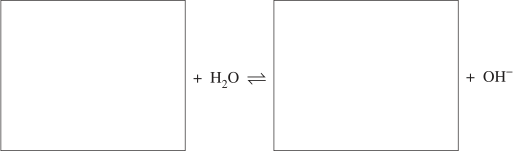
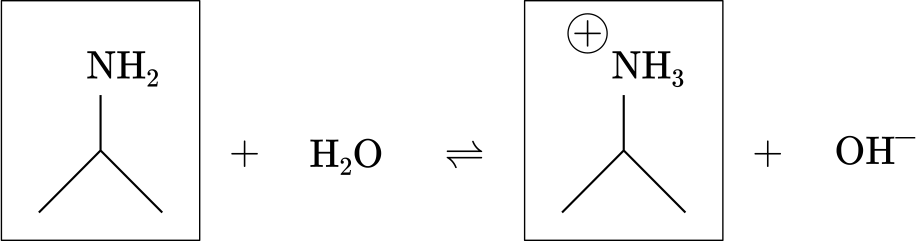
  1. Using structural formulae, complete the equation for the reaction of propan-2-amine with water.   (2 marks)
     
         
  2. The equilibrium constant for the reaction of propan-2-amine with water is  `4.37 xx10^(-4)`.
  3. Calculate the concentration of hydroxide ions in this solution.   (3 marks)

    --- 5 WORK AREA LINES (style=lined) ---

Show Answers Only

a.   


b.   

\begin{array} {|l|c|c|c|}
\hline  & \ce{C3H7NH2} & \ce{C3H7NH3} & \ce{OH–} \\
\hline \text{Initial} & 1.00 & 0 & 0 \\
\hline \text{Change} & -x & +x & +x \\
\hline \text{Equilibrium} & 1.00-x & x & x \\
\hline \end{array}

 
\[ K_b = \ce{\frac{[C3H7NH3+][OH– ]}{[C3H7NH2 ]}} = \frac{x^2}{(1.00-x)} \]

Assume `1.00-x=1.00` because `x` is negligible:

`4.37 xx 10^(−4)` `= x^2 / 1.00`  
`x` `=sqrt(4.37 xx 10^(−4))`  
  `= 0.0209\ text{mol L}^(–1)`  

 
`=> [text{OH}^– ] = 0.0209\ text{mol L}^(–1)`

Show Worked Solution

a.   


♦ Mean mark (a) 48%.

b.   

\begin{array} {|l|c|c|c|}
\hline  & \ce{C3H7NH2} & \ce{C3H7NH3} & \ce{OH–} \\
\hline \text{Initial} & 1.00 & 0 & 0 \\
\hline \text{Change} & -x & +x & +x \\
\hline \text{Equilibrium} & 1.00-x & x & x \\
\hline \end{array}

 
\[ K_b = \ce{\frac{[C3H7NH3+][OH– ]}{[C3H7NH2 ]}} = \frac{x^2}{(1.00-x)} \]

Assume `1.00-x=1.00` because `x` is negligible:

`4.37 xx 10^(−4)` `= x^2 / 1.00`  
`x` `=sqrt(4.37 xx 10^(−4))`  
  `= 0.0209\ text{mol L}^(–1)`  

 
`=> [text{OH}^– ] = 0.0209\ text{mol L}^(–1)`


Mean mark (b) 51%.

Filed Under: Bronsted-Lowry Theory, Equilibrium Constant, Reactions of Organic Acids and Bases Tagged With: Band 5, smc-3671-20-Calcs given K(eq), smc-3671-40-K(eq) and pH, smc-3671-50-Acids and bases, smc-3674-10-Calculations Involving pH, smc-3674-18-Dissociation in Water, smc-3680-60-Reactions of Organic Acids and Bases

CHEMISTRY, M6 2020 HSC 14 MC

The equation for the autoionisation of water is shown.

\( \ce{2H2O(l)  \rightleftharpoons  \ H3O+(aq) + OH-(aq)} \)

At 50°C the water ionisation constant, `K_(w)`, is  `5.5 xx10^(-14)`.

What is the pH of water at 50°C?

  1.  5.50
  2.  6.63
  3.  6.93
  4.  7.00
Show Answers Only

`B`

Show Worked Solution

\(\ce{$K_w$ = [H3O+][OH–]}\)

Since \(\ce{[H3O+] = [OH–]}\):

`[text{H}_3 text{O}^+]^2` `=5.5 xx 10^(−14)`  
`[text{H}_3 text{O}^+]` `= 2.3 xx 10^(−7}\  text{mol L}^(–1)`  

 
`text{pH = −log}_(10) (2.3 xx 10^(−7) ) = 6.63`

`=> B`

Filed Under: Bronsted-Lowry Theory, Equilibrium Constant Tagged With: Band 4, smc-3671-20-Calcs given K(eq), smc-3671-40-K(eq) and pH, smc-3671-60-Ionic solutions, smc-3674-10-Calculations Involving pH

CHEMISTRY, M5 2021 HSC 31

Ammonia is produced according to the following equilibrium equation.

   \(\ce{N2($g$) + 3H2($g$)\rightleftharpoons 2NH3($g$)}\)

There are 4.50 moles of nitrogen gas, 1.00 mole of hydrogen gas and 5.80 moles of ammonia in a 10.0 L vessel. The system is at equilibrium at 298 K. The value of `K_{eq}` at this temperature is 748 .

How many moles of nitrogen gas need to be added to the vessel to increase the amount of ammonia by 0.050 moles?   (4 marks)

Show Answers Only
  `text{N}_2`  `\ \ +\ \ `   `3 text{H}_2`   `⇋`   `\ \ 2 text{NH}_3`
Initial `(4.5 + x)\ text{moles}`   `1.0\ text{moles}`   `5.8\ text{moles}`
Change `− 0.025\ text{moles}`   `− 0.075\ text{moles}`   `+ 0.05\ text{moles}`
Equilibrium   `(4.475 + x)\ text{moles}`   `0.925\ text{moles}`   `5.85\ text{moles}`
Equilibrium 
concentration  
`[4.475 + x] / 10\ text{mol L}^ (–1)`    `0.0925\ text{mol L}^(–1)`   `0.585\ text{mol L}^(–1)`

 
`K_(eq) = [NH_3]^2 / [[N_2] [H_2]^3] `

`748 = 0.585^2 / [(4.475 + x) / 10 xx 0.0925^3]`

`748 xx (4.475 + x) / 10 xx 0.0925^3 = 0.585^2`

`(4.475 + x)/10` `= 0.585^2 / [748 xx 0.0925^3]`  
`4.475+x` `=[10 xx 0.585^2] / [748 xx 0.0925^3]`  
`x` `=[10 xx 0.585^2] / [748 xx 0.0925^3]-4.475`  
  `=1.3\ text{moles (1 d.p.)}`  

 
∴ 1.3 moles of nitrogen must be added to the equilibrium mixture.

Show Worked Solution
  `text{N}_2`  `\ \ +\ \ `   `3 text{H}_2`   `⇋`   `\ \ 2 text{NH}_3`
Initial `(4.5 + x)\ text{moles}`   `1.0\ text{moles}`   `5.8\ text{moles}`
Change `− 0.025\ text{moles}`   `− 0.075\ text{moles}`   `+ 0.05\ text{moles}`
Equilibrium   `(4.475 + x)\ text{moles}`   `0.925\ text{moles}`   `5.85\ text{moles}`
Equilibrium 
concentration  
`[4.475 + x] / 10\ text{mol L}^ (–1)`    `0.0925\ text{mol L}^(–1)`   `0.585\ text{mol L}^(–1)`

 
`K_(eq) = [NH_3]^2 / [[N_2] [H_2]^3] `

`748 = 0.585^2 / [(4.475 + x) / 10 xx 0.0925^3]`

`748 xx (4.475 + x) / 10 xx 0.0925^3 = 0.585^2`

`(4.475 + x)/10` `= 0.585^2 / [748 xx 0.0925^3]`  
`4.475+x` `=[10 xx 0.585^2] / [748 xx 0.0925^3]`  
`x` `=[10 xx 0.585^2] / [748 xx 0.0925^3]-4.475`  
  `=1.3\ text{moles (1 d.p.)}`  

 
∴ 1.3 moles of nitrogen must be added to the equilibrium mixture.


♦ Mean mark 44%.

Filed Under: Equilibrium Constant Tagged With: Band 5, smc-3671-20-Calcs given K(eq), smc-3671-35-Chemical equation given

CHEMISTRY, M5 2021 HSC 19 MC

A quantity of silver nitrate is added to 250.0 mL of 0.100 mol L ¯1 potassium sulfate at 298 K in order to produce a precipitate. Silver nitrate has a molar mass of 169.9 g mol ¯1.

What mass of silver nitrate will cause precipitation to start?

  1. 0.00510 g
  2. 0.186 g
  3. 0.465 g
  4. 0.854 g
Show Answers Only

`C`

Show Worked Solution

The reaction when silver nitrate is added to potassium sulfate is:

`text{2} text{Ag} text{NO}_(3) (aq) + text{K}_(2) text{SO}_(4) (aq) →  text{Ag}_(2) text{SO}_(4) (s) + text{2} text{K} text{NO}_(3) (aq)`
 

Since each `text{K}_(2) text{SO}_(4)` molecule has 1 sulfate ion

`[text{SO}_(4) ^(2-)] = text{K}_(2) text{SO}_(4) = 0.100\ text{mol L}^(-1)`
 

`text{Ag}_(2) text{SO}_(4) (s) ⇋ 2text{Ag}^(+) (aq) + text{SO}_(4) ^(\ 2-) (aq)`

`text{K}_(sp) = [text{Ag}^(+)]^2 [text{SO}_(4) ^(2-)]`
 

From the data sheet:

`text{K}_(sp) = text{1.20 x 10}^-5`

`text{1.20 x 10}^-5 = [text{Ag}^(+)]^2  xx  [text{SO}_(4) ^(\ 2-)]`

`text{1.20 x 10}^-5 = [text{Ag}^(+)]^2  xx  [text{0.100}]`

`[text{Ag}^(+)] = 0.01095…\ text{mol L}^(-1)`

`[text{Ag}^(+)] = [text{AgNO}_(3)]`
 

`text{n(AgNO}_(3)) = text{c}  xx text{V} = 0.01095… xx 0.250 = 0.00273…\ text{mol}`

`text{m(AgNO}_(3)) = text{n} xx text{MM} = 0.00273… xx 169.9 = 0.465\ text{g}`

`=> C`


♦ Mean mark 45%.

Filed Under: Equilibrium Constant Tagged With: Band 5, smc-3671-20-Calcs given K(eq), smc-3671-30-Deduce chemical equation, smc-3671-70-Precipitate

Copyright © 2014–2025 SmarterEd.com.au · Log in