SmarterEd

Aussie Maths & Science Teachers: Save your time with SmarterEd

  • Login
  • Get Help
  • About

CHEMISTRY, M6 2025 HSC 11 MC

The structures of two substances, \(\text{X}\) and \(\text{Y}\), are shown.
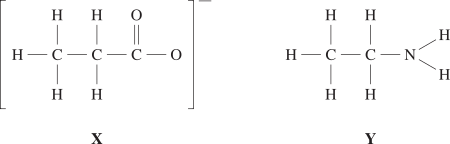
 

Which row of the table correctly classifies these substances as a Brønsted-Lowry acid or a Brønsted-Lowry base?
 

\begin{align*}
\begin{array}{l}
\rule{0pt}{2.5ex} \ & \\
 \ \rule[-1ex]{0pt}{0pt}& \\
\rule{0pt}{2.5ex}\textbf{A.}\rule[-1ex]{0pt}{0pt}\\
\rule{0pt}{2.5ex}\textbf{B.}\rule[-1ex]{0pt}{0pt}\\
\rule{0pt}{2.5ex}\textbf{C.}\rule[-1ex]{0pt}{0pt}\\
\rule{0pt}{2.5ex}\textbf{D.}\rule[-1ex]{0pt}{0pt}\\
\end{array}
\begin{array}{|c|c|}
\hline
\rule{0pt}{2.5ex}\textit{Brønsted-Lowry} & \textit{Brønsted-Lowry} \\
\textit{acid}\rule[-1ex]{0pt}{0pt}& \textit{base} \\
\hline
\rule{0pt}{2.5ex}\text{-}\rule[-1ex]{0pt}{0pt}&\text{X and Y}\\
\hline
\rule{0pt}{2.5ex}\text{X and Y}\rule[-1ex]{0pt}{0pt}& \text{-}\\
\hline
\rule{0pt}{2.5ex}\text{Y}\rule[-1ex]{0pt}{0pt}& \text{X} \\
\hline
\rule{0pt}{2.5ex}\text{X}\rule[-1ex]{0pt}{0pt}& \text{Y} \\
\hline
\end{array}
\end{align*}
Show Answers Only

\(A\)

Show Worked Solution
  • A Brønsted-Lowry acid is a proton donor and a Brønsted-Lowry base is a proton acceptor.
  • \(X\) is propanoate (the conjugate base of propanoic acid) and is therefore a proton accepter making it a Brønsted-Lowry base.
  • \(Y\) is ethanamine and is considered a weak base where the \(\ce{NH2}\) group can accept a proton to become \(\ce{NH3+}\).

\(\Rightarrow A\)

♦ Mean mark 45%.

Filed Under: Bronsted-Lowry Theory Tagged With: Band 5, smc-3674-30-Conjugate Acids/Bases

CHEMISTRY, M6 2016 HSC 10 MC

Which of the following is the conjugate base of the \(\ce{H_2PO_4^- ion}\)?

  1. \(\ce{H_3PO_4}\)
  2. \(\ce{H_3PO_3}\)
  3. \(\ce{HPO_4^2-}\)
  4. \(\ce{HPO_3^2-}\)
Show Answers Only

`C`

Show Worked Solution
  • Any conjugate base will have 1 less proton.

`=>C`

Filed Under: Bronsted-Lowry Theory Tagged With: Band 4, smc-3674-30-Conjugate Acids/Bases

CHEMISTRY, M6 2022 HSC 22

The following equation describes an equilibrium reaction.

\( \ce{HF(aq) + PO4^3-(aq) \rightleftharpoons HPO4^2-(aq) + F-(aq)} \)

Identify ONE base and its conjugate acid in the above equation.   (2 marks)
 

--- 0 WORK AREA LINES (style=lined) ---

Show Answers Only

Possible answers:

\begin{array} {ll}
\text{Base} & \text{Conjugate Acid} \\
\hline \ce{PO4^3-(aq)} & \ce{HPO4^2-(aq)} \\
\ce{F-(aq)} & \ce{HF(aq)} \\
  \end{array}

Show Worked Solution

Possible answers:

\begin{array} {ll}
\text{Base} & \text{Conjugate Acid} \\
\hline \ce{PO4^3-(aq)} & \ce{HPO4^2-(aq)} \\
\ce{F-(aq)} & \ce{HF(aq)} \\
  \end{array}

Filed Under: Bronsted-Lowry Theory, Properties of Acids and Bases Tagged With: Band 3, smc-3673-10-Arrhenius and Bronsted-Lowry, smc-3673-50-Acid Reactions, smc-3674-30-Conjugate Acids/Bases

Copyright © 2014–2026 SmarterEd.com.au · Log in