SmarterEd

Aussie Maths & Science Teachers: Save your time with SmarterEd

  • Login
  • Get Help
  • About

CHEMISTRY, M6 2024 HSC 34

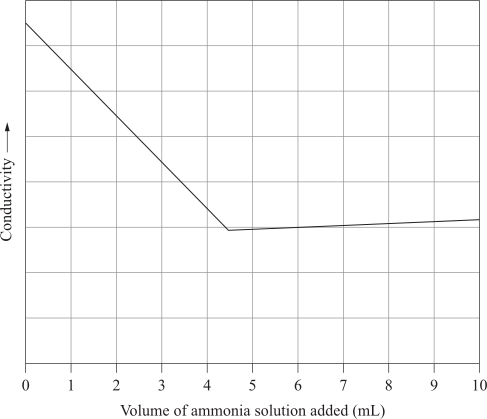
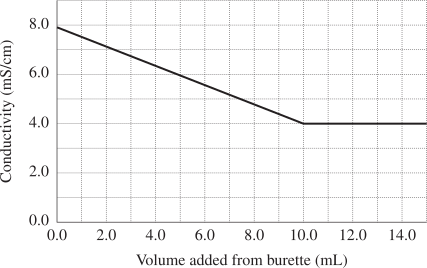
An aqueous solution of ammonia is added to a solution containing hydrochloric acid. A plot of conductivity against volume of ammonia solution added is shown. The temperature of the solution is kept constant throughout and the conductivity of the solution is corrected for dilution.
 

The relative conductivities of some relevant ions are shown in the table.

\begin{array}{|l|c|}
\hline \textit{Ion } & \textit{Relative conductivity } \\
\hline \ce{H^{+}} & 4.76 \\
\hline \ce{OH^{-}} & 2.70 \\
\hline \ce{Cl^{-}} & 1.04 \\
\hline \ce{NH_4^{+}} & 1.00 \\
\hline
\end{array}

Explain the shape of the graph. Include TWO balanced chemical equations in your answer.   (4 marks)

--- 13 WORK AREA LINES (style=lined) ---
Show Answers Only

  • Initially, \(\ce{H^+(aq)}\) and \(\ce{Cl^-(aq)}\) are present in the solution. Due to the significant relative conductivity of \(\ce{H^+(aq)}\), the overall conductivity of the solution is high.
  • As ammonia is added to the solution prior to the equivalence point (below 4.5 mL), hydrochloric acid is neutralized by the addition of ammonia according to the reaction:
  •    \(\ce{H^+(aq) + NH3(aq) -> NH4^+(aq)}\)
  • This results in the replacement of \(\ce{H^+}\), which exhibit high conductivity, with \(\ce{NH4^+}\), which have lower conductivity. Solution conductivity decreases.
  • The conductivity at the equivalence point is the lowest as only \(\ce{Cl^-}\) and \(\ce{NH4^+}\) ions are present which both have low relative conductivities.
  • Beyond the equivalence point, the excess ammonia added reacts partially with water to form \(\ce{NH4^+}\) and \(\ce{OH^-}\) ions according to the equation:
  •    \(\ce{NH3(aq) + H2O(l) \rightleftharpoons NH4^+(aq) + OH^-(aq)}\)
  • Although these ions are more conductive than the reactant molecules, the ionisation of ammonia is limited due to the presence of \(\ce{NH4^+}\)​ ions already in the solution (as per Le Châtelier’s Principle).
  • Consequently, the conductivity increases only slightly after the equivalence point.

Show Worked Solution

  • Initially, \(\ce{H^+(aq)}\) and \(\ce{Cl^-(aq)}\) are present in the solution. Due to the significant relative conductivity of \(\ce{H^+(aq)}\), the overall conductivity of the solution is high.
  • As ammonia is added to the solution prior to the equivalence point (below 4.5 mL), hydrochloric acid is neutralized by the addition of ammonia according to the reaction:
  •    \(\ce{H^+(aq) + NH3(aq) -> NH4^+(aq)}\)
  • This results in the replacement of \(\ce{H^+}\), which exhibit high conductivity, with \(\ce{NH4^+}\), which have lower conductivity. Solution conductivity decreases.
  • The conductivity at the equivalence point is the lowest as only \(\ce{Cl^-}\) and \(\ce{NH4^+}\) ions are present which both have low relative conductivities.
  • Beyond the equivalence point, the excess ammonia added reacts partially with water to form \(\ce{NH4^+}\) and \(\ce{OH^-}\) ions according to the equation:
  •    \(\ce{NH3(aq) + H2O(l) \rightleftharpoons NH4^+(aq) + OH^-(aq)}\)
  • Although these ions are more conductive than the reactant molecules, the ionisation of ammonia is limited due to the presence of \(\ce{NH4^+}\)​ ions already in the solution (as per Le Châtelier’s Principle).
  • Consequently, the conductivity increases only slightly after the equivalence point.

Filed Under: Quantitative Analysis Tagged With: Band 4, smc-3675-20-Titration Curves and Conductivity Graphs

CHEMISTRY, M6 2024 HSC 17 MC

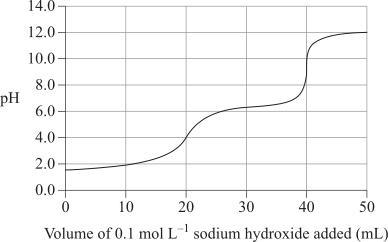
20 mL of a 0.1 mol L\(^{-1}\) solution of an acid is titrated against a 0.1 mol L\(^{-1}\) solution of sodium hydroxide. A graph of pH against the volume of sodium hydroxide for this experiment is shown.


Which of the following acids was used in the titration?

\begin{align*}
\begin{array}{l}
\ & \\
\textbf{A.}\\
\textbf{B.}\\
\textbf{C.}\\
\textbf{D.}\\
\end{array}
\begin{array}{|c|c|c|}
\hline
\quad \textit{Acid}\quad  & \quad pK_{a1}\quad & \quad pK_{a2}\quad \\
\hline
1& 4.76 & – \\
\hline
2 & \text{Strong} & – \\
\hline
3 & 1.91 & 6.30 \\
\hline
4 & 4.11 & 9.61 \\
\hline
\end{array}
\end{align*}

Show Answers Only

\(C\)

Show Worked Solution
  • There are two equivalence points on the graph, so the acid is diprotic and will have two \(pK_a\) values.
  • The reaction at the first equivalence point is: 
  •   \(\ce{H2A -> HA^- + H^+}\)
  • The reaction at the second equivalence point is: 
  •   \(\ce{HA^- -> A^{2-} + H^+}\)
  • The \(pK_a\) values for each equivalence point will be equal to the pH values at the half-equivalence points.
  • The first half-equivalence point occurs at 10 mL, where the corresponding pH is 1.91 \(\Rightarrow pK_{a1}\) = 1.91
  • The second half-equivalence point will occur halfway between the first two equivalence points, at 30 mL
  • The corresponding pH is 6.30 \(\Rightarrow pK_{a2}\) = 6.30

\(\Rightarrow C\)

♦ Mean mark 41%.
COMMENT: Student’s did well understanding the relationship between the \(pK_a\) values and half-equivalence points.

Filed Under: Quantitative Analysis Tagged With: Band 5, smc-3675-20-Titration Curves and Conductivity Graphs

CHEMISTRY, M6 2023 HSC 9 MC

A titration was performed using two solutions of equal concentration, producing the following titration curve.
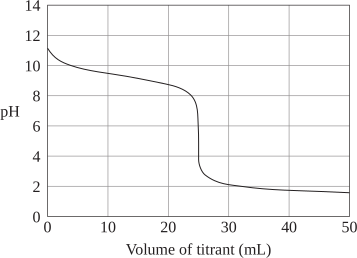
 

Which combination of solutions does the titration curve represent?

  1. Addition of a weak base to a weak acid
  2. Addition of a weak base to a strong acid
  3. Addition of a strong acid to a weak base
  4. Addition of a strong acid to a strong base
Show Answers Only

\(C\)

Show Worked Solution
  • Weak base acts as a buffer, resisting an immediate decrease in pH upon addition of strong acid

\(\Rightarrow C\)

Filed Under: Quantitative Analysis Tagged With: Band 4, smc-3675-20-Titration Curves and Conductivity Graphs

CHEMISTRY, M6 EQ-Bank 25

The graph shows changes in pH for the titrations of equal volumes of solutions of two monoprotic acids, Acid 1 and Acid 2.
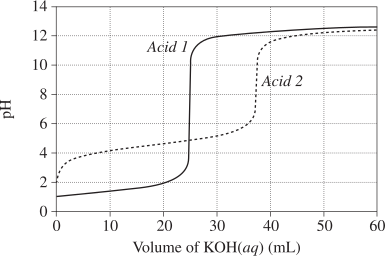
 

Explain the differences between Acid 1 and Acid 2 in terms of their relative strengths and concentrations.   (3 marks)

--- 6 WORK AREA LINES (style=lined) ---

Show Answers Only
  • Acid 1 is a strong acid. Its initial pH = 1 and its equivalence point is at pH = 7.
  • Acid 2 is a weaker acid. Its initial pH ~ 2 and its equivalence point is >7.
  • Acid 2 has a higher concentration than Acid 1 as it doesn’t take that much more \(\ce{KOH}\) to neutralise it.
Show Worked Solution
  • Acid 1 is a strong acid. Its initial pH = 1 and its equivalence point is at pH = 7.
  • Acid 2 is a weaker acid. Its initial pH ~ 2 and its equivalence point is >7.
  • Acid 2 has a higher concentration than Acid 1 as it doesn’t take that much more \(\ce{KOH}\) to neutralise it.

Filed Under: Bronsted-Lowry Theory, Quantitative Analysis Tagged With: Band 5, smc-3674-15-pH of Mixed Solution, smc-3674-20-Strong/Weak Acids & Bases, smc-3675-20-Titration Curves and Conductivity Graphs, smc-3675-40-Strong/Weak Acids

CHEMISTRY, M6 2019 HSC 24

A conductometric titration was undertaken to determine the concentration of a barium hydroxide solution. The solution was added to 250.0 mL of standardised 1.050 × 10 ¯ 3 mol L ¯1 hydrochloric acid solution. The results of the titration are shown in the conductivity graph.
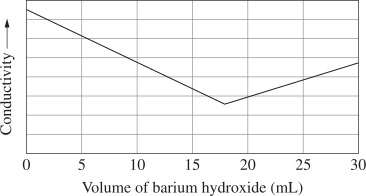


  1. Explain the shape of the titration curve.   (3 marks)

    --- 8 WORK AREA LINES (style=lined) ---

  2. The equivalence point was reached when a volume of 17.15 mL of barium hydroxide was added.
  3. Calculate the concentration of barium hydroxide (in mol L¯1), and give a relevant chemical equation.   (4 marks)

    --- 10 WORK AREA LINES (style=lined) ---

Show Answers Only

a.   Titration curve shape:

  • The conductivity of a solution of hydrochloric acid is initially very high due to the high concentration of ions in the solution.
  • As barium hydroxide is added, the conductivity decreases because the concentration of \(\ce{H+}\) decreases due to the neutralization reaction with \(\ce{OH-}\) ions.
  • The conductivity reaches a minimum at the equivalence point, which is when all the \(\ce{H+}\) ions have been removed and the solution only contains \(\ce{Ba^2+}\) and \(\ce{Cl-}\) ions.
  • These ions are much less mobile than \(\ce{H+}\) or \(\ce{OH-}\) ions, so the conductivity is lower at the equivalence point.
  • After the equivalence point, the conductivity increases as more barium hydroxide is added, resulting in an increase in the concentration of \(\ce{OH-}\) ions and therefore an increase in conductivity.
     

b.   \(\ce{2HCl(aq) + Ba(OH)2(aq) -> BaCl2(aq) + 2H2O(l)} \)

\(\ce{[Ba(OH)2]} = 7.653 \times 10^{-3}\ \text{mol L}^{-1}\)

Show Worked Solution

a.   Titration curve shape:

  • The conductivity of a solution of hydrochloric acid is initially very high due to the high concentration of ions in the solution.
  • As barium hydroxide is added, the conductivity decreases because the concentration of \(\ce{H+}\) decreases due to the neutralization reaction with \(\ce{OH-}\) ions.
  • The conductivity reaches a minimum at the equivalence point, which is when all the \(\ce{H+}\) ions have been removed and the solution only contains \(\ce{Ba^2+}\) and \(\ce{Cl-}\) ions.
  • These ions are much less mobile than \(\ce{H+}\) or \(\ce{OH-}\) ions, so the conductivity is lower at the equivalence point.
  • After the equivalence point, the conductivity increases as more barium hydroxide is added, resulting in an increase in the concentration of \(\ce{OH-}\) ions and therefore an increase in conductivity.

♦ Mean mark (a) 46%.

b.   \(\ce{2HCl(aq) + Ba(OH)2(aq) -> BaCl2(aq) + 2H2O(l)} \)

\(\ce{n(HCl) = c \times V = 1.050 \times 10^{-3} \times 250 = 2.625 \times 10^{-4} mol }\)

\(\ce{n(Ba(OH)2) = 0.5 \times n(HCl) = 1.3125 \times 10^{-4} mol}\)

\(\ce{[Ba(OH)2] = \dfrac{\text{n}}{\text{V}}}=\dfrac{1.3125 \times 10^{-4}}{0.01715}=7.653 \times 10^{-3}\ \text{mol L}^{-1}\)

Filed Under: Quantitative Analysis Tagged With: Band 4, Band 5, smc-3675-10-Titration, smc-3675-20-Titration Curves and Conductivity Graphs

CHEMISTRY, M6 2019 HSC 6 MC

The diagram represents the titration curve for a reaction between a particular acid a particular base. 
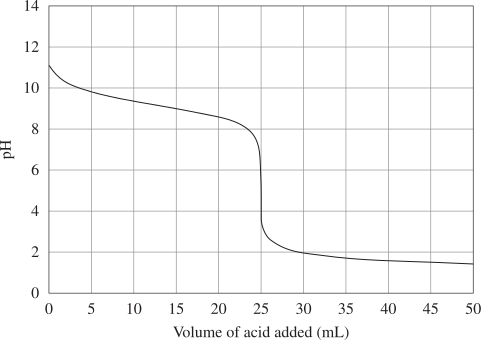
 

Which of the following equations best represents the reaction described by the titration curve?

  1. \(\ce{NH3 (aq) + HCl(aq) to NH4 Cl (aq)}\)
  2. \(\ce{NaOH(aq) + HCl(aq) to NaCl(aq) + H2O(l)}\)
  3. \(\ce{NH3 (aq) + CH3 COOH(aq) to CH3COONH4(aq)}\)
  4. \(\ce{NaOH(aq) + CH3 COOH(aq) to CH3COONa(aq)+H2O (l)}\)
Show Answers Only

\(A\)

Show Worked Solution
  • The titration curve shows the progress of a titration in which a weak base \(\ce{NH3}\) is reacting with a strong acid \(\ce{CHl}\) .
  • As the acid is added to the base, the pH of the solution moves lower.

\(\Rightarrow A\)

Filed Under: Quantitative Analysis Tagged With: Band 4, smc-3675-20-Titration Curves and Conductivity Graphs

CHEMISTRY, M6 2019 HSC 5 MC

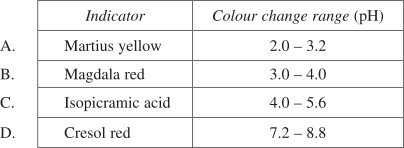
The diagram represents the titration curve for a reaction between a particular acid and a particular base. 
 

Which indicator would be best for this titration?
Show Answers Only

`C`

Show Worked Solution
  • The pH range at which isopicramic acid exhibits a colour change includes the point at which the acid and base react in equal amounts (equivalence point), which is at approximately pH 5.
  • The colour change can be used to identify when the equivalence point has been reached in a titration.

`=>C`

Filed Under: Properties of Acids and Bases, Quantitative Analysis Tagged With: Band 3, smc-3673-15-Indicators, smc-3675-20-Titration Curves and Conductivity Graphs

CHEMISTRY, M6 2020 HSC 8 MC

A weak base is titrated with 1.0 mol L\(^{-1}\) aqueous \(\ce{HCI}\). The \(\ce{pH}\) curve is shown.
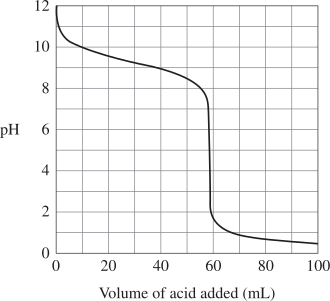


At which pH value would the solution be most effective as a buffer?

  1. 5
  2. 7
  3. 8
  4. 9
Show Answers Only

\(D\)

Show Worked Solution
  • The solution would be most effective as a buffer at \(\ce{pH}\) 9 because this corresponds to the half-equivalent point.

\(\Rightarrow D\)


♦♦ Mean mark 37%.

Filed Under: Quantitative Analysis Tagged With: Band 5, smc-3675-20-Titration Curves and Conductivity Graphs, smc-3675-60-Buffers

CHEMISTRY, M6 2022 HSC 15 MC

A 25.00 mL sample of 0.1131 `\text{mol}\ text{L}^(-1)` `\text{HCl}(aq)` was titrated with an aqueous ammonia solution. The conductivity of the solution was measured throughout the titration and the results graphed.
 

What was the concentration of the ammonia solution?

  1. 0.0452 `\text{mol}\ text{L}^(-1)`
  2. 0.189 `\text{mol}\ text{L}^(-1)`
  3. 0.283 `\text{mol}\ text{L}^(-1)`
  4. 0.690 `\text{mol}\ text{L}^(-1)`
Show Answers Only

`C`

Show Worked Solution

The equivalence point occurs at 10.0 mL of ammonia.

`text{HCl} (aq) + text{NH}_3 (aq) → text{NH}_4 text{Cl} (aq)`

`text{n(HCl)}` `= text{c} xx text{V}`
  `= 0.1131 xx 0.02500`
  `= 2.828 xx  text{10}^(−3)  text{mol}`

 
`text{n(NH}_3 )= text{n(HCl)}= 2.828 xx text{10}^(−3)  text{mol}`

`:.\ text{[NH}_3]= text{n} / text{V}= [2.828 xx text{10}^(−3)] / 0.0100= 0.283  text{mol L}^(–1)`

 `=> C`

Filed Under: Quantitative Analysis Tagged With: Band 4, smc-3675-20-Titration Curves and Conductivity Graphs

CHEMISTRY, M6 2021 HSC 16 MC

This titration curve is produced when an acid is titrated with a sodium hydroxide solution of the same concentration.

How many acidic protons does this acid possess?

  1. 1
  2. 2
  3. 3
  4. 4
Show Answers Only

`B`

Show Worked Solution
  • From the graph there are 2 equivalence points (at ~ 10 mL and 20 mL), indicating that the acid is diprotic.
  • i.e. it contains 2 acidic protons.

`=> B`


♦ Mean mark 39%.

Filed Under: Quantitative Analysis Tagged With: Band 5, smc-3675-20-Titration Curves and Conductivity Graphs

Copyright © 2014–2025 SmarterEd.com.au · Log in