SmarterEd

Aussie Maths & Science Teachers: Save your time with SmarterEd

  • Login
  • Get Help
  • About

CHEMISTRY, M6 2025 HSC 31

Hydrazine is a compound of hydrogen and nitrogen. The complete combustion of 1.0 L of gaseous hydrazine requires 3.0 L of oxygen, producing 2.0 L of nitrogen dioxide gas and 2.0 L of water vapour. All volumes are measured at 400°C.

  1. Use the chemical equation for the combustion of hydrazine to show that the molecular formula for hydrazine is \(\ce{N2H4}\).   (2 marks)

    --- 5 WORK AREA LINES (style=lined) ---

  2. The relationship between the acid equilibrium constant \(\left(K_a\right)\) and the corresponding conjugate base equilibrium constant \(\left(K_b\right)\) is shown.
      1. \(K_a \times K_b=K_w\)
  3. Use a relevant chemical equation to calculate the pH of a  0.20 mol L\(^{-1}\) solution of \(\ce{N2H5+}\) using the following data:
    • the \(K_b\) of hydrazine is \(1.7 \times 10^{-6}\) at 25°C
    • \(\ce{N2H5+}\) is the conjugate acid of \(\ce{N2H4}\).   (4 marks)
Show Answers Only

a.    Using Avogadro’s law:

  • At the same temperature and pressure, gas volumes are proportional to moles (i.e. the volume ratio will be equal to the mole ratio in a balanced equation).
  •    \(\ce{N2H4(g) + 3O2(g) -> 2NO2(g) + 2H2O(g)}\)
  • Mole ratio  \(\text{Hydrazine} : \ce{O2} : \ce{NO2} : \ce{H2O} = 1:3:2:2\ \ \Rightarrow\ \) matches the volume ratios given.
  • Therefore \(\ce{N2H4}\) is the correct molecular formula for hydrazine.

b.    \(\text{pH} = 4.46\)

Show Worked Solution

a.    Using Avogadro’s law:

  • At the same temperature and pressure, gas volumes are proportional to moles (i.e. the volume ratio will be equal to the mole ratio in a balanced equation).
  •    \(\ce{N2H4(g) + 3O2(g) -> 2NO2(g) + 2H2O(g)}\)
  • Mole ratio  \(\text{Hydrazine} : \ce{O2} : \ce{NO2} : \ce{H2O} = 1:3:2:2\ \ \Rightarrow\ \) matches the volume ratios given.
  • Therefore \(\ce{N2H4}\) is the correct molecular formula for hydrazine.

b.    \(K_a(\ce{N2H5+}) = \dfrac{K_w}{K_b(\ce{N2H4})} = \dfrac{1 \times 10^{-14}}{1.7 \times 10^{-6}} = 5.88235 \times 10^{-9}\)

  • The ionisation of \(\ce{N2H5+}\) is given the chemical equation below:
  •    \(\ce{N2H5+(aq) + H2O(l) \leftrightharpoons N2H4(aq) + H3O+(aq)}\)
  •    \(K_a = \dfrac{\ce{[H3O+][N2H4]}}{\ce{[N2H5+]}}\)
     
  • Using an Ice Table where all numbers are in mol L\(^{-1}\).

\begin{array} {|c|c|c|c|}
\hline  & \ce{[N2H5+]} & \ce{[N2H4]} & \ce{[H3O+]} \\
\hline \text{Initial} & 0.20 & 0 & 0 \\
\hline \text{Change} & -x & +x & +x \\
\hline \text{Equilibrium} & 0.20 -x & x & x \\
\hline \end{array}


  • Substituting into the \(K_a\) expression:
   \(\dfrac{x^2}{0.20-x}\) \(=5.88235 \times 10^{-9}\)  
\(\dfrac{x^2}{0.20}\) \(=5.88235 \times 10^{-9}\), as \(x\) is really small  
\(x\) \(=3.42997 \times 10^{-5}\)  


   \(\text{pH}\) \(=-\log_{10}(\ce{[H3O+]})\)  
  \(=-\log_{10}(3.42997 \times 10^{-5})\)  
  \(=4.46\)  

Filed Under: Bronsted-Lowry Theory, Quantitative Analysis Tagged With: Band 4, Band 5, smc-3674-10-Calculations Involving pH, smc-3675-30-Ka/Kb

CHEMISTRY, M6 2025 HSC 26

A hydrogen atom on the methyl group of ethanoic acid can be replaced with a single halogen atom. A general formula for these haloethanoic acids is shown.

\(\ce{X-CH2COOH \quad (X = F,Cl,Br or I)}\)

The \(p K_a\) values of the four haloethanoic acids are given in the table.

\begin{array}{|l|c|c|}
\hline
\rule{0pt}{2.5ex}\textit{Acid} \rule[-1ex]{0pt}{0pt}& \quad \quad \ce{X} \quad \quad & \quad \quad p K_a \quad \quad\\
\hline
\rule{0pt}{2.5ex}\text{Fluoroethanoic acid } \quad \rule[-1ex]{0pt}{0pt}& \ce{F} & 2.6 \\
\hline
\rule{0pt}{2.5ex}\text{Chloroethanoic acid } \rule[-1ex]{0pt}{0pt}& \ce{Cl} & 2.9 \\
\hline
\rule{0pt}{2.5ex}\text{Bromoethanoic acid } \rule[-1ex]{0pt}{0pt}& \ce{Br} & 2.9 \\
\hline
\rule{0pt}{2.5ex}\text{Iodoethanoic acid } \rule[-1ex]{0pt}{0pt}& \ce{I}& 3.2 \\
\hline
\end{array}

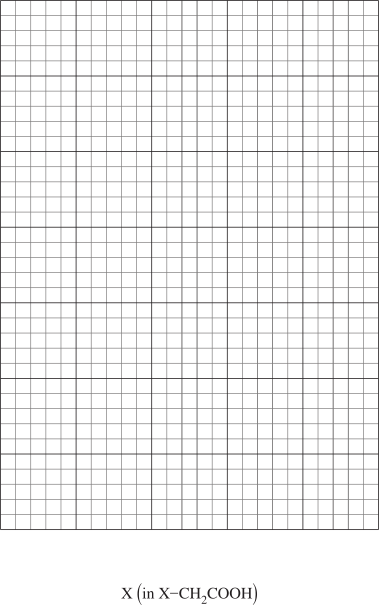
  1. Construct an appropriate graph for the four haloethanoic acids, showing their \(p K_a\) values and the identity of the halogen \(\ce{X}\) in each molecule, in the order provided in the table.   (3 marks)
     

--- 0 WORK AREA LINES (style=lined) ---

  1. Describe the trend in the relative strengths of the haloethanoic acids.   (2 marks)

    --- 4 WORK AREA LINES (style=lined) ---

Show Answers Only

a. 
     

b.    The strength of the haloethanoic acids can be explained by the relationship between \(pK_a\), \(K_a\) and the degree of ionisation.

  • Since \(pK_a\) is inversely related to \(K_a\) (\(pK_a = -\log_{10}(K_a)\)), a lower \(pK_a\) corresponds to a higher \(K_a\) and therefore greater ionisation in water.
  • Fluoroethanoic acid, with the lowest \(pK_a\) value, has the highest \(K_a\) and ionises the most, making it the strongest acid.
  • As you move down the halogen group from \(\ce{F}\) to \(\ce{I}\), \(pK_a\) increases and \(K_a\) decreases, so the acids ionise less and become weaker, with iodoethanoic acid being the weakest.
Show Worked Solution

a.    
         

b.    The strength of the haloethanoic acids can be explained by the relationship between \(pK_a\), \(K_a\) and the degree of ionisation.

  • Since \(pK_a\) is inversely related to \(K_a\) (\(pK_a = -\log_{10}(K_a)\)), a lower \(pK_a\) corresponds to a higher \(K_a\) and therefore greater ionisation in water.
  • Fluoroethanoic acid, with the lowest \(pK_a\) value, has the highest \(K_a\) and ionises the most, making it the strongest acid.
  • As you move down the halogen group from \(\ce{F}\) to \(\ce{I}\), \(pK_a\) increases and \(K_a\) decreases, so the acids ionise less and become weaker, with iodoethanoic acid being the weakest.

Filed Under: Quantitative Analysis Tagged With: Band 4, smc-3675-30-Ka/Kb, smc-3675-40-Strong/Weak Acids

CHEMISTRY, M6 2025 HSC 19 MC

0.1 mol of solid sodium acetate is dissolved in 500 mL of 0.1 mol L\(^{-1}\) \(\ce{HCl}\) in a beaker. This solution has a pH of 4.8 .

500 mL of distilled water is then added to the beaker.

What is the pH of the final solution?

  1. 2.4
  2. 4.5
  3. 4.8
  4. 5.1
Show Answers Only

\(C\)

Show Worked Solution
  • The initial reaction between sodium acetate and hydrochloric acid runs to completion as \(\ce{HCl}\) is a strong acid:
  •    \(\ce{CH3COO-(aq) + HCl(aq) -> CH3COOH(aq) + Cl-(aq)}\)
  • \(n(\ce{CH3COO-}) = 0.1\ \text{mol}\)
  • \(n(\ce{HCl}) = 0.5\ \text{L} \times 0.1\ \text{mol L}^{-1} = 0.05\ \text{mol}\)
  • As they react in a \(1:1\) ratio, \(\ce{HCl}\) is the limiting reagent.
  • \(n(\ce{CH3COO-_{\text{after reaction}}}) = n(\ce{CH3COO_{\text{initial}}})-n(\ce{CH3COO_{\text{reacted}}}) = 0.1-0.05 = 0.05\ \text{mol}\)
  • \(n(\ce{CH3COOH_{\text{after reaction}}}) = n(\ce{CH3COO_{\text{reacted}}}) = 0.05\ \text{mol}\)
  • The following equilibrium reaction is then established below dilution
  •    \(\ce{CH3COOH(aq) + H2O(l) \leftrightharpoons CH3COO-(aq) + H3O+(aq)}\)
  • Therefore the following ice table can be constructed:

\begin{array} {|c|c|c|c|}
\hline  & \ce{[CH3COOH]} & \ce{[CH3COO-]} & \ce{[H3O+]} \\
\hline \text{Initial} & 0.1 & 0.1 & 0 \\
\hline \text{Change} & -10^{-4.8} & +10^{-4.8} & +10^{-4.8} \\
\hline \text{Equilibrium} & 0.1-10^{-4.8} & 0.1+10^{-4.8} & +10^{-4.8} \\
\hline \end{array}

\(\therefore K_a = \dfrac{(0.1+10^{-4.8})(10^{-4.8})}{0.1-10^{-4.8}} = 1.585395 \times 10^{-5}\)

  • Then considering the dilution which would shift the equilibrium position to the right.

\begin{array} {|c|c|c|c|}
\hline  & \ce{[CH3COOH]} & \ce{[CH3COO-]} & \ce{[H3O+]} \\
\hline \text{Initial} & 0.1 \times \dfrac{500\ \text{mL}}{1000\ \text{mL}} = 0.05 & 0.1 \times \dfrac{500\ \text{mL}}{1000\ \text{mL}} = 0.05 & 0 \\
\hline \text{Change} & -x & +x & +x \\
\hline \text{Equilibrium} & 0.05-x & 0.05+x & +x \\
\hline \end{array}

  • As \(K_{eq}\) is small, \(0.05 -x \approx 0.05\)  and  \(0.05 + x \approx 0.05\). 
  •    \(\therefore K_{eq} = \dfrac{0.05x}{0.05} = x = 1.585395 \times 10^{-5}\)
  • \(\text{pH} = -\log_{10}\ce{[H3O+]} = -\log_{10}(1.585395 \times 10^{-5}) = 4.79962 = 4.8\ \text{(1 d.p.)}\)

\(\Rightarrow C\)

Filed Under: Bronsted-Lowry Theory, Quantitative Analysis Tagged With: Band 6, smc-3674-15-pH of Mixed Solution, smc-3675-30-Ka/Kb, smc-3675-40-Strong/Weak Acids

CHEMISTRY, M5 2024 HSC 39

Water and octan-1-ol do not mix. When an aqueous solution of bromoacetic acid \(\left(\ce{BrCH2COOH}\right)\) is shaken with octan-1-ol, an equilibrium system is established between bromoacetic acid dissolved in the octan-1-ol and in the water.

\(\ce{BrCH2COOH(aq) \rightleftharpoons BrCH2COOH}\textit{(octan-l-ol)}\)

The equilibrium constant expression for this system is

\(K_{e q}=\dfrac{\left[\ce{BrCH2COOH}\textit{(octan-l-ol)}\right]}{\left[\ce{BrCH2COOH}\textit{(aq)}\right]}\).

An aqueous solution of bromoacetic acid with an initial concentration of 0.1000 mol L \(^{-1}\) is shaken with an equal volume of octan-1-ol. Bromoacetic acid does not dissociate in octan-1-ol but does dissociate in water, with \(K_a=1.29 \times 10^{-3}\). When the system has reached equilibrium, the \(\left[\ce{H+}\right]\) is \(9.18 \times 10^{-3} \text{ mol L}^{-1}\).

Calculate the equilibrium concentration of aqueous bromoacetic acid and hence, or otherwise, calculate the \(K_{eq}\) for the octan-1-ol and water system.   (4 marks)

--- 10 WORK AREA LINES (style=lined) ---

Show Answers Only

\(0.390\) 

Show Worked Solution

  • The ionisation of bromoacetic acid in water is:
  •    \(\ce{BrCH2COOH(aq) \rightleftharpoons BrCH2COO^-(aq) + H^+(aq)}\)
  • At equilibrium \(\ce{[BrCH2COO^-(aq)] = [H^+(aq)]} = 9.18 \times 10^{-3}\ \text{mol L}^{-1}\) as the are formed in a \(1:1\).
\(K_{a}\) \(=\dfrac{\ce{[H^+][BrCH2COO^-]}}{\ce{[BrCH2COOH]_{eq}}}\)  
\(\ce{[BrCH2COOH]_{eq}}\) \(=\dfrac{\ce{[H^+][BrCH2COO^-]}}{K_a}\)  
  \(=\dfrac{(9.18 \times 10^{-3})^2}{1.29 \times 10^{-3}}\)  
  \(=0.06533\ \text{mol L}^{-1}\)  


\(\ce{[BrCH2COOH]_{\text{total}}}=\ce{[BrCH2COOH(aq)]_{eq} + [BrCH2COO^-(aq)]}\)

\(\ce{+ [BrCH2COOH(octan-1-ol)]_{eq}}\)

\(\ce{[BrCH2COOH(octan-1-ol)]_{eq}}\) \(=0.1000-0.06533-9.18 \times 10^{-3}\)  
  \(=0.02549\ \text{mol L}^{-1}\)    
     
  • Since the volume of the aqueous solution of bromoacetic acid and octane is the same, the concentration values between the water and octane solutions can be added/subtracted in one equation and mole calculations are not required.
  •    \(K_{eq} = \dfrac{\ce{[BrCH2COOH(octan-1-ol)]_{eq}}}{\ce{[BrCH2COOH(aq)]_{eq}}}= \dfrac{0.02549}{0.06533}=0.390\ \text{(3 sig. fig.)}\)
♦♦ Mean mark 27%.
COMMENT: Students who identified the acid conc in the organic solvent often succeeded in this question.

Filed Under: Equilibrium Constant, Quantitative Analysis Tagged With: Band 5, Band 6, smc-3671-10-Find K(eq), smc-3675-30-Ka/Kb

CHEMISTRY, M6 2023 HSC 35

  1. A 0.2000 mol L\(^{-1} \) solution of dichloroacetic acid \( \ce{(CHCl2COOH)} \) has a pH of 1.107. Dichloroacetic acid is monoprotic.
  2. Calculate the \( K_a \) for dichloroacetic acid.   (3 marks)

--- 12 WORK AREA LINES (style=lined) ---

  1. The following data apply to the ionisation of acetic acid \( \ce{(CH3COOH)} \) and trichloroacetic acid \( \ce{(CCl3COOH)} \).  
  \( \ce{CH3 COOH }\) \( \ce{CCl3COOH} \)
\( p K_a \) \(4.76\) \(0.51\)
\( \Delta H° \text{(kJ mol}^{-1})\) \(-0.1\) \(+1.2\)
\(\Delta S° \text{(J K}^{-1} \text{ mol}^{-1})\) \(-91.6\) \(-5.8\)
\( -T \Delta S° \text{(kJ mol}^{-1}) \) \(+27.3\) \(+1.7\)
\( \Delta G° \text{(kJ mol}^{-1}) \) \(+27.2\) \(+2.9\)
  1.  
    Explain the relative strength of these acids with reference to the data.   (3 marks)

--- 8 WORK AREA LINES (style=lined) ---

Show Answers Only

a.    \(K_a = 0.0501\)

b.    Relative strength of acids:

  • The \(pK_a\) of trichloroacetic acid is lower than the \(pK_a\) of acetic acid, so trichloroacetic acid is a stronger acid than acetic acid.
  • The \(\Delta S°\) term for acetic acid is a significantly lower number than for the trichloroacetic acid (noting they are both negative).
  • In both cases, this value will contribute unfavourably to each acid’s \(\Delta G°\) value, with the effect much larger for acetic acid than for trichloroacetic acid.
  • It follows from this result that the ionisation of acetic acid is less favourable than it is for trichloroacetic acid, making the latter the stronger acid.
Show Worked Solution

a.   \(\ce{CHCl2COOH(aq) \rightleftharpoons H+(aq) + CHCl2COO-(aq)} \)

\(\ce{[H+] = 10^{-\text{pH}} = 10^{-1.107} = 0.0782\ \text{mol L}^{-1}} \)

♦ Mean mark (a) 54%.

\begin{array} {|l|c|c|c|}
\hline  & \ce{CHCl2COOH(aq)} & \ce{H+(aq)} & \ce{CHCl2COO^{-}(aq)} \\
\hline \text{Initial} & \ \ \ \ 0.2000 &  0 & 0 \\
\hline \text{Change} & -0.0782 & +0.0782 & \ \ \ +0.0782 \\
\hline \text{Equilibrium} & \ \ \ \ 0.1218 & \ \ \ \ 0.0782 & \ \ \ \ \ \ 0.0782 \\
\hline \end{array}

\(K_a\) \(= \dfrac{\ce{[H+][CHCl2COO-]}}{\ce{[CHCl2COOH]}} \)  
  \(= \dfrac{0.0782 \times 0.0782}{0.1218} \)  
  \(= 0.0501\)  

 
b.
    Relative strength of acids:

  • The \(pK_a\) of trichloroacetic acid is lower than the \(pK_a\) of acetic acid, so trichloroacetic acid is a stronger acid than acetic acid.
  • The \(\Delta S°\) term for acetic acid is a significantly lower number than for the trichloroacetic acid (noting they are both negative).
  • In both cases, this value will contribute unfavourably to each acid’s \(\Delta G°\) value, with the effect much larger for acetic acid than for trichloroacetic acid.
  • It follows from this result that the ionisation of acetic acid is less favourable than it is for trichloroacetic acid, making the latter the stronger acid.
♦ Mean mark (b) 52%.

Filed Under: Quantitative Analysis Tagged With: Band 5, smc-3675-30-Ka/Kb, smc-3675-40-Strong/Weak Acids

CHEMISTRY, M6 EQ-Bank 13 MC

The pKa of trichloroacetic acid is 0.70 and the pKa of acetic acid is 4.8.

Which of the following identifies the acid with the higher pH and explain why?

  1. Acetic acid as it is less likely to lose a hydrogen ion
  2. Acetic acid as it is more likely to lose a hydrogen ion
  3. Trichloroacetic acid as it is less likely to lose a hydrogen ion
  4. Trichloroacetic acid as it is more likely to lose a hydrogen ion
Show Answers Only

`A`

Show Worked Solution
  • Higher pH corresponds to a weaker acid.
  • Higher pKa corresponds to a weaker acid (i.e. a higher pH).
  • Acetic acid the weaker acid (higher pKa), meaning it is less likely to dissociate in solution and lose a hydrogen ion.

`=> A`

Filed Under: Quantitative Analysis Tagged With: Band 4, smc-3675-30-Ka/Kb, smc-3675-40-Strong/Weak Acids

CHEMISTRY, M6 EQ-Bank 24

The pH of a 0.30 M aqueous propanoic acid solution was measured to be 2.7. The dissociation of propanoic acid is represented below.

\(\ce{CH3CH2COOH($aq$) + H2O($l$) \rightleftharpoons CH3CH2COO^-($aq$) + H3O^{+}($aq$)}\)

Calculate the `K_a` of the solution.   (3 marks)

Show Answers Only

\(\ce{$K_{a}$ = 1.3 \times 10^{-5}}\)

Show Worked Solution

\(\ce{pH = -log_{10}[H3O^{+}] = 2.7} \)

\(\ce{[H3O^{+}] = 10^{-2.7} = 1.995 \times 10^{-3} mol L^{-1}}\)

\(\ce{[H3O^{+}] = [CH3CH2COO^{-}]} \)

\begin{aligned}
\ce{$K_{a}$} &= \dfrac{\ce{[H3O^{+}][CH3CH2COO^{-}]}}{\ce{[CH3CH2COOH]}}  \\
&= \dfrac{\ce{(1.995 \times 10^{-3})(1.995 \times 10^{-3})}}{\ce{(0.30 – 1.995 \times 10^{-3})}}   \\
&= \ce{1.3 \times 10^{-5}}
\end{aligned}

Filed Under: Quantitative Analysis Tagged With: Band 5, smc-3675-30-Ka/Kb

CHEMISTRY, M6 2021 HSC 36

The `p K_a` of sulfurous acid in the following reaction is 1.82.

\(\ce{H2SO3($aq$) + H2O($l$)\rightleftharpoons H3O^+($aq$) + HSO3^-($aq$)}\)

The `p K_(a)` of hydrogen sulfite in the following reaction is 7.17.

\(\ce{HSO3^-($aq$) + H2O($l$)\rightleftharpoons H3O^+($aq$) + SO3^2-($aq$)}\)

Calculate the equilibrium constant for the following reaction:

\(\ce{H2SO3($aq$) + 2H2O($l$)\rightleftharpoons 2H3O^+($aq$) + SO3^2-($aq$)}\)   (5 marks)

Show Answers Only

`text{K}_(eq) = 1.02 xx 10^-9`

Show Worked Solution

`text{Ka}_1 = [[text{HSO}^(3-) ] [text{H}_3 text{O}^+ ]] / [[text{H}_2 text{SO}_3]]`

`text{Ka}_2 = [[text{SO}_3 ^(2-)] [text{H}_3 text{O}^+ ]] / [[text{HSO}_3 ^- ]]`

`text{K}_(eq) = [[text{SO}_3  ^(2-) ] [text{H}_3 text{O}^+ ]^2] / [[text{H}_2 text{SO}_3 ]]`

`text{K}_(eq}` can be derived by multiplying `text{Ka}_1` with `text{Ka}_2`

   `text{Ka}` `= 10^-text{pK}`
   `text{Ka}_1` `= 10^(-1.82)`
`text{Ka}_2` `= 10^(-7.17)`

 
`text{K}_(eq) = 10^(-1.82) xx 10^(-7.17)= 1.02 xx 10^-9`


♦ Mean mark 50%.

Filed Under: Quantitative Analysis Tagged With: Band 5, smc-3675-30-Ka/Kb

CHEMISTRY, M6 2019 HSC 27

The relationship between the acid dissociation constant, `K_a`, and the corresponding conjugate base dissociation constant, `K_b`, is given by:

`K_(a)xxK_(b)=K_(w)`

Assume that the temperature for part (a) and part (b) is 25°C.

  1. The `K_a` of hypochlorous acid `text{(HOCl)}` is  `3.0 xx10^(-8)`.
  2. Show that the `K_b` of the hypochlorite ion, `text{OCl}^-`, is  `3.3 xx10^(-7)`.   (1 mark)

    --- 3 WORK AREA LINES (style=lined) ---

  3. The conjugate base dissociation constant, `K_b`, is the equilibrium constant for the following equation:
  4.      `text{OCl}^(-)(aq)+ text{H}_(2) text{O}(l) ⇌ text{HOCl}(aq)+ text{OH}^(-)(aq)`
  5. Calculate the pH of a 0.20 mol L¯1 solution of sodium hypochlorite `(text{NaOCl})`.   (4 mark)

    --- 14 WORK AREA LINES (style=lined) ---

Show Answers Only
  1. `K_b=3.3 xx 10^{-7}`
  2. \(\ce{pH = 14-3.59 = 10.41}\)
Show Worked Solution

a.   `K_(a)xxK_(b)=K_(w)\ \ =>\ \ K_b=(K_(w))/(K_(a))`

`K_b=(1.0 xx 10^{-14})/(3.0 xx 10^{-8}=3.3 xx 10^{-7}`
 

b.   \(\ce{OCl-(aq) + H2O(l) \rightleftharpoons HOCl(aq) + OH-(aq)}\)
 

\begin{array} {|l|c|c|c|}
\hline  & \ce{OCl-} & \ce{HOCl} & \ce{OH–} \\
\hline \text{Initial} & 0.20 & 0 & 0 \\
\hline \text{Change} & -x & +x & +x \\
\hline \text{Equilibrium} & 0.20-x & x & x \\
\hline \end{array}

 
\[ K_b = \ce{\frac{[HOCl][OH– ]}{[OCl-]}} = \frac{x^2}{(0.20-x)} \]

Assume  `0.20-x~~0.20`  because `x` is negligible:

`3.3 xx 10^(-7)` `= x^2 / (0.20-x)`  
`x` `=sqrt(3.3 xx 10^(−7) xx 0.20)`  
  `= 2.5690 xx 10^{-4}\ text{mol L}^(–1)`  

 
\(\ce{[OH-] = 2.5690 \times 10^{-4} mol L^{-1}}\)

\(\ce{pOH = -log10[OH-] = -log10(2.5690 \times 10^{-4}) = 3.59}\)

\(\therefore \ce{pH = 14-3.59 = 10.41}\)


♦ Mean mark (b) 45%.

Filed Under: Bronsted-Lowry Theory, Equilibrium Constant, Quantitative Analysis Tagged With: Band 4, Band 5, smc-3671-10-Find K(eq), smc-3671-35-Chemical equation given, smc-3671-40-K(eq) and pH, smc-3671-50-Acids and bases, smc-3674-10-Calculations Involving pH, smc-3675-30-Ka/Kb

CHEMISTRY, M6 2022 HSC 20 MC

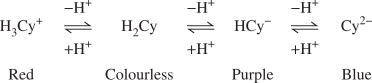
Cyanidin is a plant pigment that may be used as a pH indicator. It has four levels of protonation, each with a different colour, represented by these equilibria:
 

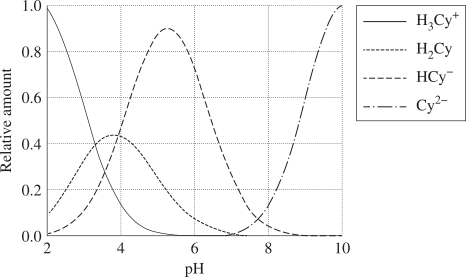
The following graph shows the relative amount of each species present at different pH values.
 

What colour would the indicator be if added to a 0.75 mol L\(^{-1}\) solution of hypoiodous acid, \(\text{HIO}\ \left(p K_a=10.64\right)\)?

  1. Red
  2. Colourless
  3. Purple
  4. Blue
Show Answers Only

\(C\)

Show Worked Solution

\(\ce{HIO(aq) + H2O(l) \leftrightharpoons IO^– (aq) + H3O^+ (aq)}\)

\begin{array} {|l|c|c|c|}
\hline  & \text{HIO} & \ \ \text{IO}^– \ \  & \ \  \text{H}_3 \text{O}^+\ \  \\
\hline \text{Initial} & 0.75 & 0 & 0 \\
\hline \text{Change} & -x & +x & +x \\
\hline \text{Equilibrium} & 0.75 − x & x & x \\
\hline \end{array}

 
\(\text{K}_a=\dfrac{\left[ IO ^{-}\right]\left[ H _3 O ^{+}\right]}{[ HIO ]}=\dfrac{x^2}{(0.75-x)}\)

\(\text{K}_a \ \text{is small} \Rightarrow 0.75-x \approx 0.75\)

\(\begin{aligned}
K _a & =\dfrac{x^2}{0.75} \\
10^{-10.64} & =\dfrac{x^2}{0.75} \\
x^2 & =10^{-10.64} \times 0.75 \\
x & =\sqrt{10^{-10.64} \times 0.75} \\
& =4.1 \times 10^{-6} \ \text{mol L}^{-1} \\
\therefore\left[ H _3 O ^{+}\right] & =4.1 \times 10^{-6} \ \text{mol L}^{-1}
\end{aligned}\)

\(\text{pH}=-\log _{10}\left[4.1 \times 10^{-6}\right]=5.38\)

\(\text{The major species at pH (see graph) = 5.38 is purple.}\)

\(\Rightarrow C\)


♦ Mean mark 46%.

Filed Under: Bronsted-Lowry Theory, Quantitative Analysis Tagged With: Band 5, smc-3674-10-Calculations Involving pH, smc-3675-30-Ka/Kb

CHEMISTRY, M6 2021 HSC 20 MC

The trimethylammonium ion, \(\ce{[({CH_3)_3NH}]^+}\), is a weak acid. The acid dissociation equation is shown.

\(\ce{[(CH3)3NH]+($aq$)+H2O($l$)\rightleftharpoons  H3O+($aq$)+(CH3)3N($aq$)} \quad K_a = 1.55 \times 10^{-10}\)

At 20°C, a saturated solution of trimethylammonium chloride, \(\ce{[(CH_3)_3NH]Cl}\), has a pH of 4.46.

What is the \(K_{sp}\) of trimethylammonium chloride?

  1. \(1.26 \times 10^{-9}\)
  2. \(7.76\)
  3. \(60.2\)
  4. \(5.01 \times 10^{10}\)
Show Answers Only

\(C\)

Show Worked Solution

\(\ce{\left[\left(CH3\right)_3 NH \right]^{+}(aq)+ H2O(l) \leftrightharpoons H3O ^{+}(aq)+\left(CH3\right)_3 N(aq)}\)

   \(K_a=\dfrac{\left[\left(\text{CH}_3\right)_3 \text{N}\right]\left[ \text{H}_3 \text{O} ^{+}\right]}{\left[\left( \text{CH} _3\right)_3 \text{NH} \right]^{+}}\)
 

\(\text{Calculate}\ K_{sp}:\)

\(\ce{\left[\left(CH _3\right)_3 NH \right] Cl (s) \leftrightharpoons\left[\left( CH _3\right)_3 NH \right]^{+}(aq)+ Cl ^{-}(aq)}\)

   \(K_{sp}=\ce{[(CH3)_3NH)^+] [Cl^-]}\)

\(\text{pH} = \ce{4.46 \rightarrow \left[H3O^+\right] = 10^{-4.46}}\)
  

\(\text{Using stoichiometry;}\)

\(\ce{[(CH3)_3N)^+]=[H3O^+] = 10^{-4.46}}\)

 
\(\text{Using}\ K_{a}:\)

\(1.55 \times 10^{-10}=\dfrac{\left(10^{-4.46} \times 10^{-4.46}\right)}{\ce{\left(CH3\right)3NH^{+}}}\)

\(\ce{\left[\left(\left(CH3\right)_3NH \right)^{+}\right]}=\dfrac{\left(10^{-4.46} \times 10^{-4.46}\right)}{1.55 \times 10^{-10}}=7.7565 \ldots  \text{mol L}^{-1}\)
 

\(\ce{\left[Cl^{-}\right]=\left[\left(\left( CH3\right)_3NH\right)^{+}\right]}=7.7565 \ldots \text{mol L}^{-1}\)

\(\therefore K_{sp}=\ce{\left[\left(\left(CH3\right)_3NH\right)^{+}\right]\times\left[Cl^{-}\right]=7.7565 \ldots \times 7.7565 \ldots=60.2}\)

\(\Rightarrow C\)


♦♦♦ Mean mark 19%.

Filed Under: Bronsted-Lowry Theory, Quantitative Analysis Tagged With: Band 6, smc-3674-10-Calculations Involving pH, smc-3675-30-Ka/Kb

CHEMISTRY, M6 2021 HSC 6 MC

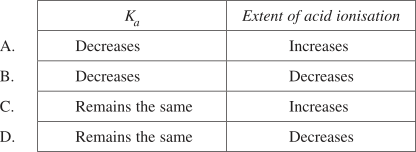
Which row of the table describes what happens when a solution of a weak acid is diluted? (Assume constant temperature.)
 

Show Answers Only

`C`

Show Worked Solution

A weak acid has the following equilibrium:

   `text{HA} (aq) + text{H}_2 text{O} (l) ⇋ text{A}^(-) (aq) + text{H}_3 text{O}^(+) (aq)`

   `text{K}_a =  [[text{A}^(-)][text{H}_3text{O}^(+)] ]/[[text{HA}]]`

  • The value of  `text{K}_a` is only affected by temperature, and thus the value of `text{K}_a` will remain the same.
  • When the solution is diluted, water is added. According to Le Chatelier’s Principle, the equilibrium will shift to the right to counteract the change.
  • Thus, the equilibrium will shift to the right and increase the extent of ionisation.

`=>C`


♦♦♦ Mean mark 25%.

Filed Under: Bronsted-Lowry Theory, Quantitative Analysis Tagged With: Band 6, smc-3674-20-Strong/Weak Acids & Bases, smc-3675-30-Ka/Kb

Copyright © 2014–2025 SmarterEd.com.au · Log in