SmarterEd

Aussie Maths & Science Teachers: Save your time with SmarterEd

  • Login
  • Get Help
  • About

CHEMISTRY, M6 2024 HSC 16 MC

Which of the following is the overall reaction that takes place when a strong acid is added to a buffer containing equal amounts of acetic acid and acetate ions?

  1. \(\ce{HCOO^{-} +H_3O^{+} \rightarrow HCOOH + H_2O}\)
  2. \(\ce{CH_3COOH +OH^{-} \rightarrow CH_3COO^{-} + H_2O}\)
  3. \(\ce{CH_3COO^{-} +H_3O^{+} \rightarrow CH_3COOH + H_2O}\)
  4. \(\ce{CH_3COOH +H_3O^{+} \rightarrow CH_3C(OH)_2^{+} + H_2O}\)
Show Answers Only

\(C\)

Show Worked Solution
  • A buffer maintains the pH of a solution when a small amount of acid or base is added to it by shifting its equilibrium position to minimise change in the concentration of \(\ce{H3O+}\) or \(\ce{OH-}\) ions.
  • When a strong acid is added to the solution, the \(\ce{[H3O+]}\) is increased, hence the system will react to reduce the increase in \(\ce{[H3O+]}\).
  • Hence, the hydronium ions will react with the weak base of the buffer solution to minimise the change in pH of the solution.
  •    \(\ce{CH_3COO^{-} +H_3O^{+} \rightarrow CH_3COOH + H_2O}\)

\(\Rightarrow C\)

Filed Under: Quantitative Analysis Tagged With: Band 4, smc-3675-60-Buffers

CHEMISTRY, M6 EQ-Bank 27

What determines the pH of a buffer solution?   (2 marks)

Show Answers Only
  • The strength of the acid. The greater the pKa of (weaker) the acid, the greater the buffer pH.
  • Relative concentrations of acid and base. 
Show Worked Solution
  • The strength of the acid. The greater the pKa of (weaker) the acid, the greater the buffer pH.
  • Relative concentrations of acid and base. 

Filed Under: Quantitative Analysis Tagged With: Band 4, smc-3675-60-Buffers

CHEMISTRY, M6 EQ-Bank 29

Explain why a mixture of acetic acid (1 M) and sodium acetate (1 M) can act as a buffer while a mixture of hydrochloric acid (1 M) and sodium chloride (1 M) cannot.   (3 marks)

--- 8 WORK AREA LINES (style=lined) ---

Show Answers Only
  • A buffer is a mixture of a weak acid and its conjugate base which is able to counteract changes in pH when small amounts of acid or base is added.
  • In this case acetic acid and sodium acetate can act as a buffer. The following equilibrium is established:
  •    \(\ce{CH3COOH(aq) + H2O(l) \rightleftharpoons CH3COO^-(aq) + H3O+(aq)}\)
  • Any addition of acid to the mixture increases the \(\ce{[H3O^+]}\) and shifts the above equilibrium to the left, removing \(\ce{H3O^+}\) ions and minimising a change in pH. 
  • Likewise, any addition of base causes \(\ce{OH^-}\) ions to react with \(\ce{H3O^+}\) in solution. This shifts the above equilibrium to the right, generating more \(\ce{H3O^+}\) and maintaining a relatively constant pH.
  • Hydrochloric acid is a strong acid, so its conjugate base, chloride has negligible basic activity.
  • The dissociation of hydrochloric acid goes to completion, so addition of base simply lowers the pH of the solution as there is no aqueous hydrochloric acid able to generate \(\ce{H3O^+}\). Addition of acid will raise the pH as chloride ions are unable to react with \(\ce{H3O^+}\) ions.
Show Worked Solution
  • A buffer is a mixture of a weak acid and its conjugate base which is able to counteract changes in pH when small amounts of acid or base is added.
  • In this case acetic acid and sodium acetate can act as a buffer. The following equilibrium is established:
  •    \(\ce{CH3COOH(aq) + H2O(l) \rightleftharpoons CH3COO^-(aq) + H3O+(aq)}\)
  • Any addition of acid to the mixture increases the \(\ce{[H3O^+]}\) and shifts the above equilibrium to the left, removing \(\ce{H3O^+}\) ions and minimising a change in pH. 
  • Likewise, any addition of base causes \(\ce{OH^-}\) ions to react with \(\ce{H3O^+}\) in solution. This shifts the above equilibrium to the right, generating more \(\ce{H3O^+}\) and maintaining a relatively constant pH.
  • Hydrochloric acid is a strong acid, so its conjugate base, chloride has negligible basic activity.
  • The dissociation of hydrochloric acid goes to completion, so addition of base simply lowers the pH of the solution as there is no aqueous hydrochloric acid able to generate \(\ce{H3O^+}\). Addition of acid will raise the pH as chloride ions are unable to react with \(\ce{H3O^+}\) ions.

Filed Under: Quantitative Analysis Tagged With: Band 5, smc-3675-60-Buffers

CHEMISTRY, M6 2018 HSC 17 MC

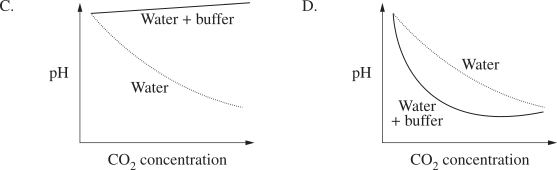
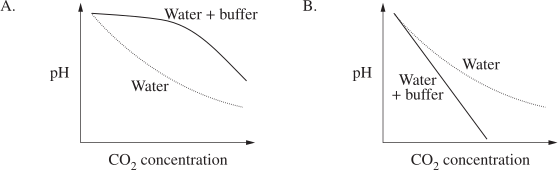
Increasing amounts of carbon dioxide were dissolved in two beakers, one containing water and one a mixture of water and a buffer. The pH in each beaker was measured and the results graphed.

Which graph best represents the results?


Show Answers Only

`A`

Show Worked Solution

By Elimination:

  • A buffer will resist changes in pH caused by the addition of an acidic or basic solution.
  • If the water and buffer solution is decreasing in pH, the water solution will be declining in pH quicker and its graph will lie below (eliminate B and D).
  • If the water and buffer solution is increasing in pH, the water solution should be increasing at a greater rate (eliminate C).

`=>A`

Filed Under: Quantitative Analysis Tagged With: Band 4, smc-3675-60-Buffers

CHEMISTRY, M6 2018 HSC 15 MC

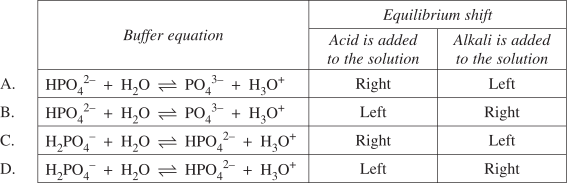
A solution containing potassium dihydrogen phosphate and potassium hydrogen phosphate is a common laboratory buffer with a \(\ce{pH}\) close to 7.

Which row of the table correctly identifies the chemistry of this buffer?
 

Show Answers Only

\(D\)

Show Worked Solution

By Elimination:

  • Dihydrogen phosphate molecule is \(\ce{H2PO4-}\) and hydrogen phosphate is \(\ce{HPO4^2-}\) (eliminate A and B)
  • When acid is added, by Le Chatelier’s principle, the equation will shift to the left to reduce the \(\ce{H3O+}\)

\(\Rightarrow D\)


Mean mark 55%.

Filed Under: Quantitative Analysis Tagged With: Band 5, smc-3675-60-Buffers

CHEMISTRY, M6 2015 HSC 24

  1. Explain why the salt, sodium acetate, forms a basic solution when dissolved in water. Include an equation in your answer.   (2 marks)

    --- 5 WORK AREA LINES (style=lined) ---

  2. A solution is prepared by using equal volumes and concentrations of acetic acid and sodium acetate.
  3. Explain how the pH of this solution would be affected by the addition of a small amount of sodium hydroxide solution. Include an equation in your answer.   (3 marks)

    --- 5 WORK AREA LINES (style=lined) ---

Show Answers Only

a.   \(\ce{CH3COO-(aq) + H2O(l) \rightleftharpoons CH3COOH(aq) + OH-(aq)}\)

  • Sodium acetate is a basic salt.
  • Acetate is a strong base that accepts a proton, producing hydroxide.
  • The presence of \(\ce{OH-}\) ions produced by the hydrolysis of \(\ce{CH3COO-}\) increases the pH, producing a basic solution. 

b.  \(\ce{CH3COO-(aq) + H3O+(l) \rightleftharpoons CH3COOH(aq) + H2O(l)}\)

  • The \(\ce{OH-}\) ions introduced into the solution will react with the \(\ce{H3O+}\) ions, reducing their concentration in the equilibrium mixture.
  • By Le Chatelier’s principle, this will subsequently move the reaction to the left to increase the \(\ce{H3O+}\) ions, thus minimising any change in pH.
Show Worked Solution

a.   \(\ce{CH3COO-(aq) + H2O(l) \rightleftharpoons CH3COOH(aq) + OH-(aq)}\)

  • Sodium acetate is a basic salt.
  • Acetate is a strong base that accepts a proton, producing hydroxide.
  • The presence of \(\ce{OH-}\) ions produced by the hydrolysis of \(\ce{CH3COO-}\) increases the pH, producing a basic solution.  

♦♦ Mean mark (a) 37%.

b.  \(\ce{CH3COO-(aq) + H3O+(l) \rightleftharpoons CH3COOH(aq) + H2O(l)}\)

  • The \(\ce{OH-}\) ions introduced into the solution will react with the \(\ce{H3O+}\) ions, reducing their concentration in the equilibrium mixture.
  • By Le Chatelier’s principle, this will subsequently move the reaction to the left to increase the \(\ce{H3O+}\) ions, thus minimising any change in pH.

♦♦♦ Mean mark (b) 25%.

Filed Under: Bronsted-Lowry Theory, Quantitative Analysis Tagged With: Band 5, Band 6, smc-3674-18-Dissociation in Water, smc-3675-60-Buffers

CHEMISTRY, M6 2017 HSC 14 MC

One litre of an aqueous solution is formed from mixing equal volumes of 0.2 mol L\(^{-1}\) hydrochloric acid \(\ce{(HCl)}\) and 0.2 mol L\(^{-1}\) sodium chloride \(\ce{(NaCl)}\).

How effective as a buffer is the aqueous solution formed?

  1. Ineffective, because \(\ce{HCl}\) is a strong acid
  2. Effective, because \(\ce{Cl-}\) is the conjugate base of \(\ce{HCl}\)
  3. Ineffective, because \(\ce{NaCl}\) forms a neutral salt solution
  4. Effective, because the pH would change when a solution of \(\ce{NaOH}\) is added
Show Answers Only

\(A\)

Show Worked Solution
  • \(\ce{HCl}\) is a strong acid
  • Aqueous solution formed will be ineffective as a buffer (no equilibrium in solution will be formed).

\(\Rightarrow A\)


♦ Mean mark 51%.

Filed Under: Quantitative Analysis Tagged With: Band 5, smc-3675-60-Buffers

CHEMISTRY, M6 2019 HSC 22

A buffer was prepared with acetic acid and sodium acetate. A few drops of universal indicator were then added. When small amounts of either 0.1 mol L ¯1 \(\ce{HCl(aq)}\) or 0.1 mol L ¯1 \(\ce{NaOH(aq)}\) were added, no change in the colour of the solution was observed.

Explain these observations. Support your answer with at least ONE chemical equation.   (4 marks)

Show Answers Only

\(\ce{CH3COOH(aq) + H2O(l) \rightleftharpoons CH3COO-(aq) + H3O+(aq)}\)

  • A buffer is a solution that resists changes in pH when small amounts of acid or base are added.
  • When a small amount of acid or base is added to a buffer solution containing \(\ce{CH3COOH}\) and \(\ce{CH3COO-}\), the equilibrium of the reaction shifts in order to minimise the disturbance and maintain a stable pH.
  • This is due Le Chatelier’s Principle, which states that when a disturbance occurs in a chemical system at equilibrium, the equilibrium will shift in a way that minimises the disturbance.
  • If acid is added to the buffer solution, the equilibrium will shift to the left to use the \(\ce{H3O+}\) ions, and if base is added, the equilibrium will shift to the right to increase the \(\ce{H3O+}\) concentration.
  • As a result, the pH remains relatively stable and there is no change in the colour of the indicator.
Show Worked Solution

\(\ce{CH3COOH(aq) + H2O(l) \rightleftharpoons CH3COO-(aq) + H3O+(aq)}\)

  • A buffer is a solution that resists changes in pH when small amounts of acid or base are added.
  • When a small amount of acid or base is added to a buffer solution containing \(\ce{CH3COOH}\) and \(\ce{CH3COO-}\), the equilibrium of the reaction shifts in order to minimise the disturbance and maintain a stable pH.
  • This is due Le Chatelier’s Principle, which states that when a disturbance occurs in a chemical system at equilibrium, the equilibrium will shift in a way that minimises the disturbance.
  • If acid is added to the buffer solution, the equilibrium will shift to the left to use the \(\ce{H3O+}\) ions, and if base is added, the equilibrium will shift to the right to increase the \(\ce{H3O+}\) concentration.
  • As a result, the pH remains relatively stable and there is no change in the colour of the indicator.

♦♦ Mean mark 38%.

Filed Under: Quantitative Analysis Tagged With: Band 5, smc-3675-60-Buffers

CHEMISTRY, M6 2020 HSC 8 MC

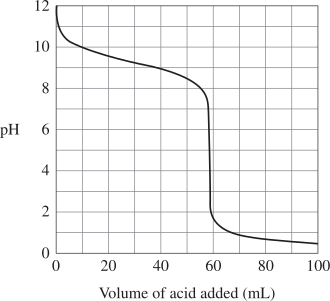
A weak base is titrated with 1.0 mol L\(^{-1}\) aqueous \(\ce{HCI}\). The \(\ce{pH}\) curve is shown.


At which pH value would the solution be most effective as a buffer?

  1. 5
  2. 7
  3. 8
  4. 9
Show Answers Only

\(D\)

Show Worked Solution
  • The solution would be most effective as a buffer at \(\ce{pH}\) 9 because this corresponds to the half-equivalent point.

\(\Rightarrow D\)


♦♦ Mean mark 37%.

Filed Under: Quantitative Analysis Tagged With: Band 5, smc-3675-20-Titration Curves and Conductivity Graphs, smc-3675-60-Buffers

CHEMISTRY, M6 2021 HSC 34

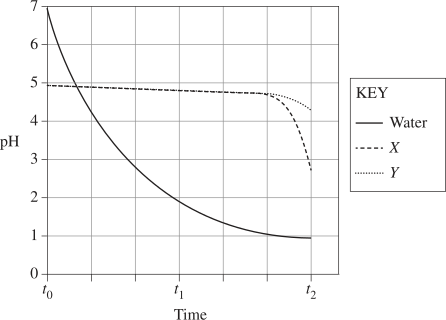
Gaseous `text{HCl}` was bubbled into water and two solutions, `X` and `Y`. Solutions `X` and `Y` contain the same type of ions. The pH of each was monitored over time and recorded in the graph shown.
 

Explain the observed pH of the water and each of the solutions at `t_0, t_1` and `t_2`. Include a relevant balanced chemical equation in your answer.   (5 marks)

--- 16 WORK AREA LINES (style=lined) ---

Show Answers Only

When `text{HCl}` is added to water, hydronium ions are produced:

`text{HCl} (aq) + text{H}_2 text{O} (l) → text{Cl}^- (aq) + text{H}_3 text{O}^+ (aq).`

At  `t_0`:

  • pH (water) = 7, pH (`X`) = pH (`Y`) = 4.9

At  `t_1:`

  • the pH of water significantly decreases, this is due to `text{HCl}` reacting with `text{H}_2text{O}` to produce `text{H}_3 text{O}^+` ions.
  • However, the pH of `X` and `Y` only slightly decreases. This indicates that `X` and `Y` are buffer solutions, ie contain a mixture of a weak acid or base and resist changes in pH when acids or bases are added.
  • Therefore, when `text{HCl}` is added, `text{H}_3 text{O}^+` increases, and thus disturbs the equilibrium.
  • According to Le Chatelier’s Principle, the system will shift to decrease the `text{H}_3 text{O}^+` concentration, and therefore the pH change is minimised.
  •    `text{HA} (aq) +  text{H}_2 text{O} (l)  ⇋  text{A}^- (aq) + text{H}_3 text{O}^+ (aq)`

At  `t_2:`

  • the decrease in pH of water becomes more gradual because pH is calculated on a `text{log}_10` scale, and thus requires a greater amount of change in `text{[H}_3 text{O}^+]` to result in a significant change in pH.
  • The pH of `X` and `Y` begin to significantly decrease as they have reached their buffer capacity.
  • The pH is lower for `X` because it was initially a less concentrated buffer and thus had a lower buffer capacity.
Show Worked Solution

When `text{HCl}` is added to water, hydronium ions are produced:

`text{HCl} (aq) + text{H}_2 text{O} (l) → text{Cl}^- (aq) + text{H}_3 text{O}^+ (aq).`

At  `t_0`:

  • pH (water) = 7, pH (`X`) = pH (`Y`) = 4.9

At  `t_1:`

  • the pH of water significantly decreases, this is due to `text{HCl}` reacting with `text{H}_2text{O}` to produce `text{H}_3 text{O}^+` ions.
  • However, the pH of `X` and `Y` only slightly decreases. This indicates that `X` and `Y` are buffer solutions, ie contain a mixture of a weak acid or base and resist changes in pH when acids or bases are added.
  • Therefore, when `text{HCl}` is added, `text{H}_3 text{O}^+` increases, and thus disturbs the equilibrium.
  • According to Le Chatelier’s Principle, the system will shift to decrease the `text{H}_3 text{O}^+` concentration, and therefore the pH change is minimised.
  •    `text{HA} (aq) +  text{H}_2 text{O} (l)  ⇋  text{A}^- (aq) + text{H}_3 text{O}^+ (aq)`

At  `t_2:`

  • the decrease in pH of water becomes more gradual because pH is calculated on a `text{log}_10` scale, and thus requires a greater amount of change in `text{[H}_3 text{O}^+]` to result in a significant change in pH.
  • The pH of `X` and `Y` begin to significantly decrease as they have reached their buffer capacity.
  • The pH is lower for `X` because it was initially a less concentrated buffer and thus had a lower buffer capacity.

♦ Mean mark 48%.

Filed Under: Quantitative Analysis Tagged With: Band 5, smc-3675-60-Buffers

Copyright © 2014–2025 SmarterEd.com.au · Log in