SmarterEd

Aussie Maths & Science Teachers: Save your time with SmarterEd

  • Login
  • Get Help
  • About

CHEMISTRY, M7 2025 HSC 21

Consider the following organic reaction.

In the space provided, identify reaction condition \(X\) and name the organic product.   (2 marks)

\begin{array}{|l|l|}
\hline
\rule{0pt}{2.5ex} \quad \quad \textit{Reaction condition X} \quad \quad  \rule[-1ex]{0pt}{0pt}& \quad \textit{IUPAC name of organic product } \quad\\
\hline
\rule{0pt}{2.5ex} \rule[-1ex]{0pt}{0pt}& \\
\rule{0pt}{2.5ex} \rule[-1ex]{0pt}{0pt}& \\
\hline
\end{array}

--- 0 WORK AREA LINES (style=lined) ---

Show Answers Only
  • Reaction condition \(X\): UV light
  • IUPAC name: 2-bromobutane
Show Worked Solution
  • Reaction condition \(X\): UV light
  • IUPAC name: 2-bromobutane

Filed Under: Hydrocarbons and Associated Reactions, Nomenclature Tagged With: Band 4, smc-3676-08-Halogenated Organic Compounds, smc-3677-80-Reactions of Saturated Hydrocarbons

CHEMISTRY, M7 EQ-Bank 26

This flow chart shows reactions involving six different organic compounds (A to F).


Draw the structures of compounds A to F, justifying your diagrams with reference to the information provided.   (7 marks)

--- 16 WORK AREA LINES (style=lined) ---

Show Answers Only

A:  
       

B:  
       

C:  
           

D:  
       

E:  
       

F:  
       

Show Worked Solution
  • A combines with dilute  \(\ce{H2SO4}\)  to produce two alcohols.
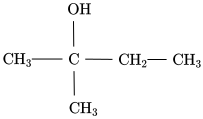
  • C doesn’t react with strong oxidant (i.e. it is a tertiary alcohol).

C:  
           

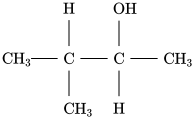
  • B must therefore be 2-methylbutan-1-ol or 3-methylbutan-2-ol.
  • Since B gives two products when heated with concentrated \(\ce{H2SO4}\), it must be 3-methylbutan-2-ol, as 2-methylbutan-1-ol will only produce one product.

B:  
       

  • D is a ketone, produced by B reacting with a strong oxidant.

D:  
       

  • A can be dehydrated using concentrated  \(\ce{H2SO4}\)  on either B or C.

A:  
       

  • B dehydrates to A or E. Given A‘s structure above,

E:  
       

  • C dehydrates to A or F. Again, given A’s structure above,

F:  
       

Filed Under: Hydrocarbons and Associated Reactions Tagged With: Band 4, Band 5, smc-3677-40-Molecular Shape, smc-3677-80-Reactions of Saturated Hydrocarbons

CHEMISTRY, M8 2016 HSC 25

An unattended car is stationary with its engine running in a closed workshop. The workshop is 5.0 m × 5.0 m × 4.0 m and its volume is `1.0 × 10^(5)` L. The engine of the car is producing carbon monoxide in an incomplete combustion according to the following chemical equation:

\[\ce{C8H18(l) + \frac{17}{2}O2(g) -> 8CO(g) + 9H2O(l)} \]

Exposure to carbon monoxide at levels greater than 0.100 g L¯1 of air can be dangerous to human health.

6.0 kg of octane was combusted by the car in this workshop.

Using the equation provided, determine if the level of carbon monoxide produced in the workshop would be dangerous to human health. Support your answer with relevant calculations.   (4 marks)

--- 8 WORK AREA LINES (style=lined) ---

Show Answers Only

\[\ce{n(C8H18) = \frac{m}{MM} = \frac{6000}{8 \times 12.01 + 18 \times 1.008} = \frac{6000}{114.224} = 52.53 mol}\]

\(\ce{n(CO) = 8 \times n(C8H18) = 420.24 mol}\)

\(\ce{m(CO) = n \times MM = 420.24 \times (12.01 + 16.00) = 11 771 g}\)

\[\ce{[CO] = \frac{11\ 771}{1 \times 10^{5}} = 0.118 g L^{-1}}\]

  • The carbon monoxide level is dangerous to human health as 0.118 g L¯1 exceeds the safe limit of 0.100 g L¯1 .
Show Worked Solution

\[\ce{n(C8H18) = \frac{m}{MM} = \frac{6000}{8 \times 12.01 + 18 \times 1.008} = \frac{6000}{114.224} = 52.53 mol}\]

\(\ce{n(CO) = 8 \times n(C8H18) = 420.24 mol}\)

\(\ce{m(CO) = n \times MM = 420.24 \times (12.01 + 16.00) = 11 771 g}\)

\[\ce{[CO] = \frac{11\ 771}{1 \times 10^{5}} = 0.118 g L^{-1}}\]

  • The carbon monoxide level is dangerous to human health as 0.118 g L¯1 exceeds the safe limit of 0.100 g L¯1 .

Filed Under: Hydrocarbons and Associated Reactions Tagged With: Band 4, smc-3677-80-Reactions of Saturated Hydrocarbons

CHEMISTRY, M7 2016 HSC 15 MC

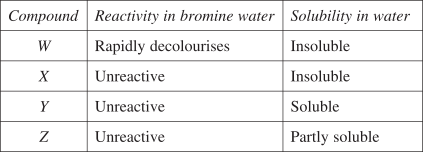
The table lists some properties of the straight-chained carbon compounds `W, X, Y` and `Z`.
 

Which row of the following table best identifies the compounds `W, X, Y` and `Z`?
 

\begin{align*} 
\begin{array}{c|c}
\rule{0pt}{2.5ex}\text{          }\rule[-1ex]{0pt}{0pt} \\
\rule{0pt}{2.5ex}\text{A.}\ \ \ \ \ \rule[-1ex]{0pt}{0pt} \\
\rule{0pt}{2.5ex}\text{B.}\ \ \ \ \ \rule[-1ex]{0pt}{0pt} \\
\rule{0pt}{2.5ex}\text{C.}\ \ \ \ \ \rule[-1ex]{0pt}{0pt} \\
\rule{0pt}{2.5ex}\text{D.}\ \ \ \ \ \rule[-1ex]{0pt}{0pt} \\
\end{array}
\begin{array}{|c|c|}
\hline
\rule{0pt}{2.5ex}\textit{W}\rule[-1ex]{0pt}{0pt} & \rule{0pt}{2.5ex}\textit{X}\rule[-1ex]{0pt}{0pt} & \rule{0pt}{2.5ex}\textit{Y}\rule[-1ex]{0pt}{0pt}& \rule{0pt}{2.5ex}\textit{Z}\rule[-1ex]{0pt}{0pt}\\
\hline
\rule{0pt}{2.5ex}\ \ \ \ce{C3H6}\ \ \ \rule[-1ex]{0pt}{0pt} & \rule{0pt}{2.5ex}\ \ \ \ce{C3H8}\ \ \ \rule[-1ex]{0pt}{0pt} & \rule{0pt}{2.5ex}\ce{CH3OH}\rule[-1ex]{0pt}{0pt}& \rule{0pt}{2.5ex}\ce{C4H9OH}\rule[-1ex]{0pt}{0pt}\\
\hline
\rule{0pt}{2.5ex}\ce{C3H8}\rule[-1ex]{0pt}{0pt} & \rule{0pt}{2.5ex}\ce{C3H6}\rule[-1ex]{0pt}{0pt} & \rule{0pt}{2.5ex}\ce{CH3OH}\rule[-1ex]{0pt}{0pt}& \rule{0pt}{2.5ex}\ce{C4H9OH}\rule[-1ex]{0pt}{0pt}\\
\hline
\rule{0pt}{2.5ex}\ce{C3H6}\rule[-1ex]{0pt}{0pt} & \rule{0pt}{2.5ex}\ce{C3H8}\rule[-1ex]{0pt}{0pt} & \rule{0pt}{2.5ex}\ce{C4H9OH}\rule[-1ex]{0pt}{0pt}& \rule{0pt}{2.5ex}\ce{CH3OH}\rule[-1ex]{0pt}{0pt}\\
\hline
\rule{0pt}{2.5ex}\ce{C3H8}\rule[-1ex]{0pt}{0pt} & \rule{0pt}{2.5ex}\ce{C3H6}\rule[-1ex]{0pt}{0pt} & \rule{0pt}{2.5ex}\ce{C4H9OH}\rule[-1ex]{0pt}{0pt}& \rule{0pt}{2.5ex}\ce{CH3OH}\rule[-1ex]{0pt}{0pt}\\
\hline
\end{array}
\end{align*}

Show Answers Only

`A`

Show Worked Solution
  • Compound W is unsaturated (C–C multiple bonds exist).
  • Compound X is saturated (all C–C bonds are single bonds).
  • Shorter alcohols, such as \(\ce{CH3OH}\) are more soluble.

`=>A`

Filed Under: Alcohols, Hydrocarbons and Associated Reactions Tagged With: Band 4, smc-3677-70-Reactions of Unsaturated Hydrocarbons, smc-3677-80-Reactions of Saturated Hydrocarbons, smc-3679-50-Solubility and Boiling Point

CHEMISTRY, M7 2017 HSC 7 MC

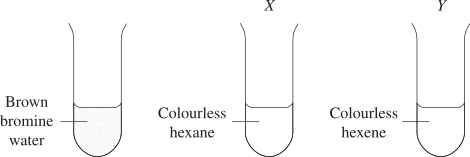
Three test tubes were set up as shown.


Bromine water was added to `X` and `Y` in the absence of UV light.

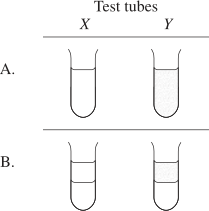
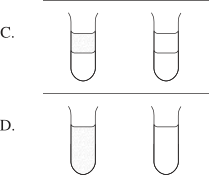
Which of the following best represents the changes in test tubes `X` and `Y` ?
 

Show Answers Only

`C`

Show Worked Solution

By Elimination:

  • Liquids are immiscible (eliminate A and D).
  • Bromine water does not decolourise with with alkanes, but does with alkenes (eliminate B).

`=>C`


♦♦ Mean mark 33%.

Filed Under: Hydrocarbons and Associated Reactions Tagged With: Band 5, smc-3677-70-Reactions of Unsaturated Hydrocarbons, smc-3677-80-Reactions of Saturated Hydrocarbons

CHEMISTRY, M8 2021 HSC 21

Four organic liquids are used in an experiment. The four liquids are

    • hexane
    • hex-1-ene
    • propan-1-ol
    • propanoic acid
  1. State ONE safety concern associated with organic liquids and suggest ONE way to address this safety concern.   (2 marks)

    --- 4 WORK AREA LINES (style=lined) ---
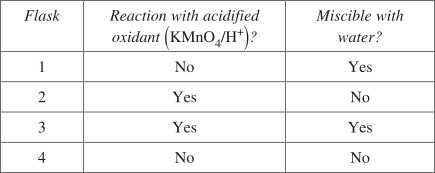
  2. The organic liquids are held separately in four flasks but the flasks are not labelled. Tests were conducted to identify these liquids. The outcomes of the tests are summarised below.   (2 marks)


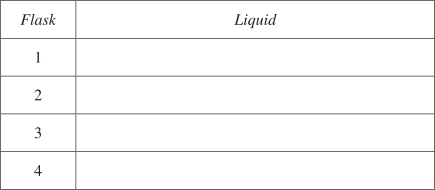
    Identify the FOUR liquids.
     
           
  3. What chemical test, other than those used in part (b), could be used to confirm the identification of ONE of the liquids? Include the expected observation in your answer.   (2 marks)

    --- 4 WORK AREA LINES (style=lined) ---
Show Answers Only

a.    A safety concern is that the organic liquids are flammable.

To address this, keep substance away from open flames and keep away from ignition sources.
 

b.    Flask 1: propanoic acid  (carboxylic acids can’t be oxidised and are polar)

Flask 2: hex-1-ene (alkenes can be oxidised and are non-polar)

Flask 3: propan-1-ol (primary alcohols can be oxidised and are polar)

Flask 4: hexane (alkanes don’t react with acidified oxidants and are non-polar)
 

c.   Hex-1-ene

  • Could be identified using the bromine water test.
  • The addition of brown bromine water to an alkene causes an addition reaction where the solution changes colours from brown to colourless.

Propanoic acid

  • Could be identified through a neutralisation reaction using `text{Na}_2text{CO}_3`.
  • Effervescent reaction will result.

Propan-1-ol

  • Could be identified through an oxidation reaction using acidified dichromate.
  • The reaction would cause the solution to change from green to orange.
Show Worked Solution

a.    A safety concern is that the organic liquids are flammable.

To address this, keep substance away from open flames and keep away from ignition sources.
 

b.    Flask 1: propanoic acid  (carboxylic acids can’t be oxidised and are polar)

Flask 2: hex-1-ene (alkenes can be oxidised and are non-polar)

Flask 3: propan-1-ol (primary alcohols can be oxidised and are polar)

Flask 4: hexane (alkanes don’t react with acidified oxidants and are non-polar)
 

c.   Hex-1-ene

  • Could be identified using the bromine water test.
  • The addition of brown bromine water to an alkene causes an addition reaction where the solution changes colours from brown to colourless.

Propanoic acid

  • Could be identified through a neutralisation reaction using `text{Na}_2text{CO}_3`.
  • Effervescent reaction will result.

Propan-1-ol

  • Could be identified through an oxidation reaction using acidified dichromate.
  • The reaction would cause the solution to change from green to orange.

Filed Under: Hydrocarbons and Associated Reactions, Organic Substances Tagged With: Band 3, Band 4, smc-3677-30-Solubility and Boiling Point, smc-3677-70-Reactions of Unsaturated Hydrocarbons, smc-3677-80-Reactions of Saturated Hydrocarbons, smc-3683-55-C=C Bonds

Copyright © 2014–2025 SmarterEd.com.au · Log in