SmarterEd

Aussie Maths & Science Teachers: Save your time with SmarterEd

  • Login
  • Get Help
  • About

CHEMISTRY, M8 2025 HSC 8 MC

An alkene \(\text{X}\) with only one \(\text{C} \ = \ \text{C}\) bond undergoes an addition reaction with an unknown substance to produce \(\text{Y}\) .

\(\text{X}\ +\ \text{unknown substance} \rightarrow \text{Y}\)

The following table shows the molecular ion peaks for \(\text{X}\) and \(\text{Y}\).

\begin{array}{|c|c|}
\hline
\rule{0pt}{2.5ex}\text{X} \rule[-1ex]{0pt}{0pt}& \text{Y} \\
\hline
\rule{0pt}{2.5ex} \quad \quad 70 \ \text{m/z} \quad \quad\rule[-1ex]{0pt}{0pt}& \quad \quad 90 \ \text{m/z} \quad \quad \\
\hline
\end{array}

Which of the following can be the unknown substance?

  1. Water
  2. Fluorine
  3. Hydrogen
  4. Hydrogen fluoride
Show Answers Only

\(\Rightarrow D\)

Show Worked Solution
  • The molecule ion peaks for \(\text{X}\) and \(\text{Y}\) correspond to their molecular masses.
  • By the law of conservation of mass, the mass of the unknown substance must be the difference in mass between the substances \(\text{X}\) and \(\text{Y}\).
  • Hence the molecular mass of the unknown substance \(=90-70 = 20\ \text{g mol}^{-1}\).
  • This corresponds to the molecular mass of  \(\ce{HF} = 1.008 + 19.00 = 20.008\ \text{g mol}^{-1}\).

\(\Rightarrow D\)

Filed Under: Hydrocarbons and Associated Reactions, Organic Substances Tagged With: Band 4, smc-3677-70-Reactions of Unsaturated Hydrocarbons, smc-3683-40-Mass Spectrometry

CHEMISTRY, M8 2024 HSC 9 MC

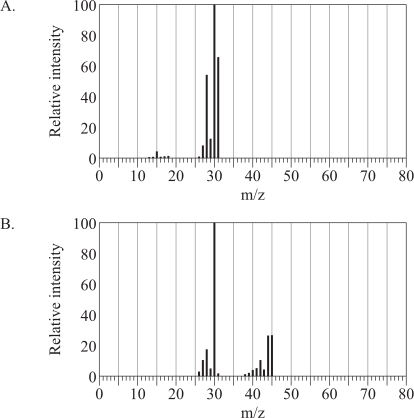
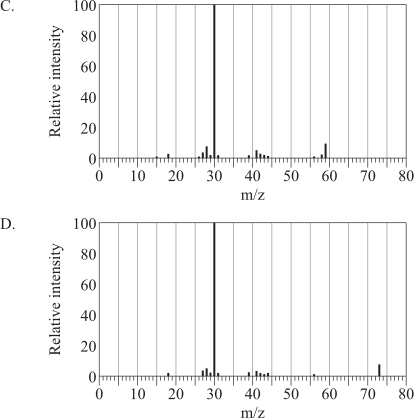
Which of the following is the mass spectrum of ethanamine?


Show Answers Only

\(B\)

Show Worked Solution
  • The molar mass of ethanamine, \(\ce{CH3CH2NH2}\), is 45.086 g mol\(^{-1}\)
  • The peak with the largest mass to charge ratio displays the molar mass of the substance.
  • Therefore, the parent ion peak will be at 45.

\(\Rightarrow B\)

Filed Under: Organic Substances Tagged With: Band 3, smc-3683-40-Mass Spectrometry

CHEMISTRY, M8 2021 VCE 7*

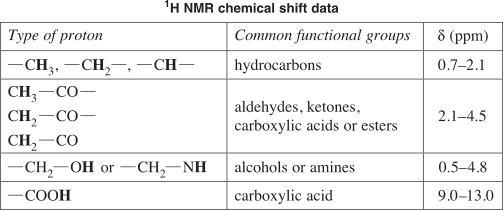
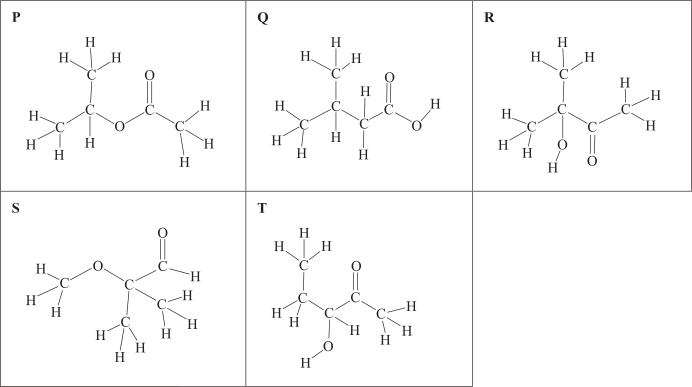
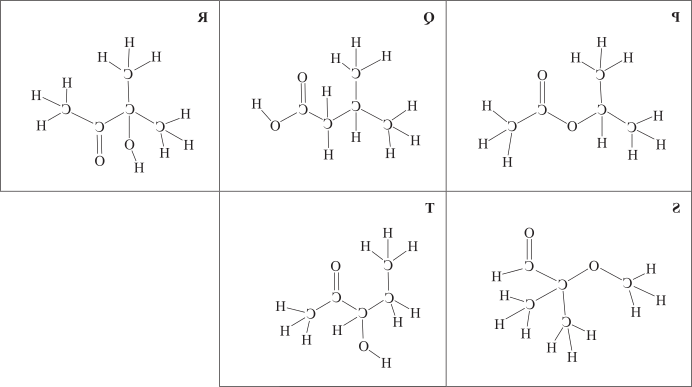
Two students are given a homework assignment that involves analysing a set of spectra and identifying an unknown compound. The unknown compound is one of the molecules shown below.
 

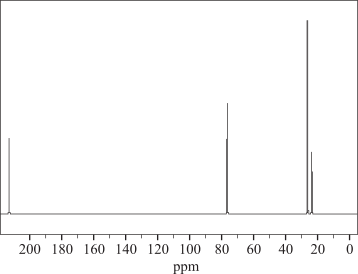
The \(^{13}\text{C NMR}\) spectrum of the unknown compound is shown below.
 

  1. Based on the number of peaks in the \(^{13}\text{C NMR}\) spectrum above, which compound – \(\text{P, Q, R, S}\) or \(\text{T}\) – could be eliminated as the unknown compound?   (1 mark)

    --- 1 WORK AREA LINES (style=lined) ---
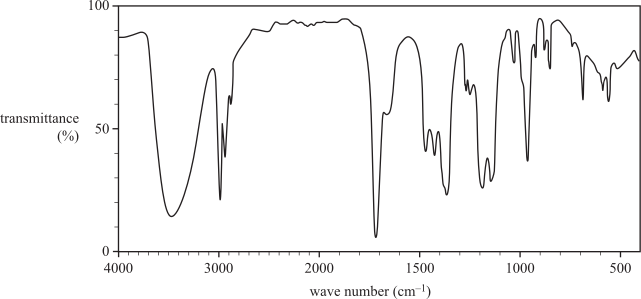
  2. The infra-red (IR) spectrum of the unknown compound is shown below.
     

  1. Identify which of the five compounds (1 or more) can be eliminated on the basis of the IR spectrum. Justify your answer using data from the IR spectrum.   (3 marks)

    --- 6 WORK AREA LINES (style=lined) ---
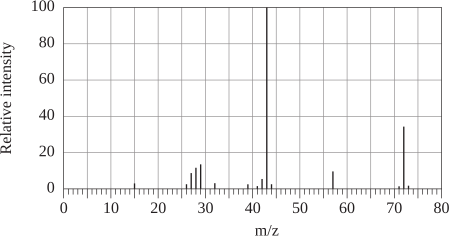
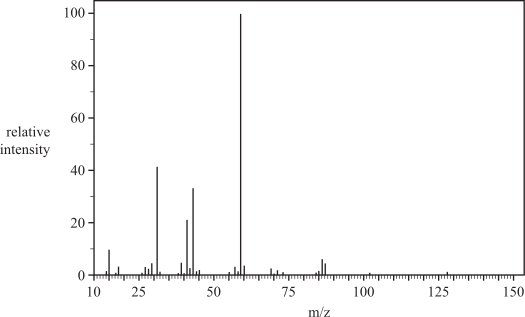
  2. The mass spectrum of the unknown compound is shown below.
     

  1. Write the chemical formula of the species that produces a peak at m/z = 43.   (1 mark)

    --- 1 WORK AREA LINES (style=lined) ---
  2. Explain why one molecule can produce multiple peaks on a mass spectrum.   (2 mark)

    --- 4 WORK AREA LINES (style=lined) ---
Show Answers Only

a.    The \(^{13}\text{C NMR}\) shows 4 different carbon environments.

  • Compound \(T\) has 5 unique carbon environments and can be eliminated. 

b.    Compounds \(\text{P, Q}\) and \(\text{S}\) can be eliminated.

  • Compounds \(\text{S}\) and \(\text{P}\) both don’t have an \(\ce{OH}\) alcohol group, however the IR spectrum clearly shows an \(\ce{OH}\) alcohol group with an absorbance at 3500 cm\(^{-1}\).
  • Compound \(\text{Q}\) contains an \(\ce{OH}\) acid group whereas the IR spectrum shows an \(\ce{OH}\) alcohol group at 3500 cm\(^{-1}\). There is no evidence of a broad \(\ce{OH}\) acid group between 2500–3000 cm\(^{-1}\). 

c.i.  The unknown compound is compound \(\text{R}\).

  • The chemical species are fragments of the original compound with a positive charge.
  • The chemical formulas could include \(\ce{[CH3CO]^+}\) or \(\ce{[C2H3O]^+}\) 

 ii.   Ions of that molecule must be formed to produce peaks on the mass spectrum.

  • Organic compounds can be split up into numerous different ions when producing fragment patterns leading to multiple different peaks on the mass spectrum.

Show Worked Solution

a.    The \(^{13}\text{C NMR}\) shows 4 different carbon environments.

  • Compound \(T\) has 5 unique carbon environments and can be eliminated.

b.    Compounds \(\text{P, Q}\) and \(\text{S}\) can be eliminated.

  • Compounds \(\text{S}\) and \(\text{P}\) both don’t have an \(\ce{OH}\) alcohol group, however the IR spectrum clearly shows an \(\ce{OH}\) alcohol group with an absorbance at 3500 cm\(^{-1}\).
  • Compound \(\text{Q}\) contains an \(\ce{OH}\) acid group whereas the IR spectrum shows an \(\ce{OH}\) alcohol group at 3500 cm\(^{-1}\). There is no evidence of a broad \(\ce{OH}\) acid group between 2500–3000 cm\(^{-1}\). 
♦ Mean mark (b) 43%.
COMMENT: Recognise the difference between OH alcohols and OH acid groups.

c.i.   The unknown compound is compound \(\text{R}\).

  • The chemical species are fragments of the original compound with a positive charge.
  • The chemical formulas could include \(\ce{[CH3CO]^+}\) or \(\ce{[C2H3O]^+}\)
♦ Mean mark (c.i.) 50%.
COMMENT: Ions require a positive charge.

 ii.    Ions of that molecule must be formed to produce peaks on the mass spectrum.

  • Organic compounds can be split up into numerous different ions when producing fragment patterns leading to multiple different peaks on the mass spectrum.
♦ Mean mark (c.ii.) 39%.

Filed Under: Organic Substances Tagged With: Band 5, smc-3683-40-Mass Spectrometry, smc-3683-50-Combining Techniques

CHEMISTRY, M8 2023 VCE 29 MC

Which one of the following statements about mass spectrometry is always correct?

  1. The relative molecular mass of a molecule is determined from the base peak.
  2. The peaks in a mass spectrum are caused by the presence of different isotopes.
  3. The base peak is formed when an uncharged species is removed from the molecule.
  4. The height of each peak in the mass spectrum is measured relative to the height of the base peak.
Show Answers Only

\(D\)

Show Worked Solution
  • The relative molecular mass of a molecule is determined from the peak with the largest m/z ratio (eliminate \(A\)).
  • The peaks in a mass spectrum is caused by the molecules splitting up into different ions as they are bombarded with electrons. Some peaks that differ by a value of 1 are caused by the presence of different isotopes but this is not for all peaks (eliminate \(B\)).
  • All peaks on the mass spectrometry graph are charged ions (eliminate \(C\)).
  • The base peak is the largest peak on a mass spectrometry graph and therefore the abundances of each peak are relative to the height of the base peak.

\(\Rightarrow D\)

♦ Mean mark 46%.

Filed Under: Organic Substances Tagged With: Band 5, smc-3683-40-Mass Spectrometry

CHEMISTRY, M8 2023 HSC 19 MC

The diagram shows a simplified mass spectrum for butan-2-one.
 

Which equation best represents the process that produces the particle responsible for the peak at m/z 43 ?

  1. \( \ce{CH3COCH2CH3^{+} \rightarrow  CH3CO + ^{+}CH2CH3} \)
  2. \( \ce{CH3COCH2CH3^{+} \rightarrow CH3CO^{+} + CH2CH3} \)
  3. \( \ce{CH3COCH2CH3^{+} \rightarrow CH3CH2CH2 + ^{+}CHO} \)
  4. \( \ce{CH3COCH2CH3^{+} \rightarrow CH3CH2CH2^{+} + CHO} \)
Show Answers Only

\(B\)

Show Worked Solution
  • The peaks in mass spectra represent fragments of organic molecules.
  • Mass Spectrometers can only detect charged particles meaning the peak at 43 m/z could only represent:
  •    \(\ce{CH3COCH2CH3^+, ^+CH2CH3, CH3CO^+, ^+CHO,}\)  or  \(\ce{CH3CH2CH2^+}\)
  • The m/z ratio is indicative of a fragment’s molecular weight which corresponds to \(\ce{CH3CO^+}\)

\(\Rightarrow B\)

♦ Mean mark 51%.

Filed Under: Organic Substances Tagged With: Band 5, smc-3683-40-Mass Spectrometry

CHEMISTRY, M8 2023 HSC 28

Alkene \(\ce{Q}\) undergoes an addition reaction with chlorine gas to form compound \(\ce{R}\).

  1. Describe a chemical test that could be done in a school laboratory to confirm that \(\ce{Q}\) is an alkene. Include expected observations in your answer.  (2 marks)

--- 4 WORK AREA LINES (style=lined) ---
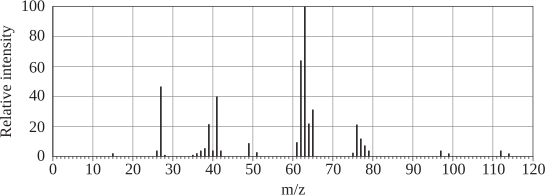
  1. Compound \(\ce{R}\) was analysed and found to contain approximately 32% carbon by mass. The mass spectrum of compound \(\ce{R}\) is shown. 

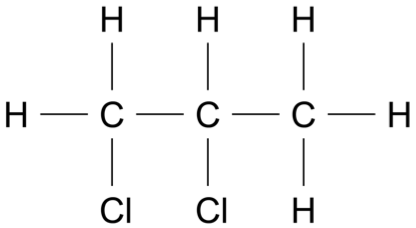
  1. Provide a structural formula for compound \(\ce{R}\). Support your answer with calculations.  (3 marks)

--- 9 WORK AREA LINES (style=lined) ---
Show Answers Only

a.    Chemical test for an alkene

  • Prepare a sample of alkene \(\ce{Q}\) in a clean test tube.
  • Add a few drops of bromine water to the sample.
  • The bromine water will be decolourised if \(\ce{Q}\) is an alkene.

Other correct answers could include:

  • The addition of potassium permanganate will also be decolourised by \(\ce{Q}\) if it is an alkene. 

b.   Molecular ion is present at m/z = 114

Atomic mass of \(\text{C}\) (in compound \(\ce{R}\)) = 32% × 114 = 36

\(\text{C}\) atoms in 1 molecule of R = 36 ÷ 12 = 3

Mass (non-\(\text{C}\)) = 114 – 36 = 78

\(\Rightarrow\) Two atoms of \(\ce{Cl}\) are in compound \(\ce{R}\)

\(\therefore\) \(\ce{R}\) has the formula \(\ce{C3H6Cl2}\), and structure:
 

Show Worked Solution

a.    Chemical test for an alkene

  • Prepare a sample of alkene \(\ce{Q}\) in a clean test tube.
  • Add a few drops of bromine water to the sample.
  • The bromine water will be decolourised if \(\ce{Q}\) is an alkene.

Other correct answers could include:

  • The addition of potassium permanganate will also be decolourised by \(\ce{Q}\) if it is an alkene.

b.   Molecular ion is present at m/z = 114

Atomic mass of \(\text{C}\) (in compound \(\ce{R}\)) = 32% × 114 = 36

\(\text{C}\) atoms in 1 molecule of R = 36 ÷ 12 = 3

Mass (non-\(\text{C}\)) = 114 – 36 = 78

\(\Rightarrow\) Two atoms of \(\ce{Cl}\) are in compound \(\ce{R}\)

\(\therefore\) \(\ce{R}\) has the formula \(\ce{C3H6Cl2}\), and structure:
 

♦ Mean mark (b) 53%.

Filed Under: Organic Substances Tagged With: Band 4, Band 5, smc-3683-40-Mass Spectrometry

CHEMISTRY, M8 EQ-Bank 22

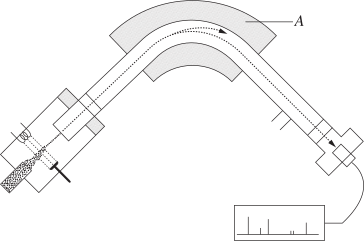
  1. The diagram is a schematic representation of a mass spectrometer.
     

  1. Name and outline the function of the part labelled `A` in the diagram.   (2 marks)

    --- 4 WORK AREA LINES (style=lined) ---
  2. Outline the advantages of using mass spectrometry for analysis of a compound.   (3 marks)

    --- 8 WORK AREA LINES (style=lined) ---
Show Answers Only

a.   \(\ce{A}\) is a magnet.

  • It bends the charged particles that are accelerated through an electric field and directed through it.
  • The amount of bending can then be used to distinguish between and identify the particles/ions.

b.   Advantages of mass spectrometry

  • The mass spectrometer can identify the mass/charge ratio of ions that pass through it. This data can then be used to identify components of a mixture or components in a compound.
  • Different isotopes of elements in a compound can be identified by mass spectrometers. This allows the compound to be matched to a sample.
  • Mass spectrometry can provide both qualitative and quantitative data on a compound.
  • Finally, mass spectrometers only require a small quantity of a compound to perform detailed analysis, as well as being fast and sensitive.
Show Worked Solution

a.   \(\ce{A}\) is a magnet.

  • It bends the charged particles that are accelerated through an electric field and directed through it.
  • The amount of bending can then be used to distinguish between and identify the particles/ions.

b.   Advantages of mass spectrometry

  • The mass spectrometer can identify the mass/charge ratio of ions that pass through it. This data can then be used to identify components of a mixture or components in a compound.
  • Different isotopes of elements in a compound can be identified by mass spectrometers. This allows the compound to be matched to a sample.
  • Mass spectrometry can provide both qualitative and quantitative data on a compound.
  • Finally, mass spectrometers only require a small quantity of a compound to perform detailed analysis, as well as being fast and sensitive.

Filed Under: Organic Substances Tagged With: Band 3, Band 4, smc-3683-40-Mass Spectrometry

CHEMISTRY, M8 EQ-Bank 21

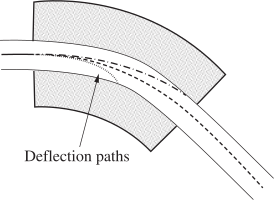
The diagram shows the deflection paths of different ions through a mass spectrometer.
 

Account for the different deflection paths.   (3 marks)

Show Answers Only
  • Mass spectrometers use an electric field to accelerate positively charged ions before passing them through a magnetic field.
  • Once in the magnetic field, the ions travel in a curved path, the direction of which depends on whether the ion is positively or negatively charged.
  • The amount of curvature is dependent on the speed at which the ion is travelling and its mass to charge ratio.
  • Lighter ions have less momentum and are deflected more strongly than heavier ions.
Show Worked Solution
  • Mass spectrometers use an electric field to accelerate positively charged ions before passing them through a magnetic field.
  • Once in the magnetic field, the ions travel in a curved path, the direction of which depends on whether the ion is positively or negatively charged.
  • The amount of curvature is dependent on the speed at which the ion is travelling and its mass to charge ratio.
  • Lighter ions have less momentum and are deflected more strongly than heavier ions.

Filed Under: Organic Substances Tagged With: Band 3, smc-3683-40-Mass Spectrometry

CHEMISTRY, M8 2019 HSC 4 MC

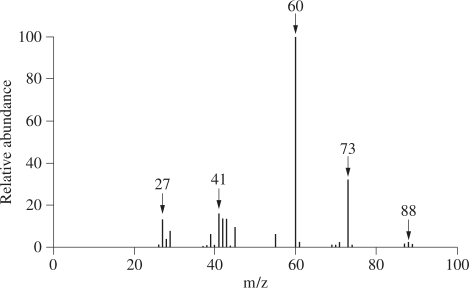
The diagram shows the mass spectrum of an organic compound.
 

Which compound was analysed?

  1. Butan-1-amine
  2. Butanoic acid
  3. Ethanoic acid
  4. Iron`text{(II)}` sulfide
Show Answers Only

`B`

Show Worked Solution
  • The parent ion in the mass spectrum has a mass to charge ratio (m/z) of 88 that matches the molar mass of butanoic acid.

`=>B`

Filed Under: Organic Substances Tagged With: Band 4, smc-3683-40-Mass Spectrometry

CHEMISTRY, M8 2020 HSC 21

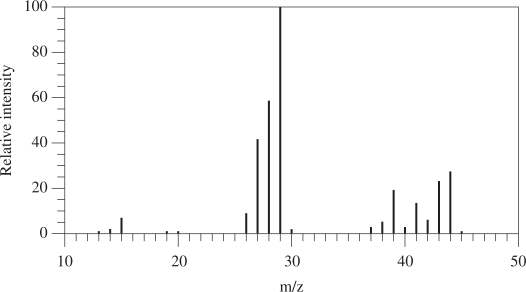
The mass spectrum of an alkane is shown.
 

Use the information provided to identify the alkane and justify your choice.   (2 marks)

Show Answers Only
  • The alkane is propane.
  • The mass spectrum has a molecular ion peak of 44, which indicates that the alkane is \( \ce{C3H8} \) (propane).
Show Worked Solution
  • The alkane is propane.
  • The mass spectrum has a molecular ion peak of 44, which indicates that the alkane is \( \ce{C3H8} \) (propane).

Filed Under: Organic Substances Tagged With: Band 4, smc-3683-40-Mass Spectrometry

CHEMISTRY, M8 2020 HSC 1 MC

What is the function of the magnetic field in a mass spectrometer?

  1. It detects the mass of the particles.
  2. It deflects the stream of charged particles.
  3. It excites electrons to higher energy levels.
  4. It produces a stream of electrons that bombards the sample.
Show Answers Only

`B`

Show Worked Solution
  • Magnetic fields cause charged particles to travel in a circular path.

`=> B`

Filed Under: Organic Substances Tagged With: Band 4, smc-3683-40-Mass Spectrometry

Copyright © 2014–2025 SmarterEd.com.au · Log in