SmarterEd

Aussie Maths & Science Teachers: Save your time with SmarterEd

  • Login
  • Get Help
  • About

CHEMISTRY, M8 2025 HSC 30

Phosgene is used in industry as a starting material to synthesise useful polymers. Phosgene \(\ce{(Cl2CO)}\) is a gas at room temperature and is highly toxic.

  1. Justify a suitable precaution when using phosgene.   (2 marks)

    --- 5 WORK AREA LINES (style=lined) ---

  2. Phosgene is synthesised by the reaction of carbon monoxide \(\ce{(CO)}\) and chlorine \(\ce{(Cl2)}\) in the gas phase.
      1. \(\ce{Cl2(g) + CO(g) \rightleftharpoons Cl2CO(g)}\)
  3. Explain why an excess of carbon monoxide and a catalyst are used in the industrial synthesis of phosgene.   (3 marks)

    --- 8 WORK AREA LINES (style=lined) ---
Show Answers Only

a.    Precaution when using phosgene inside a fume hood:

  • As phosgene is a highly toxic gas at room temperature. working in a fume hood prevents inhalation by safely removing the gas from the breathing zone and venting it outside the laboratory.
  • This measure significantly reduces the risk of poisoning and exposure.

b.   Role of excess carbon monoxide:

  • An excess of carbon monoxide is used to increase the rate of production of phosgene.
  • According to Le Chatelier’s principle, increasing the concentration of \(\ce{CO}\) shifts the equilibrium to the right, favouring the formation of \(\ce{Cl2CO}\) and increasing the overall yield of phosgene.

Role of catalyst:

  • A catalyst is used to increase the rate of reaction by providing an alternative reaction pathway with a lower activation energy.
  • This allows phosgene to be produced more rapidly and efficiently without affecting the equilibrium position.
  • In industrial settings, this increases production speed and reduces energy costs.
Show Worked Solution

a.    Precaution when using phosgene inside a fume hood:

  • As phosgene is a highly toxic gas at room temperature. working in a fume hood prevents inhalation by safely removing the gas from the breathing zone and venting it outside the laboratory.
  • This measure significantly reduces the risk of poisoning and exposure.

b.   Role of excess carbon monoxide:

  • An excess of carbon monoxide is used to increase the rate of production of phosgene.
  • According to Le Chatelier’s principle, increasing the concentration of \(\ce{CO}\) shifts the equilibrium to the right, favouring the formation of \(\ce{Cl2CO}\) and increasing the overall yield of phosgene.

Role of catalyst:

  • A catalyst is used to increase the rate of reaction by providing an alternative reaction pathway with a lower activation energy.
  • This allows phosgene to be produced more rapidly and efficiently without affecting the equilibrium position.
  • In industrial settings, this increases production speed and reduces energy costs.

Filed Under: Chemical Synthesis and Design Tagged With: Band 4, smc-3684-20-Reaction conditions, smc-3684-30-Yield and purity, smc-3684-50-Enviro/social/economic issues

CHEMISTRY, M8 2024 HSC 31

The atom economy ( AE ) of a reaction is a measure of the mass of atoms in the starting materials that are incorporated into the desired product. Higher AE means lower mass of waste products.

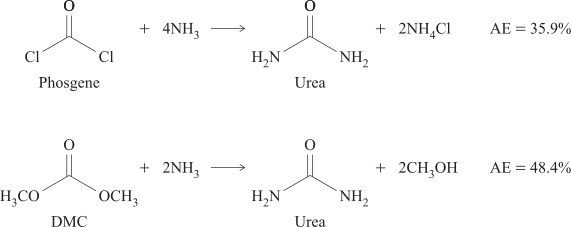
Urea can be produced in a variety of ways. One way is to react ammonia (high toxicity) with phosgene (high toxicity). Another way is to react ammonia with dimethyl carbonate (DMC, low toxicity). The chemical equations and AE for these two processes are provided.
 

Which of these two processes is preferable for urea production? Justify your answer with reference to the information provided.   (3 marks)

--- 8 WORK AREA LINES (style=lined) ---

Show Answers Only

  • The atom economy for the reaction utilizing dimethyl carbonate (DMC) is 48.4%, which is significantly higher compared to the 35.9% achieved in the reaction using phosgene.
  • Consequently, the process involving DMC generates a lower mass of waste products and relies on a less hazardous starting material.
  • Additionally, the DMC-based synthesis requires only 2 moles of ammonia, compared to the 4 moles needed for the phosgene process.
  • These factors highlight the synthesis of urea via DMC as the preferable method for urea production as it offers advantages in terms of atom economy, reduced toxicity of reactants, and minimized use of harmful chemicals.

Show Worked Solution

  • The atom economy for the reaction utilizing dimethyl carbonate (DMC) is 48.4%, which is significantly higher compared to the 35.9% achieved in the reaction using phosgene.
  • Consequently, the process involving DMC generates a lower mass of waste products and relies on a less hazardous starting material.
  • Additionally, the DMC-based synthesis requires only 2 moles of ammonia, compared to the 4 moles needed for the phosgene process.
  • These factors highlight the synthesis of urea via DMC as the preferable method for urea production as it offers advantages in terms of atom economy, reduced toxicity of reactants, and minimized use of harmful chemicals.

Filed Under: Chemical Synthesis and Design Tagged With: Band 4, smc-3684-20-Reaction conditions, smc-3684-40-Industrial uses, smc-3684-50-Enviro/social/economic issues

CHEMISTRY, M8 2022 HSC 33

Analyse how a student could design a chemical synthesis process to be undertaken in the school laboratory. In your response, use a specific process relating to the synthesis of an organic compound, including a chemical equation, and refer to:

  • selection of reagent(s)
  • reaction conditions
  • any potential hazards and any safety precautions to minimise the risk
  • yield and purity of the product(s).   (8 marks)

--- 25 WORK AREA LINES (style=lined) ---

Show Answers Only

Selecting reagents

  • The student could synthesise ethyl ethanoate through esterification between acetic acid and ethanol.
  • Both readily available in the school laboratory and are relatively safe.

Acetic acid + ethanol  ⇌  Ethyl ethanoate + water

  • Concentrated sulfuric acid should be used as the acid catalyst as it is a strong acid that is also readily available. 

Reaction conditions

  • Increasing the temperature of the system increases the reaction rate because it increases the average kinetic energy of the reactant molecules, and thus increases the likelihood of successful collisions, producing more product.
  • Additionally, the addition of reactants would increase the likelihood of successful collisions, thus increasing the reaction rate.
  • The reaction should also be undertaken under reflux allowing vaporised molecules to condense and return back to the reaction vessel, increasing the amount of reactants, and thus increasing the rate of reaction. 
  • Concentrated sulfuric acid should also be utilised as a catalyst in order to speed up the reaction and lower the activation energy. 

Potential hazards and safety precautions

  • The acetic acid and sulfuric acid used is corrosive and may cause skin and eye burns, therefore, appropriate lab coat and safety glasses should be utilised.
  • The organic reactants are highly flammable and may cause fires. The reaction mixture should be heated on a hot plate or heating mantle instead of a bunsen burner.
  • Refluxing may cause pressure build-up, therefore, ensure the reflux condenser is open.
  • Superheating and bumping may occur in apparatus. Boiling chips should be utilised to provide nucleation sites allowing liquids to boil smoothly. 

Yield and purity

  • Concentrated sulfuric acid, used as a catalyst, also acts as a dehydrating agent that removes water from the system and improves yield.
  • When the reaction reaches equilibrium, the ester can be separated from the mixture by adding excess sodium carbonate solution in order to neutralise the acid.
  • Transfer to a separation funnel to separate the organic layer (containing the ester) from the aqueous layer.
  • Then use fractional distillation to separate the ester from the organic layer.
Show Worked Solution

Selecting reagents

  • The student could synthesise ethyl ethanoate through esterification between acetic acid and ethanol.
  • Both readily available in the school laboratory and are relatively safe.

Acetic acid + ethanol  ⇌  Ethyl ethanoate + water

  • Concentrated sulfuric acid should be used as the acid catalyst as it is a strong acid that is also readily available. 

Reaction conditions

  • Increasing the temperature of the system increases the reaction rate because it increases the average kinetic energy of the reactant molecules, and thus increases the likelihood of successful collisions, producing more product.
  • Additionally, the addition of reactants would increase the likelihood of successful collisions, thus increasing the reaction rate.
  • The reaction should also be undertaken under reflux allowing vaporised molecules to condense and return back to the reaction vessel, increasing the amount of reactants, and thus increasing the rate of reaction. 
  • Concentrated sulfuric acid should also be utilised as a catalyst in order to speed up the reaction and lower the activation energy. 

Potential hazards and safety precautions

  • The acetic acid and sulfuric acid used is corrosive and may cause skin and eye burns, therefore, appropriate lab coat and safety glasses should be utilised.
  • The organic reactants are highly flammable and may cause fires. The reaction mixture should be heated on a hot plate or heating mantle instead of a bunsen burner.
  • Refluxing may cause pressure build-up, therefore, ensure the reflux condenser is open.
  • Superheating and bumping may occur in apparatus. Boiling chips should be utilised to provide nucleation sites allowing liquids to boil smoothly. 

Yield and purity

  • Concentrated sulfuric acid, used as a catalyst, also acts as a dehydrating agent that removes water from the system and improves yield.
  • When the reaction reaches equilibrium, the ester can be separated from the mixture by adding excess sodium carbonate solution in order to neutralise the acid.
  • Transfer to a separation funnel to separate the organic layer (containing the ester) from the aqueous layer.
  • Then use fractional distillation to separate the ester from the organic layer.

♦♦ Mean mark 52%.

Filed Under: Chemical Synthesis and Design Tagged With: Band 4, Band 5, Band 6, smc-3679-20-Reactions of Alcohols, smc-3680-10-Esters, smc-3684-20-Reaction conditions, smc-3684-30-Yield and purity

Copyright © 2014–2025 SmarterEd.com.au · Log in