SmarterEd

Aussie Maths & Science Teachers: Save your time with SmarterEd

  • Login
  • Get Help
  • About

PHYSICS, M5 2024 HSC 9 MC

Object \(P\) is dropped from rest, and object \(Q\) is launched horizontally from the same height.
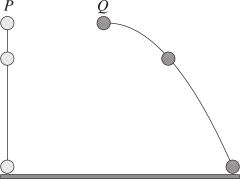
 

Which option correctly compares the projectile motion of \(P\) and \(Q\) ?

  1. The acceleration of \(P\) is less than the acceleration of \(Q\).
  2. The final velocity of \(Q\) is greater than the final velocity of \(P\).
  3. The time of flight of \(Q\) is greater than the time of flight of \(P\).
  4. The initial vertical velocity of \(P\) is less than the initial vertical velocity of \(Q\).
Show Answers Only

\(B\)

Show Worked Solution
  • Both objects start with the same initial vertical velocity and experience the same acceleration due to gravity. Therefore both objects will hit the ground at the same time with the same final vertical velocity.
  • Object \(Q\) however, has both vertical and horizontal velocity while object \(P\) only has vertical velocity. Therefore object \(Q\) will have a greater total final velocity when compared with \(P\).

\(\Rightarrow B\)

Filed Under: Projectile Motion Tagged With: Band 4, smc-3690-10-Projectile Motion Models, smc-3690-35-Initial Velocity, smc-3690-90-Velocity and Acceleration

PHYSICS, M5 2023 HSC 32

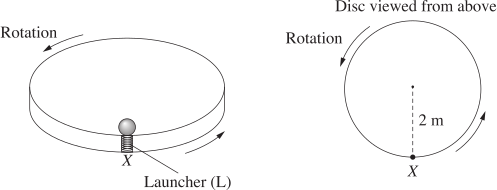
A horizontal disc rotates at 3 revolutions per second around its centre, with the top of the disc at ground level.

At 2 m from the centre of the disc, a ball is held in place at ground level on the top of the disc by a spring-loaded projectile launcher. At position \(X\), the launcher fires the ball vertically upward with a velocity of 5.72 m s\(^{-1}\).


Calculate the ball's position relative to the launcher's new position, at the instant the ball hits the ground.   (7 marks)

--- 14 WORK AREA LINES (style=lined) ---

Show Answers Only

The position of the ball relative to the launcher’s new position is 44.19 m, 5.2\(^{\circ}\) below the horizontal line of the launcher.

Show Worked Solution

Find horizontal velocity of the ball, \(v_{\text{x}}\):

\(T=\dfrac{1}{3} = 0.333\ \text{seconds} \)

\(v_{\text{x}}=\dfrac{2\pi r}{T}=\dfrac{2\pi \times 2}{0.333…}=37.699\ \text{ms}^{-1}\)

♦ Mean mark 53%.

Calculating the time of flight, \(t_1\):

Let  \(t_2\) = time to max height

\(v_{\text{y}}\) \(=u_{\text{y}} + at_2\)  
\(t_2\) \(=\dfrac{v_{\text{y}}-u_{\text{y}}}{a}=\dfrac{0-5.72}{-9.8}=0.58367\ \text{sec} \)  


Time of flight (\(t_1)= 2 \times t_2= 1.167\ \text{s}\)
 

Range of the ball from launch position:

\(s_{\text{x}}=v_{\text{x}} \times t_2=37.699 \times 1.167=44.0\ \text{m}\)
 

Position of the launcher (L) when the ball hits the ground:

  • Revolutions (before ball lands) = 3 × 1.167 = 3.5 revolutions
  • The Launcher (L) is \(\frac{1}{2}\) a revolution past its starting point.
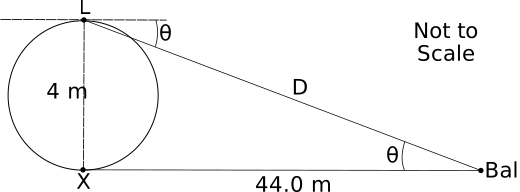
  • Thus, the positions of both the ball and the launcher at the time when the ball hits the ground can be demonstrated in the diagram below.


\(D\) \(=\sqrt{44.0^2+4^2}=44.18\ \text{m}\)  
\(\theta\) \(=\tan ^{-1}\left(\dfrac{4}{44.0}\right)=5.2^{\circ}\)  


  • The final position of the ball relative to \(L\) is 44.18 m, 5.2\(^{\circ}\) below the horizontal line at \(L\).

Filed Under: Circular Motion, Projectile Motion Tagged With: Band 5, Band 6, smc-3690-25-Range, smc-3690-35-Initial Velocity, smc-3690-45-Time of Flight, smc-3691-20-Applications of Circular Motion

PHYSICS, M5 2020 HSC 24

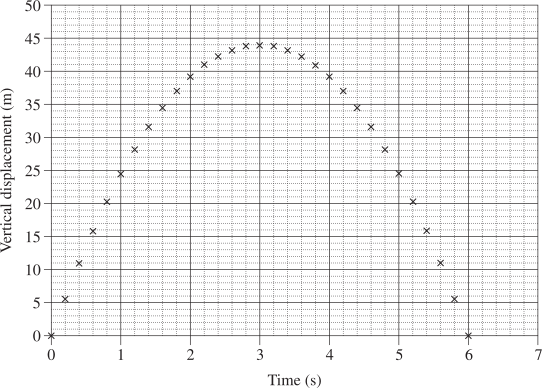
The graph shows the vertical displacement of a projectile throughout its trajectory. The range of the projectile is 130 m.
 

Calculate the initial velocity of the projectile.   (4 marks)

--- 12 WORK AREA LINES (style=lined) ---

Show Answers Only

`37\ text{m s}^(-1)`, at 54° above the horizontal.

Show Worked Solution

From the graph, at  `t=3`, the projectile reaches a maximum height of 44 m:

`s_(y)` `=u_(y)t+(1)/(2)a_(y)t^(2)`  
`44` `=u_(y)(3)-(1)/(2)(9.8)(3^(2))`  
`u_(y)` `=29.4\ text{m s}^(-1)`  

  
Find `u_x` given time of flight = 6 s:

`u_(x)=(s_(x))/(t)=(130)/(6)=21.7\ text{m s}^(-1)`
 

Using Pythagoras:

`u^(2)` `=u_(x)^(2)+u_(y)^(2)`  
  `=21.7^(2)+29.4^(2)`  
`u` `=37\ text{m s}^(-1)`  

  
Find launch angle (`theta)`:

`tan theta` `=(u_y)/(u_x)`  
`theta` `=54^(@)`  

  
So,  `u=37\ text{m s}^(-1)`, at 54° above the horizontal.

Filed Under: Projectile Motion Tagged With: Band 4, smc-3690-30-Launch Angle, smc-3690-35-Initial Velocity, smc-3690-60-Graphs

Copyright © 2014–2025 SmarterEd.com.au · Log in