SmarterEd

Aussie Maths & Science Teachers: Save your time with SmarterEd

  • Login
  • Get Help
  • About

PHYSICS, M5 2024 HSC 9 MC

Object \(P\) is dropped from rest, and object \(Q\) is launched horizontally from the same height.
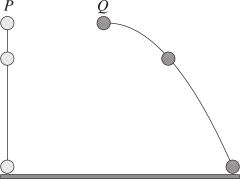
 

Which option correctly compares the projectile motion of \(P\) and \(Q\) ?

  1. The acceleration of \(P\) is less than the acceleration of \(Q\).
  2. The final velocity of \(Q\) is greater than the final velocity of \(P\).
  3. The time of flight of \(Q\) is greater than the time of flight of \(P\).
  4. The initial vertical velocity of \(P\) is less than the initial vertical velocity of \(Q\).
Show Answers Only

\(B\)

Show Worked Solution
  • Both objects start with the same initial vertical velocity and experience the same acceleration due to gravity. Therefore both objects will hit the ground at the same time with the same final vertical velocity.
  • Object \(Q\) however, has both vertical and horizontal velocity while object \(P\) only has vertical velocity. Therefore object \(Q\) will have a greater total final velocity when compared with \(P\).

\(\Rightarrow B\)

Filed Under: Projectile Motion Tagged With: Band 4, smc-3690-10-Projectile Motion Models, smc-3690-35-Initial Velocity, smc-3690-90-Velocity and Acceleration

PHYSICS, M5 2019 VCE 12 MC

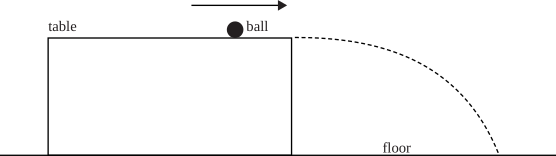
A small ball is rolling at constant speed along a horizontal table. It rolls off the edge of the table and follows the parabolic path shown in the diagram below. Ignore air resistance.
 

Which one of the following statements about the motion of the ball as it falls is correct?

  1. The ball's speed increases at a constant rate.
  2. The momentum of the ball is conserved.
  3. The acceleration of the ball is constant.
  4. The ball travels at constant speed.
Show Answers Only

\(C\)

Show Worked Solution
  • During projectile motion the ball is only subject to the acceleration due to gravity.
  • Hence the acceleration of the ball is constant.

\(\Rightarrow C\)

Filed Under: Projectile Motion Tagged With: Band 4, smc-3690-90-Velocity and Acceleration

PHYSICS, M5 EQ-Bank 3 MC

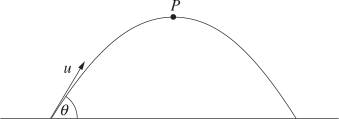
A ball is launched at speed `u` and angle `theta` from the horizontal as shown. `P` is the highest point reached by the ball.
 

Ignoring air resistance, what is the speed of the ball at point `P` ?

  1. Zero
  2. `u`
  3. `u\ cos theta`
  4. `u\ sin theta`
Show Answers Only

`C`

Show Worked Solution
  • At point `P`, the ball has no vertical velocity.
  • The ball’s speed is only due to its horizontal speed which is constant at  `v_(x)=u\ costheta`  throughout its entire flight.

`=>C`

Filed Under: Projectile Motion Tagged With: Band 4, smc-3690-90-Velocity and Acceleration

PHYSICS, M5 EQ-Bank 5 MC

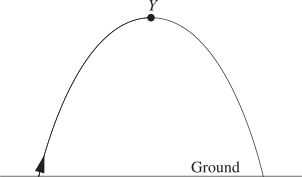
An object is projected upwards from the ground, and follows a path as represented in the diagram.
 

Which of the following describes the projectile's horizontal and vertical acceleration at point `Y` ?

  1. Both the horizontal and vertical acceleration are zero.
  2. Both the horizontal and vertical acceleration are `9.8 \ text{m s}^(-2)`.
  3. The horizontal acceleration is `9.8 \ text{m s}^(-2)` and the vertical acceleration is zero.
  4. The horizontal acceleration is zero and the vertical acceleration is `9.8 \ text{m s}^(-2)`.
Show Answers Only

`D`

Show Worked Solution
  • There are no horizontal forces acting on the ball throughout its flight, so its horizontal acceleration is always zero.
  • The ball experiences a net downwards force due to gravity. This results in a constant vertical acceleration of `9.8  text{m s}^(-2)` downwards.

`=>D`

Filed Under: Projectile Motion Tagged With: Band 3, smc-3690-90-Velocity and Acceleration

PHYSICS M5 2022 HSC 29

An apple was thrown horizontally to the east from the window of a car which was moving with a uniform velocity to the north.

Explain the horizontal and vertical components of the apple's motion during its flight.   (4 marks)

--- 10 WORK AREA LINES (style=lined) ---

Show Answers Only

Horizontal component:

  • Initially, the horizontal component of the apple’s velocity is the vector sum of the car’s velocity to the north, and the velocity to the east at which the apple was thrown. 
  • There is no horizontal force, and consequently no horizontal acceleration of the apple. So, its horizontal velocity remains constant throughout its flight.

Vertical component:

  • The apple has zero initial vertical velocity.
  • There is a downwards force acting on the apple due to gravity. So, the apple accelerates vertically downwards causing its downwards velocity to increase at a constant rate until it hits the floor.
Show Worked Solution

Horizontal component:

  • Initially, the horizontal component of the apple’s velocity is the vector sum of the car’s velocity to the north, and the velocity to the east at which the apple was thrown. 
  • There is no horizontal force, and consequently no horizontal acceleration of the apple. So, its horizontal velocity remains constant throughout its flight.

Vertical component:

  • The apple has zero initial vertical velocity.
  • There is a downwards force acting on the apple due to gravity. So, the apple accelerates vertically downwards causing its downwards velocity to increase at a constant rate until it hits the floor.

Mean mark 51%.

Filed Under: Projectile Motion Tagged With: Band 5, smc-3690-10-Projectile Motion Models, smc-3690-90-Velocity and Acceleration

PHYSICS M5 2022 HSC 8 MC

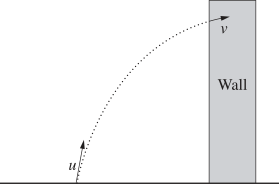
An object is launched with an initial velocity, `u`, and hits a wall with a final velocity, `v`.


Which statement correctly compares components of `u` and `v` ?

  1. The vertical component of `v` is less than the vertical component of `u`.
  2. The vertical component of `v` is greater than the vertical component of `u`.
  3. The horizontal component of `v` is less than the horizontal component of `u`.
  4. The horizontal component of `v` is greater than the horizontal component of `u`.
Show Answers Only

`A`

Show Worked Solution
  • The vertical velocity of the projectile decreases under the influence of gravity. The horizontal velocity of the projectile remains constant.

`=>A`

Filed Under: Projectile Motion Tagged With: Band 3, smc-3690-90-Velocity and Acceleration

PHYSICS, M5 2019 HSC 1 MC

A projectile is launched by a cannon as shown.
 

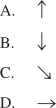
Which arrow represents the velocity of the projectile at its maximum height?

Show Answers Only

`D`

Show Worked Solution
  • At its maximum height the vertical velocity of the projectile is zero.

`=> D`

Filed Under: Projectile Motion Tagged With: Band 3, smc-3690-90-Velocity and Acceleration

PHYSICS, M5 2020 HSC 20 MC

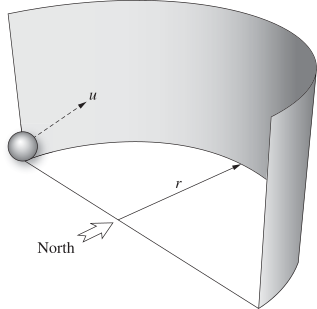
The diagram shows a smooth, semi-circular, vertical wall with radius, `r`.

A ball is launched from the position shown with a velocity `u` towards north at an angle to the horizontal.
 

The ball follows a trajectory around the wall before landing on the ground, opposite its starting point. It does not reach the top of the wall.

Assume that there is no friction between the ball and the wall.

Which statement correctly describes the net force acting on the ball during its motion?

  1. The magnitude of the net force remains constant.
  2. The direction of the net force is vertically downwards.
  3. The direction of the net force is perpendicular to the wall.
  4. The magnitude of the net force reaches a minimum when the ball is at its highest point.
Show Answers Only

`A`

Show Worked Solution
  • The ball experiences a constant, downwards acting weight force.
  • The ball also experiences a centripetal force with constant magnitude due to its constant horizontal speed, perpendicular to its weight.
  • Since both forces are always perpendicular, the magnitude of the net force on the ball remains constant.

`=>A`


♦ Mean mark 31%.

Filed Under: Circular Motion, Projectile Motion Tagged With: Band 5, smc-3690-90-Velocity and Acceleration

PHYSICS, M5 2020 HSC 15 MC

A rocket returns to Earth for reuse after launching satellites, using its engines to make a controlled landing.

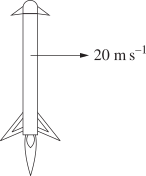
The rocket having a mass of 7800 kg is on approach to the ground, travelling horizontally at 20 m s ¯1 as shown in the diagram, when the engine thrust is changed to 90 000 newtons.
 

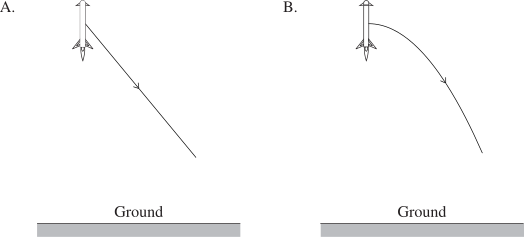
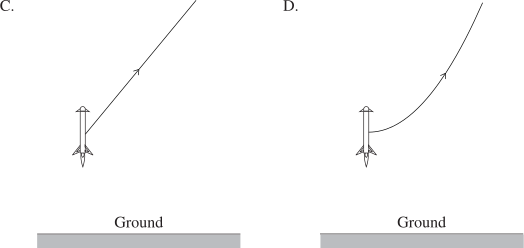
Which diagram shows the trajectory of the rocket following this change of thrust?
 

Show Answers Only

`D`

Show Worked Solution
  • Initial horizontal direction → net zero force
  • `W=mg=7800 xx 9.8=76\ 440\ text{N}`
  • Since  `90\ 000\ text{N} > 76\ 440` → net upwards force → net upwards acceleration.
  • Net upwards acceleration with constant horizontal velocity results in an upwards parabolic trajectory.

`=>D`

Filed Under: Projectile Motion Tagged With: Band 4, smc-3690-10-Projectile Motion Models, smc-3690-90-Velocity and Acceleration

Copyright © 2014–2025 SmarterEd.com.au · Log in