SmarterEd

Aussie Maths & Science Teachers: Save your time with SmarterEd

  • Login
  • Get Help
  • About

PHYSICS, M5 2015 HSC 26

Consider the following two models used to calculate the work done when a 300 kg satellite is taken from Earth's surface to an altitude of 200 km.

You may assume that the calculations are correct.
 

  1. What assumptions are made about Earth's gravitational field in models `X` and `Y` that lead to the different results shown?   (2 marks)

--- 5 WORK AREA LINES (style=lined) ---

  1. Why do models `X` and `Y` produce results that, although different, are close in value?   (1 mark)

--- 3 WORK AREA LINES (style=lined) ---

  1. Calculate the orbital velocity of the satellite in a circular orbit at the altitude of 200 km.   (3 marks)

--- 5 WORK AREA LINES (style=lined) ---

Show Answers Only

a.  Model `X`:

  • Assumes Earth’s gravitational field strength remains constant moving upwards from the surface.

Model `Y`:

  • Assumes Earth’s gravitational field strength changes with altitude.

b.   Similarity of results due to:

  • The variation in gravitational field strength from Earth’s surface to an altitude of 200 km is minimal, so both models `X` and `Y` produce similar results.

c.   `v=7797  text{ms}^(-1)`

Show Worked Solution

a.  Model `X`:

  • Assumes Earth’s gravitational field strength remains constant moving upwards from the surface.

Model `Y`:

  • Assumes Earth’s gravitational field strength changes with altitude.

♦ Mean mark (a) 54%.

b.   Similarity of results due to:

  • The variation in gravitational field strength from Earth’s surface to an altitude of 200 km is minimal, so both models `X` and `Y` produce similar results.

♦♦ Mean mark (b) 38%.

c.    Centripetal force = force due to gravity:

`F_(c)` `=F_(g)`  
`(mv^2)/(r)` `=(GMm)/(r^2)`  
`:.v` `=sqrt((GM)/(r))=sqrt((6.67 xx10^(-11)xx6xx10^(24))/(6.58 xx10^(6)))=7797  text{ms}^(-1)`  

Filed Under: Circular Motion, Motion in Gravitational Fields Tagged With: Band 4, Band 5, smc-3691-20-Applications of Circular Motion, smc-3691-80-Satellites, smc-3692-30-Orbital Velocity/Period/Radius

PHYSICS, M5 2015 HSC 11 MC

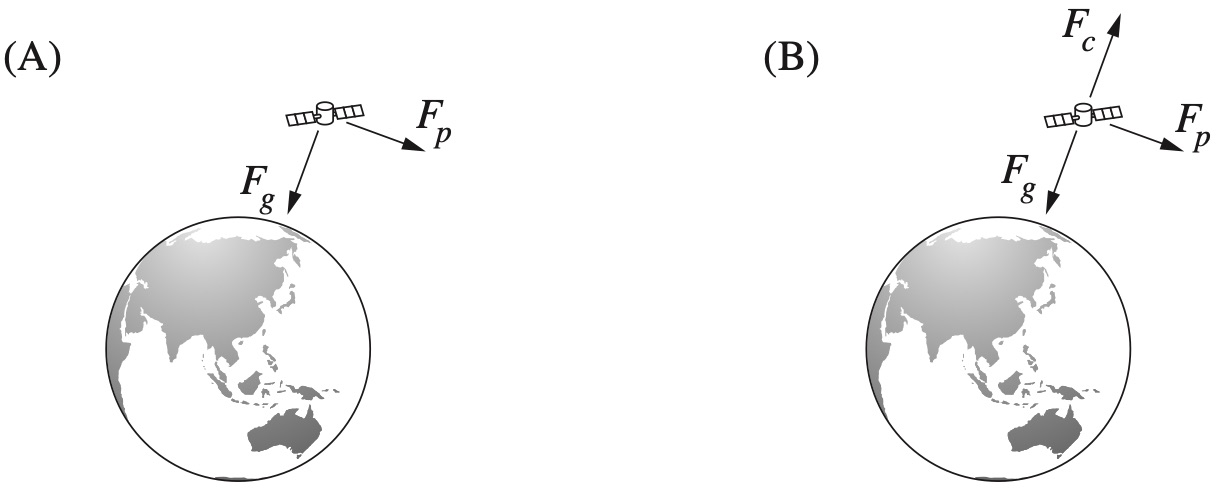
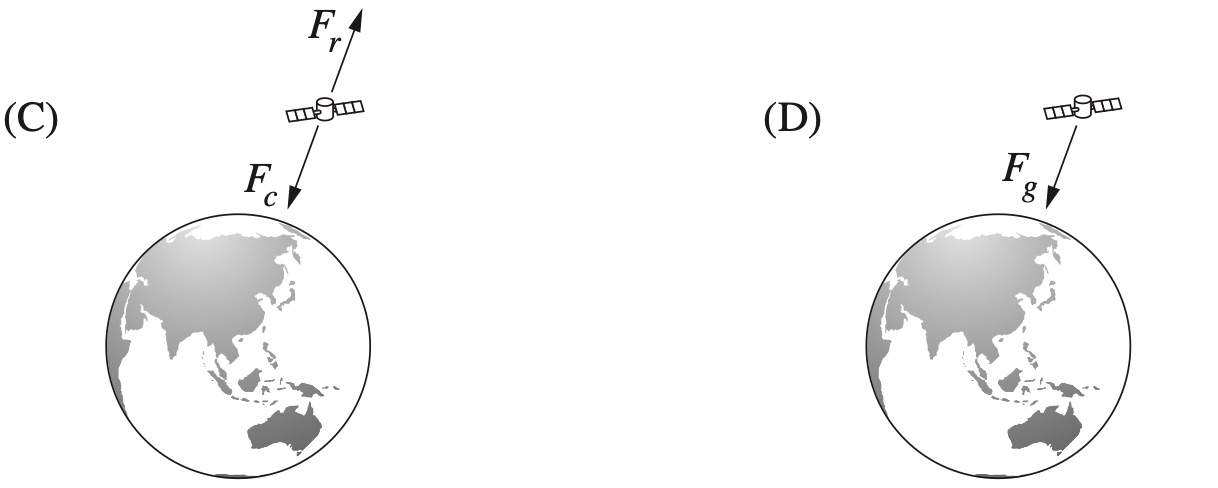
Which of the following diagrams correctly represents the force(s) acting on a satellite in a stable circular orbit around Earth?


Show Answers Only

`D`

Show Worked Solution
  • In a stable, circular orbit the satellite requires no propulsion force to keep it in orbit. This is due to it undergoing uniform circular motion with gravity acting as its centripetal force.
  • A force of gravity acts on the satellite, with direction towards Earth’s centre of mass. 
  • No ‘reaction force’ acts on the satellite. This is because any ‘reaction’ to the gravitational force exerted on the satellite by the Earth is an equal and opposite force exerted on the Earth by the satellite (Newton’s Third Law).
  • i.e. The reaction force acts on the Earth, not the satellite.

`=>D`


♦♦♦ Mean mark 29%.

Filed Under: Circular Motion, Motion in Gravitational Fields Tagged With: Band 6, smc-3691-20-Applications of Circular Motion, smc-3691-80-Satellites, smc-3692-40-Satellites

PHYSICS M5 2022 HSC 35

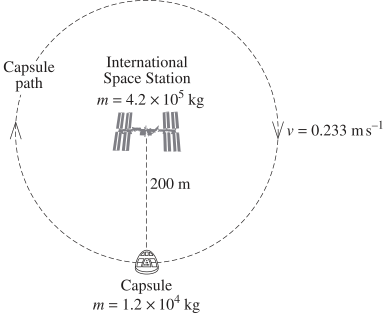
A capsule travels around the International Space Station (ISS) in a circular path of radius 200 m as shown.


Analyse this system to test the hypothesis below.  (5 marks)

The uniform circular motion of the capsule around the ISS can be accounted for in terms of the gravitational force between the capsule and the ISS.

--- 10 WORK AREA LINES (style=lined) ---

Show Answers Only

Find the gravitational force between the capsule and the ISS:

`F` `=(GMm)/(r^2)`  
  `=(6.67 xx10^-11 xx4.2 xx10^5 xx 1.2 xx10^4)/(200^2)`  
  `=8.4 xx10^(-6)  text{N}`  

 
Find the centripetal force required to keep the capsule in its orbit:

   `F_(c)=(mv^2)/(r)=(1.2 xx10^4 xx 0.233^2)/(200)=3.26  text{N}`

  • The gravitational force is not sufficient to provide the necessary centripetal force to keep the capsule in orbit around the ISS.
  • The hypothesis is invalid.
Show Worked Solution

Find the gravitational force between the capsule and the ISS:

`F` `=(GMm)/(r^2)`  
  `=(6.67 xx10^-11 xx4.2 xx10^5 xx 1.2 xx10^4)/(200^2)`  
  `=8.4 xx10^(-6)  text{N}`  

 
Find the centripetal force required to keep the capsule in its orbit:

`F_(c)=(mv^2)/(r)=(1.2 xx10^4 xx 0.233^2)/(200)=3.26  text{N}`

  • The gravitational force is not sufficient to provide the necessary centripetal force to keep the capsule in orbit around the ISS.
  • The hypothesis is invalid.

Filed Under: Circular Motion, Motion in Gravitational Fields Tagged With: Band 4, smc-3691-10-Centripetal Forces, smc-3691-80-Satellites, smc-3692-10-Gravity between 2 objects, smc-3692-40-Satellites

Copyright © 2014–2025 SmarterEd.com.au · Log in