SmarterEd

Aussie Maths & Science Teachers: Save your time with SmarterEd

  • Login
  • Get Help
  • About

PHYSICS, M6 EQ-Bank 24

Negatively charged particles were accelerated from rest between a pair of parallel metal plates. The potential difference between the plates was varied, and the final velocity of the particles was measured for each variation.
 

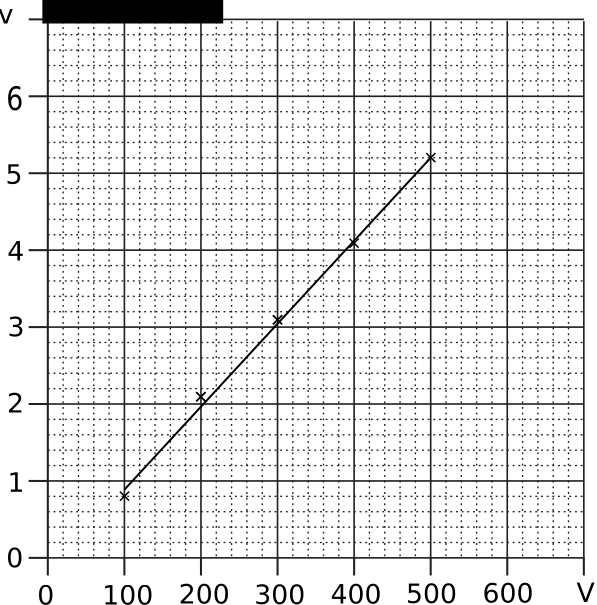
The data in the table show the potential difference between the plates and the square of the corresponding final velocity of the particles.

\begin{array}{|c|c|}
\hline
\rule{0pt}{2.5ex}\textit{Potential difference}\ \text{(V)} \rule[-1ex]{0pt}{0pt}&\quad v^2\left(\times 10^9 \, \text{m}^2\, \text{s}^{-2}\right) \quad \\
\hline
\rule{0pt}{2.5ex}100\rule[-1ex]{0pt}{0pt}&0.8\\
\hline
\rule{0pt}{2.5ex}200\rule[-1ex]{0pt}{0pt}& 2.1\\
\hline
\rule{0pt}{2.5ex}300\rule[-1ex]{0pt}{0pt}& 3.1 \\
\hline
\rule{0pt}{2.5ex}400\rule[-1ex]{0pt}{0pt}& 4.1 \\
\hline
\rule{0pt}{2.5ex}500\rule[-1ex]{0pt}{0pt}& 5.2 \\
\hline
\end{array}

  1. Plot the data on the grid provided and draw a line of best fit.


--- 0 WORK AREA LINES (style=lined) ---

  1. A student hypothesised that the charged particles are electrons. Justify whether the student's hypothesis is correct or not. Support your answer using the data provided and relevant calculations.

    --- 10 WORK AREA LINES (style=lined) ---

Show Answers Only

a.   


b.    The gradient of the line = `(v^2)/(V)`

Calculate the gradient (choose values close to limits):

`text{gradient}` `=((5.2-0.9) xx10^(9))/(500-100)`  
  `=1.1 xx10^7  text{m}^2  text{s}^(-2)  text{V}^(-1)`  

 
The change in kinetic energy is equal to the work done by the electric field on the charged particles:

`W` `=Delta K`  
`qV` `=(1)/(2)mv^2`  
`(V^2)/(v)` `=(2q)/(m)`  

 
Charge to mass ratio of the particles:

`(q)/(m)` `=(V^2)/(2v)`  
  `=(text{gradient})/(2)`  
  `=5.4 xx10^6  text{C kg}^(-1)`  

 
 Charge to mass ratio of an electron:

`(q)/(m)` `=(1.602 xx10^(-19))/(9.109 xx10^(-31))`  
  `=1.8 xx10^(11)  text{C kg}^(-1)`  

  
Therefore, the charged particles are not electrons.
Show Worked Solution

a.   


b.    The gradient of the line = `(v^2)/(V)`

Calculate the gradient (choose values close to limits):

`text{gradient}` `=((5.2-0.9) xx10^(9))/(500-100)`  
  `=1.1 xx10^7  text{m}^2  text{s}^(-2)  text{V}^(-1)`  

 
The change in kinetic energy is equal to the work done by the electric field on the charged particles:

`W` `=Delta K`  
`qV` `=(1)/(2)mv^2`  
`(V^2)/(v)` `=(2q)/(m)`  

 
Charge to mass ratio of the particles:

`(q)/(m)` `=(V^2)/(2v)`  
  `=(text{gradient})/(2)`  
  `=5.4 xx10^6  text{C kg}^(-1)`  

 
 Charge to mass ratio of an electron:

`(q)/(m)` `=(1.602 xx10^(-19))/(9.109 xx10^(-31))`  
  `=1.8 xx10^(11)  text{C kg}^(-1)`  

  
Therefore, the charged particles are not electrons.
Filed Under: Charged Particles, Conductors and Electric/Magnetic Fields Tagged With: Band 3, Band 5, smc-3693-20-EF Strength, smc-3693-35-Kinematic/Work Calcs

PHYSICS, M6 EQ-Bank 8 MC

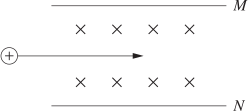
A positively-charged ion travelling at 250 ms ¯1 is fired between two parallel charged plates, \(M\) and \(N\). There is also a magnetic field present in the region between the two plates. The direction of the magnetic field is into the page as shown. The ion is travelling perpendicular to both the electric and the magnetic fields.
 

The electric field between the plates has a magnitude of 200 V m ¯1. The magnetic field is adjusted so that the ion passes through undeflected.

What is the magnitude of the adjusted magnetic field, and the polarity of the \(M\) terminal relative to the \(N\) terminal?

\begin{align*}
\begin{array}{l}
\rule{0pt}{2.5ex} \ & \\
\ \rule[-1ex]{0pt}{0pt}& \\
\rule{0pt}{2.5ex}\textbf{A.}\rule[-1ex]{0pt}{0pt}\\
\rule{0pt}{2.5ex}\textbf{B.}\rule[-1ex]{0pt}{0pt}\\
\rule{0pt}{2.5ex}\textbf{C.}\rule[-1ex]{0pt}{0pt}\\
\rule{0pt}{2.5ex}\textbf{D.}\rule[-1ex]{0pt}{0pt}\\
\end{array}
\begin{array}{|c|c|}
\hline
\rule{0pt}{2.5ex}\textit{Magnitude of magnetic field }& \textit{Polarity of M relative to N} \\
\text{(teslas)}\rule[-1ex]{0pt}{0pt}& \text{} \\
\hline
\rule{0pt}{2.5ex}0.8\rule[-1ex]{0pt}{0pt}&\text{positive}\\
\hline
\rule{0pt}{2.5ex}0.8\rule[-1ex]{0pt}{0pt}& \text{negative}\\
\hline
\rule{0pt}{2.5ex}1.25\rule[-1ex]{0pt}{0pt}& \text{positive} \\
\hline
\rule{0pt}{2.5ex}1.25\rule[-1ex]{0pt}{0pt}& \text{negative} \\
\hline
\end{array}
\end{align*}

Show Answers Only

\(A\)

Show Worked Solution
  • The ion passes through undeflected, so the magnitude of the force it experiences due to the magnetic field is equal to the magnitude of the force it experiences due to the electric field. 
  • As the ion travels perpendicular to the magnetic field:
\(F\) \(=qvB\)  
\(E q\) \(=qvB\)  
\(B\) \(=\dfrac{E}{v}\)  
  \(=\dfrac{V}{d} \times \dfrac{1}{v}=\dfrac{200}{250}=0.8 \ \text{T}\)  
     
  •  Using the right hand palm rule, the magnetic field exerts a force up the page on the positive ion. The electric field must therefore exert a force down the page on the ion.
  • \(M\) must be positive relative to \(N\).

\(\Rightarrow A\)

Filed Under: Charged Particles, Conductors and Electric/Magnetic Fields Tagged With: Band 5, smc-3693-18-Combination EF and MF, smc-3693-20-EF Strength

PHYSICS, M6 2016 HSC 5 MC

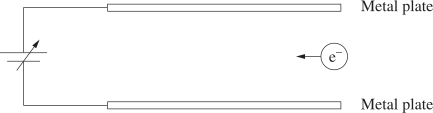
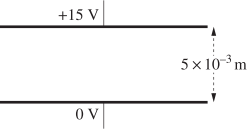
The diagram shows two parallel charged plates `5 × 10^(-3)  text{m}` apart.
 

What is the magnitude of the electric field between the plates in `text{V m}^(-1)` ?

  1. `3.3 × 10^(-4)`
  2. `0.33`
  3. `3`
  4. `3000`
Show Answers Only

`D`

Show Worked Solution

`E=(V)/(d)=(15)/(0.005)=3000\ text{V m}^(-1)`

`=>D`

Filed Under: Charged Particles, Conductors and Electric/Magnetic Fields, Electrostatics Tagged With: Band 3, smc-3693-20-EF Strength, smc-4283-10-Electric fields

PHYSICS, M6 2017 HSC 11 MC

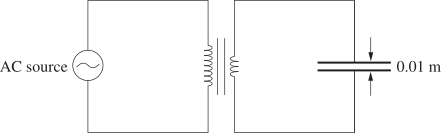
An AC source is connected to a transformer having a primary winding of 900 turns. Connected to the secondary winding of 450 turns is a pair of parallel plates 0.01 m apart.
 

The AC input is shown in the graph.
 

What is the maximum field strength (in `text{V m}^(-1)`) produced between the plates?

  1. `1.7`
  2. `6.8`
  3. `1.7 × 10^4`
  4. `6.8 × 10^4`
Show Answers Only

`C`

Show Worked Solution

Maximum voltage in primary coil = 340 `text{V}`  (see graph)

`(V_(p))/(V_(s))` `=(N_(p))/(N_(s))`  
`(340)/(V_(s))` `=(900)/(450)`  
`V_(s)` `=(450 xx 340)/900=170\ text{V}`  

 
∴ The maximum voltage in the secondary circuit is 170 `text{V}`.

  `E=(V)/(d)=(170)/(0.01)=1.7 xx10^(4)\ text{V m}^(-1)`

`=>C`

Filed Under: Charged Particles, Conductors and Electric/Magnetic Fields, Electromagnetic Induction Tagged With: Band 4, smc-3693-20-EF Strength, smc-3705-50-Transformer Calcs

Copyright © 2014–2025 SmarterEd.com.au · Log in