SmarterEd

Aussie Maths & Science Teachers: Save your time with SmarterEd

  • Login
  • Get Help
  • About

PHYSICS, M6 2024 HSC 17 MC

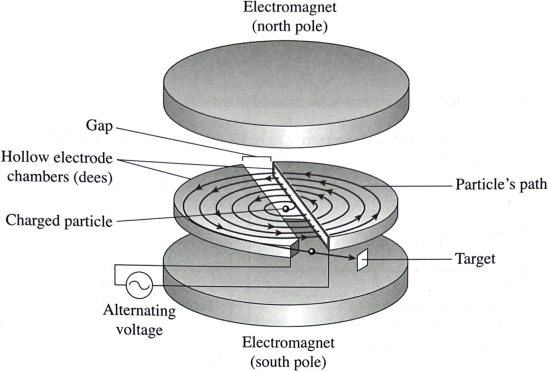
The diagram shows a type of particle accelerator called a cyclotron.

Cyclotrons accelerate charged particles, following the path as shown.
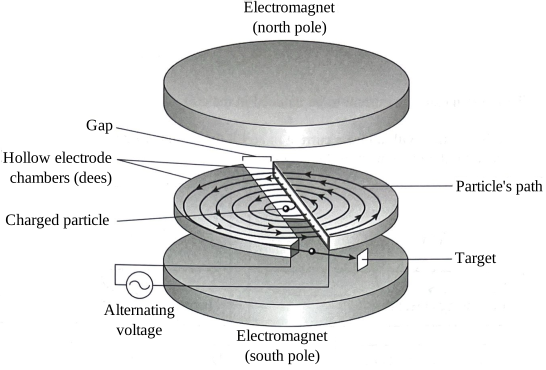


An electric field acts on a charged particle as it moves through the gap between the dees. A strong magnetic field is also in place.

Once a charged particle has the required velocity, it exits the accelerator towards a target.

Which of the following is true about a charged particle in a cyclotron?

  1. It increases speed while inside the dees.
  2. It only accelerates while between the dees.
  3. It undergoes acceleration inside and between the dees.
  4. It slows down inside the dees and speeds up between the dees.
Show Answers Only

\(C\)

Show Worked Solution
  • When the charged particle is between the dees, it will experience an acceleration due to the electric field present where \(a = \dfrac{qE}{m}\).
  • When the charged particle is inside of the dees, the particle undergoes uniform circular motion due to the strong magnetic field in place from the electromagnets.
  • While the magnitude of the velocity of the charged particle does not change, the direction of the velocity does. Hence, there is a change in velocity of the particle so it is experiencing an acceleration.
  • A charged particle will experience a centripetal force/acceleration when moving perpendicular to a magnetic field.

\(\Rightarrow C\)

♦ Mean mark 45%.

Filed Under: Charged Particles, Conductors and Electric/Magnetic Fields Tagged With: Band 5, smc-3693-18-Combination EF and MF, smc-3693-65-Uniform Circular Motion

PHYSICS, M6 2024 HSC 19 MC

In a vacuum chamber there is a uniform electric field and a uniform magnetic field.

A proton having a velocity, \(v\), enters the chamber. Its velocity remains unchanged as it travels through the chamber.

A second proton having a velocity, \(2v\), in the same direction as the first proton, then enters the chamber at the same point as the first proton.

In the chamber, the acceleration of the second proton

  1. is zero.
  2. is constant in magnitude and direction.
  3. changes in both magnitude and direction.
  4. is constant in magnitude, but not direction.
Show Answers Only

\(C\)

Show Worked Solution
  • The first proton, with velocity \(v\), travels through with no deflection. The net force acting on the proton is zero.
  • However, as the second proton has a velocity of \(2v\), \(F_B > F_E\) and the initial direction of \(F_B\) will be in the opposite direction of \(F_E\). This will cause the second proton to undergo circular motion (force is perpendicular to the velocity). 
  • The acceleration of the second proton will change direction as the centripetal force/acceleration will act towards the centre of the circular path that the second proton undertakes.
  • The magnitude of the acceleration of the second proton will also change. Initially \(F_B\) opposes \(F_E\) and \(F_{\text{net}}\) is at a minimum. As the direction of \(F_B\) changes, \(F_{\text{net}}\) will increase as \(F_E\) will not directly oppose \(F_B\).
  • As the magnitude of the net force on the second proton increases, the magnitude of the acceleration on the second proton will also increase.

\(\Rightarrow C\)

♦♦♦ Mean mark 26%.

Filed Under: Charged Particles, Conductors and Electric/Magnetic Fields Tagged With: Band 6, smc-3693-18-Combination EF and MF, smc-3693-65-Uniform Circular Motion

PHYSICS, M6 2019 VCE 1

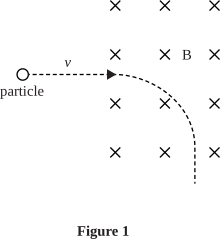
A particle of mass \(m\) and charge \(q\) travelling at velocity \(v\) enters a uniform magnetic field \(\text{B}\), as shown in the diagram.
 

  1. Is the charge \(q\) positive or negative? Give a reason for your answer.   (1 mark)

--- 2 WORK AREA LINES (style=lined) ---

  1. Explain why the path of the particle is an arc of a circle while the particle is in the magnetic field.   (2 marks)

--- 3 WORK AREA LINES (style=lined) ---

Show Answers Only

a.    Using the right-hand rule:

  • Thumb is in direction of velocity (right) and fingers are in direction of B-field (Into the page).
  • As the force on the charge is down the page (back of the hand), the charge must be negative.

b.    For circular motion to occur:

  • The force must be at right-angles to the velocity of the particle.
  • The force must be of constant magnitude \((F=qvB)\).
  • In the given example, the force on the charged particle due to the magnetic field is perpendicular to its velocity and the magnitude of the force remains constant.
  • The particle will therefore follow the arc of a circle while in the magnetic field.

Show Worked Solution

a.    Using the right-hand rule:

  • Thumb is in direction of velocity (right) and fingers are in direction of B-field (Into the page).
  • As the force on the charge is down the page (back of the hand), the charge must be negative.
♦ Mean mark (a) 44%.

b.    For circular motion to occur:

  • The force must be at right-angles to the velocity of the particle.
  • The force must be of constant magnitude \((F=qvB)\).
  • In the given example, the force on the charged particle due to the magnetic field is perpendicular to its velocity and the magnitude of the force remains constant.
  • The particle will therefore follow the arc of a circle while in the magnetic field.
♦♦♦ Mean mark (b) 27%.

Filed Under: Charged Particles, Conductors and Electric/Magnetic Fields Tagged With: Band 5, Band 6, smc-3693-15-Charged Particles in MF, smc-3693-65-Uniform Circular Motion

PHYSICS, M6 2020 VCE 3-4 MC

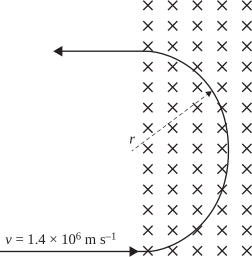
A positron with a velocity of 1.4 × 10\(^6\) m s\(^{-1}\) is injected into a uniform magnetic field of 4.0 × 10\(^{-2}\) T, directed into the page, as shown in the diagram below.

It moves in a vacuum in a semicircle of radius \(r\). The mass of the positron is 9.1 × 10\(^{-31}\) kg and the charge on the positron is 1.6 × 10\(^{-19}\) C. Ignore relativistic effects.


Question 3

Which one of the following best gives the speed of the positron as it exits the magnetic field?

  1. 0 m s\(^{-1}\)
  2. much less than 1.4 × 10\(^6\) m s\(^{-1}\)
  3. 1.4 × 10\(^6\) m s\(^{-1}\)
  4. greater than 1.4 × 10\(^6\) m s\(^{-1}\)


Question 4

The speed of the positron is changed to 7.0 × 10\(^5\) m s\(^{-1}\).

Which one of the following best gives the value of the radius \(r\) for this speed?

  1. \(\dfrac{r}{4}\)
  2. \(\dfrac{r}{2}\)
  3. \(r\)
  4. \(2 r\)
Show Answers Only

\(\text{Question 3:}\ C\)

\(\text{Question 4:}\ B\)

Show Worked Solution

Question 3

  • As the direction of the force is perpendicular to the velocity, the velocity will not change.
  • The velocity will be \(1.4 \times 10^6\ \text{ms}^{-1}\)

\(\Rightarrow C\)
 

Question 4

\(F_B\) \(=F_c\)  
\(qvB\) \(=\dfrac{mv^2}{r}\)  
\(r\) \(=\dfrac{mv}{qB}\)  
  •  Therefore, \(r \propto v\).
  • If the velocity is halved, the radius will also be halved.

\(\Rightarrow B\)

Filed Under: Charged Particles, Conductors and Electric/Magnetic Fields Tagged With: Band 4, smc-3693-15-Charged Particles in MF, smc-3693-65-Uniform Circular Motion

PHYSICS, M6 2023 HSC 24

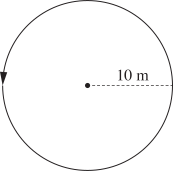
An electron is travelling at 3.0 \(\times\) 10\(^{6}\) m s\(^{-1}\) in the path shown.
 

Calculate the magnetic field required to keep the electron in the path.  (3 marks)

--- 6 WORK AREA LINES (style=lined) ---

Show Answers Only

\(1.7 \times 10^{-6}\) \(\text{T}\)

Show Worked Solution
  • The force from the magnetic field on the electron provides the centripetal acceleration for it to travel in uniform circular motion.
\( F_B\) \(=F_c\)  
\(qvB\) \(=\dfrac{mv^2}{r}\)  
\(B\) \(=\dfrac{mv}{qr}\)  
  \(=\dfrac{9.109 \times 10^{-31} \times 3.0 \times 10^6}{1.602 \times 10^{-19} \times 10}\)  
  \(=1.7 \times 10^{-6}\) \(\text{T}\)  


  • Magnetic field strength required = \(1.7 \times 10^{-6}\) \(\text{T}\).
Mean mark 57%.

Filed Under: Charged Particles, Conductors and Electric/Magnetic Fields Tagged With: Band 4, smc-3693-15-Charged Particles in MF, smc-3693-65-Uniform Circular Motion

PHYSICS, M6 2017 HSC 18 MC

A particle of mass \(m\) and charge \(q\) travelling at velocity \(v\) enters a magnetic field of magnitude \(B\) and follows the path shown.
 

A second particle enters a magnetic field of magnitude \(2B\) with a velocity of  \(\dfrac{1}{2}v\)  and follows an identical path.

What is the mass and charge of the second particle?

\begin{align*}
\begin{array}{l}
\rule{0pt}{2.5ex} \ \rule[-1ex]{0pt}{0pt}& \\
\rule{0pt}{2.5ex}\textbf{A.}\rule[-1ex]{0pt}{0pt}\\
\rule{0pt}{2.5ex}\textbf{B.}\rule[-1ex]{0pt}{0pt}\\
\rule{0pt}{2.5ex}\textbf{C.}\rule[-1ex]{0pt}{0pt}\\
\rule{0pt}{2.5ex}\textbf{D.}\rule[-1ex]{0pt}{0pt}\\
\end{array}
\begin{array}{|c|c|}
\hline
\rule{0pt}{2.5ex}\quad \textit{Mass}\quad \rule[-1ex]{0pt}{0pt}& \quad \textit{Charge} \quad \\
\hline
\rule{0pt}{2.5ex}m\rule[-1ex]{0pt}{0pt}&q\\
\hline
\rule{0pt}{2.5ex}\frac{1}{2} m\rule[-1ex]{0pt}{0pt}& 2q\\
\hline
\rule{0pt}{2.5ex}4m\rule[-1ex]{0pt}{0pt}& q \\
\hline
\rule{0pt}{2.5ex}m\rule[-1ex]{0pt}{0pt}& \frac{1}{2}q \\
\hline
\end{array}
\end{align*}

Show Answers Only

\(C\)

Show Worked Solution
  • The centripetal force acting on the charge is given by the force it experiences due to the magnetic field:
\(F_c\) \(=F_b\)  
\(\dfrac{m v^2}{r}\) \(=q v B\)  
\(r\) \(=\dfrac{m v}{q B}\)  

 
\(\text{Given} \ B=2 B \ \text{and} \ v=\dfrac{1}{2} v:\)

  \(r=\dfrac{m \frac{1}{2} v}{q(2 B)}=\dfrac{m v}{4 q B}\)

  •  \(\text{In order for the radius to remain the same, \(\dfrac{m}{q}\) must be four}\)

\(\Rightarrow C\)


♦♦ Mean mark 35%.

Filed Under: Charged Particles, Conductors and Electric/Magnetic Fields Tagged With: Band 5, smc-3693-15-Charged Particles in MF, smc-3693-65-Uniform Circular Motion

PHYSICS, M6 2018 HSC 13 MC

An electron moves in a circular path with radius \(r\) in a magnetic field as shown.
 

If the speed of the electron is increased, which row of the table correctly shows the effects of this change?

\begin{align*}
\begin{array}{l}
\rule{0pt}{2.5ex} \ \rule[-1ex]{0pt}{0pt}& \\
\rule{0pt}{2.5ex}\textbf{A.}\rule[-1ex]{0pt}{0pt}\\
\rule{0pt}{2.5ex}\textbf{B.}\rule[-1ex]{0pt}{0pt}\\
\rule{0pt}{2.5ex}\textbf{C.}\rule[-1ex]{0pt}{0pt}\\
\rule{0pt}{2.5ex}\textbf{D.}\rule[-1ex]{0pt}{0pt}\\
\end{array}
\begin{array}{|l|l|}
\hline
\rule{0pt}{2.5ex}\quad \textit{Force on electron}\quad\rule[-1ex]{0pt}{0pt}& \quad \textit{Radius of path} \quad\\
\hline
\rule{0pt}{2.5ex}\text{Increases}\rule[-1ex]{0pt}{0pt}&\text{Decreases}\\
\hline
\rule{0pt}{2.5ex}\text{Increases}\rule[-1ex]{0pt}{0pt}& \text{Increases}\\
\hline
\rule{0pt}{2.5ex}\text{Decreases}\rule[-1ex]{0pt}{0pt}& \text{Decreases} \\
\hline
\rule{0pt}{2.5ex}\text{Decreases}\rule[-1ex]{0pt}{0pt}& \text{Increases} \\
\hline
\end{array}
\end{align*} 

Show Answers Only

\(B\)

Show Worked Solution
  • Using the formula  \(F=qvB\), increasing the speed of the electron increases the force acting on it.
  • The centripetal force acting on the electron is given by the force it experiences due to the magnetic field:
  •    \(\dfrac{m v^2}{r}=q v B \Rightarrow r=\dfrac{m v}{q B} \Rightarrow r \propto v\)
  • Increasing the speed of the electron increases its radius.

\(\Rightarrow B\)


Mean mark 53%.

Filed Under: Charged Particles, Conductors and Electric/Magnetic Fields Tagged With: Band 5, smc-3693-15-Charged Particles in MF, smc-3693-65-Uniform Circular Motion

PHYSICS, M6 2019 HSC 33

A proton and an alpha particle are fired into a uniform magnetic field with the same speed from opposite sides as shown. Their trajectories are initially perpendicular to the field.


Explain ONE similarity and ONE difference in their trajectories as they move in the magnetic field.   (4 marks)

--- 10 WORK AREA LINES (style=lined) ---

Show Answers Only

Similarity:

  • Both particles experience a constant force, given by  `F=qvB`, perpendicular to their velocity and the magnetic field lines and will undergo circular motion.

Difference:

  • The centripetal force acting on both particles is given by the force they experience due to the magnetic field as follows:
  •    `(mv^2)/(r)=qvB\ \ =>\ \ r=(mv)/(qB)`
  • The alpha particle has four times the mass and two times the charge of the proton
  • Therefore, the radius of its trajectory will be twice that of the protons.
Show Worked Solution

Similarity:

  • Both particles experience a constant force, given by  `F=qvB`, perpendicular to their velocity and the magnetic field lines and will undergo circular motion.

Difference:

  • The centripetal force acting on both particles is given by the force they experience due to the magnetic field as follows:
  •    `(mv^2)/(r)=qvB\ \ =>\ \ r=(mv)/(qB)`
  • The alpha particle has four times the mass and two times the charge of the proton
  • Therefore, the radius of its trajectory will be twice that of the protons.

Filed Under: Charged Particles, Conductors and Electric/Magnetic Fields Tagged With: Band 4, smc-3693-15-Charged Particles in MF, smc-3693-65-Uniform Circular Motion

PHYSICS, M7 2021 HSC 20 MC

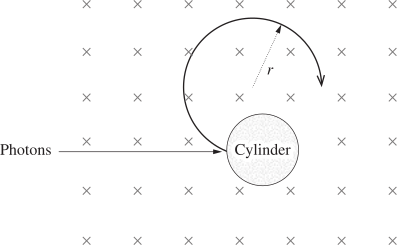
A metal cylinder is located in a uniform magnetic field. The work function of the metal is `phi`.

Photons having an energy of 2`phi` strike the side of the cylinder, liberating photoelectrons which travel perpendicular to the magnetic field in a circular path. The maximum radius of the path is `r`.
 

If the photon energy is doubled, what will the maximum radius of the path become?

  1. `2r`
  2. `3r`
  3. `sqrt2r`
  4. `sqrt3r`
Show Answers Only

`D`

Show Worked Solution
`K_max` `=(1)/(2)mv_(max)^2`  
`v_(max)` `=sqrt((2K_(max))/(m))\ \ `… (1)  

  
Substitute (1) into  `r=(mv)/(qB)`:

    `r=(m)/(qB)sqrt((2K_(max))/(m))`

    `r prop sqrt(K_(max))`
 

  • When the photon energy is `2phi, K_max=phi.`
  • When the photon energy is doubled to `4phi, K_max=3phi.`
  • ∴ Since  `r prop sqrt(K_(max)) ` the radius increases by a factor of `sqrt(3).`

`=>D`


♦ Mean mark 24%.

Filed Under: Charged Particles, Conductors and Electric/Magnetic Fields, Light: Quantum Model Tagged With: Band 6, smc-3693-65-Uniform Circular Motion, smc-3698-10-Photoelectric Effect, smc-3698-20-Kinetic energy calcs

Copyright © 2014–2025 SmarterEd.com.au · Log in