SmarterEd

Aussie Maths & Science Teachers: Save your time with SmarterEd

  • Login
  • Get Help
  • About

PHYSICS, M6 2023 HSC 25b

Explain why the torque of a DC motor decreases as its rotational speed increases.   (2 marks)

--- 5 WORK AREA LINES (style=lined) ---

Show Answers Only

  • Torque in a simple DC motor can be calculated using  \(\tau=nIAB \sin\theta\).
  • Initially, the current through the coil of the motor is a maximum as the motor is stationary.
  • As the rotational speed of the motor begins to increase, there is a change of flux experienced through the coil of the motor which will induce an EMF in the coil (Faraday’s Law).
  • This induced back EMF will act to oppose the original EMF that produced it (Lenz’s Law).
  • Thus, the voltage through the coil will decrease which will decrease the current through the coil and the torque (\(\tau \propto I \)). 

Show Worked Solution

  • Torque in a simple DC motor can be calculated using  \(\tau=nIAB \sin\theta\).
  • Initially, the current through the coil of the motor is a maximum as the motor is stationary.
  • As the rotational speed of the motor begins to increase, there is a change of flux experienced through the coil of the motor which will induce an EMF in the coil (Faraday’s Law).
  • This induced back EMF will act to oppose the original EMF that produced it (Lenz’s Law).
  • Thus, the voltage through the coil will decrease which will decrease the current through the coil and the torque (\(\tau \propto I \)). 
♦ Mean mark 49%.

Filed Under: Applications of the Motor Effect Tagged With: Band 5, smc-3695-10-Torque, smc-3695-20-Back emf

PHYSICS, M6 EQ-Bank 16 MC

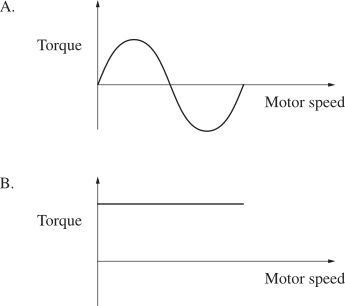
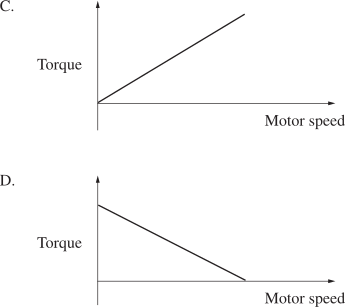
An experiment was carried out to investigate the change in torque for a DC motor with a radial magnetic field. The data from start up to operating speed were graphed.

Which graph is most likely to represent this set of data?
 

Show Answers Only

`D`

Show Worked Solution
  • The DC motor has a radial magnetic field, so the coil is always perpendicular to the magnetic field. This means the torque for the motor does not depend on the angle of the coil.
  • The torque for this DC motor is therefore given by  `tau=NIAB`.
  • As the speed of the motor increases from start to operating speed, the rate of change of magnetic flux through its coil increases, increasing the induced emf in the motor (Faraday’s Law).
  • This induced back emf acts to oppose the rotation of the motor (Lenz’s Law). 
  • The back emf opposes the current supplied to the motor, decreasing the net current through the motor.
  • Therefore, the torque produced by the motor decreases as motor speed increases.

`=>D`

Filed Under: Applications of the Motor Effect Tagged With: Band 5, smc-3695-10-Torque, smc-3695-20-Back emf

PHYSICS, M6 EQ-Bank 23

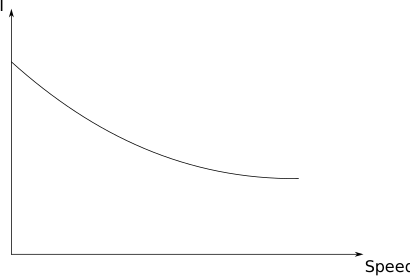
An electric motor is connected to a power supply of constant voltage. The motor runs at different speeds by adjusting a brake.

On the graph below, show the relationship between the current through the motor and its speed?  (2 marks)


--- 14 WORK AREA LINES (style=lined) ---
Show Answers Only

Show Worked Solution

Points to note on graph shape:

  • As the speed of the motor increases, the rate of change of magnetic flux through its coil increases.
  • This increases the induced emf in the motor (Faraday’s Law).
  • This induced emf, known as back emf acts to oppose the rotation of the motor (Lenz’s Law). 
  • The back emf opposes the current supplied to the motor and decreases the net current through the motor.

Filed Under: Applications of the Motor Effect Tagged With: Band 4, smc-3695-20-Back emf

PHYSICS, M6 2016 HSC 9 MC

How does back emf affect a DC motor?

  1. It creates heat in the iron core.
  2. It limits the speed of the motor.
  3. It reverses the current in the coil.
  4. It increases the torque of the motor.
Show Answers Only

`B`

Show Worked Solution
  • Back emf in a DC motor increases as the speed of rotation increases until the back emf completely opposes the supplied emf.
  • When this occurs, the DC motor no longer accelerates and its speed is limited.

`=>B`

Filed Under: Applications of the Motor Effect Tagged With: Band 4, smc-3695-20-Back emf

PHYSICS, M6 2018 HSC 4 MC

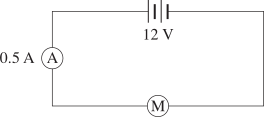
A motor, battery and ammeter are connected in series. When the motor is turning at full speed, the ammeter has a reading of 0.1 A. While the motor is spinning, a person holds the shaft of the motor to stop it.

Which row of the table correctly identifies the change in the ammeter reading and an explanation for the change?
 

\begin{align*}
\begin{array}{l}
\rule{0pt}{1.5ex} \ \rule[-0.5ex]{0pt}{0pt}& \\
\rule{0pt}{2.5ex}\textbf{A.}\rule[-1ex]{0pt}{0pt}\\
\rule{0pt}{2.5ex}\textbf{B.}\rule[-1ex]{0pt}{0pt}\\
\rule{0pt}{2.5ex}\textbf{C.}\rule[-1ex]{0pt}{0pt}\\
\rule{0pt}{2.5ex}\textbf{D.}\rule[-1ex]{0pt}{0pt}\\
\end{array}
\begin{array}{|l|l|}
\hline
\rule{0pt}{1.5ex}\ \ \ \textit{Reading on ammeter}\rule[-0.5ex]{0pt}{0pt}& \quad \ \ \textit{Explanation} \\
\hline
\rule{0pt}{2.5ex}\text{Decreases}\rule[-1ex]{0pt}{0pt}&\text{Decrease in back emf}\\
\hline
\rule{0pt}{2.5ex}\text{Increases}\rule[-1ex]{0pt}{0pt}& \text{Increase in back emf}\\
\hline
\rule{0pt}{2.5ex}\text{Decreases}\rule[-1ex]{0pt}{0pt}& \text{Increase in back emf} \\
\hline
\rule{0pt}{2.5ex}\text{Increases}\rule[-1ex]{0pt}{0pt}& \text{Decrease in back emf} \\
\hline
\end{array}
\end{align*}

Show Answers Only

\(D\)

Show Worked Solution

Results of holding the motor still:

  • Decrease in the rate of change of flux through the coil.
  • Decrease in induced back EMF.
  • As this induced back EMF opposes the supplied current (Lenz’s Law), the reading on the ammeter will increase.

\(\Rightarrow D\)


♦ Mean mark 50%.

Filed Under: Applications of the Motor Effect Tagged With: Band 5, smc-3695-20-Back emf

PHYSICS M6 2022 HSC 19 MC

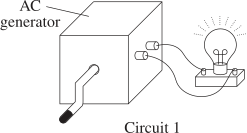
An AC generator is operated by turning a handle, which rotates a coil in a magnetic field.

The handle is turned at a constant speed and the AC voltage output of the generator causes a light globe connected to it to light up, as shown in Circuit 1.


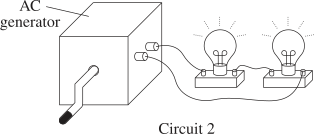
A second identical light globe is then connected in series to the generator output, as shown in Circuit 2 . The handle is turned at the same constant speed.
 

Which statement describes and explains the effort required to turn the handle in Circuit 2, compared to Circuit 1 ?

  1. The handle in Circuit 2 is easier to turn because the smaller current in Circuit 2 produces less opposing torque.
  2. The handle in Circuit 2 is easier to turn because the voltage output is shared equally across the two identical light globes.
  3. The handle in Circuit 2 is more difficult to turn because the larger current in Circuit 2 produces more opposing torque.
  4. The handle in Circuit 2 is more difficult to turn because it takes more power to operate the two identical globes than it does to operate the single globe.
Show Answers Only

`A`

Show Worked Solution
  • Circuit 2 has a greater resistance due to the second light globe in series.
  • The current in circuit 2 is smaller.
  • As this current is the induced current which opposes the rotation of the handle, the handle in circuit 2 is easier to turn.

`=>A`


♦♦♦ Mean mark 17%.

Filed Under: Applications of the Motor Effect Tagged With: Band 6, smc-3695-20-Back emf

PHYSICS, M6 2019 HSC 31

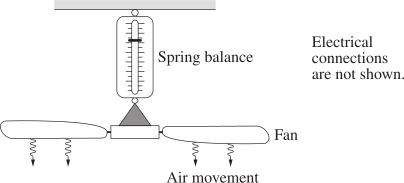
A student suspends an electric ceiling fan from a spring balance.

The fan is switched on, reaching a maximum rotational velocity after ten seconds.
 

  1. Explain the changes that would be observed on the spring balance in the first 15 seconds after the fan is switched on.   (4 marks)

--- 8 WORK AREA LINES (style=lined) ---
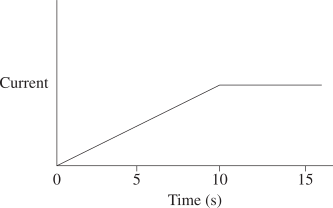
  1. The student predicted that the current through the fan's motor would vary as shown on the graph.   


Assess the accuracy of the student's prediction.   (4 marks)

--- 8 WORK AREA LINES (style=lined) ---
Show Answers Only

a.    As the fan rotates it exerts a downwards force on air molecules.

  • By Newton’s Third Law, an equal and opposite force is exerted on the fan by the air. This counteracts the fan’s weight, decreasing the net downwards force acting on the fan.

For the first ten seconds:

  • The fan’s rotation speed increases.
  • The force on the fan due to the air increases.
  • The force observed on the spring balance decreases.

After ten seconds:

  • The force acting on the fan due to the air remains constant.
  • The recorded force on the spring balance remains constant.

b.   Between 0-10 seconds:

  • The student’s prediction of an increasing current is incorrect.
  • Initially, the current through the motor is at a maximum as the fan’s motor is stationary and it experiences no change in magnetic flux (no back EMF induced).
  • As the fan speeds up, the rate of change of flux through the motor increases.
  • An increasing EMF is induced in the motor (Faraday’s Law).
  • This is back EMF which acts to oppose the current.
  • There is a decrease in current occurs during the first 10 seconds.

Between 10-15 seconds:

  • The student’s prediction of a constant current is correct.
  • The motor is rotating at a constant speed.
  • The magnitude of induced back EMF remains constant.
  • The current through the motor remains constant.
Show Worked Solution

a.    As the fan rotates it exerts a downwards force on air molecules.

  • By Newton’s Third Law, an equal and opposite force is exerted on the fan by the air. This counteracts the fan’s weight, decreasing the net downwards force acting on the fan.

For the first ten seconds:

  • The fan’s rotation speed increases.
  • The force on the fan due to the air increases.
  • The force observed on the spring balance decreases.

After ten seconds:

  • The force acting on the fan due to the air remains constant.
  • The recorded force on the spring balance remains constant.

♦ Mean mark (a) 48%.

b.   Between 0-10 seconds:

  • The student’s prediction of an increasing current is incorrect.
  • Initially, the current through the motor is at a maximum as the fan’s motor is stationary and it experiences no change in magnetic flux (no back EMF induced).
  • As the fan speeds up, the rate of change of flux through the motor increases.
  • An increasing EMF is induced in the motor (Faraday’s Law).
  • This is back EMF which acts to oppose the current.
  • There is a decrease in current occurs during the first 10 seconds.

Between 10-15 seconds:

  • The student’s prediction of a constant current is correct.
  • The motor is rotating at a constant speed.
  • The magnitude of induced back EMF remains constant.
  • The current through the motor remains constant.

♦ Mean mark (b) 39%.

Filed Under: Applications of the Motor Effect Tagged With: Band 5, smc-3695-20-Back emf

PHYSICS, M6 2020 HSC 32

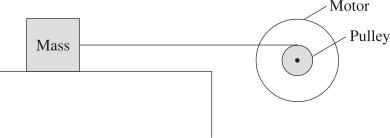
A rope connects a mass on a horizontal surface to a pulley attached to an electric motor as shown.
 

Explain the factors that limit the speed at which the mass can be pulled along the horizontal surface. Use mathematical models to support your answer.   (7 marks)

--- 20 WORK AREA LINES (style=lined) ---
Show Answers Only
  • The factors limiting the speed of the mass along horizontal surface can be divided into two main parts; 1-Factors involving friction between the mass and the table and 2-Factors involving the force output of the motor and pulley.

Friction between the mass and table

  • The mass will experience a friction force of  `F_(f)=mu N`. Since the mass has no vertical acceleration,  `N=mg\ \ =>\ \ F_(f)=mu mg.`
  • The speed at which the mass can be pulled is limited by the coefficient of kinetic friction between the mass and the table `mu` and the magnitude of the mass `m`.

 Force output of the motor and pulley

  • The power of the motor depends on its torque and the pulley radius `(tau=rF sin theta).`
  • The torque produced by the motor is given by  `tau=NIAB sin theta`
  • The force of the motor and hence maximum speed at which the mass can be pulled is also limited by the number of turns of the coil in the motor, the current passing through the coils, the area of the coils and the magnetic field strength of the stator magnets.

Answers could also contain:

  • Back emf in the motor limiting its maximum speed.
  • The efficiency of the motor.
Show Worked Solution
  • The factors limiting the speed of the mass along horizontal surface can be divided into two main parts; 1-Factors involving friction between the mass and the table and 2-Factors involving the force output of the motor and pulley.

Friction between the mass and table

  • The mass will experience a friction force of  `F_(f)=mu N`. Since the mass has no vertical acceleration,  `N=mg\ \ =>\ \ F_(f)=mu mg.`
  • The speed at which the mass can be pulled is limited by the coefficient of kinetic friction between the mass and the table `mu` and the magnitude of the mass `m`.

 Force output of the motor and pulley

  • The power of the motor depends on its torque and the pulley radius `(tau=rF sin theta).`
  • The torque produced by the motor is given by  `tau=NIAB sin theta`
  • The force of the motor and hence maximum speed at which the mass can be pulled is also limited by the number of turns of the coil in the motor, the current passing through the coils, the area of the coils and the magnetic field strength of the stator magnets.

Answers could also contain:

  • Back emf in the motor limiting its maximum speed.
  • The efficiency of the motor.
Mean mark 58%.

Filed Under: Applications of the Motor Effect Tagged With: Band 4, Band 5, smc-3695-10-Torque, smc-3695-20-Back emf

PHYSICS, M6 2021 HSC 12 MC

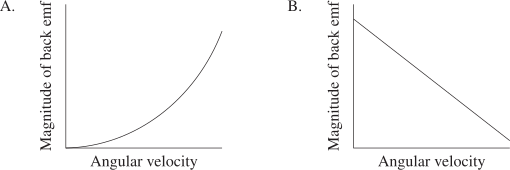
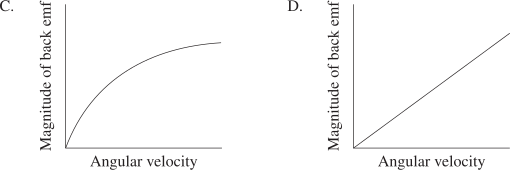
Which graph shows the magnitude of back emf induced in a DC motor rotating continuously at different angular velocities?


Show Answers Only

`D`

Show Worked Solution

`epsi=-(Delta Phi)/(Delta t)`

`omega=(Delta theta)/(Delta t)`

`∴ epsi=-(Delta Phi)/(Delta theta)omega\ \ \` (linear)

`=>D`


♦ Mean mark 31%.

Filed Under: Applications of the Motor Effect Tagged With: Band 5, smc-3695-20-Back emf

Copyright © 2014–2025 SmarterEd.com.au · Log in